


Table of content
- Labiaplasty in Dubai quick facts
- Are you a good candidate for labia reduction surgery?
- Which type of anesthesia is used for labiaplasty?
- How does Dr. Baycin perform labiaplasty in Dubai?
- Do you need customized clitoral hood reduction combined with labiaplasty?
- What is recovery after labia reduction like?
- What are the risks and complications of labiaplasty?
- Checklist before having labiaplasty in Dubai
- How much does a labiaplasty cost in Dubai, UAE?
- Get appointment
For a procedure so often reduced to trimming excess skin, labiaplasty is, in my hands, an exercise in design. I am Dr. Nazmi Baycin, and over more than a thousand labiaplasty procedures I have come to regard it as one of the most personal operations in aesthetic surgery — one where millimeters, symmetry, and the preservation of sensation matter more than in almost any other. I perform labiaplasty in Dubai not to a standard template, but to a design drawn individually around each woman’s own anatomy. That distinction is the whole of it.
Every woman’s anatomy is different, and a result that looks natural and feels comfortable depends on careful planning and precise surgical technique — not a routine excision. Performing labiaplasty in Dubai within private, JCI-accredited hospitals, with complete discretion, I design each procedure to reduce the labia minora while bringing the labia majora and clitoral hood into quiet, natural balance. The guiding principle is the same one that governs all my work: to restore form is to restore function.
Labiaplasty in Dubai quick facts
| Procedure detail | Labiaplasty in Dubai |
|---|---|
| Technique | Individually designed marginal trim (95% of cases) |
| Suturing | Micro-surgical, internal, no visible stitches |
| Anesthesia | Local (±sedation) or general — patient’s choice |
| Procedure time | ~60 minutes |
| Hospital stay | Day case (no overnight stay) |
| Downtime | A few days |
| Sutures | Absorbable, hidden (none to remove) |
| Laser used | No — avoided to prevent thermal wound damage |
| Intimacy | Resume at 3–4 weeks, once pain-free |
| Full healing | ~6–8 weeks |
What can labiaplasty in Dubai do for you?
Labiaplasty reduces and reshapes enlarged or asymmetric labia minora, easing the physical discomfort that can come with them — irritation, chafing, and discomfort during exercise, cycling, or intimacy — while restoring a natural, balanced appearance. For many women the benefit is as much emotional as physical: relief from self-consciousness, and a renewed sense of confidence and comfort in their own body.
Importantly, the procedure preserves everything that matters functionally. It does not affect fertility, normal delivery, sexual sensation, or climax — and for many women it improves comfort and confidence in intimacy rather than diminishing it.
Are you a good candidate for labia reduction surgery?
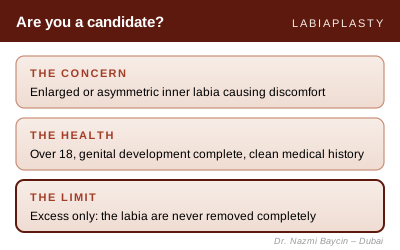 A clean medical history, free of systemic disease such as heart disease, is the foundation for anyone considering labiaplasty in Dubai. Beyond that, the procedure is well suited to women experiencing labia hypertrophy — enlarged labia minora — provided their genital development is complete.
A few reassurances matter here, because they are the questions I am asked most. Labiaplasty is unaffected by whether you have given birth, and it can be performed regardless of sexual history; because the hymen sits at the vaginal entrance, the surgery does not affect it. Nor does labia reduction hinder your ability to conceive, deliver normally, or experience intimacy and climax — women who have had labiaplasty can still conceive in future, and many find the procedure enhances comfort and sexual function rather than compromising it.
If your concern extends beyond the inner labia, a fuller assessment across the range of female cosmetic genital surgery in Dubai will identify which procedure — or combination — best fits your anatomy and goals.
Which type of anesthesia is used for labiaplasty?
There are three anesthesia options, and the choice is yours, guided by what will make you feel most at ease. At a minimum, labiaplasty requires only local anesthesia, which is what I most often use.
- Local anesthesia: because the area is sensitive, the initial injection can be briefly uncomfortable — about a minute — followed by five to ten minutes to reach full numbness, after which you feel no pain during the procedure. This is my usual choice.
- Local anesthesia with deep sedation: if you would rather not experience the injection at all, deep sedation places you in a deep sleep, unaware of the surgery.
- General anesthesia: although rarely necessary for labiaplasty, general anesthesia is available if you prefer it.
| Option | What you feel | When I use it | Effect on recovery |
|---|---|---|---|
| Local anesthesia | The initial injection is briefly uncomfortable — about a minute — then five to ten minutes to full numbness. No pain at all during the procedure. | My usual choice. Labiaplasty requires only local anesthesia at a minimum, and this is what I most often use. | Day case, home the same day. Because the local is long-acting, there is no discomfort on day one; mild pain the following day is easily managed with medication for a couple of days. |
| Local anesthesia with deep sedation | Nothing at all, including the injection. Deep sedation places you in a deep sleep, unaware of the surgery. | When you would rather not experience the injection. | Day case. The long-acting local still covers the first day. |
| General anesthesia | Nothing; you are fully asleep throughout. | Rarely necessary for labiaplasty, but available if you prefer it. | Day case. The long-acting local still covers the first day. |
Your safety and comfort come first, so you are free to choose the option in which you feel safest.
How does Dr. Baycin perform labiaplasty?

A marginal skin excess removal method of labiaplasty

A wedge-shaped skin removal method of labiaplasty

A zigzag-shaped skin removal method of labiaplasty
Before anything else, I mark the trimming lines on both the left and right labia to ensure perfect symmetry — the single most important step in avoiding the uneven results that bring so many women to me for correction. The aim is a balanced shape and size on both sides, designed uniquely for each patient’s anatomy rather than imposed from a template.
During the procedure I carefully remove the excess inner-labial tissue, then reshape what remains to align smoothly with the outer labia, creating harmony between the labia minora, labia majora, and clitoral hood. The labia are richly supplied with nerves, so to protect sensation for the future I use meticulous micro-dissection that preserves nerve integrity. I never remove the labia completely — they serve an essential role in protecting the vaginal opening, and that protection is always preserved.
Marginal trim vs. wedge technique — which is safer?
My principal method is marginal skin removal — the trim technique — which I have used, in customized forms of this method, on more than 95% of my patients. Its great advantage is that it does not scar the body of the labia, and it minimizes the wound-edge problems that other methods risk. Every labiaplasty I perform is planned freehand around each patient’s own anatomy rather than traced from a standard reduction template; the reasoning behind that refusal to work to a pattern is set out in the design principles behind natural labial contours.
I reserve the wedge technique for rare cases where a specific segment must be reduced and there is sufficient length to close the edges without tension; it is not suitable for reducing overall labial size, because using it that way invites wound dehiscence and retraction of the labial edge.

Labiaplasty is a matter of design rather than excision, and the two halves of that decision carry equal weight. On one side, what is reduced: excess tissue along the free edge of the labia minora, asymmetry greater than about 5 mm, excess clitoral hood skin where a fold is present, and darker pigmentation at the labial edge, addressed in the same step. On the other, what is preserved in every case: the labia themselves, which are never removed completely because they protect the vaginal opening; the nerve supply, protected by meticulous micro-dissection; the portion of the hood that covers the clitoris; the hymen, which sits at the vaginal entrance and is unaffected; and fertility, normal delivery, sexual sensation, and climax. Mild asymmetry within the range of natural variation is deliberately left alone. I plan each reduction freehand around the individual woman’s anatomy rather than tracing a standard template, because the question is never how much tissue can be removed, but how little needs to be.
Why Dr. Baycin does not use laser for labiaplasty
Some surgeons choose to perform labiaplasty using laser technology, often promoting it as an advanced method. But, I prefer to work without a laser because the scalpel gives me more precise control at the edge: it cuts exactly the line I have marked, and leaves no zone of thermal injury for the tissue to heal through. In an area where the goal is a fine, well-hidden scar, that control is worth more than the technology label.
Laser is a sophisticated tool, but it deposits thermal energy at the wound edge, and how much that matters depends on the specific device rather than on the word laser. In an animal study comparing scalpel, diode-laser and CO2-laser excision, the diode wounds healed more slowly through the first week while the CO2 wounds behaved much like the scalpel.
| Complication | Technique with the highest pooled rate | Pooled rate (95% CI) |
|---|---|---|
| Wound dehiscence | Laser-assisted labiaplasty | 5% (2–8%) |
| Wound dehiscence | Wedge resection | 3% (1–5%) |
| Hematoma formation | W-shape resection | 8% (<1–23%) |
| Postoperative bleeding | W-shape resection | 2% (<1–15%) |
| Transient pain or discomfort | De-epithelialization | 2% (<1–23%) |
| Transient pain or discomfort | W-shape resection | 2% (<1–15%) |
| Overall patient satisfaction | All techniques pooled | 99% (97–99%) |
Source and scope. Systematic review and meta-analysis reveals laser-assisted labiaplasty carried the highest pooled incidence of wound dehiscence. That finding is one reason I work with cold steel: the scalpel cuts exactly the line I have marked and leaves no zone of thermal injury for the tissue to heal through. On a wound edge measured in millimeters it gives finer control and gentler tissue handling, which in my hands produces a smoother recovery and a more refined result. The dehiscence figures above point the same way for laser-assisted labiaplasty specifically.
How does Dr. Baycin correct asymmetrical labia?
Natural asymmetry between the two sides is common, and I address it directly during surgery. Where one side is larger, I tailor the reduction to bring the two into balance, adjusting to the individual anatomy to achieve the result we have planned together. Mild asymmetry within the range of natural variation is normal and acceptable; a difference greater than about 5 mm is what I consider to warrant correction. To learn more about why asymmetry is common, when it becomes noticeable, and how balanced contours are created while preserving normal anatomy, read how to correct labial asymmetry.
Preserving sensation: the micro-surgical, no-visible-stitch approach
Standard suturing is, to my eye, the source of most poor labiaplasty scars: every external stitch leaves a small notch, and the result is an irregular, notched wound edge. I avoid this entirely. I close with micro-surgical internal suturing using absorbable material placed beneath the skin, so there are no visible stitches on the surface, nothing to remove, and a faster, cleaner recovery. Where a woman is troubled by darker pigmentation along the labial edge, the marginal trim method can address it by removing that outer skin in the same step. To learn more about the neurovascular map behind a reduction that refines shape without sacrificing feeling, read how sensation is preserved during inner-labia reduction.

Dr. Nazmi Baycin, a leading authority in female cosmetic genital surgery, presented advanced labiaplasty techniques at the 2011 Cosmetic Gynecology Congress, where he served as an invited lecturer and trainer in his capacity as a plastic surgeon — a milestone session that helped shape modern aesthetic approaches in the field.
Do you need clitoral hood reduction combined with labiaplasty?
Sometimes there is excess skin around the clitoris, which can look like an additional fold of tissue between the outer labia. Where it is present, I tailor the labiaplasty design to address it, and I always preserve the portion of the hood that covers and protects the clitoris itself. In rare and extreme cases I can also create fully customized designs to correct significant disfigurement.
Two questions sit behind that judgment, and each has an article of its own. Whether the hood should be reduced at all — and what happens to its proportions when the labia are reduced and the hood is not — is set out in why the hood cannot be left out of a labiaplasty plan. How the reduction itself is carried out around the dorsal nerve is set out in the nerve-sparing technique for clitoral hood reduction.
Where it is wanted, labia reduction can also be combined with labia majora surgery and/or vaginal tightening.
Why design and surgical technique are critical in labiaplasty
Labiaplasty is often imagined as a simple matter of removing skin and stitching the edge. In reality, a natural, comfortable result demands careful design and precise technique — and when those are neglected, women are left with problems that are often harder to fix than the original concern. The corrections I am most often asked to perform after labiaplasty done elsewhere fall into a recognizable pattern:
- Labial asymmetry: one side reduced more than the other. Mild, natural-range asymmetry is acceptable; a difference greater than 5 mm warrants revision.
- Insufficient removal: residual tissue still causing discomfort or dissatisfaction.
- Excessive removal: near-total removal of the labia, causing functional and aesthetic problems.
- Irregular wound edge: a notched, uneven incision line, usually from standard external suturing.
- Wound dehiscence and poor healing: partial reopening of the incision, slowing recovery and risking visible scarring.
- Clitoral exposure: over-removal of the protective hood, leaving heightened sensitivity or discomfort.
None of these is bad luck. Each one traces back to a decision made before the first incision — how much to remove, where to place the line, whether the two sides were marked against each other — which is why I treat the design as the operation and the excision as merely carrying it out. I have written separately on the common unwanted results after labiaplasty and how each one can be avoided, including the revision options where a primary procedure has already gone wrong.
Some of these are minor; others significantly affect comfort or confidence and require corrective surgery — almost always more complex than getting it right the first time. This is precisely why design and technique, not speed, define a good labiaplasty.
Every unwanted labiaplasty outcome I’m asked to correct traces back to planning rather than tools — which is why careful preoperative design matters so much.
In-depth reading: the anatomy, technique, and considerations behind labiaplasty in Dubai
Labiaplasty is a single procedure with many facets — why women choose it, how much tissue to leave rather than remove, how I combine it with clitoral hood reduction, how I revise a previous result, and what it means for comfort and function. These detailed articles explore each dimension in depth.
- The cosmetic, functional, and emotional reasons women choose it — how aesthetic, physical, and emotional motivations combine in the decision.
- How labial discomfort is diagnosed before surgery — why identifying excess tissue is a biomechanical assessment of how the tissue moves.
- Why restraint, not aggressive removal, defines a natural result — why knowing how much not to remove is the real mark of expertise.
- Why revision is a fundamentally different operation — how fixing a failed labiaplasty inverts the original: the 9-to-12-month timing it demands.
- Revision surgery for an over-resected or malpositioned result — how a previous labiaplasty can be corrected back toward natural contours.
- Correcting scarring from a poor primary procedure — rebuilding rather than removing when an earlier operation has left tight, notched, or uneven tissue.
- What labial reduction means for comfort and sexual function — the evidence on how a well-planned reduction affects daily comfort and intimacy.
- When to combine it with a pubic lift or vaginoplasty — treating the mons, labia, and vaginal opening as one connected aesthetic unit.
- How surgery can improve labial discoloration and hyperpigmentation — why darker edges often arise from redundant tissue .
- How to treat thick labial tissue with advanced surgical techniques — why thicker tissue requires a different surgical strategy to achieve a refined, natural appearance.
Where does Dr. Baycin perform labiaplasty in Dubai?
I perform labiaplasty in a private, JCI-accredited hospital in Dubai that meets the highest standards of safety, hygiene, and discretion. Your privacy and comfort are protected at every step, and your procedure takes place in a fully equipped, modern surgical setting designed for safe, respectful care.
What is recovery after labia reduction like?
Labiaplasty recovery is more straightforward and far less painful than most women expect. Because I use a long-acting local anesthetic, you feel no discomfort on the first day — usually when pain would otherwise peak; once it wears off the next day, any mild pain is easily managed with medication for a couple of days. You can return to your normal routine within a few days of leaving the hospital.
A little blood oozing in the first day or two is entirely normal and settles on its own — a sanitary pad, as during a period, is all that is needed. Some swelling and bruising is also normal and fades within a week. You may notice a brief stinging when urine contacts the fresh wound; this too settles within a day or two as healing begins. To understand the recovery timeline after surgery, visit my week by week recovery article.
What should you do (and avoid) after labiaplasty?
The wound needs no special care beyond keeping it clean — you may shower the next day and wash gently with a mild baby shampoo. Because I use absorbable, hidden sutures, there are no stitches to remove. You can resume sexual intercourse about three to four weeks after surgery, once you are comfortable and pain-free. To understand the full science behind how I support your healing after surgery, visit my structured labiaplasty aftercare protocol article.
Download Dr. Baycin’s labiaplasty aftercare instructions
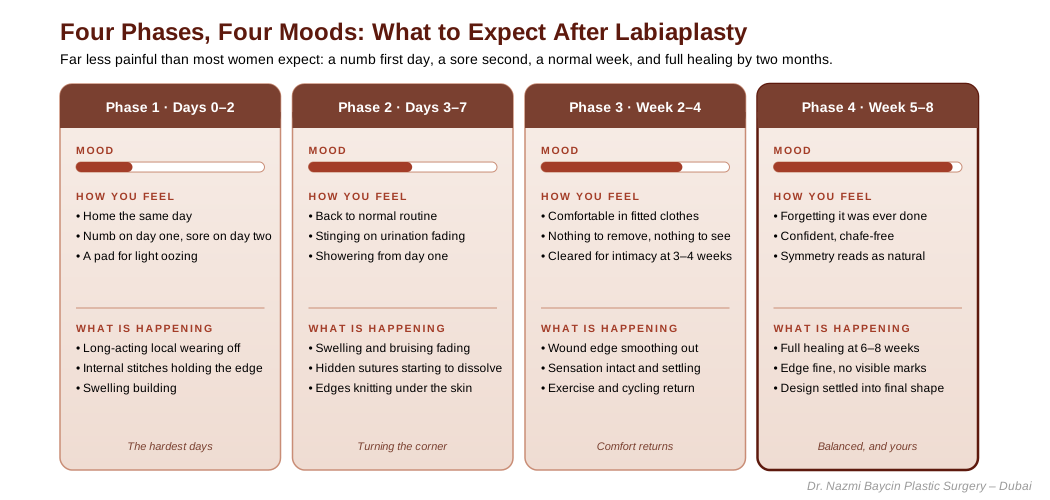
Recovery after labiaplasty is more straightforward and far less painful than most women expect. Because I use a long-acting local anesthetic, the first day is numb and comfortable; the mild soreness arrives on day two, when the local wears off, and is easily managed with medication for a couple of days. A little oozing needs only a sanitary pad, and a brief sting on urination settles within a day or two. You may shower from the next day, and you are back to your normal routine within a few days, as the swelling and bruising fade over the first week. The sutures are absorbable and hidden, so there is nothing to remove. Over weeks two to four the edge smooths and sensation settles, and intimacy can resume at three to four weeks once you are pain-free. Full healing takes six to eight weeks. The mood follows: tender, then relieved, then comfortable, then simply at ease. The pace varies with personality; the shape rarely does.
Can I see the labiaplasty before and after pictures?
UAE rules do not allow me to share labiaplasty before and after pictures. However, if you visit me for consultation, I would show you plenty of before and after pictures.
What are the risks and complications of labiaplasty?

Patient satisfaction rate after labiaplasty surgery
As with any surgery, labiaplasty carries potential risks — principally infection, bleeding, wound dehiscence, and asymmetry. Infection and bleeding are largely avoided with careful technique and appropriate antibiotics, while asymmetry, dehiscence, and edge irregularities are closely tied to the surgeon’s skill and the design used. Across the published literature complication rates are reported technique by technique rather than as a single overall figure, and overall patient satisfaction is among the highest in aesthetic surgery — a 2022 meta-analysis of 3,804 patients found a pooled satisfaction rate of 99%.
In my own practice of more than 1,000 labiaplasty procedures I have not had a major complication. Once healing is complete there are no visible surgical marks — often, even another doctor would not be able to tell the surgery had been performed. When labiaplasty is approached as design rather than mere excision, the result is reliably natural, comfortable, and discreet.
Checklist before having labiaplasty in Dubai
IMPORTANT ! Before getting the appointment, check your medical conditions yourself.
| # | Conditions | Safety | Aesthetic Suitability |
|---|---|---|---|
| 1 | Are you over 18? | 🟢 Fit for surgery | — |
| 2 | Do you experience discomfort, irritation, or visibility of enlarged labia? | 🟢 Fit for surgery | 🟡 Ideal candidate |
| 3 | Do you feel aesthetic or psychological concerns related to labial size or shape? | 🟢 Fit for surgery | 🟡 Ideal candidate |
| 4 | Do you experience functional issues such as discomfort during exercise, intimacy, or clothing? | 🟢 Fit for surgery | 🟡 Ideal candidate |
| 5 | Do you have a cardiovascular problem such as heart disease or deep vein thrombosis? | 🔴 Contraindicated | — |
| 6 | Do you have pulmonary system problems such as chronic lung disease? | 🔴 Contraindicated | — |
| 7 | Do you have chronic liver disease? | 🔴 Contraindicated | — |
| 8 | Do you have a urinary system disease such as kidney failure? | 🔴 Contraindicated | — |
| 9 | Do you have a hematologic problem such as anemia or coagulopathy? | 🔴 Contraindicated | — |
| 10 | Do you have any transmitting disease through blood such as HIV? | 🔴 Contraindicated | — |
| 11 | Have you been taking anticoagulant medication? | 🔴 Contraindicated | — |
| 12 | Have you been taking psychotropic drugs? | 🔴 Contraindicated | — |
| 13 | Any drug abuse or addiction | 🔴 Contraindicated | — |
Completed genital development · labia hypertrophy causing discomfort or self-consciousness · good general health, no uncontrolled systemic disease · realistic expectations · understands sensation and function are preserved · (pregnancy/childbirth history not a barrier).
How much does a labiaplasty cost in Dubai, UAE?
Labiaplasty prices in Dubai can differ quite a bit from one clinic to another, typically ranging from 10,000 AED (around $2,800) to 30,000 AED (approximately $8,200).
Keep in mind that these figures don’t represent Dr. Baycin’s specific rates; you’ll receive the exact cost during your consultation after he evaluates your situation.
For a complete overview of treatment fees, please refer to full price list of the procedures. If you are looking specifically for this procedure, you can also review pricing information.
Schedule your private consultation with Dr. BaycinWhat makes Dr. Baycin an exceptional labiaplasty surgeon in Dubai?
For a procedure this personal, women seek a surgeon who combines technical mastery with genuine discretion and care. That is the standard my practice is built on.
- Over 25 years of experience: a board-certified plastic surgeon, DHA-licensed, and a member of the American Society of Plastic Surgeons (ASPS), with internationally recognized expertise in female genital aesthetics.
- A recognized authority: an invited lecturer and trainer on advanced labiaplasty technique at the 2011 Cosmetic Gynecology Congress.
- Individualized design, never a template: each procedure is planned around the patient’s own anatomy, goals, and proportions.
- Micro-surgical technique: advanced micro-dissection and internal suturing that minimize tissue trauma, preserve sensation, and leave no visible stitches — for smooth, natural, virtually scarless results.
- An exceptional safety record: no major complication across more than 1,000 labiaplasty cases, with consistently high patient satisfaction.
- Comprehensive, unhurried consultations: every option clearly explained, expectations set honestly, and no unnecessary procedures ever pushed.
- Strong post-operative care: structured follow-up, clear pain-management and wound-care protocols.
- An international, trusted reputation: women from the UAE, the GCC, and beyond travel to him for discreet, high-quality, natural-looking results.
- Unwavering confidentiality: every consultation, procedure, and follow-up handled with complete privacy.
- A holistic, empathetic approach: recognizing the emotional significance of intimate surgery, and supporting each patient with sensitivity and respect.
About Dr. Nazmi Baycin
Surgery, to me, is precision applied in service of restoration — a conviction that has guided every one of the more than 7,000 procedures I have performed over 25 years in practice. I am a DHA-licensed, board-certified plastic surgeon, trained in Turkey and based in Dubai since 2016. I operate exclusively within JCI-accredited hospitals, and hold international membership in the American Society of Plastic Surgeons (ASPS). Three techniques, in particular, have become signatures of my practice. Scarless breast augmentation, performed through a transaxillary approach that leaves no incision on the breast itself. Labiaplasty designed individually around each patient’s own anatomy, never to a standard template. And 3D customized facial bone implants, engineered through CT-based bespoke printing — a technique I currently offer as the only surgeon in Dubai providing it. My practice today spans facial rejuvenation, breast surgery, body contouring, and cosmetic genital procedures, drawing patients from across the UAE, Europe, and the wider GCC. Yet the principle guiding each of these specialties has never changed: to restore form is to restore function.
FAQs about labiaplasty in Dubai
-
What is labiaplasty?
Labiaplasty, or labia reduction, is how I reshape and reduce the inner lips of the vulva, the labia minora, when they are enlarged or asymmetrical. Women come to me for both physical and emotional reasons: discomfort during exercise, cycling, or intimacy, irritation from clothing, or simple self-consciousness. I design every labiaplasty individually around a woman’s own anatomy, using a micro-surgical, scarless technique with no visible stitches, always with complete discretion and care for both comfort and a natural appearance.
Prospokpokpokpok
kjoıjıjjjp
Conshfchgfdfsdutrdu
şjhşjhşjh
ıhşhşhhgş
Review Overviewjhljhjl SUMMARY mjhfljhfgljhgvlıg
-
How much does labiaplasty cost in Dubai?
Labiaplasty prices in Dubai can vary from clinic to clinic, generally ranging from AED 10,000 to AED 30,000, depending on the complexity of the case and the technique used. These are general market figures, not Dr. Baycin’s personal rates; the precise cost is confirmed at your private, confidential consultation, once your individual situation has been assessed.
Prospokpokpokpok
kjoıjıjjjp
Conshfchgfdfsdutrdu
şjhşjhşjh
ıhşhşhhgş
Review Overviewjhljhjl SUMMARY mjhfljhfgljhgvlıg
-
Why do women choose labiaplasty in Dubai?
The reasons are a mix of the physical and the emotional, and both are entirely valid. Enlarged labia can cause genuine discomfort during exercise, cycling, or intimacy, chafing against clothing, or irritation and hygiene difficulties. Just as often, the concern is how the area looks, which can affect a woman’s confidence and comfort in her own body. Whatever brings a woman to consultation, I treat her reasons with respect and complete confidentiality, and plan around what she hopes to achieve.
Prospokpokpokpok
kjoıjıjjjp
Conshfchgfdfsdutrdu
şjhşjhşjh
ıhşhşhhgş
Review Overviewjhljhjl SUMMARY mjhfljhfgljhgvlıg
-
What is your scarless, individually designed technique?
Rather than applying one fixed method, I design each labiaplasty around the individual woman’s anatomy, because every woman is different. I use a micro-surgical, scarless technique with fine, dissolvable stitches that leave no visible sutures, and I plan the incision so it follows the natural contours of the area, where any fine line settles almost invisibly. This individualized, meticulous approach is a large part of why my results look natural and my complication rate has been so low.
Prospokpokpokpok
kjoıjıjjjp
Conshfchgfdfsdutrdu
şjhşjhşjh
ıhşhşhhgş
Review Overviewjhljhjl SUMMARY mjhfljhfgljhgvlıg
-
What surgical techniques are used for labiaplasty in Dubai?
There are two principal approaches, and I choose between them based on your anatomy and goals. The trim technique removes excess tissue along the free edge of the labia, which is straightforward and precise. The wedge technique removes a V-shaped section and rejoins the edges, preserving the natural border of the labia. Each has its place, and part of the value of an individually designed operation is selecting, and sometimes blending, the method that best suits your particular anatomy.
Prospokpokpokpok
kjoıjıjjjp
Conshfchgfdfsdutrdu
şjhşjhşjh
ıhşhşhhgş
Review Overviewjhljhjl SUMMARY mjhfljhfgljhgvlıg
-
Will labiaplasty leave visible scars or stitches?
No. A scarless result with no visible stitches is central to how I perform this procedure. I use fine, dissolvable sutures that disappear on their own, so nothing needs to be removed, and I place the incision along the natural edge and contours of the labia, where the fine line settles to become very difficult to see once healed. This discreet, meticulous closure is one of the reasons the results look so natural.
Prospokpokpokpok
kjoıjıjjjp
Conshfchgfdfsdutrdu
şjhşjhşjh
ıhşhşhhgş
Review Overviewjhljhjl SUMMARY mjhfljhfgljhgvlıg
-
Is labiaplasty painful?
It is more comfortable than most women expect. The procedure can be performed under local anesthesia, sometimes with light sedation, or under general anesthesia, depending on the case and your preference, so you feel nothing during it. Afterward, most women describe mild soreness or tenderness rather than real pain, which is easily managed with simple pain relief. Because I use dissolvable stitches, there is nothing to remove later, which spares any added discomfort during healing.
Prospokpokpokpok
kjoıjıjjjp
Conshfchgfdfsdutrdu
şjhşjhşjh
ıhşhşhhgş
Review Overviewjhljhjl SUMMARY mjhfljhfgljhgvlıg
-
What is recovery after labiaplasty like?
Recovery is generally quick and straightforward. As a day procedure, it allows you home the same day, and most women return to desk work and light daily activity within a few days. Some swelling and tenderness in the first week or two are normal and settle steadily. I usually advise avoiding strenuous exercise, cycling, and intimacy for about three to four weeks, until you are comfortable and pain-free, and I guide you through discreet, simple aftercare.
Prospokpokpokpok
kjoıjıjjjp
Conshfchgfdfsdutrdu
şjhşjhşjh
ıhşhşhhgş
Review Overviewjhljhjl SUMMARY mjhfljhfgljhgvlıg
-
Will labiaplasty affect sensation or sexual function?
When performed carefully, labiaplasty does not impair sensation or sexual function; in fact, many women find intimacy more comfortable afterward, because the discomfort or self-consciousness that troubled them is resolved. My technique is designed to preserve the natural anatomy and its nerve supply, reshaping only the excess tissue. This careful, anatomy-respecting approach is exactly why choosing an experienced surgeon matters, and it is reflected in the high satisfaction reported for the procedure.
Prospokpokpokpok
kjoıjıjjjp
Conshfchgfdfsdutrdu
şjhşjhşjh
ıhşhşhhgş
Review Overviewjhljhjl SUMMARY mjhfljhfgljhgvlıg
-
Is labiaplasty in Dubai safe?
In experienced hands labiaplasty is very safe, and across more than a thousand cases I have performed, there have been no major complications. Minor risks such as temporary swelling, bruising, or, uncommonly, minor wound separation are possible, and I keep these low through meticulous micro-surgical technique and careful aftercare. The published evidence reflects this too, reporting high satisfaction and a low complication rate. Good general health and a clean medical history further support a safe procedure.
Prospokpokpokpok
kjoıjıjjjp
Conshfchgfdfsdutrdu
şjhşjhşjh
ıhşhşhhgş
Review Overviewjhljhjl SUMMARY mjhfljhfgljhgvlıg
-
Are you a good candidate for labiaplasty?
You may be a good candidate if enlarged or asymmetrical labia cause you physical discomfort, irritation, or self-consciousness, and you are in good general health. It helps to reflect beforehand on whether your concern is mainly physical, aesthetic, or both, since that guides the plan. A clean medical history is the foundation of safe surgery. Above all, the consultation is an unhurried, confidential conversation in which we discuss your goals honestly and design an approach that genuinely serves them.
Prospokpokpokpok
kjoıjıjjjp
Conshfchgfdfsdutrdu
şjhşjhşjh
ıhşhşhhgş
Review Overviewjhljhjl SUMMARY mjhfljhfgljhgvlıg
-
Can labiaplasty in Dubai be combined with other procedures?
Yes. Labiaplasty is often combined with other intimate procedures within a single, private recovery when a woman wishes. It pairs naturally with vulvoplasty to refine the outer labia, or with vaginoplasty, so that several concerns are addressed together. At your confidential consultation I assess your goals and health and recommend combining procedures only where it is safe and genuinely right for you.
Prospokpokpokpok
kjoıjıjjjp
Conshfchgfdfsdutrdu
şjhşjhşjh
ıhşhşhhgş
Review Overviewjhljhjl SUMMARY mjhfljhfgljhgvlıg
pokpokpokpok
kjoıjıjjjp
hfchgfdfsdutrdu
şjhşjhşjh
ıhşhşhhgş
| jhljhjl |
|
|
SUMMARY
mjhfljhfgljhgvlıg |
|


GET APPOINTMENT
Get ready to look and feel best… You deserve…

pokpokpokpok
kjoıjıjjjp
hfchgfdfsdutrdu
şjhşjhşjh
ıhşhşhhgş
| jhljhjl |
|
|
SUMMARY
mjhfljhfgljhgvlıg |
|