


Table of content
- J Plasma in Dubai quick facts
- What is J Plasma (Renuvion)?
- What can J-Plasma in Dubai do for you?
- What are the benefits of J-Plasma?
- Are you a good candidate for J-Plasma?
- Which areas of the body can J-Plasma treat?
- How does Dr. Baycin perform J-Plasma?
- Where does Dr. Baycin perform J-Plasma in Dubai?
- What is recovery after J-Plasma like?
- What are the risks and complications of J-Plasma?
- J-Plasma in Dubai: suitability and safety checklist
- What are the steps of J-Plasma in Dubai from consultation to surgery?
- How much does a J Plasma cost in Dubai, UAE?
- What makes Dr. Baycin an exceptional J Plasma provider in Dubai?
- About Dr. Nazmi Baycin
- FAQs about J Plasma in Dubai
- What is J-Plasma (Renuvion)?
- How much does J-Plasma cost in Dubai?
- How does J-Plasma tighten the skin?
- Why did you become an early adopter of this technology?
- Is J-Plasma a replacement for a facelift or tummy tuck?
- What areas can be treated with J-Plasma in Dubai?
- Is J-Plasma in Dubai often combined with liposuction?
- Will J-Plasma leave scars?
- What is recovery after J-Plasma like?
- When will I see the results of J-Plasma?
- Is J-Plasma in Dubai safe?
- Are you a good candidate for J-Plasma?
- In-depth reading: the science, candidacy, and role of J-Plasma in Dubai
- What patients say
- Book a J-Plasma consultation in Dubai
Removing fat is only half the job — what you do about the skin left behind is what separates a good body-contouring result from a great one. I am Dr. Nazmi Baycin, and I was among the first surgeons in the UAE to adopt J-Plasma, also known as Renuvion, precisely because it solves that problem. My J-Plasma treatment in Dubai uses controlled plasma energy to tighten loose or sagging skin from beneath the surface, giving a firmer, smoother result without the long scars and downtime of traditional skin-removal surgery.
It is a minimally invasive answer to a common frustration: skin that has lost its grip after weight loss, after pregnancy, or simply with age. Performing J-Plasma in Dubai within JCI-accredited hospitals, I use it both on its own for mild to moderate laxity and, often, alongside liposuction to tighten the skin as I refine the contour beneath it. The principle is the one that guides all my work: to restore form is to restore function.
J Plasma in Dubai quick facts
| Procedure detail | J-Plasma (Renuvion) skin tightening in Dubai |
|---|---|
| Technology | Helium plasma + radiofrequency (subdermal) |
| Treats | Mild–moderate skin laxity; face, neck & body |
| Invasiveness | Minimally invasive (few-millimeter incisions) |
| Anesthesia | Local ± sedation, or general for larger areas |
| Procedure time | About 1–2 hours (from ~30 min for a small area) |
| Hospital stay | Day case (overnight if combined with major liposuction) |
| Sutures | Hidden dissolvable sutures or adhesive strips |
| Downtime | 3–4 days |
| First results | Immediate tightening; builds over months |
| Longevity | Lasts for years with stable weight & care |
| Not for | Weight loss, or severe laxity (needs surgery) |
What is J Plasma (Renuvion)?
J-Plasma, often called Renuvion, is an innovative technology that combines helium plasma energy with radiofrequency (RF) to tighten and rejuvenate the skin with precision. It is minimally invasive and can be used across the body — face, neck, arms, abdomen, thighs, and beyond. Why a focused helium-plasma field behaves differently from the diffuse heat of older devices — and what that difference means for precision, thermal spread, and how quickly you see a change — is the subject of my article on how J-Plasma differs from traditional heat-based tightening. The published evidence is strongest where the device is used alongside surgery: in a randomized controlled trial of 76 patients undergoing lipoabdominoplasty after a weight loss of at least 20 kg, adding Renuvion produced significantly better patient-rated appraisal of excess skin at six months, one year and two years than lipoabdominoplasty alone, with both the patients and the assessing authors blinded to the allocation. Both arms had surgery, so the trial measures what Renuvion adds to an operation rather than what it achieves on its own.
What can J-Plasma in Dubai do for you?
J-Plasma is an excellent option for tightening skin that has lost its firmness and for refining contour where the skin no longer fits the body beneath it. It works well for loose or sagging skin after weight loss or with age, for fine lines and wrinkles, for laxity around the neck, jowls, or abdomen, for uneven, inelastic skin texture, and as a complement to addressing stubborn fat deposits.
What J-Plasma can and cannot treat
One honest point matters more than any other here: J-Plasma is a skin-tightening and contouring procedure, not a weight-loss solution. It works best for patients who are already close to their ideal weight but are troubled by loose skin or minor fat pockets. If your skin laxity is severe, a tightening device will not be enough, and a surgical option that removes the excess skin, such as a tummy tuck or a facelift, will give you a far better result, with liposuction added where excess fat also needs addressing — something I will always tell you honestly at consultation rather than sell you a treatment that cannot meet your goal.
| Factor | J-Plasma (Renuvion) | Surgical skin removal (tummy tuck / facelift) |
|---|---|---|
| Best for | Mild to moderate skin laxity | Severe laxity and excess skin |
| Invasiveness | Minimally invasive, few-mm incisions | Surgical, with longer incisions |
| Scarring | Minimal, discreet | A longer scar, placed discreetly |
| Downtime | About 3–4 days | Typically 1–2 weeks or more |
| Result | Gradual tightening over months | Immediate, maximal skin removal |
What are the benefits of J-Plasma?
What I value most about offering J-Plasma is how much it delivers for how little it asks of the patient. It is minimally invasive, needing only tiny incisions, which means less scarring and a quicker recovery than traditional surgery. It is precise, letting me target specific areas with real accuracy for a natural result. It works quickly — many patients see an immediate tightening, which then continues to improve over the following months as collagen production builds. It is versatile, applicable to nearly any part of the body. And its effects are long-lasting: the collagen remodeling J-Plasma triggers can hold its result for years with proper care.
Are you a good candidate for J-Plasma?
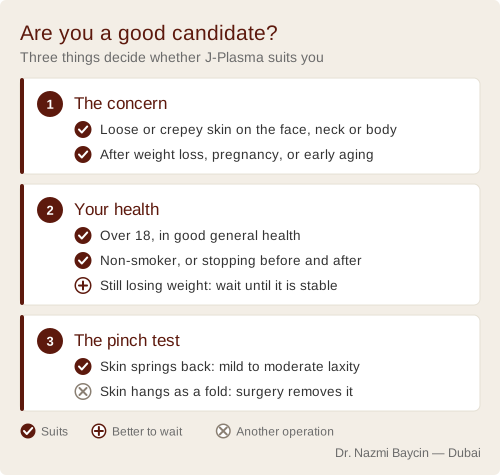 At our consultation I will assess whether J-Plasma is genuinely the right fit for you. The ideal candidates are over 18, have mild to moderate skin laxity, are in good general health, hold realistic expectations, are non-smokers (or willing to stop before and after, since smoking hinders healing), and are committed to keeping a stable weight. If you have recently lost a significant amount of weight or want to address early aging of the skin, J-Plasma may suit you well. If your laxity is more advanced, I will say so, and we will look instead at the surgical options that will actually achieve what you want.
A simple check I use in the room is the pinch test. Skin that recoils when it is pinched and released is lax but still elastic, and J-Plasma will tighten it; skin that hangs as a fold and does not spring back is true excess, and only removing it will help. It also matters where you are in your own journey. If you are still losing weight, we wait until it has been stable for a few months, because skin cannot be tightened around a moving target. And if your plan already includes liposuction, J-Plasma is usually best delivered in the same session, through the same tiny incisions, so the skin is tightened over the newly refined contour in one recovery rather than two.
Which areas of the body can J-Plasma treat?
J-Plasma is genuinely versatile. The most common areas are the face, neck, and jawline, where it smooths sagging skin and softens wrinkles. It is equally effective on the abdomen, arms, and thighs — particularly for loose skin after weight loss or with age — and it is often used to tighten the décolletage and to improve skin tone on the lower body, including the buttocks.
How does Dr. Baycin perform J-Plasma?
My aim throughout is the best possible result with the least risk and discomfort. I begin with a detailed consultation to assess your skin, discuss your goals, and confirm J-Plasma is right for you. On the day, once the treatment area is marked, I apply anesthesia — local, sometimes with mild sedation, or general for larger areas — to keep you comfortable.
The J-Plasma device uses a small handheld probe that releases helium gas together with radiofrequency energy; when the helium is ionized it forms a cold plasma that delivers controlled heat precisely where it is needed, tightening the skin and stimulating collagen in the deeper layers. I make tiny incisions, usually just a few millimeters, and pass the device beneath the skin, watching the temperature and energy delivery closely at every point so each area receives exactly the right dose for optimal tightening and nothing more. When the treatment is complete, I close the small incisions with hidden dissolvable sutures or adhesive strips. The whole procedure usually takes about one to two hours — from around thirty minutes for a small single area — and most patients go home the same day.
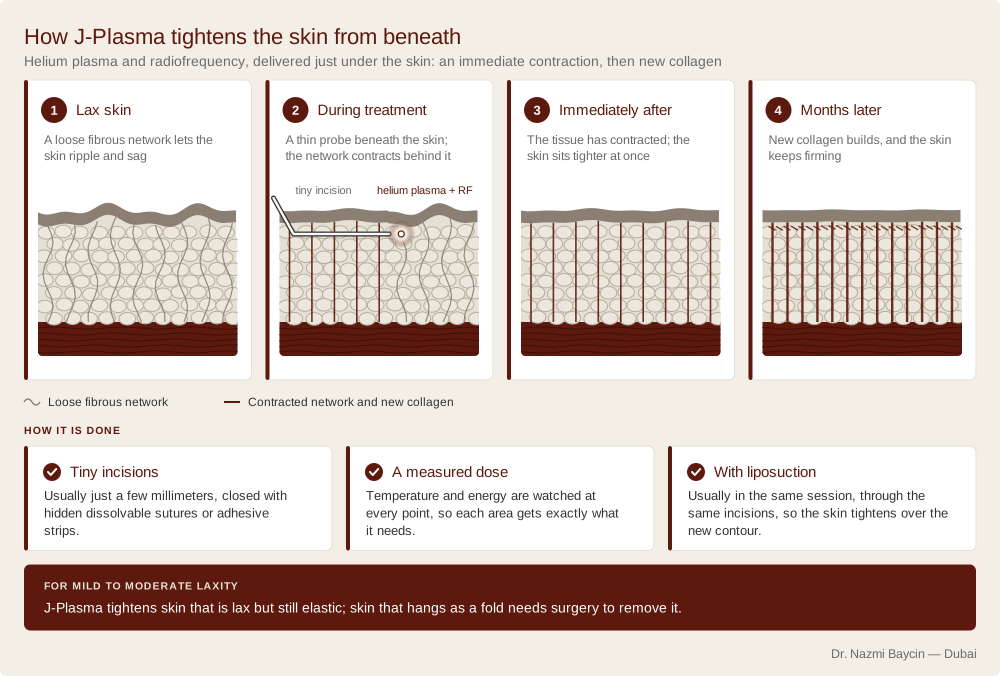
J-Plasma works from beneath the skin, not on its surface. Through an incision of just a few millimeters, a thin probe passes under the skin and releases helium plasma with radiofrequency energy, which contracts the loose fibrous network that lets lax skin ripple and sag; the tightening is visible straight away, though swelling masks some of it at first. Over the following months the body lays down fresh collagen, and the skin keeps firming. Because the helium keeps the energy precise and the surrounding tissue cool, each area receives exactly the dose it needs, and nothing more.
Where does Dr. Baycin perform J-Plasma in Dubai?
I perform every J-Plasma treatment in a modern, JCI-accredited hospital in Dubai that follows strict international standards of safety and cleanliness. Your treatment takes place in a fully equipped, high-quality medical environment, using advanced technology for safe, effective, and comfortable care.
What is recovery after J-Plasma like?
One of the real advantages of J-Plasma is how quickly you recover. In the first hours you may notice mild swelling, bruising, or discomfort, all easily managed with the medication I prescribe. For the first few days it is best to take things gently and avoid strenuous activity, following the aftercare instructions I give you. Most patients are back to work and light activities within a week, as the swelling and bruising fade, and the typical downtime is only three to four days. Over the following months your skin continues to tighten and improve as collagen production builds, and with good care the result can last for years. I will arrange follow-up appointments to monitor your healing along the way. To understand the full science behind how I support your healing after surgery, see my advanced recovery protocol in Dubai article.
Download Dr. Baycin’s J-Plasma aftercare instructions
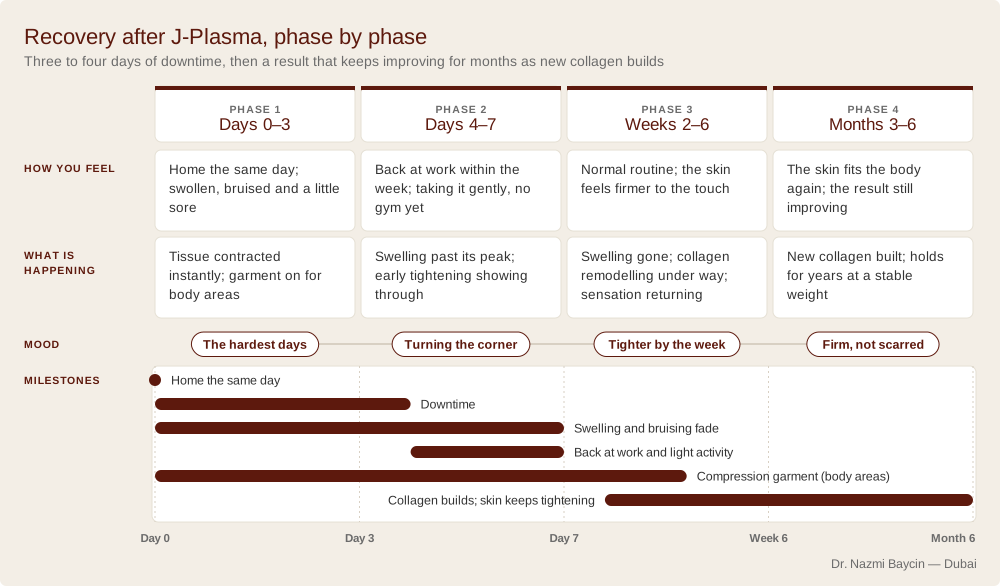
Recovery after J-Plasma is one of its real advantages. You go home the same day, and the first three days bring mild swelling, bruising and a little soreness, all easily managed with the medication I prescribe; for body areas a compression garment supports the tightening. Take those days gently and avoid strenuous activity. By the end of the first week most patients are back at work and light activities as the bruising fades, with typical downtime of only three to four days. Over weeks two to six the swelling clears, the garment comes off, and the skin feels firmer to the touch as collagen remodeling gets under way; any numb patches recover their sensation. The lasting improvement then builds over three to six months as new collagen forms, so the result you see at first is only the beginning, and with a stable weight and good care it holds for years. The mood follows: swollen and impatient, relieved at work, pleased in the mirror, then quietly confident. The pace varies with personality; the shape rarely does.
What are the risks and complications of J-Plasma?
Like any procedure, J-Plasma carries some risks, and I believe in being clear about them. Infection is rare, and I take every precaution to prevent it and give you clear aftercare guidance for your incisions. The incisions are small and usually heal well, though as with any procedure there is a slight chance of a visible scar. In rare cases, skin irregularities such as uneven texture or contour can occur. And some patients notice temporary numbness or altered sensitivity in the treated area, which typically resolves on its own. At consultation we will go through your skin, your goals, and these risks in full, so you feel confident and well-informed before we proceed.
J-Plasma in Dubai: suitability and safety checklist
Important: This checklist helps you prepare for your consultation. It cannot decide whether surgery is safe or suitable for you. Please disclose your full medical history, medicines, and supplements when we meet — everything you share stays confidential.
- Discuss at consultation We plan around it together. Usually not a barrier on its own.
- Medical review The anesthesia team or a specialist reviews it, sometimes with tests or a clearance letter, before a date is confirmed.
- Postpone Surgery waits until this has changed or settled.
- Alternative advised This procedure is not the right fit; another option may suit you better.
| # | Question | Why it matters | If the answer is “NO” |
|---|---|---|---|
| 1 | Are you 18 or older? | This treatment is offered to adults only. | Not offered |
| 2 | When you pinch the loose skin and let go, does it spring back, rather than hang as a fold? | Skin that recoils is lax but elastic and can be tightened; skin that hangs is true excess that only removal will correct. | Alternative advised A tummy tuck, facelift, or another lift. |
| 3 | Is your goal skin tightening, rather than weight loss? | J-Plasma tightens skin; it does not reduce weight. Stubborn fat is treated with liposuction, often in the same session. | Alternative advised Liposuction, with or without J-Plasma. |
| 4 | Has your weight been stable for a few months? | Skin cannot be tightened around a changing shape. | Postpone Until your weight has settled. |
| 5 | Do you understand that tightening builds gradually over 3–6 months and is less than surgery that removes skin? | Immediate contraction is followed by new collagen; the degree varies with skin quality and area. | Discuss at consultation |
| # | Does this apply to you? | Why it matters | Usual next step |
|---|---|---|---|
| Medical history | |||
| 6 | Heart disease, high blood pressure, or an irregular heartbeat | Anesthesia and the procedure add strain on the heart. | Medical review |
| 7 | A previous blood clot (DVT or PE), a clotting disorder, or a close relative with clots | Surgery raises clot risk; prevention is planned around your personal risk. | Medical review |
| 8 | Diabetes | Blood-sugar control affects healing and infection risk. | Medical review |
| 9 | Asthma, other lung disease, or sleep apnea | These affect breathing under sedation or general anesthesia. | Medical review |
| 10 | Liver or kidney disease, anemia, or a bleeding disorder | These affect how medicines are cleared, bleeding, and recovery. | Medical review |
| 11 | HIV, hepatitis B or C, or another blood-borne infection | Well-controlled infection does not automatically rule surgery out; your team plans around it. | Discuss at consultation In confidence. |
| 12 | Past problems with anesthesia, or allergy to local anesthetics, antibiotics, or latex | Depending on the area, local anesthesia with or without sedation, or general anesthesia, is used. | Medical review |
| 13 | A pacemaker, defibrillator, or other implanted electronic device | The device uses radiofrequency energy, which needs specific precautions around implanted electronics. | Medical review |
| 14 | Fillers, threads, or implants in the area to be treated | Heat beneath the skin near these materials changes how and where energy is delivered. | Medical review |
| 15 | Previous surgery, liposuction, or energy-based treatments (such as radiofrequency or ultrasound tightening) in the area | Scar tissue and earlier treatment change how the skin responds. | Discuss at consultation |
| 16 | Medicines that suppress the immune system, such as long-term steroids or biologic treatments | These slow healing and raise infection risk. | Medical review Never stop a prescribed medicine on your own. |
| 17 | A rash, infection, or open wound in the area to be treated | Treating through affected skin raises infection risk. | Postpone Until treated and healed. |
| 18 | A history of keloid or thick, raised scars | Affects how the small entry points heal. | Discuss at consultation |
| 19 | Pregnant or breastfeeding | Elective treatment is deferred until after pregnancy and breastfeeding. | Postpone |
| Medicines and supplements | |||
| 20 | Blood thinners, aspirin, or anti-inflammatories such as ibuprofen | These increase bleeding; some are paused before surgery under medical guidance. | Medical review Never stop a prescribed medicine on your own. |
| 21 | Supplements such as fish oil, vitamin E, ginkgo, garlic, or turmeric | Several raise bleeding risk and are usually paused before surgery. | Discuss at consultation |
| 22 | Weight-loss injections such as semaglutide or tirzepatide | They slow stomach emptying, which matters for sedation or general anesthesia, and mean your weight may still be changing. | Medical review |
| 23 | The contraceptive pill, hormone therapy, or prescribed testosterone | Estrogen raises clot risk; testosterone can thicken the blood. | Medical review |
| 24 | Anabolic steroids or other performance-enhancing drugs | These affect the heart, liver, blood count, and anesthesia. | Medical review Please be open with us — it stays confidential. |
| 25 | Antidepressants or other psychiatric medication | Some interact with anesthesia or pain medicines. | Medical review Keep taking them unless your prescriber advises otherwise. |
| Lifestyle and travel | |||
| 26 | Smoking, vaping, or any nicotine — including pouches, gum, or patches | Nicotine reduces blood flow to the skin and slows healing; stopping before and after treatment is advised. | Discuss at consultation Nicotine-free recovery period is advised. |
| 27 | Recreational drug use or regular heavy drinking | These interact with anesthesia and slow healing. | Medical review |
| 28 | Flying long-haul to Dubai for surgery, or planning to fly home soon after | Long flights add to clot risk around surgery. | Discuss at consultation We plan your travel dates with you. |
| Expectations and wellbeing | |||
| 29 | Do you spend a lot of time worrying about how your skin or body looks, or feel no change would be enough even when others disagree? | This can be a sign of body-image distress that surgery rarely relieves. | Discuss at consultation A supportive, private conversation. |
Medical note: A medical condition, infection, or medicine does not automatically rule out J-Plasma. The decision depends on the diagnosis, how well it is controlled, the planned procedure, and assessment by the surgeon and anesthesia team. Never stop or change prescribed medication without advice from your treating clinician.
J-Plasma risks: These include swelling, bruising, temporary numbness or altered sensation, infection, a small visible scar at an entry point, and, rarely, uneven texture or contour. They are discussed in full at consultation.
Aesthetic note: J-Plasma tightens mild to moderate skin laxity and builds firmness over months. It does not replace skin-removal surgery where there is substantial excess skin, and the result depends on skin quality, the area treated, and individual healing.
Checklist medically reviewed by Dr. Nazmi Baycin, DHA-licensed plastic surgeon · Checklist last updated: 21.10.2026
What are the steps of J-Plasma in Dubai from consultation to surgery?
J-Plasma is performed under local anesthesia, sometimes with sedation, or under general anesthesia for larger areas, and the path from your first visit to your procedure follows five steps. Each one is there to confirm that the treatment is both safe and right for you.
- Consultation: I assess your skin with the pinch test, to tell laxity that J-Plasma can tighten from true excess skin that only surgery will remove, confirm that your weight has been stable for a few months, and plan whether J-Plasma is done on its own or alongside liposuction in the same session. Consultations are paid, and this is where your exact pricing is confirmed.
- Booking the procedure: Once you decide to proceed, we reserve your surgery date. Procedures are scheduled within 2–10 days, depending on the hospital’s operating theater (OT) availability.
- Preoperative blood tests: Routine blood tests are carried out before surgery to confirm that you are in good general health for general anesthesia or sedation. They are not required where a small area is treated under local anesthesia alone.
- Preoperative anesthesia consultation for clearance: The anesthesiologist reviews your test results and medical history and gives clearance for general anesthesia or sedation. This step is not required where a small area is treated under local anesthesia alone.
- Procedure: Your J-Plasma treatment is performed in a JCI-accredited hospital and takes about 1–2 hours (from around 30 minutes for a small area). The hospital stay is a day case (overnight if combined with major liposuction).
How much does a J Plasma cost in Dubai, UAE?
The cost of J Plasma (Renuvion) in Dubai can vary quite a bit from one clinic to another, typically falling between 15,000 AED ($4,100) and 35,000 AED ($9,600). These figures don’t represent Dr. Baycin’s specific pricing; you’ll get the exact amount during your consultation after he evaluates your condition.
Keep in mind that the price might increase based on how complex the procedure is. This cost covers the surgeon’s fee, blood tests, hospital stay, medications, and any supplies used during your treatment.
For a complete overview of treatment fees, please refer to full price list of the procedures. If you are looking specifically for this procedure, you can also review pricing information.
Schedule your private consultation with Dr. BaycinWhat makes Dr. Baycin an exceptional J Plasma provider in Dubai?
With J-Plasma, patients want more than the technology itself — they want the skill and judgment to use it well — and with more than 100 successful J-Plasma procedures, that is the standard Dr. Baycin holds.
- An early adopter in the UAE: one of the first to bring Renuvion technology to the region, Dr. Baycin blends J-Plasma with advanced body-contouring techniques for firmer, tighter, more youthful skin with minimal downtime.
- 25+ years of surgical excellence: a board-certified plastic surgeon, DHA-licensed and an ASPS member, among the most respected names in cosmetic medicine.
- A personalized treatment philosophy: every skin is different, so each plan follows a thorough evaluation and is built around the patient’s goals for a natural, harmonious result.
- Advanced technology for faster recovery: an energy-based, minimally invasive approach that significantly shortens recovery compared with traditional surgery.
- An uncompromising safety record: thousands of cosmetic procedures with an impeccable safety record and the highest standards of care.
- Honest, transparent consultations: the science explained, realistic outcomes set, and surgical alternatives offered openly when they would serve you better.
- Comprehensive aftercare: structured follow-up and direct surgeon access for a smooth, comfortable recovery.
- International recognition: patients travel from across Europe, the Middle East, and beyond for his expertise.
- Proven results: 100+ J-Plasma treatments delivering natural tightening, youthful skin, and enhanced definition.
- Compassion with artistry: every treatment approached with empathy, precision, and respect for individual beauty.
About Dr. Nazmi Baycin
Surgery, to me, is precision applied in service of restoration — a conviction that has guided every one of the more than 7,000 procedures I have performed over 25 years in practice. I am a DHA-licensed, board-certified plastic surgeon, trained in Turkey and based in Dubai since 2016. I operate exclusively within JCI-accredited hospitals, and hold international membership in the American Society of Plastic Surgeons (ASPS). Three techniques, in particular, have become signatures of my practice. Scarless breast augmentation, performed through a transaxillary approach that leaves no incision on the breast itself. Labiaplasty designed individually around each patient’s own anatomy, never to a standard template. And 3D customized facial bone implants, engineered through CT-based bespoke printing — a technique I currently offer as the only surgeon in Dubai providing it. My practice today spans facial rejuvenation, breast surgery, body contouring, and cosmetic genital procedures, drawing patients from across the UAE, Europe, and the wider GCC. Yet the principle guiding each of these specialties has never changed: to restore form is to restore function.
FAQs about J Plasma in Dubai
-
What is J-Plasma (Renuvion)?
J-Plasma, also known by its brand name Renuvion, is an advanced skin-tightening technology I use to firm loose or sagging skin on the face, neck, and body. It works by combining helium gas, energized into a cool plasma, with radiofrequency energy, delivered just beneath the skin. This precise energy causes the tissue to contract immediately and stimulates lasting new collagen, tightening the skin from within without the long scars and downtime of traditional surgery.
-
How much does J-Plasma cost in Dubai?
J-Plasma prices in Dubai can vary from clinic to clinic, generally ranging from AED 15,000 to AED 35,000, depending on the area treated and whether it is combined with liposuction or another procedure. These are general market figures, not Dr. Baycin’s personal rates; the exact cost is confirmed at your consultation, once the area and your goals have been assessed.
-
How does J-Plasma tighten the skin?
It works through a precise, two-part action beneath the skin. I pass a thin device just under the surface, where it releases helium plasma combined with radiofrequency energy. This does two things at once: it causes the tissue to contract instantly, so you see immediate tightening, and it triggers your body to build fresh collagen over the following months, which continues to firm and improve the skin. The helium delivery keeps the energy precise and the surrounding tissue cool.
-
Why did you become an early adopter of this technology?
Because I could see what it solved. For years, the frustration with body contouring was that removing fat often left loose skin behind, and the only remedy was extensive surgery with long scars. When Renuvion emerged as a way to tighten that skin from beneath, with tiny incisions instead of long ones, I recognized its value early and adopted it ahead of most. That experience means I understand precisely where this technology excels and, just as importantly, where it does not.
-
Is J-Plasma a replacement for a facelift or tummy tuck?
Not quite, and I am always honest about this. J-Plasma is superb for mild to moderate skin laxity, offering real tightening with far less downtime than surgery. But where there is significant excess, hanging skin, a surgical facelift or a tummy tuck remains the better answer, because those procedures physically remove the surplus skin. Rather than fit you to the technology, I recommend whichever genuinely suits your degree of laxity, and sometimes that is surgery.
-
What areas can be treated with J-Plasma in Dubai?
J-Plasma is versatile and works across the face and body wherever skin has lost its firmness. On the face and neck, it tightens the jawline, jowls, and the under-chin area beautifully. On the body, it is excellent for the abdomen, arms, thighs, and other areas prone to laxity, particularly after weight loss or where skin has loosened over time. It is especially valuable in combination with liposuction, tightening the skin over an area where fat has just been removed.
-
Is J-Plasma in Dubai often combined with liposuction?
Yes, and this is one of its most powerful uses. When I perform liposuction, removing the fat can sometimes leave the overlying skin loose, especially in patients whose skin has lost elasticity. By applying J-Plasma through the same tiny incisions immediately afterward, I tighten that skin over the newly contoured area in a single procedure. The result is smoother and firmer than liposuction alone could achieve, with no additional scarring and one shared recovery.
-
Will J-Plasma leave scars?
Scarring is minimal, which is one of the technology’s great advantages. I deliver the energy through very small incisions, just a few millimeters, rather than the long incisions surgery requires, and these tiny entry points heal to become very difficult to notice. When J-Plasma is combined with liposuction, I use the same small access points for both, so there are no additional scars at all. This is a large part of what makes the downtime so much shorter than surgery.
-
What is recovery after J-Plasma like?
Recovery is considerably quicker than with surgery, which is a major part of its appeal. You go home the same day, and while there will be some swelling and bruising in the treated area over the first one to two weeks, most people return to their normal routine within a few days. You will usually wear a compression garment for body areas to support the tightening. The skin firms progressively over the following months as new collagen forms.
-
When will I see the results of J-Plasma?
You see two stages of improvement. There is an immediate tightening visible right after treatment, as the tissue contracts in response to the energy, though some of this is initially masked by swelling. Then the more significant, lasting improvement develops gradually as your body produces new collagen, continuing to firm the skin over roughly three to six months. So the result you see at first is only the beginning; the skin keeps improving well after the procedure.
-
Is J-Plasma in Dubai safe?
Yes, in trained, experienced hands it is a safe procedure, and its precision is one of its strengths, because the helium delivery keeps the energy controlled and the surrounding tissue protected. As with any procedure involving energy beneath the skin, technique and proper patient selection are what keep it safe, which is exactly where my early and extensive experience matters. Minor swelling and bruising are normal, and any concerns are discussed fully at consultation alongside your medical history.
-
Are you a good candidate for J-Plasma?
You are likely a good candidate if you have mild to moderate loose or crepey skin on the face, neck, or body that you would like firmed without major surgery, and you are over 18 and in good general health. It is particularly well suited to skin laxity after weight loss or alongside liposuction. If your skin laxity is severe, I will tell you honestly that a surgical lift would serve you better, since setting realistic expectations is part of achieving a result you are happy with.
In-depth reading: the science, candidacy, and role of J-Plasma in Dubai
Deeper reading on the mechanism behind the tightening, how it compares with older technologies, who is and is not a candidate, its role after fat removal, and how it pairs with volume restoration:
- How J-Plasma differs from traditional heat-based tightening — why a focused helium-plasma field contracts collagen with more precision than diffuse radiofrequency or ultrasound, and where each one fits.
- The science of collagen contraction — and the safety limits behind it — how controlled thermal energy remodels collagen at defined temperatures, and the parameters that keep the treatment safe.
- Who is not a candidate — and why the limits matter — the pinch test that separates laxity from true skin excess, and the profiles that need excisional surgery rather than tightening.
- Preventing loose skin after liposuction — and why the sequence matters — how it stops secondary laxity when applied in the right order, and when an excisional lift is the better call instead.
- Restoring lost volume and skin tone together with fat transfer — pairing autologous fat transfer with skin contraction to treat both deficits of facial aging in one plan.
What patients say


Book a J-Plasma consultation in Dubai
Get ready to look and feel best… You deserve…
