


Table of content
- What is hymenoplasty?
- Why do you need hymen repair in Dubai?
- Are you a good candidate for hymen repair in Dubai?
- How is hymenoplasty performed?
- Why a new lining lasts longer than re-stitching remnants
- Where is hymenoplasty performed in Dubai?
- What is recovery after hymenoplasty like?
- What are the risks and complications of hymenoplasty?
- How much does a hymenoplasty cost in Dubai, UAE?
- FAQs about hymenoplasty in Dubai
Hymenoplasty is a personal decision, and it belongs entirely to the woman making it. Hymenoplasty in Dubai — also called hymen repair or hymen reconstruction — restores or recreates the hymenal tissue using a reliable, durable surgical technique, carried out with complete discretion and respect. Women choose this procedure for their own personal, cultural, religious, or emotional reasons, and the role of care here is not to question those reasons but to provide safe, expert, confidential treatment.
Every patient deserves to feel informed and at ease before deciding. Hymen repair surgery is carried out with particular care for privacy at every stage — from the first confidential consultation to recovery. This page sets out honestly what the procedure involves, how it is performed, what recovery is like, and the real risks, so the decision is a fully informed one. The principle is a simple one: to restore form is to restore function.
Hymenoplasty in Dubai quick facts
| Procedure detail | Hymenoplasty in Dubai |
|---|---|
| Also known as | Hymen repair, hymen reconstruction, hymenorrhaphy |
| Technique | New lining reconstructed from base tissue (durable) using micro-surgical methods |
| Anesthesia | Local, with optional sedation or general |
| Procedure time | About 40 minutes (30 min–1 hour) |
| Hospital stay | Day case — no hospitalization |
| Stitches | Dissolvable (none to remove) |
| Shower | Same day — does not affect the result |
| Tissue healing | About 10–14 days |
| Exercise | After about 2 weeks |
| Result | Permanent — until the next intercourse |
| Privacy | Fully confidential throughout |
What is hymenoplasty?
Hymenoplasty — also known as hymen repair, hymen reconstruction, or hymenorrhaphy — is a procedure that restores or recreates the thin membrane of hymenal tissue at the vaginal opening. It is one of the least invasive of the intimate procedures, usually taking around forty minutes, and it can be performed under local anesthesia, with sedation or general anesthesia available for those who would prefer it. It is a day procedure, with no hospital stay required. The aim is simply to reconstruct the tissue reliably and discreetly, according to each woman’s own wishes.
Why do you need hymen repair in Dubai?
Women choose hymenoplasty for many different reasons that are entirely their own — personal, cultural, religious, or emotional. For some it carries deep cultural or religious significance; for others it is a private, personal choice. Whatever the reason, it is a valid and individual decision, and it is treated with discretion and without judgment. The responsibility of good care is to make sure each patient understands the procedure fully, to answer questions honestly, and to provide safe, confidential treatment so that the decision is respected and privacy protected throughout.
Are you a good candidate for hymen repair in Dubai?
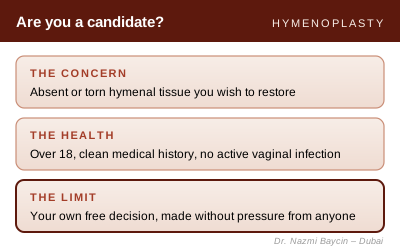 Hymenoplasty is performed only for women aged 18 and over, and only where the decision is the patient’s own, made freely and without pressure from anyone else. Beyond that, the most critical prerequisite is the absence of any active vaginal infection; common conditions such as yeast infections, for example, can interfere with proper tissue integration after suturing. So if an infection is present, it is standard practice to treat it with medication first before proceeding with the procedure — this is a routine precaution, not a barrier.
How is hymenoplasty performed in Dubai?
Hymenoplasty usually takes about forty minutes, and local anesthesia is generally enough to numb the area completely; because it is natural to feel anxious about an intimate procedure, sedation or general anesthesia is available for anyone who would rather be relaxed or asleep. There are different techniques for hymen repair, and every surgeon has their own approach: some stitch the remaining edges of the hymen together, while others reconstruct a new lining that recreates the hymen.
Why does a new lining last longer than re-stitching hymen remnants?
The choice of technique matters, and it is worth being honest about why. The hymen is a delicate, thin membrane that tears easily. If the surgeon opts for the method of stitching the remnants together, a simpler and cheaper method, it’s likely that the sutures may tear fragile remnants fairly quickly.
Even a small movement can cause the sutures to pull loose and the repaired edges to separate. For that reason, rather than depending on the fragile remnants, reconstructing a new lining using the deeper base tissues gives a more reliable and more durable result, closed with dissolvable stitches so there is nothing to remove.

A repair is only as strong as the tissue that holds the stitches. The membrane itself is thin and tears easily, so re-stitching the remaining edges — the simpler and cheaper method — places the sutures in tissue that cannot bear load: a small movement pulls them through, and the edges separate, often within days. Reconstructing a new lining from the deeper base tissue approximated with internal stitches changes what carries the load. The lining is raised from the base and closed in two separate layers, inner and outer, using fine micro-instruments and atraumatic dissection that preserve the blood supply; the base takes the strain, not the membrane, which is why the reconstruction resists accidental tearing through the 10–14 days of healing. Both methods use dissolvable stitches and both are day cases, and both are designed to separate at intercourse — what differs is whether the repair survives everything before that. This is the technique used here, in a JCI-accredited facility in Dubai, with full confidentiality throughout.
Which technical factors affect the success of hymenoplasty?
Another important factor in successful wound healing is the use of atraumatic surgical techniques. A critical principle is repairing the outer and inner tissue layers separately, which reduces the risk of wound separation and promotes more secure healing. This multi-layered repair provides additional structural strength, making the reconstruction more resistant to accidental tearing during the healing period. Achieving this requires delicate microsurgical tissue dissection with fine micro-instruments that minimize tissue trauma, preserve the blood supply, and create optimal conditions for tissue repair. This meticulous approach not only reduces the risk of tissue damage but also contributes to a stronger, more reliable reconstruction.
| Factor | Re-stitching the remnants | Reconstructing a new lining |
|---|---|---|
| What is sutured | The torn edges of the existing membrane, joined edge to edge | A new lining raised from the deeper base tissue |
| What carries the load | The sutures alone, in tissue that tears easily | The base tissue carries the load which is approximated with internal stitches; the membrane is not under strain |
| Layers closed | One | Two, inner and outer, closed separately |
| Instruments | Standard | Micro-instruments; atraumatic dissection preserving blood supply |
| Procedure time | Shorter | About 40 minutes |
| Main failure mode | Sutures pull through with small movements; separation often within days | Hygiene factors near the urethra; movement alone rarely reopens it |
| Durability | Short-term | Long-term — holds until intercourse |
| Stitches · stay | Dissolvable · day case | Dissolvable · day case |
| Cost | Lower | Higher, reflecting the technique |
| Reliability (Based on personal experience) |
The main risk after hymenoplasty is reopening. This can happen due to the surgical technique as mentioned. There are also uncontrollable factors that can contribute to this issue. For instance, certain hygiene factors can lead to the wound reopening. Vaginal secretions or accidental urine contact with the wound, which is likely due to the close proximity of the urethra to the repaired hymen, are common culprits.
The largest published account of the procedure is a seven-year retrospective analysis of 4,259 hymenoplasty records from a single specialized practice. It is principally a demographic and decision-making study rather than a comparison of techniques, and it reports mostly successful outcomes with minor complications while calling for comprehensive patient support and counseling. One difference worth stating plainly: that cohort spanned ages 14 to 49, whereas this procedure is performed here only for women aged 18 and over.
Where is hymenoplasty performed in Dubai?
Hymenoplasty should be performed in a private, JCI-accredited facility in Dubai that upholds the highest international standards for safety, hygiene, and — above all for a procedure this personal — patient confidentiality. Care takes place in a discreet, fully equipped, modern surgical environment, with privacy protected at every step. For some patients, hymenoplasty forms part of a wider, fully confidential conversation about cosmetic genital surgery, and only what is relevant to the individual patient should ever be discussed.
What is recovery after hymenoplasty like?
Recovery from hymenoplasty is straightforward and essentially pain-free. The local anesthetic keeps the patient comfortable through the procedure and into the next day, and a return to normal routine is possible straight away — showering is perfectly fine and will not affect the result.
Healing of the tissue itself takes about 10 to 14 days. Walking and going about the day normally are fine, but during this period it is best to avoid spreading the legs too wide, as that can put tension on the stitches; exercise can resume after about two weeks, by which time healing is well established.
One honest, practical point: because the repaired tissue is designed to be delicate, intercourse at any time — whether before or after full healing — is likely to cause the repair to separate, with some bleeding, so the timing of intercourse is something to consider in personal planning.
For more on the science behind recovery support after surgery, see the advanced recovery protocol in Dubai article.
Download hymenoplasty aftercare instructions
What are the risks and complications of hymenoplasty?
Honesty about the risks matters, particularly because hymenoplasty is a less common procedure and the published data on its outcomes, while growing, remains limited. The main risk is reopening of the repair. This can happen because of the surgical technique used, or if the area is put under stress by movement, and there are also factors outside anyone’s full control.
Hygiene plays a part: because the repaired tissue sits very close to the urethra, vaginal secretions or accidental contact with urine can affect healing and contribute to reopening. If a reopening does occur, a further procedure is needed to repair it. Choosing a reliable technique from the outset — reconstructing a new lining rather than relying on fragile remnants — is the best way to reduce that risk.
Visit homepage to learn more about Dr. Baycin and his surgical mastery.
How much does a hymenoplasty cost in Dubai, UAE?
Hymenoplasty costs in Dubai vary from clinic to clinic and depend on several factors, ranging between 10,000 ($2,800) and 40,000 AED ($11,000).
For a complete overview of treatment fees, please refer to full price list of the procedures.
Schedule your private consultation with Dr. BaycinAbout Dr. Nazmi Baycin
Surgery, to me, is precision applied in service of restoration — a conviction that has guided every one of the more than 7,000 procedures I have performed across 25 years in practice. I am a DHA-licensed, board-certified plastic surgeon, trained in Turkey and based in Dubai since 2016. I operate exclusively within JCI-accredited hospitals, and hold international membership in the American Society of Plastic Surgeons (ASPS). Three techniques, in particular, have become signatures of my practice. Scarless breast augmentation, performed through a transaxillary approach that leaves no incision on the breast itself. Labiaplasty designed individually around each patient’s own anatomy, never to a standard template. And 3D customized facial bone implants, engineered through CT-based bespoke printing — a technique I currently offer as the only surgeon in Dubai providing it. My practice today spans facial rejuvenation, breast surgery, body contouring, and cosmetic genital procedures, drawing patients from across the UAE, Europe, and the wider GCC. Yet the principle guiding each of these specialties has never changed: to restore form is to restore function.
FAQs about hymenoplasty in Dubai
-
What is hymenoplasty?
Hymenoplasty, also known as hymen repair or hymen reconstruction, is a minor surgical procedure that restores the hymen, the thin membrane at the vaginal opening. It is a discreet, confidential day procedure carried out under local anesthesia. Women choose it for a range of personal, cultural, and private reasons, and every case is handled with complete privacy and without judgment. The aim is a natural, reliable restoration of the hymen, planned around each woman’s individual circumstances and wishes.
-
How much does hymenoplasty cost in Dubai?
Hymenoplasty costs in Dubai vary from clinic to clinic, generally between AED 10,000 and AED 40,000, and much of that range reflects the technique: a simple re-stitching of the remnants and a durable reconstruction of a new lining differ in complexity and time. These are general market figures; the precise fee for the reconstruction performed here is confirmed during a private, confidential consultation, once the individual situation has been assessed.
-
Why do women choose hymenoplasty in Dubai?
Women choose hymenoplasty for many deeply personal reasons, and each is treated as entirely valid. For some it relates to cultural or personal significance; for others it follows a change they simply wish to reverse. The reasons a woman brings are respected without question or judgment, and the decision is understood to be a private one. Throughout the process, discretion and confidentiality are paramount, so that each woman can proceed with confidence and peace of mind.
-
What techniques are used for hymen repair in Dubai?
There are two main approaches. The simpler method stitches the remaining edges of the hymen together; because the membrane is thin and tears easily, those sutures can pull loose with a small movement, and the repair often separates within days. The other method reconstructs a new lining from the deeper base tissue and closes it in two separate layers, so the base carries the load rather than the fragile membrane. That reconstruction is the technique used here, because it is the one that reliably holds through healing and until intercourse.
-
Is hymenoplasty in Dubai confidential?
Yes, confidentiality is central to how this procedure is handled. From the first consultation onward, every stage is managed with complete discretion and privacy, and a woman’s reasons for seeking the procedure are never questioned. It is performed quietly as a day case, with no need for an overnight stay. This emphasis on privacy is designed to ensure that each woman feels safe, respected, and fully in control of a decision that belongs entirely to her.
-
How is the hymenoplasty in Dubai procedure performed?
Hymenoplasty is a short procedure, usually about forty minutes, performed under local anesthesia so the area is fully numbed, with sedation or general anesthesia available for anyone who would prefer to be relaxed or asleep. A new lining is reconstructed from the deeper base tissue using fine micro-instruments and atraumatic dissection, then closed in two separate layers with fine, dissolvable stitches. It is carried out as a day case, so the patient returns home the same day with clear, discreet aftercare guidance.
-
What type of anesthesia is used for hymen repair?
Hymenoplasty is usually performed under local anesthesia, which numbs the area thoroughly so the procedure is comfortable while the patient remains awake, and its short duration makes for a fast, straightforward recovery. Because it is natural to feel anxious about an intimate procedure, sedation or general anesthesia is available for anyone who would rather be relaxed or asleep. The choice is discussed openly during the private consultation beforehand, and it does not change the result.
-
What is recovery after hymenoplasty like?
Recovery is quick and generally straightforward. As a day procedure, it allows a return home the same day, and most women resume their normal daily routine within a short time. There may be mild discomfort or light spotting in the first few days, which settles on its own, and the stitches used are dissolvable, so none need to be removed. Simple hygiene measures and the discreet aftercare instructions provided support smooth, comfortable healing.
-
Will there be any visible signs of the surgery?
No. Hymenoplasty is designed to leave no outward sign that a procedure has been performed. The repair is internal and uses fine, dissolvable stitches that disappear on their own, and healing occurs discreetly. This careful, natural-looking result is an essential part of the procedure’s purpose, and it reflects the overall emphasis on privacy and discretion that defines every stage, from the confidential consultation through to full recovery.
-
How long before the results are effective?
The reconstruction is in place from the day of surgery, and the tissue itself heals over about 10 to 14 days, with exercise possible after about two weeks. From then on the result is stable and holds until intercourse, whenever that is; it is not a repair that fades with time. This is the practical difference from a simple re-stitching of the remnants, which is intended only for a short window and often separates within days. Timing is discussed precisely at the confidential consultation so the plan fits each woman’s own circumstances.
-
Is hymenoplasty in Dubai safe?
Hymenoplasty is a minor, low-risk procedure when performed by an experienced surgeon in a proper clinical setting. As with any surgery, minor risks such as mild discomfort, light spotting, or, uncommonly, infection are possible, and these are minimized through careful technique and good hygiene. Good general health and a clean medical history support a safe procedure and smooth recovery. Any concerns are addressed fully and confidentially during the consultation before proceeding.
-
Can hymenoplasty in Dubai be combined with other procedures?
Yes. Hymenoplasty can be performed alongside other intimate procedures when a woman wishes, such as labiaplasty or vaginoplasty, so that several concerns are addressed within a single, private recovery. Whether to combine procedures is decided together during the confidential consultation, where each woman’s goals and health are assessed and only genuinely suitable, safe options are recommended, always with her privacy fully protected.


GET APPOINTMENT
Get ready to look and feel best… You deserve…
