


Table of content
- What problems can eyelid surgery correct?
- How does Dr. Baycin perform upper eyelid surgery?
- How does Dr. Baycin perform lower eyelid surgery (eye bag removal)?
- Which anesthesia is used for eyelid surgery?
- What is recovery after eyelid surgery like?
- What are the risks and complications of eyelid surgery?
- Checklist before having eyelid surgery in Dubai, UAE
- How much does an eyelid surgery cost in Dubai, UAE?
- Get appointment
The eyes are the first thing we read in a face, and the first place age shows. I am Dr. Nazmi Baycin, and across more than five hundred and fifty eyelid surgery procedures I have learned that blepharoplasty is among the most exacting operations in aesthetics — a few millimeters in either direction is the difference between a rested, natural eye and an operated, hollow, or pulled-down one. My eyelid surgery in Dubai is built on that precision: removing exactly what should go, repositioning rather than simply discarding, and protecting the delicate balance that keeps the eye looking like itself.
That restraint is the whole art. Performing eyelid surgery in Dubai within JCI-accredited hospitals, I correct the upper lid in two dimensions rather than one, treat the under-eye not by emptying it but by smoothing the lid-to-cheek transition, and safeguard the lower lid against the malposition that mars so much eyelid surgery. The principle is the one that guides all my work: to restore form is to restore function.
Eyelid surgery in Dubai quick facts
| Procedure detail | Eyelid surgery (blepharoplasty) in Dubai |
|---|---|
| Procedures | Upper eyelid, lower eyelid (eye bag removal), or both |
| Signature detail | 2D upper-lid correction; fat repositioning; ectropion-safe technique |
| Anesthesia | Local (upper); general or sedation (lower) |
| Procedure time | ~40 minutes per eyelid |
| Hospital stay | Day case — home in 2–3 hours |
| Incision | Upper: in the lid fold · Lower: ~1.5 mm below the lashes |
| Stitches | Removed at 4–5 days |
| Downtime | 5–7 days (back to work ~1 week) |
| Swelling / bruising | Peaks day 2; fades within ~1 week |
| Final result | Visible immediately; settles over 4–6 months |
What problems can eyelid surgery correct?
The eyelids are central to expression, and among the first areas where aging shows — which is why drooping, wrinkled lids so often lend the face a tired, worn look even when you feel rested. With time the upper eyelids loosen and the brow begins to descend, and that excess skin weighs the lid down into a hooded, heavy appearance. The lower lid ages differently: first the under-eye bags emerge, then, as the skin loses firmness, fine wrinkles follow. Eyelid surgery addresses both — lifting the heaviness from above and smoothing the tiredness from below — to restore an open, refreshed, and youthful eye. For a fuller rejuvenation of the upper face, it also pairs naturally with a brow lift, since a sagging brow and a heavy upper lid often occur together.
Are you a good candidate for eyelid surgery?
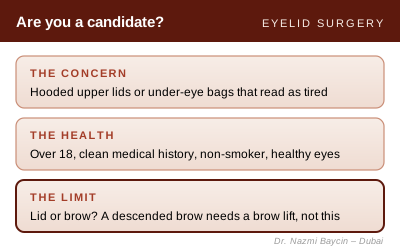 You are likely a good candidate if you have hooded or drooping upper lids, under-eye bags, or puffiness that makes you look tired, and you are in good general health with no serious eye conditions. A clean medical history, free of systemic disease such as heart disease, is the foundation of safe surgery and the starting point of every assessment I make.
Healthy eyes matter too: conditions such as severe dry eye are discussed carefully beforehand, since eyelid surgery can affect them. At our consultation I assess your lid skin, the position of your brow, the fat pads, and the laxity of the lower lid, then match the procedure precisely to what your eyes need.
One assessment matters more than any other here, and it is easy to get wrong: a heavy upper lid and a descended brow look almost identical in the mirror but need different operations. If the true problem is the brow rather than the lid, removing eyelid skin will not correct it — and can make matters worse. I explain the manual test that separates the two in my article on telling a heavy brow from heavy eyelids.
How does Dr. Baycin perform lower eyelid surgery (eye bag removal)?

Diagram shows removable skin excess during the lower eyelid surgery
The lower lid is a different problem and demands a different philosophy. I make a fine incision about 1.5 mm below the lash line, and here the primary target is the under-eye fat pads, with skin tightening playing only a supporting role. Those pads are what create the tired, shadowed bulge that can make a well-rested person look exhausted.
Three ways to treat the tear trough
There are three ways to correct the under-eye, and choosing well is everything. The first is simply to remove the fat bags — effective, but it can leave a hollow, skeletonized look beneath the eye if overdone. The second, and the most commonly used, is to tighten the membrane that forms the front wall of the fat pads so it holds them back: the bags stay intact, but the tightened wall pushes them flat. The third — which I have used increasingly in recent years — is fat repositioning: rather than discard the excess fat, I move it down into the upper cheek and tear-trough hollow. Its great advantage is that it smooths the line between the lower lid and the cheek so the two blend seamlessly, replacing the tired step-off with a single, youthful curve.
| Approach | What happens to the fat | Effect on the lid-to-cheek transition | Main limitation |
|---|---|---|---|
| Removing the fat bags | The fat pads are excised and discarded. | The bulge is gone, but nothing fills the hollow beneath it. | Effective, but if overdone it can leave a hollow, skeletonized look beneath the eye. |
| Tightening the septal wall | The fat is kept. The membrane forming the front wall of the fat pads is tightened so it holds them back. | The bags stay intact but are pushed flat. The step-off between lid and cheek is unchanged, because no fat is moved into the trough. | Addresses the bulge without addressing the hollow below it. |
| Repositioning the fat | The fat is kept and moved down into the upper cheek and the tear-trough hollow. | The tired step-off is replaced with a single, youthful curve — lid and cheek blend seamlessly. |
Choosing well between these is everything. The second method is the one most commonly used, and it does flatten the bulge — but it treats the bag and leaves the hollow. In recent years I have moved increasingly toward the third, because the eye’s own fat is better used as structure than discarded as excess: filling the trough rather than emptying it is what allows the result to age gracefully instead of hollowing out over time.
How does Dr. Baycin protect the lower lid against malposition?
Two different problems get confused under one name. Ectropion is outward turning of the lid margin away from the eye; retraction is the lid margin sitting too low, showing sclera beneath the iris. Both are lower-lid malpositions, both are uncommon in careful hands, and both come from the same root error — removing skin in pursuit of tightness and leaving the remainder under tension that drags the margin down.
My rule is firm: no more than 3 mm of skin is ever removed, however much excess appears to be there. And I always anchor the lower-lid tissue to the outer rim of the orbital bone with an internal suture, so the lid holds its natural position against gravity and skin tension.

Two different problems get confused under one name. Ectropion is outward turning of the lid margin away from the eye; retraction is the margin sitting too low, showing sclera beneath the iris. Both are lower-lid malpositions, both are uncommon in careful hands, and both come from the same root error — removing skin in pursuit of tightness and leaving the remainder under tension that drags the margin down. My rule is firm: no more than 3 mm of skin is ever removed, however much excess appears to be there. And I always anchor the lower-lid tissue to the outer rim of the orbital bone with an internal suture, so the lid holds its natural position against gravity and skin tension rather than depending on a tight closure. Across more than 550 eyelid procedures, those two rules are what a stable lower lid rests on.
Those are the two rules I operate by. The reasoning behind each has its own article: how the muscle itself is elevated and held is set out in the orbicularis suspension technique I use to support the lower lid; how the lateral canthus is assessed and reinforced, and when a canthopexy or canthoplasty is indicated, is set out in preventing retraction through canthal support. Both cover the eversion and the retraction forms of malposition, because the two share one prevention.
How does Dr. Baycin perform upper eyelid surgery?

Diagram shows removable skin excess during the upper eyelid surgery
In upper eyelid surgery I place the incision along the natural fold of the lid, so the fine scar settles invisibly within that crease. Through it I remove the precise excess of skin, and where heavy, swollen fat pads blur the lid, I remove those too — a lasting correction, since new fat pads do not form in the same place again. Reducing both the skin and the fat lightens the whole upper lid and sharpens the definition of the fold, opening the eye to a more youthful, rested expression.
Why two-dimensional correction matters
Here is where my approach differs from many. Because gravity pulls loose skin downward, most surgeons tighten the upper lid only vertically — and in doing so they leave the horizontal looseness uncorrected, which is why some eyelid results never look quite clean. I always plan upper eyelid surgery as a two-dimensional correction, addressing both the vertical and the horizontal excess, so the lid is genuinely smooth rather than merely shortened.
| Factor | Upper eyelid surgery | Lower eyelid surgery (eye bag removal) |
|---|---|---|
| Main concern | Hooded, heavy, drooping upper lid | Under-eye bags, puffiness, tear-trough shadow |
| Primary target | Excess skin (+ fat pads), in two dimensions | Fat pads (repositioned or held back); skin tightening secondary |
| Incision | Within the natural upper-lid fold | ~1.5 mm below the lash line |
| Anesthesia | Usually local | Usually general (or local with sedation) |
| Key safeguard | Two-dimensional correction (no residual skin) | ≤3 mm skin removal + orbital-rim fixation |
In-depth reading: diagnosis, technique & safe eyelid surgery in Dubai
Explore the thinking behind a natural, stable result — how the right diagnosis and the right structural technique prevent the complications that most often bring patients in for revision:
- Preserving eye shape by conserving volume — the preservation-first philosophy that frames the rest: why treating orbital fat as structure to reposition, not excess to remove, keeps the eye looking rested rather than hollowed and gaunt.
- Preventing lower-lid retraction and scleral show — how lateral canthal support, and the choice between canthopexy and canthoplasty, holds the lid margin against the eye.
- Supporting the muscle rather than trimming the lid — how the descended orbicularis is elevated and anchored, and what the published series do and do not show about it.
- Repositioning fat rather than removing it — why moving the eye’s own fat to fill the tear trough ages more gracefully than emptying the under-eye and hollowing it out.
- Telling a heavy brow from heavy eyelids — the manual brow-elevation test that decides whether the real problem is the lid or a descended brow, and which procedure each needs.
- How eyelid anatomy differs across ethnicities — why the crease, fat, and skin of Asian and Caucasian lids call for different surgical planning in Dubai’s diverse population.
Which anesthesia is used for eyelid surgery?
Blepharoplasty can be done under either general or local anesthesia, and the right choice depends on which lids are being treated. For upper eyelid surgery alone, local anesthesia numbs the area perfectly well, and it is what I usually use — the eyes stay closed throughout, so it poses no difficulty. For lower eyelid surgery I generally prefer general anesthesia, though local with deep sedation also works well.
The reason is practical: working with instruments directly in front of an open eye can be psychologically uncomfortable, and involuntary blinking makes such delicate work harder — so general anesthesia is both the more rational choice and the more comfortable one for patient and surgeon alike. Where I combine eyelid surgery with another procedure, I also lean toward general anesthesia.
| Factor | Local anesthesia | Local anesthesia with deep sedation | General anesthesia |
|---|---|---|---|
| When Dr. Baycin uses it | Upper eyelid surgery on its own | Lower eyelid surgery, as an alternative to general | Lower eyelid surgery; upper and lower together; eyelid surgery combined with another procedure such as a brow lift or facelift |
| Your state during surgery | Awake; the eyelids are numb | Asleep but breathing on your own; no memory of the procedure | Fully unconscious, breathing supported by the anesthetist |
| Why it suits that operation | The eyes stay closed throughout, so an awake patient poses no difficulty | Removes the discomfort of instruments in front of an open eye while avoiding full general anesthesia | The eye is open during lower-lid work; sedation or general prevents involuntary blinking and the psychological discomfort of watching the instruments |
| Pain during the procedure | None; you may feel light pressure or touch | None | None |
| Who administers it | The surgeon, by injection into the eyelid | Anesthetist gives the sedation; surgeon numbs the eyelid | Anesthetist |
| Setting | JCI-accredited hospital | JCI-accredited hospital | JCI-accredited hospital |
| Fasting beforehand | Not usually required | Required, as for general anesthesia | Required, typically from midnight before surgery |
| Waking and going home | Immediate; home within an hour or two | Wake within minutes; home within two to three hours | Effects wear off within a few hours; home within two to three hours |
| Escort needed to go home | Advisable | Required | Required |
| Common after-effects | None beyond the surgery itself | Brief drowsiness | Grogginess for a few hours; occasionally nausea or a sore throat |
| Suitability | Most patients; not ideal for those who are very anxious about being awake | Patients who want to be unaware but are keen to avoid general anesthesia | Standard for lower-lid and combined cases; requires pre-operative medical clearance |
| Effect on the surgical result | None | None | None — the choice is about comfort and steadiness during surgery, not the outcome |
Where does Dr. Baycin perform eyelid surgery in Dubai?
I perform every eyelid surgery in a JCI-accredited, world-class hospital in Dubai that follows the highest international standards of safety and hygiene. Your procedure takes place in a fully equipped, advanced surgical environment built for precision, safety, and natural-looking results.

A symphony of precision and artistry — Dr. Nazmi Baycin performs eyelid surgery with masterful finesse, restoring youthful elegance while preserving the natural beauty of every expression.
What is recovery after eyelid surgery like?
You can go home just a few hours after eyelid surgery — usually within two to three. Some mild discomfort is normal and easily managed with painkillers, and because the tissue around the eyes is loose, swelling and bruising are expected to some degree in everyone. Ice packs make a real difference here: keep them gently around the eyes through the first day, up until you go to bed. The swelling peaks on the second day — don’t be alarmed if it looks worse then — and eases steadily afterward.
If you had general anesthesia, its effects wear off within a few hours and you can be up and about once your strength returns; many patients feel well enough to manage daily tasks the very next day. Eyelid surgery will not confine you to bed, and the more you move, the better you will feel. To understand the full science behind how I support your healing after surgery, visit my advanced recovery protocol in Dubai article.
What should you do after eyelid surgery?
Once home — the same day or the next — you can return to your normal routine without keeping to bed. The stitches come out four to five days after surgery, and the swelling and bruising largely fade within about a week, so most patients are back to work within a week, or even after just four days if they are comfortable being seen with a little residual bruising. The eyelids take around four to six months to settle into their final shape. The results, though, are visible almost immediately — and deeply satisfying: in place of a tired, sad, or angry look, a refreshed and youthful eye.
Download Dr. Baycin’s eyelid surgery aftercare instructions
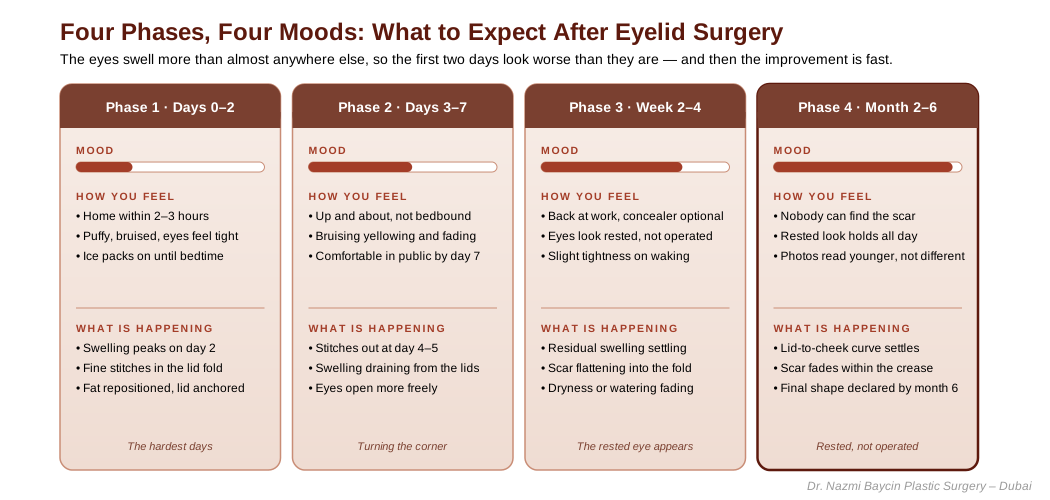
Recovery after eyelid surgery is front-loaded. You go home within two or three hours, and because the tissue around the eyes is so loose, everyone swells and bruises to some degree; ice packs through the first day make a real difference. The swelling peaks on day two, which is the moment not to look too closely in the mirror, and then eases steadily. You are up and about from the start rather than in bed. The stitches come out at four to five days, the bruising largely fades within the week, and most patients are back at work by day seven, some by day four with a little concealer. Over weeks two to four the lids settle and any dryness or watering fades, and the final shape declares itself between four and six months, with the scar lost in the crease. The mood follows a step behind: alarmed on day two, relieved by day five, quietly pleased at a month, and finally simply rested. The pace varies with personality; the shape rarely does.
What are the risks and complications of eyelid surgery?
Eyelid anatomy is intricate, so there are several potential pitfalls in surgery — but most are rare, and most are avoidable with careful technique by a surgeon who understands them. Where a complication does arise and causes discomfort, it can be managed and treated effectively. The possible, and largely avoidable, complications include:
- Lower-lid malposition (retraction or ectropion): from excessive skin removal and over-tightening — prevented by conservative skin removal and orbital-rim fixation.
- Residual upper-lid skin: from underestimating the skin excess — avoided by accurate two-dimensional planning.
- Hematoma: a collection of blood within the wound.
- Infection: bacterial or viral contamination.
- Wound dehiscence: from poorly tied sutures or patient non-compliance, such as rubbing or exertion.
The most consequential of these is closely tied to technique. In a retrospective review of 136 transcutaneous lower blepharoplasties performed with routine canthal support, eyelid malposition occurred in 2.94% of patients and the authors concluded that canthal support should be considered an integral part of the operation. The same series is worth reading in full rather than for that figure alone: it also records epiphora in 15%, chemosis in 9.5%, a foreign-body sensation in 6%, and seven patients — 5.1% — who needed a revision. There was no comparison group operated without canthal support, and follow-up averaged around six months, so it describes outcomes under routine canthal support rather than proving what would have happened without it.
Checklist before having eyelid surgery in Dubai
IMPORTANT ! Before getting the appointment, check your medical conditions yourself.
| # | Conditions | Safety | Aesthetic Suitability |
|---|---|---|---|
| 1 | Are you over 18? | 🟢 Fit for surgery | — |
| 2 | Do you have droopy eyelids or prominent under-eye bags? | 🟢 Fit for surgery | 🟡 Ideal candidate |
| 3 | Do you have wrinkles or signs of aging around your eyes? | 🟢 Fit for surgery | 🟡 Ideal candidate |
| 4 | Do you feel that your eyes make you appear older than your actual age? | 🟢 Fit for surgery | 🟡 Ideal candidate |
| 5 | Do you have a cardiovascular problem such as heart disease or deep vein thrombosis? | 🔴 Contraindicated | — |
| 6 | Do you have pulmonary system problems such as chronic lung disease? | 🔴 Contraindicated | — |
| 7 | Do you have chronic liver disease? | 🔴 Contraindicated | — |
| 8 | Do you have a urinary system disease such as kidney failure? | 🔴 Contraindicated | — |
| 9 | Do you have a hematologic problem such as anemia or coagulopathy? | 🔴 Contraindicated | — |
| 10 | Do you have any transmitting disease through blood such as HIV? | 🔴 Contraindicated | — |
| 11 | Have you been taking anticoagulant medication? | 🔴 Contraindicated | — |
| 12 | Have you been taking psychotropic drugs? | 🔴 Contraindicated | — |
| 13 | Any drug abuse or addiction | 🔴 Contraindicated | — |
How much does an eyelid surgery cost in Dubai, UAE?
Eyelid surgery prices in Dubai can really differ from one clinic to another, influenced by a variety of factors. You can expect costs to range from about 10,000 AED ($2,800) to 45,000 AED ($12,300).
Just so you know, these prices aren’t what Dr. Baycin charges; you’ll find out the exact amount during your consultation once he assesses your situation.
For a complete overview of treatment fees, please refer to full price list of the procedures. If you are looking specifically for this procedure, you can also review pricing information.
Schedule your private consultation with Dr. BaycinWhat makes Dr. Baycin an exceptional eyelid surgeon in Dubai?
Eyelid surgery rewards precision and restraint above all — and with more than 550 successful blepharoplasties, that is the standard Dr. Baycin holds.
- 25+ years of surgical excellence: a board-certified plastic surgeon, DHA-licensed and a member of the American Society of Plastic Surgeons (ASPS), with international training and a worldwide reputation.
- Personalized eyelid transformations: every pair of eyes is different, so each surgical plan is matched to the patient’s anatomy and goals — natural-looking lids that enhance expression and symmetry without ever looking overdone.
- Mastery of advanced techniques: precise tissue handling, preservation of the natural eyelid fold, two-dimensional upper-lid correction, and advanced fat repositioning — improving aesthetics while shortening recovery.
- Technology that supports healing: modern, minimally invasive approaches that minimize bruising, swelling, and scarring for a smoother recovery.
- Safety without compromise: an impeccable record across more than 550 eyelid procedures, underpinned by meticulous planning and malposition-safe lower-lid technique.
- Transparent, patient-centered consultations: every option explained, realistic expectations set, and patients empowered to decide.
- Dedicated post-operative care: structured aftercare and direct surgeon access throughout healing.
- A global name in eyelid surgery: patients travel from Europe, the GCC, and beyond for his results.
- Proven, lasting results: 550+ eyelid surgeries known for their natural, youthful finish.
- Compassionate, artistic care: an empathetic approach that respects the emotional weight of how the eyes shape a face.
About Dr. Nazmi Baycin
Surgery, to me, is precision applied in service of restoration — a conviction that has guided every one of the more than 7,000 procedures I have performed over 25 years in practice. I am a DHA-licensed, board-certified plastic surgeon, trained in Turkey and based in Dubai since 2016. I operate exclusively within JCI-accredited hospitals, and hold international membership in the American Society of Plastic Surgeons (ASPS). Three techniques, in particular, have become signatures of my practice. Scarless breast augmentation, performed through a transaxillary approach that leaves no incision on the breast itself. Labiaplasty designed individually around each patient’s own anatomy, never to a standard template. And 3D customized facial bone implants, engineered through CT-based bespoke printing — a technique I currently offer as the only surgeon in Dubai providing it. My practice today spans facial rejuvenation, breast surgery, body contouring, and cosmetic genital procedures, drawing patients from across the UAE, Europe, and the wider GCC. Yet the principle guiding each of these specialties has never changed: to restore form is to restore function.
FAQs about eyelid surgery in Dubai
-
What is eyelid surgery (blepharoplasty)?
Eyelid surgery, or blepharoplasty, is how I refresh tired-looking eyes by correcting the drooping, puffiness, and under-eye bags that make the face look older or more fatigued than you feel. It can address the upper lids, the lower lids, or both together. My guiding principle is restraint: I aim to rejuvenate the eyes so they look rested and natural, unmistakably your own, rather than pulled or operated upon. The eyes anchor the whole expression, so precision here changes everything.
-
How much does eyelid surgery cost in Dubai?
Eyelid surgery prices in Dubai can really differ from one clinic to another, influenced by a variety of factors, ranging from about AED 10,000 to AED 45,000. These are general market figures, not Dr. Baycin’s personal rates; the exact cost is confirmed at your consultation, once your eyes have been assessed.
-
What is the difference between upper and lower blepharoplasty?
They solve different problems. Upper blepharoplasty addresses excess, hooding skin on the upper lid, which can make the eyes look heavy or tired and, when severe, even narrow the field of vision; I remove the surplus skin and fat through the natural crease. Lower blepharoplasty targets under-eye bags and puffiness, and here my emphasis is on repositioning fat rather than simply removing it. Many patients have both treated together for a balanced, rested result.
-
Why do you reposition fat rather than remove it in lower eyelid surgery?
This is one of the most important refinements in modern eyelid surgery, and it matters a great deal. The older approach of simply removing lower-lid fat can, over time, leave the eyes looking hollow and skeletonized as the face ages. Instead, wherever possible I reposition that fat to smooth the transition between the lid and cheek, filling the tear-trough hollow rather than emptying it. The result ages far more gracefully and looks natural for far longer.
-
Will eyelid surgery leave visible scars?
Scarring is minimal and very well concealed. For the upper lid, I place the incision within the natural crease, so once healed it is hidden when your eyes are open. For the lower lid, I place the incision about 1.5 mm below the lash line, where it settles and fades to become very difficult to see. That is the route I use in every lower-lid case, because it gives me the direct access I need to reposition the fat, tighten the skin conservatively, and anchor the lid to the outer rim of the orbital bone — the fixation that protects against malposition.
-
Is eyelid surgery in Dubai safe, and what are the risks?
In experienced hands eyelid surgery is very safe, but I believe in being candid about the risks. The one I plan most carefully against in lower-lid surgery is malposition of the lid margin, whether that shows as retraction and scleral show or as frank ectropion. I guard against it by removing no more than 3 mm of skin and anchoring the lid to the orbital rim, rather than relying on a tight closure. Temporary dryness, watering, or blurred vision can occur early on and usually settle quickly as you heal.
-
How long is recovery after eyelid surgery?
Recovery is quicker than most people expect. You go home the same day, and bruising and swelling around the eyes are normal in the first week, easing steadily so that most patients feel comfortable in public after about seven to ten days. Cold compresses in the early days help considerably. Stitches are removed at four to five days. The eyes continue to refine over the following weeks, with the final, settled result emerging over four to six months.
-
Is eyelid surgery painful?
No, it is a remarkably comfortable procedure. Upper-lid surgery is usually performed under local anesthesia and lower-lid surgery under general anesthesia or local with sedation, so you feel no pain during the surgery itself. Afterward, most patients report only mild discomfort or a feeling of tightness rather than real pain, and simple pain relief is more than enough to manage it. A sensation of dryness or slight irritation in the first days is more common than pain and settles quickly with the drops I provide.
-
Will eyelid surgery get rid of my dark circles or crow’s feet?
Partly, and I am always honest about what it can and cannot do. Blepharoplasty is excellent for under-eye bags and puffiness, and when dark circles are caused by shadowing from those bags, addressing them can lighten the area noticeably. However, dark circles caused by pigmentation, and fine lines such as crow’s feet, are separate concerns that eyelid surgery does not directly treat. At consultation I explain which of your concerns surgery will resolve and which are better managed another way.
-
Are you a good candidate for eyelid surgery?
You are likely a good candidate if drooping upper lids, under-eye bags, or puffiness make your eyes look tired, and you are in good general health with realistic expectations. A clean medical history is the foundation of safe surgery, and I pay particular attention to any eye conditions, such as dryness, since these influence how I plan the procedure. There is no strict upper age limit; what matters is your health and that surgery genuinely suits what is troubling you.
-
Can eyelid surgery in Dubai be combined with other procedures?
Yes, and it pairs particularly naturally with upper-face rejuvenation. I often combine it with a brow lift, sometimes through the same access, since a heavy brow and hooded lids frequently go together, and with a facelift for fuller, balanced facial rejuvenation in a single recovery. At consultation I assess your whole face and recommend a combination only where it genuinely serves your result.
-
How long do the results of eyelid surgery last?
The results are long-lasting. Upper eyelid surgery in particular tends to last many years, and for many patients the improvement is effectively permanent, though the face continues to age naturally around the eyes over time. My emphasis on repositioning fat rather than removing it in the lower lids is precisely what helps the result endure and age gracefully. Maintaining good general skin health and sun protection helps preserve the refreshed appearance for as long as possible.


GET APPOINTMENT
Get ready to look and feel best… You deserve…
