


Table of content
- Why might you need a breast augmentation?
- Are you a good candidate for a breast augmentation?
- What breast size can you realistically achieve?
- What surgical techniques are used for breast augmentation?
- How does Dr. Baycin perform breast augmentation without scarring?
- What is recovery after breast augmentation like?
- What are the risks and complications of breast augmentation?
- Checklist before having breast augmentation in Dubai, UAE
- How much does a breast augmentation cost in Dubai, UAE?
- FAQs about breast augmentation in Dubai
- Get appointment
For most surgeons, the question in breast augmentation is which scar a woman will accept on her breast. For me, it is how to leave none at all. I am Dr. Nazmi Baycin, and the operation that has become the signature of my practice — breast augmentation in Dubai performed entirely through a small incision hidden in the underarm — answers exactly that. No incision is made on the breast itself. Nothing is cut through the breast gland. And once the underarm fold has healed, there is no visible trace that surgery was ever performed.
I did not simply adopt the transaxillary approach; I refined it. Over twenty-five years I have performed scarless breast augmentation on more than 950 patients, and along the way I engineered my own specialized instruments to insert the implant through an incision of just 2.5 to 4 centimeters — shorter than the 4 to 5 cm most surgeons require. The result is a faster recovery, a preserved capacity to breastfeed, intact nipple sensation, and a breast that looks natural because nothing on it was ever disturbed. This is the principle that guides every procedure I perform in Dubai: to restore form is to restore function.
Breast augmentation in Dubai quick facts
| Procedure detail | Breast augmentation in Dubai |
|---|---|
| Technique | Scarless transaxillary (underarm) approach |
| Incision | 2.5–4 cm, hidden in the armpit fold |
| Implant placement | Dual plane for a natural result. |
| Anesthesia | General (+ long-acting local infiltration) |
| Procedure time | ~1 hour |
| Hospital stay | Day case or one night |
| Downtime | 4–5 days |
| Shower | 2–3 days |
| Garment | 2 weeks; swimming from ~15 days |
| Sutures | Hidden, dissolvable (none to remove) |
| Scar on breast | None |
| Final result | Visible at 3–6 months |
What can a breast augmentation in Dubai do for you?
A breast augmentation adds volume and shape to breasts that are naturally small, have emptied after pregnancy, breastfeeding, or weight loss, or are visibly uneven — restoring a fuller, better-proportioned figure that fits your frame. It fills the upper breast that deflates after nursing, brings two mismatched sides into balance, and, in my hands, does all of this with no incision on the breast at all: the implant enters through the underarm, the gland is never cut, and both breastfeeding and nipple sensation are preserved.
The change is both physical and personal: clothes that finally fit the way you always wanted them to, and the confidence of a figure that matches how you see yourself. For breasts that never developed the volume you hoped for, or that lost it, no exercise, cream, or padded bra can add tissue — augmentation is the single answer that does.
Why might you need a breast augmentation?
Breast size and shape are set by things you cannot train: genetics, hormones, pregnancy, weight history, and time. Three situations bring women to me most often. Some breasts simply never developed the volume a woman hoped for, leaving a frame that looks out of proportion. Others were full once and have deflated — pregnancy and breastfeeding leave the gland smaller and the upper breast empty, and major weight loss does the same. And in a great many women the two breasts differ in size or shape; fewer than 10% are naturally symmetrical, and when the difference is visible it becomes a daily concern.
An implant answers each of these: it supplies volume where there was never enough, restores what was lost, and — using implants of differing sizes on each side, as I have done for 56 women in my own series — balances asymmetry. Where the breasts have also dropped, augmentation can be combined with a breast lift so that volume and position are corrected together.
| Factor | Breasts that never developed | Volume lost after pregnancy or weight loss | Asymmetric breasts |
|---|---|---|---|
| What has happened | The gland never reached the volume you hoped for; the frame looks out of proportion | Nursing or major weight loss leave the gland smaller and the upper breast empty | The two sides differ in size or shape — fewer than 10% of women are naturally symmetrical |
| What an implant does | Supplies the missing volume, matched to your breast base and frame | Restores what was lost and refills the upper pole | Implants of differing sizes on each side bring the two breasts into balance |
| Often combined with | — | A breast lift, if the breast has also dropped | A lift on one side only, in selected cases |
| Why the scarless route matters here | Nothing on the breast is disturbed; the result reads as your own | The gland is never cut, so a later pregnancy can still be breastfed | Two different implants, still with no scar on either breast |
| In Dr. Baycin’s 950+ series | — | 40 patients became pregnant afterwards; 29 breastfed without difficulty | 56 pre-existing asymmetries balanced with differing sizes |
Are you a good candidate for a breast augmentation?
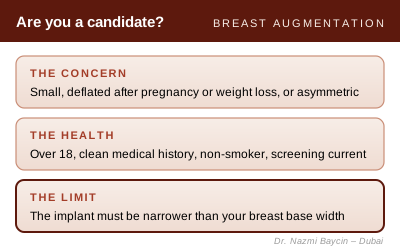 The best candidates are women in good general health, with a clean medical history free of systemic disease, whose breasts are fully developed and who want more volume, a fuller shape, or better symmetry. Most of the women who come to me either never had the volume they wanted or lost it after pregnancy, breastfeeding, or weight loss — though it is equally suited to women with a visible asymmetry between the two sides, and to those with a tuberous breast shape that an implant helps to correct. The scarless technique suits, in particular, women who want no scar on the breast, and women who plan to breastfeed in the future, since the gland is never cut.
A few specific conditions make for the safest, most satisfying result:
- a clean medical history, free of systemic disease such as heart disease
- good overall health and a stable weight
- over 18, with fully developed breasts
- realistic expectations, and an understanding that your breast base sets the size your anatomy can carry
- finished breastfeeding, ideally several months before surgery
- a non-smoker (or willing to stop well before surgery)
- no active breast disease, with age-appropriate screening up to date
- an understanding that implants are not lifetime devices
- a previous unsatisfactory augmentation is not a barrier — revision is possible
One honest note: there is no non-surgical way to add lasting breast volume — no exercise, cream, or supplement grows glandular tissue. But an implant has its own limit, too: its diameter must be smaller than your breast base width, so the size you can realistically carry is decided by your own anatomy, which I measure at consultation before any number is discussed.

Candidacy is decided by anatomy and health, not by the size a woman has in mind. Three concerns bring women to me: breasts that never developed the volume they hoped for, volume lost after pregnancy, breastfeeding, or weight loss, and a visible difference between the two sides — fewer than 10% of women are naturally symmetrical. An implant answers each: it supplies what was never there, restores what was lost, or, in differing sizes on each side, brings the two breasts into balance, as it has for 56 women in my series. Beneath that sit the conditions I check before any surgery is planned: a clean medical history, no smoking, no active breast disease with screening current, breastfeeding finished, realistic expectations, and an understanding that implants are not lifetime devices. And beneath everything sits the one limit no wish can override: the implant’s diameter must be smaller than the breast base width, which is why I measure the base, the nipple-to-fold distance under stretch, and the pinch thickness at consultation before any number is discussed.
What breast size can you realistically achieve?
Nobody has an endless capacity for breast size. Your capacity is set by your current breast size and the width of your breast base — in simple terms, the larger your existing breast, the more an implant has to work with. The size you have been dreaming of must therefore be something your anatomy can realistically carry.
The key technical rule is that the implant’s diameter should be smaller than your breast base width. If it is not, the edges of the implant can sit proud of the breast, becoming visible and even palpable. This is why the size you aspire to should be both realistic and technically possible — a judgment I make with you, not for you. It is also why the same implant gives different results in different women: a 250 cc implant that transforms a petite frame may barely register on a larger one. The right size is the one matched to your body, not to a number from an online forum. The measurements behind that judgement — base width, nipple-to-fold under stretch, and pinch thickness — are set out in my article on how implant size is measured rather than guessed.

The image highlights the importance of proper implant size selection, allowing you to observe variations in breast tissue response to different implant sizes used for breast augmentation.
What surgical techniques are used for breast augmentation?
The breast is made of milk glands and fat, with the pectoralis major and minor muscles lying between the ribs and the glandular tissue. An implant can be placed either between the gland and the muscle, or beneath the muscle against the ribs. The way the surgeon reaches that pocket — the incision — is what determines your scar, and it is the single most consequential choice in the operation. There are three established routes. What each route crosses, and what each one costs you, I compare in full in my article on where the scar goes, and what it records. Here is the short version.

Periareolar incision — placed at the areolar border.
Periareolar incision
A roughly 4 cm incision along the lower edge of the areola, with the pocket reached through the breast tissue. It heals to a subtle mark at the areolar border, and it is the only one of the three routes that passes an implant through the breast gland and its ducts.

Submammary incision — placed in the lower breast fold.
Submammary fold incision
A 4 cm incision placed in the natural fold beneath the breast, entering beneath the gland rather than through it. Its limitation is simple: the scar, however discreet, still sits on the breast.

Axillary incision — the scarless approach, hidden in the underarm.
Axillary incision
The incision follows the natural fold lines of the underarm, leaving no scar on the breast at all. Placed beneath the muscle, this approach also markedly lowers the risk of infection. Over time the underarm scar fades into the fold line and disappears. The breast gland stays completely intact — so breastfeeding and milk supply are preserved — and nipple sensation is very rarely affected. This is the approach I have built my practice on, and refined beyond the standard.
How does Dr. Baycin perform breast augmentation without scarring?
The standard transaxillary incision is about 4 to 5 cm. I have reduced mine to 2.5 to 4 cm by designing specialized instruments for implant insertion — and because the underarm fold and that short scar overlap, its visibility fades within six months and disappears entirely by a year. A smaller wound also means a quicker recovery with less discomfort. The photographs on this page show exactly this: an underarm at one year after surgery, with no scar on either side.

An implant can be placed between the gland and the muscle, or beneath the muscle against the ribs — but how the surgeon reaches that pocket is what determines the scar, and what is cut to get there. The periareolar incision, roughly 4 cm at the lower areolar border, is the only one of the three routes that passes an implant through the breast gland and its ducts. The submammary incision, also about 4 cm, enters beneath the gland rather than through it, but the scar still sits on the breast. The axillary route follows the natural fold lines of the underarm, leaving no scar on the breast at all; I perform it through 2.5 to 4 cm rather than the standard 4 to 5 cm, using instruments I designed for the approach. Because the gland is never cut, breastfeeding and milk supply are preserved and nipple sensation is very rarely affected — outcomes that incisions around the areola cannot reliably promise. In a series of more than 950 patients, 40 went on to become pregnant and 29 breastfed without any difficulty.
Is this the same as the Mia Femtech procedure?
My technique is technically similar to Mia Femtech, which is a simplified, heavily marketed version of transaxillary augmentation that has gained attention in Dubai — but the differences matter. Its own three-year study of 100 patients describes a procedure carried out with a set of proprietary single-use instruments and one specific implant, which rules out every other brand and every size that tool cannot accept. That system caps the implant at 195cc, whereas I am free to use an implant of any size your own tissue can carry. For a woman who wants a noticeable increase rather than a modest one, that constraint decides her result before the operation has begun.
That same study also records that the Mia procedure is performed without general anaesthesia and places the implant in front of the muscle — not beneath it, which is the position that gives the most natural appearance and the lowest complication risk. Because I perform essentially the same operation without the proprietary system, I am free to use any FDA-approved implant, in any size, placed exactly where your result calls for it. I set the two side by side, point by point, in my comparison of the branded system against the open transaxillary technique.

A 2.5–4 cm underarm incision is all that is needed.

Right underarm, one year post-surgery — no visible scar.

Left underarm, one year post-surgery — no visible scar.
Dr. Baycin’s transaxillary case series: 950+ patients

The picture was taken during the follow up of a patient who gave birth three months ago. The camera captured the milk drop coincidentally at the moment when coming out from the nipple.
Over twenty-five years I have performed transaxillary scarless breast augmentation on more than 950 patients. The outcomes of that series speak more clearly than any claim:
- No infections and no bleeding complications across the entire series.
- Capsular contracture in 13 patients (1.4%) within the first four months — all settled without further surgery, managed conservatively with a dedicated massage and follow-up program.
- Subtle, acceptable asymmetry in 43 patients (4.5%), none needing surgical correction.
- 56 patients with pre-existing breast asymmetry, balanced using implants of differing sizes.
- 40 patients went on to become pregnant; of these, 29 breastfed without any difficulty — direct evidence that the gland and ducts are preserved.
- One implant rupture, caused by a traffic accident, successfully removed and replaced.
These are my own consecutive results rather than a controlled comparison, and I offer them as what a refined transaxillary approach and meticulous technique have delivered in my hands.
| Outcome | Patients (n) | Rate | Notes |
|---|---|---|---|
| Surgical site infection | 0 | 0% | None across the entire series. |
| Bleeding complications | 0 | 0% | None across the entire series. |
| Capsular contracture | 13 | 1.4% | All within the first four months. Every case settled without further surgery, managed conservatively with a dedicated massage and follow-up program. |
| Subtle post-operative asymmetry | 43 | 4.5% | Within an acceptable range; none required surgical correction. |
| Implant rupture | 1 | 0.1% | Caused by a traffic accident. Successfully removed and replaced. |
| Pre-existing asymmetry corrected | 56 | 5.9% | Balanced using implants of differing sizes on each side. |
| Pregnancy after surgery | 40 | 4.2% | Followed up through pregnancy and delivery. |
| Breastfed without difficulty | 29 | 72.5% | Of the 40 patients who became pregnant — direct evidence that the gland and ducts are preserved. |
How to read this table. These are consecutive results from a single surgeon’s practice over twenty-five years, not a controlled comparison against another technique or another surgeon. Rates are calculated against the full series unless stated otherwise; the breastfeeding figure is calculated against the forty patients who became pregnant, not the whole series. No control group means these numbers describe what this approach has delivered in these hands, and should not be read as a general complication rate for breast augmentation.
In-depth reading: the techniques behind your result of breast augmentation in Dubai
Breast augmentation is a single operation built from a series of separate decisions — the route in, the pocket, the implant’s volume, shape, and profile, and how the result is protected afterward. Each of these articles takes one of those decisions further than a single page can:
- The art of the hidden underarm incision — how the implant is placed through the armpit, and why the route is technically demanding.
- Combining the underarm route with dual-plane placement — pairing hidden-incision access with a dual-plane pocket for natural coverage.
- How the dual plane balances implant, muscle, and gland — the biomechanics behind natural movement and long-term shape.
- The five implant planes, not three — subfascial and total submuscular, the two pockets most patients are never offered.
- How the plane you choose ages over time — why the pocket quietly determines how natural the result looks a decade later, not just on the day.
- Implant pocket control and long-term stability — the single biggest driver of a stable, long-lasting result isn’t the implant, it’s the pocket.
- Same volume, very different breast — how projection and base width change the outcome, so two implants of identical volume produce completely different shapes.
- Round versus teardrop, and the myth behind the choice — why the anatomical implant is not automatically the natural one, and what actually decides which suits you.
- When the breasts sit wide apart — how a broad sternal gap is planned for, and why chasing cleavage with a larger implant is the wrong instinct.
- Where the scar goes, and what it records — a comparison of every incision option and what each one costs you.
- Why patients travel from Saudi Arabia for a scar-free result — what draws women from Riyadh, Jeddah, and Khobar to Dubai.
Where does Dr. Baycin perform breast augmentation in Dubai?
I perform every breast augmentation in a top-tier, JCI-accredited hospital in Dubai that meets strict international standards of safety and hygiene. Your surgery takes place in a modern, fully equipped environment built for maximum safety and comfort — because the quality of the result is inseparable from the quality of the setting.
What is recovery after breast augmentation like?
You will not experience severe pain after the procedure. Although the surgery is performed under general anesthesia, I also infiltrate a long-acting local anesthetic directly into the surgical area, so the first day — usually when discomfort peaks — passes without pain. Any mild to moderate ache in the following days is easily managed with the pain medication and antibiotics I prescribe. Swelling and occasional bruising are normal and typically fade within ten days, and you can shower just two to three days after surgery.
Because I use absorbable, hidden sutures, there is nothing to remove. You will be mobile rather than bed-bound, and many patients return to work — or take a flight — within a few days. For the first two weeks you will wear a supportive garment; once the wound has healed at around fifteen days, you may swim. When the discomfort settles, usually ten to fifteen days in, you will begin a breast-massage routine, which I will teach you at your follow-up, to keep the implant pocket mobile as it heals.
To understand the full science behind how I support your healing after surgery, visit my advanced recovery protocol in Dubai article.
Download Dr. Baycin’s breast augmentation aftercare instructions
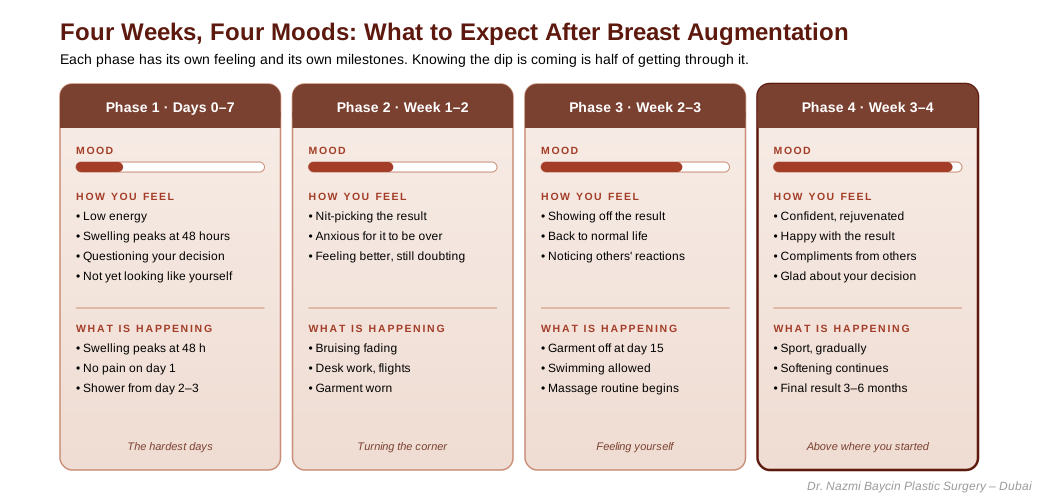
Recovery after breast augmentation runs on two tracks, and they are not in step. The body settles quickly: there is no pain on the first day because I infiltrate a long-acting local anesthetic, you shower at two to three days, most patients are back at a desk or on a flight by day four or five, the garment comes off and swimming begins at around day fifteen, and the breasts soften into their final shape over three to six months. Mood follows a different path. It dips in the first week — low energy, swelling at its peak at 48 hours, and a period of questioning the decision — turns the corner in the second week, feels like yourself by the third, and by the fourth sits above where it started. The pace varies with personality; the shape rarely does. Knowing the dip is coming is half of getting through it.
What are the risks and complications of breast augmentation?
Surgical risks such as infection and hematoma (a collection of blood) can be largely avoided with careful technique and the right medication. The complication most particular to breast implants is capsular contracture — a tightening of scar tissue that can form around the implant, usually within the first year. It arises from an individual’s healing response as well as factors inside the operating room. I set out what implant massage does and cannot do, and why I still teach it, in my article on the myth and the evidence behind implant massage; where contracture has already formed, my guide to treating established capsular contracture sets out the options honestly.
Minor asymmetry can also occur — and is worth keeping in perspective, since fewer than 10% of women have naturally symmetrical breasts to begin with. Where a patient already has a tuberous breast deformity or a pre-existing asymmetry, I correct as much as the anatomy allows, though some subtle asymmetry may remain; in my own series, 56 women with pre-existing asymmetry were balanced using implants of differing sizes.
If a previous augmentation has led to malposition, rippling, or asymmetry, my guide to revision procedures after augmentation explains how each failure is diagnosed and structurally repaired.
Checklist before having breast augmentation in Dubai
IMPORTANT ! Before getting the appointment, check your medical conditions.
| # | Conditions | Safety | Aesthetic Suitability |
|---|---|---|---|
| 1 | Are you over 18? | 🟢 Fit for surgery | — |
| 2 | Do you have underdeveloped breasts and wish for a larger breast size? | 🟢 Fit for surgery | 🟡 Ideal candidate |
| 3 | Do your breasts appear asymmetric and require correction? | 🟢 Fit for surgery | 🟡 Ideal candidate |
| 4 | Do you have a cardiovascular problem such as heart disease or deep vein thrombosis? | 🔴 Contraindicated | — |
| 5 | Do you have pulmonary system problems such as chronic lung disease? | 🔴 Contraindicated | — |
| 6 | Do you have chronic liver disease? | 🔴 Contraindicated | — |
| 7 | Do you have a urinary system disease such as kidney failure? | 🔴 Contraindicated | — |
| 8 | Do you have a hematologic problem such as anemia or coagulopathy? | 🔴 Contraindicated | — |
| 9 | Do you have any transmitting disease through blood such as HIV? | 🔴 Contraindicated | — |
| 10 | Have you been taking anticoagulant medication? | 🔴 Contraindicated | — |
| 11 | Have you been taking psychotropic drugs? | 🔴 Contraindicated | — |
| 12 | Any drug abuse or addiction | 🔴 Contraindicated | — |
Good general health · stable weight · realistic expectations and understanding of breast-capacity limits · non-smoker or willing to pause · no active breast disease (age-appropriate screening current) · understands implants are not lifetime devices.
How much does a breast augmentation cost in Dubai, UAE?
The costs of the breast augmentation in Dubai can really vary from one clinic to another. Generally, you can expect to pay anywhere from 25,000 AED ($6,800) to 60,000 AED ($16,400), depending on a few different factors.
These prices don’t reflect what Dr. Baycin charges specifically. You’ll get the exact figure during your consultation after he evaluates your situation.
For a complete overview of treatment fees, please refer to full price list of the procedures. If you are looking specifically for this procedure, you can also review pricing information.
Schedule your private consultation with Dr. BaycinWhat makes Dr. Baycin an exceptional breast augmentation surgeon in Dubai?
When women across Dubai and beyond seek breast augmentation, they are really seeking two things that rarely come together: visible enhancement and no visible trace of it. That is the standard my practice is built on.
- Clinical outcomes: the transaxillary scarless breast augmentation technique, leaving no scar on the breast — refined over 950+ cases with instruments I designed myself.
- Key safety highlights: zero infections or bleeding complications in over 950 cases; capsular contracture in only 1.4%, all resolved without surgery; preserved nipple sensation and breastfeeding ability.
- Surgical volume & experience: more than 25 years of practice and 7,000+ aesthetic procedures, including 950+ scarless breast augmentations.
- Innovation & leadership: a pioneer of scarless breast augmentation in Dubai, combining a minimally invasive route with reduced recovery time — and the only surgeon in Dubai offering this refined approach.
- Patient satisfaction & ethics: consistently praised for natural, symmetrical results, fast recovery, and personalized plans built around the patient’s goals — never upsold.
- Personalized consultations: clear, thorough discussion of options and realistic expectations, without pressure toward unnecessary procedures.
- Comprehensive aftercare: scheduled follow-ups, structured pain and wound-care protocols, and a guided massage program for pocket mobility and early detection.
- Global reputation: women from the UAE, the GCC, and worldwide choose Dr. Baycin for discreet, natural, high-quality care.
- Strict confidentiality: every consultation and procedure handled with complete privacy and discretion.
About Dr. Nazmi Baycin
Surgery, to me, is precision applied in service of restoration — a conviction that has guided every one of the more than 7,000 procedures I have performed over 25 years in practice. I am a DHA-licensed, board-certified plastic surgeon, trained in Turkey and based in Dubai since 2016. I operate exclusively within JCI-accredited hospitals, and hold international membership in the American Society of Plastic Surgeons (ASPS). Three techniques, in particular, have become signatures of my practice. Scarless breast augmentation, performed through a transaxillary approach that leaves no incision on the breast itself. Labiaplasty designed individually around each patient’s own anatomy, never to a standard template. And 3D customized facial bone implants, engineered through CT-based bespoke printing — a technique I currently offer as the only surgeon in Dubai providing it. My practice today spans facial rejuvenation, breast surgery, body contouring, and cosmetic genital procedures, drawing patients from across the UAE, Europe, and the wider GCC. Yet the principle guiding each of these specialties has never changed: to restore form is to restore function.
FAQs about breast augmentation in Dubai
-
What is breast augmentation?
Breast augmentation is how I enhance the size and shape of the breasts, most often using implants, to create a fuller, more balanced figure. Women come to me to increase their breast size, restore volume lost after pregnancy or weight change, or improve symmetry between the two sides. What distinguishes my approach is my signature scarless technique, which places the implant without leaving any scar on the breast itself. My aim is always a natural-looking, proportionate result tailored to your body.
-
How much does breast augmentation cost in Dubai?
Breast augmentation costs in Dubai vary from clinic to clinic and depend on several factors, ranging from AED 25,000 to AED 60,000, depending on the implant chosen and the details of your procedure. These are general market figures, not Dr. Baycin’s personal rates; the precise cost is confirmed at your consultation, once your goals and the right implant for you have been discussed.
-
What is the scarless (transaxillary) technique?
This is my signature approach, and it is what many women come to me for. Instead of making an incision on the breast, I place the implant through a small, hidden incision in the natural fold of the armpit, the transaxillary route. From there I create the pocket and position the implant precisely. The great advantage is that there is no scar on the breast at all, so the breast looks entirely natural and unoperated, with the only small scar concealed in the armpit crease.
-
Where is the scar with a scarless augmentation?
The only incision is a small one placed discreetly within the natural crease of the armpit, where it is well concealed and, once healed, very difficult to notice. Crucially, there is no incision and no scar anywhere on the breast itself, which is the whole point of the technique and why it is described as scarless. This is a particular advantage for women who want to be certain that nothing about their breasts reveals that a procedure has been performed.
-
What type and size of implant is right for me?
The right choice is always individual, and I guide you through it carefully at consultation. We consider implant type, such as modern cohesive silicone gel, along with size, shape, and profile, matching them to your frame, your existing tissue, and the natural look you want. Rather than simply fitting the largest possible implant, I focus on proportion and balance with your body, so the result enhances your figure naturally. Choosing well here is central to a beautiful, natural outcome.
-
Will my breasts look and feel natural?
A natural look and feel is my priority. By selecting an implant proportionate to your frame, positioning it precisely, and using the scarless technique so there is no scar on the breast, I aim for a result that looks and feels like a natural enhancement of your own body rather than an obvious one. Modern cohesive implants have a soft, natural feel, and careful placement ensures the breasts move and sit naturally. The goal is that your result simply looks like you, at your best.
-
Where is the implant placed, under or over the muscle?
In a dual plane, which I use in every augmentation I perform. The upper part of the implant sits beneath the chest muscle, giving a soft, natural upper slope and good coverage — particularly valuable for slimmer women with less natural tissue — while the lower part sits beneath the breast tissue, so the implant follows the breast’s natural shape and moves with it. Placing the implant entirely in front of the muscle gives less coverage and a higher risk of complications, which is why I do not do it. At consultation I explain how the dual plane will work with your own anatomy.
-
What is recovery after breast augmentation like?
Recovery is generally straightforward. You go home the same day or after one night, and most women return to desk work within a few days. You will feel tightness and some soreness in the first days, particularly where the implant sits under the muscle, and this eases steadily. I advise avoiding strenuous activity and heavy lifting for several weeks while everything settles, and wearing a supportive garment for the first two weeks.
-
What is capsular contracture?
It is worth understanding, as it is one of the specific considerations with any implant. The body naturally forms a soft capsule of tissue around an implant, which is normal. Occasionally this capsule tightens and firms, which is called capsular contracture and can affect the feel or shape of the breast. It is uncommon, and I minimize the risk through meticulous, sterile technique and careful implant handling and placement — the work that actually determines this is done in the operating room rather than afterward. Should it ever occur, it can be treated, and I discuss this fully with you beforehand.
-
Are breast implants permanent, and will I need them replaced?
Breast implants are long-lasting but are not necessarily lifelong devices. They do not have a fixed expiry date, and many women keep the same implants for a great many years without any issue. However, implants may eventually need replacing or revising at some point in the future, whether for a change in preference or, rarely, a problem. I discuss this honestly at consultation so you have realistic, long-term expectations from the outset, and I remain available for your follow-up care.
-
Are you a good candidate for breast augmentation?
You are likely a good candidate if you would like more breast volume, a fuller shape, or improved symmetry, your breasts are fully developed, and you are in good general health with realistic expectations. The scarless technique in particular suits women who want no scar on the breast. A clean medical history is the foundation of safe surgery. At consultation we discuss your goals, examine your anatomy, and choose the approach and implant that will give you the most natural result.
-
Can breast augmentation in Dubai be combined with other procedures?
Yes. Where the breasts are both smaller than you would like and a little sagging, augmentation can be combined with a breast lift to add volume and raise the breasts together. It is also often part of a broader plan, such as a mommy makeover with a tummy tuck. At consultation I assess your goals and overall health and recommend combining procedures only where it is safe and genuinely enhances your result.


GET APPOINTMENT
Get ready to look and feel best… You deserve…
