


Table of content
- Why do you have a double chin?
- Are you a good candidate for double chin removal?
- What are the double chin removal methods in Dubai?
- Can I see double chin removal before and after pictures?
- What is recovery after double chin removal like?
- What are the risks and complications of double chin removal?
- Checklist before having double chin treatment in Dubai, UAE
- How much does a double chin removal cost in Dubai?
- FAQs about double chin removal in Dubai
- Get appointment
A double chin is one of those features that can make a person look heavier or older than they are, and in the age of the selfie it is noticed more than ever. But here is the thing most people don’t realize: a double chin is not one problem with one solution. I am Dr. Nazmi Baycin, and my approach to double chin removal in Dubai begins not with a technique but with a diagnosis — because the fullness under the jaw can come from loose skin, excess fat, a sagging muscle, or even an under-projected chin bone, and each of those needs a different treatment.
Getting that diagnosis right is everything. Performing double chin removal in Dubai within JCI-accredited hospitals, I examine each patient carefully to identify exactly which tissue is responsible before I choose how to treat it — because removing fat will not fix a loose muscle, and tightening a muscle will not melt away fat. The principle is the one that guides all my work: to restore form is to restore function.
Double chin removal in Dubai quick facts
| Procedure detail | Double chin removal in Dubai |
|---|---|
| Treats | Fullness under the jaw from fat, muscle, skin, or bone |
| Methods | Neck liposuction, platysma tightening, neck lift, chin augmentation |
| Approach | Cause diagnosed first, then matched to method |
| Anesthesia | Usually local (± sedation; general for larger combined cases) |
| Procedure time | About 30 minutes to an hour, by method |
| Hospital stay | Day case — home about an hour after resting |
| Stitches | Hidden, dissolvable (none to remove) |
| Compression garment | About 1 week |
| Swelling / bruising | Settles within about a week |
| Final result | Settles over 1–3 months |
Why do you have a double chin?
The neck is built from skin, fat, muscle, and bone, and a fullness beneath the jaw can come from any one of them — which is precisely why an honest diagnosis matters before any treatment. There are four common causes:
- Loose skin. As we age, skin loses its elasticity and begins to sag, an effect that is often more pronounced in older and in thinner people. When skin laxity is the cause, a neck lift is usually what is needed.
- Excess fat. Fat accumulation is the most common reason of all — the area just beneath the jawbone is one of the first places to change when weight fluctuates.
- A loose platysma muscle. The platysma, the broad sheet of muscle across the neck, can slacken with age just like any other muscle, and a sagging platysma blunts the sharp angle between jaw and neck.
- An under-projected chin bone. Less commonly, an underdeveloped chin bone (micrognathia) provides too little skeletal support, allowing the soft tissue beneath to sag. Here, strengthening the chin’s projection can tighten the area.
Are you a good candidate for double chin removal?
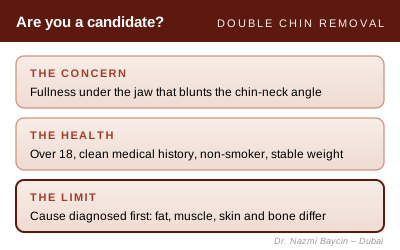 A clean medical history and good general health, free of systemic disease, are the foundation of safe double chin surgery — and the starting point of every assessment I make. Beyond that, if you have noticed soft-tissue fullness or sagging beneath your chin, whatever its cause, you may be a candidate; the right method simply depends on which tissue is responsible. Before your consultation, it helps to consider a few things:
- Whether your concern is mainly fullness (fat), looseness (skin or muscle), or a weak chin profile (bone).
- Your general health and any systemic conditions or medications.
- Whether your weight is stable, since significant fluctuation affects submental fat.
- That your expectations are realistic, and that a combination of methods may give the best result.
We will go through all of this together and arrive at the plan that genuinely fits your anatomy.
One distinction worth drawing early: this page is about fullness beneath the jaw. Where the roundness sits higher up, in the mid-cheek, the deep cheek fat pad is responsible and no amount of work on the neck will change it — that is treated by deep cheek fat reduction in Dubai, a different operation on a different fat compartment.
How does Dr. Baycin diagnose the cause before treating it?
This is the most important step, and the one I never rush. Because a double chin can come from skin, fat, muscle, or bone — and often from a combination — accurately identifying the source is what makes the difference between a good result and a disappointing one. If the problem is a loosened muscle, a fat-reduction procedure alone simply won’t address it; the approach has to match the cause. So I take the time to examine each patient thoroughly, working out exactly where the fullness is coming from. Once the diagnosis is clear, choosing the right method becomes straightforward — and that, more than any single technique, is the heart of good double chin surgery.
What are the double chin removal methods in Dubai?
There are several surgical and non-surgical ways to address submental fullness, and I match the method — or methods — to the tissue at fault.
Skin tightening (neck lift)
When excess, hanging skin below the jawline is the problem, the answer is to tighten it. A facelift — the traditional, non-endoscopic type — tightens the skin of the lower face and neck effectively, restoring a cleaner jaw and neck line where skin laxity is the cause.
Liposuction (for fat under the chin)
When fat is the culprit, liposuction is the go-to method, and the fat under the jaw can range from mild to severe. For moderate cases, lower face and neck liposuction is the right choice: both traditional and Vaser liposuction work well, and because the area beneath the chin is small, local anesthesia is usually enough, with no need for general. The procedure itself takes about thirty minutes, you can go home around an hour after resting, and you wear a compression garment for a week; some swelling and bruising are normal and settle within that week. One important nuance I always assess is whether the fat lies above or below the platysma muscle, and where the fat layer is thick, the choice between liposuction and en-bloc removal depends on its thickness. Where fat has been accompanied by loosening of the skin and muscle, additional tightening may be needed too.
Muscle tightening (platysma plication)
When the platysma muscle has loosened, I tighten it with a procedure called platysma plication, done under local anesthesia. Typically I make a small incision about three centimeters long, just behind the jawline, through which I pass the instruments; I then bring the left and right edges of the muscle together at the midline and stitch them, which tightens the muscle sheet and restores a sharper angle between jaw and neck. If there are any fat deposits, I deal with those at the same time. The whole procedure takes around thirty to forty minutes, you head home after resting for about an hour, and recovery is much like that of liposuction.
Bone support (chin augmentation)
When the jawbone is simply too small to support the soft tissue above it, the area needs more skeletal projection. Chin augmentation strengthens the chin’s projection and, in doing so, helps tighten the soft tissue beneath for a more defined jaw and neck line.
| Underlying cause | Matched treatment | What it does |
|---|---|---|
| Excess fat | Neck liposuction (traditional or Vaser) | Removes the fat, defining the chin-neck angle |
| Loose platysma muscle | Platysma plication (muscle tightening) | Sharpens the jaw-neck angle |
| Loose skin | Neck lift (facelift, non-endoscopic) | Tightens hanging skin under the jaw |
| Under-projected chin bone | Chin augmentation | Adds skeletal support to tighten soft tissue |
| Fat + muscle laxity (combined) | Liposuction and platysma tightening together — the most common, most effective combination | |
Can the methods be combined for the best result?
Very often, yes — and the two most popular methods for a double chin, liposuction and neck-muscle tightening, work beautifully together. Each does something distinct: liposuction targets and reduces the fat beneath the chin, defining the angle between chin and neck, while muscle tightening hones that angle even more precisely, though it does not itself reduce the thickness of the fat. Performed together, they address both the fat and the slackness at once, which is why a combination so often gives the cleanest, most lasting result. Achieving a striking improvement sometimes calls for exactly this kind of tailored mix.
Can I see double chin removal before and after pictures?
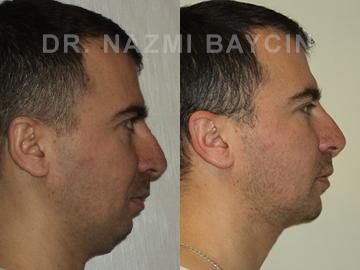

The before-and-after photographs here show how clean the improvement can be — a sharper jawline and a defined chin-neck angle. As you will see, the most striking results sometimes come from combining methods, matching each part of the treatment to each part of the problem.
Where does Dr. Baycin perform double chin removal in Dubai?
I perform every double chin procedure in a premium, JCI-accredited hospital in Dubai that meets top international standards for safety and cleanliness. Your treatment takes place in a modern, fully equipped medical environment, with expert care and patient safety the priority at every step.
What is recovery after double chin removal like?
Recovery from double chin surgery is quick and undemanding. Whichever method we use, you go home about an hour after a short rest — there is no need to stay overnight — and you can carry on with most of your daily life without much restriction. You will wear a compression garment for about a week, and it is normal to have some swelling and bruising over those first days, which fades within roughly a week. The final, settled result becomes clear gradually over the following one to three months as the tissues recover. To understand the full science behind how I support your healing after surgery, see my advanced recovery protocol in Dubai article.
Download Dr. Baycin’s double chin removal aftercare instructions
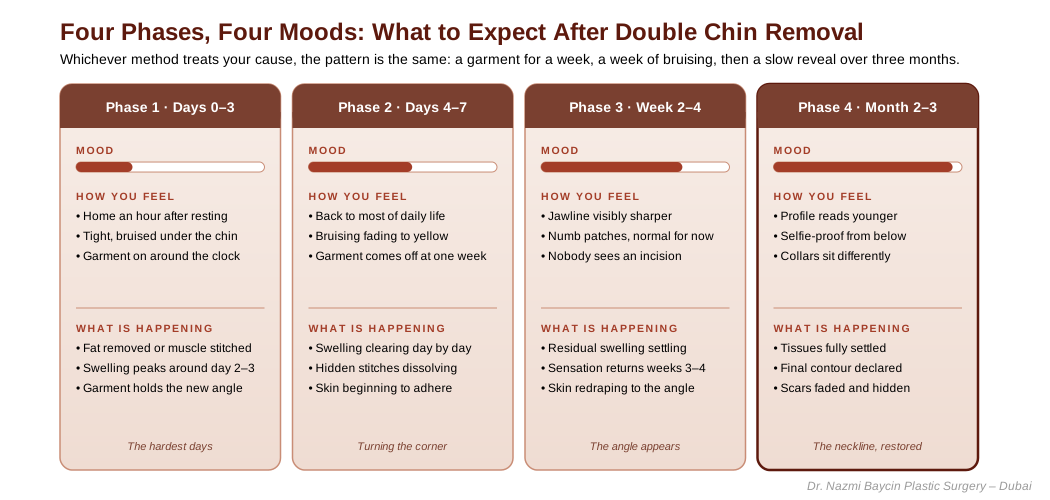
Whether I have treated your double chin with liposuction, a platysma tightening, or both, the recovery follows the same shape. You go home about an hour after resting, closed with hidden, dissolvable stitches, and you wear a compression garment for a week to hold the new angle while the tissues settle. The first three days are tight and bruised under the chin, with swelling peaking around day two or three. By the end of the first week the bruising has faded, the garment comes off, and most of daily life has resumed. Over weeks two to four the jawline sharpens visibly as the skin redrapes, and any numb patches recover their sensation. The final, settled contour declares itself over the following two to three months. The mood follows a step behind: disheartened in the garment, relieved when it comes off, quietly pleased in the mirror, and finally used to a profile that reads younger. The pace varies with personality; the shape rarely does.
What are the risks and complications of double chin removal?
All of the techniques I have described for double chin removal are, in experienced hands, very safe — but I believe in being honest about the risks even when they are small. Bleeding that pools within the wound (a hematoma) and infection are possible with any surgery, though both are usually prevented by careful surgical technique and antibiotics; a hematoma is rare after liposuction or a neck lift, and if one does occur the pooled blood is simply drawn off.
There is a very small chance — around 0.5% — of temporary nerve dysfunction during liposuction: in a series of 987 neck liposuctions, five patients had temporary marginal mandibular weakness. If it happens, it typically resolves on its own within a few weeks. You may also notice some altered sensation around the treated area; this is not a true complication and usually settles within three to four weeks. Where any complication does arise, it can be managed and treated effectively.
Checklist before having double chin removal in Dubai
IMPORTANT ! Before getting the appointment, check your medical conditions yourself.
| # | Conditions | Safety | Aesthetic Suitability |
|---|---|---|---|
| 1 | Are you over 18? | 🟢 Fit for surgery | — |
| 2 | Do you have excess fat or loose skin beneath your chin? | 🟢 Fit for surgery | 🟡 Ideal candidate |
| 3 | Would you like your jawline and neck to appear more defined and youthful? | 🟢 Fit for surgery | 🟡 Ideal candidate |
| 4 | Do you have a cardiovascular problem such as heart disease or deep vein thrombosis? | 🔴 Contraindicated | — |
| 5 | Do you have pulmonary system problems such as chronic lung disease? | 🔴 Contraindicated | — |
| 6 | Do you have chronic liver disease? | 🔴 Contraindicated | — |
| 7 | Do you have a urinary system disease such as kidney failure? | 🔴 Contraindicated | — |
| 8 | Do you have a hematologic problem such as anemia or coagulopathy? | 🔴 Contraindicated | — |
| 9 | Do you have any transmitting disease through blood such as HIV? | 🔴 Contraindicated | — |
| 10 | Have you been taking anticoagulant medication? | 🔴 Contraindicated | — |
| 11 | Have you been taking psychotropic drugs? | 🔴 Contraindicated | — |
| 12 | Any drug abuse or addiction | 🔴 Contraindicated | — |
How much does a double chin removal cost in Dubai, UAE?
The price of double chin surgery in Dubai can differ quite a bit depending on the clinic, usually falling between 10,000 AED (approximately $2,800) and 20,000 AED (around $5,500).
Keep in mind that these figures don’t represent Dr. Baycin’s rates; you’ll find out the precise cost during your consultation once he assesses your needs.
For a complete overview of treatment fees, please refer to full price list of the procedures. If you are looking specifically for this procedure, you can also review pricing information.
Schedule your private consultation with Dr. BaycinWhat makes Dr. Baycin an exceptional double chin removal surgeon in Dubai?
When patients look for the best double chin removal in Dubai, they are really after confidence, precision, and lasting results — and with more than 150 successful procedures, that is the standard Dr. Baycin holds.
- Decades of expertise, recognized worldwide: over 25 years of surgical experience, DHA-licensed and a member of the American Society of Plastic Surgeons (ASPS), drawing patients from Europe, the GCC, and beyond.
- A diagnosis-first approach: every double chin is examined to identify its true cause — fat, muscle, skin, or bone — so the treatment matches the problem rather than the other way around.
- A tailored plan for every patient: no two chins are alike; facial proportions and skin quality are analyzed to design a result of natural harmony.
- Specialized, minimally invasive techniques: advanced methods that reduce downtime and speed recovery, returning patients to daily life sooner without compromising safety or results.
- Safety as a standard: an impeccable record across a long career, with precision and patient care at the center of every procedure.
- Technology that enhances comfort: modern tools that minimize tissue trauma, scarring, and swelling, for an easier recovery.
- Transparent, honest consultations: every option explained, realistic expectations set, and no unnecessary interventions.
- Care beyond surgery: continuous guidance and personal follow-up through the whole of recovery.
- Proven results that inspire: 150+ double chin procedures celebrated for their natural finish and youthful contour.
- A surgeon who understands more than aesthetics: an empathetic approach that treats the change as an emotional one, not only a physical one.
About Dr. Nazmi Baycin
Surgery, to me, is precision applied in service of restoration — a conviction that has guided every one of the more than 7,000 procedures I have performed over 25 years in practice. I am a DHA-licensed, board-certified plastic surgeon, trained in Turkey and based in Dubai since 2016. I operate exclusively within JCI-accredited hospitals, and hold international membership in the American Society of Plastic Surgeons (ASPS). Three techniques, in particular, have become signatures of my practice. Scarless breast augmentation, performed through a transaxillary approach that leaves no incision on the breast itself. Labiaplasty designed individually around each patient’s own anatomy, never to a standard template. And 3D customized facial bone implants, engineered through CT-based bespoke printing — a technique I currently offer as the only surgeon in Dubai providing it. My practice today spans facial rejuvenation, breast surgery, body contouring, and cosmetic genital procedures, drawing patients from across the UAE, Europe, and the wider GCC. Yet the principle guiding each of these specialties has never changed: to restore form is to restore function.
FAQs about double chin removal in Dubai
-
What is double chin removal?
Double chin removal is how I treat fullness beneath the chin to create a sharper jawline and a sleeker profile. But it is not one problem with one solution, so my approach begins with a diagnosis rather than a technique. The fullness under the jaw can come from loose skin, excess fat, a sagging muscle, or an under-projected chin bone, and each needs a different treatment. I identify exactly which tissue is responsible before choosing how to treat it.
-
How much does double chin removal cost in Dubai?
The price of double chin surgery in Dubai can differ quite a bit depending on the clinic, usually falling between AED 10,000 and AED 20,000, depending on the method chosen, such as liposuction or muscle tightening. These figures are general market rates, not Dr. Baycin’s personal rates; you’ll find out the precise cost at your consultation, once your needs are assessed.
-
Why do you have a double chin?
The neck is built from skin, fat, muscle, and bone, and a fullness beneath the jaw can come from any one of them, which is precisely why an honest diagnosis matters. There are four common causes: loose skin that has lost its elasticity with age; excess fat, the most common cause of all; a loose platysma muscle that blunts the sharp jaw-neck angle; and, less often, an under-projected chin bone providing too little skeletal support for the soft tissue above.
-
How do you diagnose the cause before treating it?
This is the most important step, and the one I never rush. Because a double chin can come from skin, fat, muscle, or bone, and often a combination, accurately identifying the source is what makes the difference between a good result and a disappointing one. If the problem is a loosened muscle, a fat-reduction procedure alone simply won’t address it. So I examine each patient thoroughly to work out exactly where the fullness comes from, and once the diagnosis is clear, choosing the right method becomes straightforward.
-
What are the double chin removal methods in Dubai?
I match the method to the tissue at fault. For excess fat, I use neck liposuction, traditional or Vaser, usually under local anesthesia. For a loose platysma muscle, I perform platysma plication, bringing the muscle edges together at the midline to restore a sharper jaw-neck angle. For hanging skin, a neck lift tightens it. And where the chin bone is under-projected, chin augmentation adds the skeletal support needed.
-
Are you a good candidate for double chin removal?
If you have noticed soft-tissue fullness or sagging beneath your chin, whatever its cause, you may well be a candidate; the right method simply depends on which tissue is responsible. A clean medical history and good general health, free of systemic disease, are the foundation of safe surgery and my starting point. It also helps if your weight is stable, since significant fluctuation affects submental fat, and if you understand that a combination of methods may give the best result.
-
Can the methods be combined for the best result?
Very often, yes, and the two most popular methods, liposuction and neck-muscle tightening, work beautifully together. Each does something distinct: liposuction targets and reduces the fat beneath the chin, defining the angle between chin and neck, while muscle tightening hones that angle even more precisely, though it does not itself reduce the thickness of the fat. Performed together, they address both the fat and the slackness at once, which is why a combination so often gives the cleanest, most lasting result.
-
What is recovery after double chin removal like?
Recovery is quick and undemanding. Whichever method I use, you go home about an hour after a short rest, with no need to stay overnight, and you can carry on with most of your daily life without much restriction. You’ll wear a compression garment for about a week, and it is normal to have some swelling and bruising over the first days, which fades within roughly a week. The final, settled result becomes clear gradually over the following one to three months.
-
Is double chin removal in Dubai safe?
Yes, in experienced hands all the techniques I use are very safe, but I believe in being honest about the risks even when small. Bleeding within the wound and infection are possible with any surgery, though both are usually prevented by careful technique and antibiotics. There is a very small chance, around 0.5%, of temporary nerve dysfunction during liposuction, which typically resolves on its own within a few weeks, and any altered sensation usually settles within three to four weeks.
-
Will there be visible scars after double chin removal?
Scarring is minimal. For liposuction, the incisions beneath the chin are tiny and discreet, and for muscle tightening I place the small incision behind the jawline where it is hidden. I always close with hidden, dissolvable stitches, so there is nothing to remove later. Because the treated area and incisions are so small, and placed thoughtfully, any marks settle and fade to become very difficult to notice once you have healed.
-
How long does the double chin removal procedure take?
It usually takes about thirty minutes to an hour, depending on the method. Neck liposuction takes around thirty minutes, and platysma muscle tightening around thirty to forty minutes, with any fat deposits dealt with at the same time. If methods are combined, or a neck-lift technique is used, it takes a little longer. In every case it is a day procedure, so you rest briefly and then head home about an hour afterward.
-
Can double chin removal in Dubai be combined with other procedures?
Yes. Double chin removal pairs naturally with a facelift or neck lift, with liposuction, or with chin augmentation for a more defined facial contour in a single recovery. Because I diagnose the cause first, combining methods is often exactly what the anatomy calls for, matching each part of the treatment to each part of the problem for the cleanest overall result.


GET APPOINTMENT
Get ready to look and feel best… You deserve…
