


Table of content
- What can rhinoplasty in Dubai do for you?
- Are you a good candidate for rhinoplasty?
- Rhinoplasty before and after pictures
- How will I perform your surgery?
- How is the recovery period after rhinoplasty?
- What are the risks and complications of rhinoplasty?
- Checklist before having surgery
- How much does a rhinoplasty cost in Dubai, UAE?
- Get appointment
The nose sits at the center of the face, so a single millimeter decides whether a result looks natural or operated — and rhinoplasty is, for that reason, the most demanding operation in aesthetic surgery. I am Dr. Nazmi Baycin, and rhinoplasty is the procedure I am known for: more than six hundred noses, a revision rate under ten percent, and not a single secondary rhinoplasty needed in my career. My rhinoplasty in Dubai is not about imposing a “perfect” nose, but about designing the one nose that belongs to your face — in harmony with your chin, lips, brow, and eyes, and true to your own character.
That precision is something I have spent a career refining — to the point of contributing my own technique to the world plastic-surgery literature. Performing rhinoplasty in Dubai within JCI-accredited hospitals, I plan every nose with computerized imaging, respect the differences between a masculine and a feminine nose, and use methods that protect the airway and the supporting tissues rather than simply cutting them away. The principle is the one that guides all my work: to restore form is to restore function.
Rhinoplasty in Dubai quick facts
| Procedure detail | Rhinoplasty (cosmetic nose surgery) in Dubai |
|---|---|
| Technique | Customized; open or closed; preservation where suitable |
| Signature detail | Own-tissue grafts; bones reshaped without breaking |
| Anesthesia | General |
| Procedure time | About 2–3 hours (longer for complex/revision) |
| Hospital stay | Day case or one night |
| Splint | Removed on day 7; nasal pack out in 1–2 days |
| Scars | None visible |
| Bruising | Usually mild; fades in ~5 days |
| Downtime | 5–7 days |
| Final shape | Emerges over ~6 months |
| Revision rate | Under 10% (no secondary rhinoplasty to date) |
What can rhinoplasty in Dubai do for you?
Rhinoplasty — a nose job — reshapes the nose to address both how it looks and how it works, and for many patients it is genuinely life-changing. It corrects primary deformities a person is born with, such as a bulbous tip, a dorsal hump, or an overly wide nose; restores a nose made misshapen or asymmetric by trauma; and rebuilds a saddle-nose deformity where the bridge has collapsed, or straightens a crooked nose, restoring both symmetry and function. Where breathing is the problem, structural issues such as a deviated septum or narrow nasal passages can be corrected at the same time — a functional septoplasty combined with rhinoplasty that improves airflow and quality of life along with appearance.
It also handles the more complex cases: a secondary rhinoplasty to refine a primary result that fell short, and a revision rhinoplasty to correct complications or unsatisfactory outcomes from previous surgery — the most demanding work of all, requiring advanced skill and judgment.
Are you a good candidate for rhinoplasty?
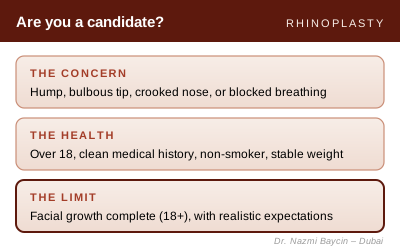
For your safety and a result you will be happy with, a few conditions matter. You should be in good general health and free of systemic disease such as heart disease, in sound mental health with realistic, reasonable expectations, and — importantly for the nose — old enough that facial growth is complete, which means at least eighteen. A clean medical history and completed personal development are the foundation of safe surgery, and the starting point of every assessment I make. Beyond that, if some feature of your nose troubles you — its size, a hump, the tip, its symmetry, or your breathing — you are likely a good candidate, and we will discuss honestly what surgery can achieve for you.
How does Dr. Baycin design your new nose?
Every nose is designed before it is operated. Using computerized imaging, I plan the shape that will suit you and show you the likely before-and-after, so we agree the goal together before surgery. The guiding rule is harmony: your nose should balance with your chin, forehead, brow, eyes, and lips, and its own parts — bridge, tip, nostrils — should be in proportion with one another. The aim is never a nose that draws attention, but one that lets the rest of your face come forward.
Why gender characteristics shape the design

First image shows a nose before the procedure. Second image shows a rhinoplasty design for male patients. Third image shows a rhinoplasty design for female patients.
A natural nose also reflects the patient’s gender, and this is something many surgeons overlook. The angle between the nose and the upper lip differs between men and women: a 90°–100° angle suits a man, while 100°-110° suits a woman. Push a man’s angle wider than 100° and the nose begins to look feminine; take a woman’s beyond 110° and the nostrils start to look upturned and unnatural. Respecting these differences is part of what makes a result look right rather than merely “done,” and it is built into every design I plan.
Can I see rhinoplasty before and after pictures?
Every nose I create comes from careful surgical planning that respects facial harmony and gender characteristics, and the before-and-after photographs here show that across a range of cases. Patients sometimes ask whether their facial expression will change after rhinoplasty; the honest answer is that even a small change to the nose can subtly shift how the whole face reads — but any change I design is planned to enhance your expression, never to diminish it.


How does Dr. Baycin perform rhinoplasty?
Because every nose and every problem is unique, I design each rhinoplasty individually — your nose may need reduction in one area, augmentation in another, or correction of asymmetry — always working toward a shape that suits the rest of your face.

Nasal bone, cartilages and septum that I reshape during the procedure
Refining the nasal tip (the 5 mm rule)
The most common tip problems are a droopy tip and a bulbous tip. To refine the tip I trim the upper half of the lower lateral cartilage, but I always leave at least a 5 mm strip of cartilage intact — that minimum strip is essential to support the nasal wing and prevent it collapsing when you breathe in. With that support preserved, I can then shape the tip as the design requires: narrowing it, lifting it, or extending it. That 5 mm minimum is one instance of a broader principle — that an operated-looking nose is almost always one stripped of its support — which I set out in full in my article on why some rhinoplasty results look unnatural.
Using your own tissue as a graft
Some noses need extra support to correct their shape or to fill a depressed area — and often the same nose has redundant tissue elsewhere that needs removing. Rather than discard that tissue, I use it: placed as a graft exactly where fullness is needed, your own tissue rebuilds the nose in a way that is perfectly compatible with your body. This is one of the quiet tricks of good rhinoplasty, and it is a technique I have published in the world plastic surgery literature — you can read my paper on bone chips and diced cartilage as an anatomically adopted graft for the nasal dorsum, drawn from sixty-seven cases with durable results over seven years.
How is the bony hump removed?
When a nasal hump needs removing, removing it also tends to improve the upper-lip angle as a welcome by-product. I remove and reshape the hump using the right tool for the case — a chisel, or an oscillating micro-saw. Where the case suits it, I favor a tissue-sparing, structure-preserving approach; you can read the philosophy behind it in my preservation rhinoplasty in Dubai article. A particular advantage of my method is that I reshape the nasal bones without breaking them, which keeps swelling and bruising to a minimum.
Open vs. closed rhinoplasty: does it matter?
There are two main techniques for cosmetic nose surgery — closed rhinoplasty and open rhinoplasty. Some surgeons are more confident with one, some with the other; in truth it is largely a matter of the individual surgeon’s preference and confidence, and a skilled surgeon achieves excellent, scar-free results with either. What matters far more than the access is the judgment and technique applied through it.
| Factor | Open rhinoplasty | Closed rhinoplasty |
|---|---|---|
| Access | Incisions inside plus a tiny one across the columella | All incisions hidden inside the nostrils |
| Best suited to | Complex reshaping, revision, major tip work | More limited, well-defined changes |
| Visible scar | A tiny columellar scar that fades to near-invisible | None — entirely internal |
| Bottom line | Largely the surgeon’s preference; an experienced surgeon achieves excellent, natural, scar-free results with either. | |
What about secondary and revision rhinoplasty?
If you are unhappy with a previous nose job, the first person to return to is the surgeon who performed it — they know what was done and will almost always want to help, since no surgeon sets out for a disappointing result. If you cannot reach an understanding with your original surgeon, then it is reasonable to seek another. Minor deformities can often be corrected with a touch-up revision rhinoplasty, sometimes even under local anesthesia. I hold this work to a high standard: fewer than 10% of my patients have needed a revision, and in my career so far not one has required a full secondary rhinoplasty.
In-depth reading: the technique and aesthetics behind rhinoplasty in Dubai
Explore the specific techniques and planning principles behind a natural, functional nose — each article goes deeper into one part of nasal surgery than a single page can:
- The open rhinoplasty approach versus closed techniques — why direct visualization through a columellar incision aids precision, and how it compares with the endonasal closed method.
- Rebuilding the nose with your own cartilage in secondary rhinoplasty — how a collapsed, previously operated framework is reconstructed with autologous septal, ear, and rib cartilage.
- Restoring breathing and shape together after a previous nose surgery — why the aesthetic framework and the airway are one system: spreader grafts re-open the internal valve and tip grafts support the external valve, so the structure that shapes the nose is the same one that holds it open.
- Nasal tip grafts and how the tip is refined — the graft types and suture strategies that define tip projection, rotation, and support.
- Ethnic rhinoplasty planning and preserving nasal identity — how aesthetic goals are balanced against the features that keep a nose true to a patient’s heritage.
- Lateral osteotomy techniques for the bony vault — the controlled fracturing that narrows and straightens the nasal pyramid with minimal bruising.
- Correcting a deviated septum when breathing is the only concern — the purely functional operation for patients who want easier airflow and no change to how the nose looks.
Where does Dr. Baycin perform rhinoplasty in Dubai?
I perform every rhinoplasty in a world-class, JCI-accredited hospital in Dubai that meets the highest international standards for safety, hygiene, and surgical care. Your procedure takes place in a fully equipped, modern surgical environment built for the precision and comfort this delicate operation demands.
What is recovery after rhinoplasty like?
If you feel well enough, you can go home the same day; if you would rather rest, an overnight stay is perfectly fine. At the end of surgery I place a plastic splint to hold the new shape, with a light pack inside the nose. Because I reshape the nasal bones without breaking them, the swelling and bruising around the eyes are usually mild. An ice pack over the eyes through the first day helps further, and a little light bleeding from the nostrils in the first days is normal. Any pain is mild, lasting a day or two and easily managed with the medication I prescribe. I remove the nasal pack within one to two days and the splint on the seventh day. Bruising usually fades within about five days and most of the swelling settles in the first week, after which the shape begins to emerge — though it takes at least six months for the last swelling to resolve, the skin to soften, and the true, final shape to appear.
To understand the full science behind how I support your healing after surgery, see my advanced recovery protocol in Dubai article.

Here is the before & after picture of the patient with a severe crooked nose deformity. The next day after having the surgery, see the vague swelling and bruising around the eyes.
Tips to care for your nose after surgery
A few simple measures protect your result while it heals:
- Use an ice pack over the eyes at 10–15 minute intervals through the first day to reduce swelling and bruising.
- If you smoke, avoid smoking for at least a week after surgery.
- Expect light blood oozing from the nostrils for a day or two; gently clean around and inside the nostrils with wet wipes or damp cotton swabs.
- Shower with warm — not hot — water after two days, since hot water dilates vessels and can cause bleeding.
- After I remove the splint on day seven, massage the nose as I show you; it both reduces swelling and helps the skin settle.
- Because the bone has been reshaped, protect your nose from any knock or trauma for three months, as even a minor impact could distort it.
- Avoid wearing eyeglasses for a couple of months — their pressure can deform the healing nose — and use contact lenses instead.
- The nasal skin is more sensitive to the sun after surgery, so use sun protection for a couple of months.
Download Dr. Baycin’s rhinoplasty aftercare instructions
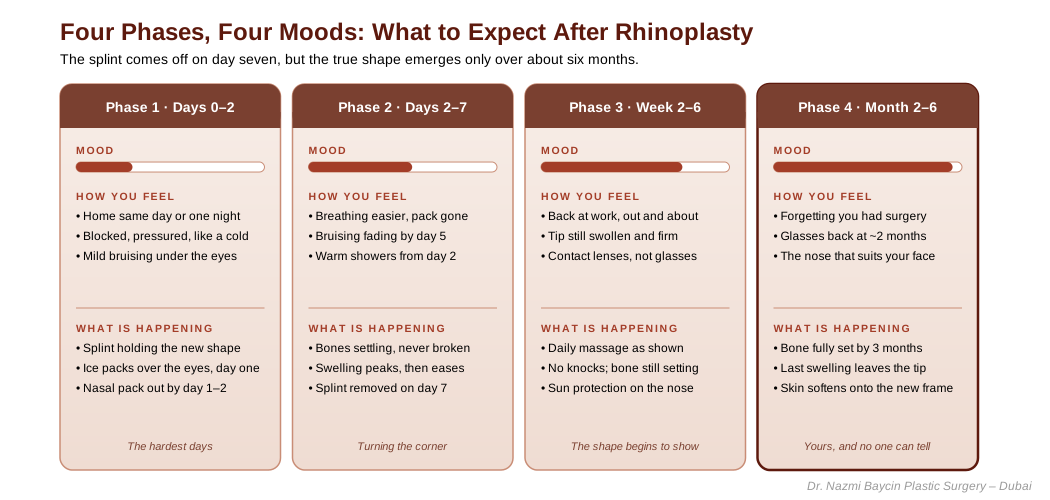
Rhinoplasty recovery is front-loaded: the inconvenience is over in a week, the result takes six months. You go home the same day or after one night, with a splint holding the new shape and a light pack inside the nose. Because the nasal bones are reshaped without breaking, bruising is mild and fades within about five days; the pack comes out within a day or two, and I remove the splint on day seven. From then on the work is protection and patience: daily massage as I show you, no knocks to the nose for three months while the bone sets, contact lenses instead of glasses for a couple of months, and sun protection on the healing skin. The tip stays swollen and firm for longest, and the last swelling leaves at around six months, when the skin has softened onto the new framework. The mood follows: congested and bruised, then relieved, then impatient with the tip, then simply at home with a nose that suits the face. The pace varies with personality; the shape rarely does.
What are the risks and complications of rhinoplasty?
Rhinoplasty is unusual among operations in that its complication rate depends overwhelmingly on the surgeon’s experience: across the profession, reported rates range from around 5% in the best hands to as high as 50% — which is precisely why the choice of surgeon matters more here than in almost any other procedure. There is no single “standard” complication figure in the literature for this reason. The most relevant measure is the need for revision or secondary surgery, which by world standards runs at 5-10%; in my own practice it has stayed under ten percent, with no secondary rhinoplasty ever required.
Beyond that, small imperfections from wound healing, cartilage memory, or individual skin characteristics can occasionally arise and are not fully within any surgeon’s control. My honest advice is not to dwell on tiny flaws that do not affect the overall look: a nose examined for hours in the mirror will always yield some imperfection, but the measure of a good result is the harmony of the whole. Where a genuine issue does arise, it can be managed and corrected.
Checklist before having rhinoplasty in Dubai
IMPORTANT ! Before getting the appointment, check your medical conditions yourself.
| # | Conditions | Safety | Aesthetic Suitability |
|---|---|---|---|
| 1 | Are you over 18? | 🟢 Fit for surgery | — |
| 2 | Do you have an obvious nasal deformity or aesthetic concern? | 🟢 Fit for surgery | 🟡 Ideal candidate |
| 3 | Do you have realistic expectations regarding nasal appearance and function? | 🟢 Fit for surgery | 🟡 Ideal candidate |
| 4 | Do you have a cardiovascular problem such as heart disease or deep vein thrombosis? | 🔴 Contraindicated | — |
| 5 | Do you have pulmonary system problems such as chronic lung disease? | 🔴 Contraindicated | — |
| 6 | Do you have chronic liver disease? | 🔴 Contraindicated | — |
| 7 | Do you have a urinary system disease such as kidney failure? | 🔴 Contraindicated | — |
| 8 | Do you have a hematologic problem such as anemia or coagulopathy? | 🔴 Contraindicated | — |
| 9 | Do you have any transmitting disease through blood such as HIV? | 🔴 Contraindicated | — |
| 10 | Have you been taking anticoagulant medication? | 🔴 Contraindicated | — |
| 11 | Have you been taking psychotropic drugs? | 🔴 Contraindicated | — |
| 12 | Any drug abuse or addiction | 🔴 Contraindicated | — |
How much does a rhinoplasty cost in Dubai, UAE?
Rhinoplasty costs in Dubai vary from clinic to clinic and depend on several factors, ranging between 20,000 ($5,500) and 50,000 AED ($13,600).
Please note that these costs do not reflect Dr. Baycin’s personal pricing; you will be informed of the exact price during the consultation, after your condition is assessed.
For a complete overview of treatment fees, please refer to full price list of the procedures. If you are looking specifically for this procedure, you can also review pricing information.
Schedule your private consultation with Dr. BaycinWhat makes Dr. Baycin an exceptional rhinoplasty surgeon in Dubai?
In rhinoplasty, patients seek more than a change of appearance — they seek harmony, balance, and renewed confidence — and with more than 600 successful nose surgeries, that is the standard Dr. Baycin holds.
- A published rhinoplasty author: beyond 25+ years as a board-certified plastic surgeon — DHA-licensed and an ASPS member — Dr. Baycin has contributed his own dorsal-graft technique to the world plastic-surgery literature, a rare mark of genuine expertise.
- Personalized for every face: no two noses, or faces, are alike; every plan is tailored to the patient’s facial structure, background, and goals for a natural, balanced, unique result.
- Pioneering, tissue-preserving techniques: from structural to preservation rhinoplasty, advanced approaches that shape the nose precisely while protecting the airway and supporting tissues — and shorten recovery.
- Bone reshaping without breaking: a method that minimizes swelling, bruising, and downtime.
- An exceptional safety record: thousands of aesthetic procedures with zero major complications, a revision rate under 10%, and no secondary rhinoplasty ever needed.
- Honest, transparent consultations: expectations, options, and realistic outcomes discussed openly, with computerized imaging so you see the plan before you decide.
- Dedicated post-operative care: structured follow-up, direct surgeon access, and continuous support through recovery.
- A global name in rhinoplasty: patients travel from across Europe, the Middle East, and beyond for his results.
- Results that transform: 600+ nose surgeries celebrated for their elegance, balance, and artistic precision.
- Where art meets compassion: an empathetic understanding of how much a nose means to the face — and to confidence.
About Dr. Nazmi Baycin
Surgery, to me, is precision applied in service of restoration — a conviction that has guided every one of the more than 7,000 procedures I have performed over 25 years in practice. I am a DHA-licensed, board-certified plastic surgeon, trained in Turkey and based in Dubai since 2016. I operate exclusively within JCI-accredited hospitals, and hold international membership in the American Society of Plastic Surgeons (ASPS). Three techniques, in particular, have become signatures of my practice. Scarless breast augmentation, performed through a transaxillary approach that leaves no incision on the breast itself. Labiaplasty designed individually around each patient’s own anatomy, never to a standard template. And 3D customized facial bone implants, engineered through CT-based bespoke printing — a technique I currently offer as the only surgeon in Dubai providing it. My practice today spans facial rejuvenation, breast surgery, body contouring, and cosmetic genital procedures, drawing patients from across the UAE, Europe, and the wider GCC. Yet the principle guiding each of these specialties has never changed: to restore form is to restore function.
FAQs about rhinoplasty in Dubai
-
What is rhinoplasty?
Rhinoplasty, or cosmetic nose surgery, is how I reshape the nose to bring it into natural harmony with the rest of the face, while protecting and often improving how you breathe. It can refine the bridge, the tip, the width, or the overall proportion of the nose. As someone who has published on nasal surgery, my guiding principle is a natural, unoperated result that suits your face, never a generic or overdone nose, and I treat the airway as being just as important as the appearance.
-
How much does rhinoplasty cost in Dubai?
Rhinoplasty costs in Dubai vary from clinic to clinic and depend on several factors, ranging between AED 20,000 and AED 50,000. These are general market figures, not Dr. Baycin’s personal rates; the precise cost is confirmed at your consultation, once your nose and your goals have been assessed.
-
What is the difference between open and closed rhinoplasty?
These are the two approaches I use, and I select between them based on your nose and your goals. In closed rhinoplasty, all the incisions are hidden inside the nostrils, so there is no external scar at all, which suits more straightforward refinements. In open rhinoplasty, I add a tiny incision across the columella, the strip of skin between the nostrils, which gives me fuller visibility and control for more complex reshaping. That small scar heals to become very difficult to see.
-
Will rhinoplasty preserve my breathing?
Yes, and this is fundamental to how I operate. A beautiful nose that does not breathe well is a failure, so I treat the airway as being every bit as important as the appearance. I preserve and, where needed, improve the internal structures that govern airflow, and I can correct functional problems such as a deviated septum blocking your breathing at the same time. Many patients find they both look better and breathe better afterward, because form and function are addressed together.
-
Will my nose look natural, or obviously done?
Natural is the entire point. My aim is a nose that looks as though you were born with it, in balance with your other features, rather than a generic, over-refined, or obviously operated result. I tailor the shape to your face and, importantly, to your gender, since a naturally masculine and a naturally feminine nose differ in ways that matter. A nose that suits you and draws no attention to itself is, to me, the mark of a successful rhinoplasty.
-
Do you tailor rhinoplasty to gender?
Yes, and it makes a real difference to a natural result. A feminine nose typically has a softer profile and a subtle, delicate refinement, while a masculine nose keeps a straighter, stronger bridge and more definition. Applying one template to every face is exactly how noses come to look artificial. So I plan each rhinoplasty around what looks naturally right for you, respecting the features that make a nose read as harmonious for your face rather than imposing a fixed ideal.
-
What does your revision rate mean for me?
Rhinoplasty is one of the most technically demanding operations in all of plastic surgery, and revision rates across the field are often quoted as high as fifteen percent or more. Across more than six hundred noses, my own revision rate is under ten percent, which reflects careful planning and precise technique. For you, it means a higher likelihood of achieving the result you want the first time, though I always discuss honestly that no surgeon can guarantee a nose will never need refinement.
-
Can rhinoplasty in Dubai be combined with chin surgery (profiloplasty)?
Yes, and it is one of my favorite combinations because the profile is read as a whole. Balancing the nose and chin together is called profiloplasty, and pairing rhinoplasty with chin augmentation often transforms a side profile far more than treating either feature alone. A prominent nose with a weak chin, for instance, settles beautifully when both are addressed. At consultation I assess your whole profile, not just the nose, so the result is balanced from every angle.
-
What is recovery after rhinoplasty like?
Recovery is steadier than many expect. You wear a small splint on the nose for about a week, and bruising and swelling around the eyes and nose are normal in the first one to two weeks, easing so that most people feel socially comfortable at around two weeks. The nose then refines gradually over a longer period: the finer details of the tip continue to settle over many months, with the final result emerging over about a year as the last swelling resolves.
-
Is rhinoplasty painful?
Most people are pleasantly surprised by how little pain there is. Rhinoplasty is performed under general anesthesia, so you feel nothing during surgery, and afterward the sensation is usually more one of congestion and pressure, like a heavy cold, than of real pain. Simple pain relief manages any discomfort easily. The splint and the blocked-nose feeling in the first week are the main nuisances, and both ease quickly as the early swelling settles.
-
Is rhinoplasty in Dubai safe, and what are the risks?
In experienced hands rhinoplasty is safe, but it is technically demanding, which is exactly why surgeon experience matters so much here. Alongside the general risks of surgery, such as bleeding or infection, the specific considerations are breathing changes, minor asymmetry, or the possible need for a small revision, which is why my sub-ten-percent revision rate is meaningful. Good general health and a clean medical history support a safe procedure, and I discuss every relevant risk fully and honestly at consultation.
-
Are you a good candidate for rhinoplasty?
You are likely a good candidate if you would like to change the shape, size, or proportion of your nose, or correct breathing difficulty, and you are in good general health with realistic expectations. It is best for the nose to be fully grown, which is generally the case in later teenage years and beyond. A clean medical history is the foundation of safe surgery. Above all, a good outcome starts with a clear, honest conversation about what will suit your face.


GET APPOINTMENT
Get ready to look and feel best… You deserve…
