

Key takeaways: restraint defines the result
- Success depends on how much is preserved, not how much is removed.
- Over-resection is the single most common and most damaging mistake.
- Blood supply, nerves, and the natural edge must all be respected.
- The natural edge — its texture, pigment, and slight irregularity — is what keeps a result from looking operated.
- Function matters as much as appearance — comfort is a core goal.
- A good result should look natural, not operated, and age gracefully.
Women seek labia reduction in Dubai for a combination of functional discomfort and aesthetic concern, and both deserve a surgical approach built on precision, restraint, and experience rather than a standardized or aggressive technique that ignores individual anatomy. The procedure is as much reconstructive as it is aesthetic, and it should prioritize function just as much as appearance. A 2015 systematic review of nineteen studies covering 1,949 labiaplasty patients proposed a classification of labial protrusion in three measured classes — up to 2 cm, 2 to 4 cm, and beyond 4 cm — with modifiers for asymmetry and for involvement of the clitoral hood. It is a reminder that what is being reduced differs in degree and in kind from one woman to the next, and that the description has to be specific before the technique can be.
Why labia reduction demands advanced surgical judgment
The labia minora are not uniform structures, and in a diverse patient population in Dubai that variation is especially pronounced. Their thickness, length, pigmentation, and vascularity vary significantly from patient to patient, and often from one side to the other in the same patient. Treating the operation as a simple trimming exercise is one of the most common and damaging mistakes an inexperienced surgeon can make. Poor judgment can lead to a series of avoidable problems: over-resection, visible scarring, asymmetry, chronic dryness or irritation, and loss of the natural contour. True expertise lies in knowing how much not to remove, and in recognizing where preservation matters more than reduction. The aim is a balanced, natural appearance that supports both comfort and confidence — never a standardized surgical look.
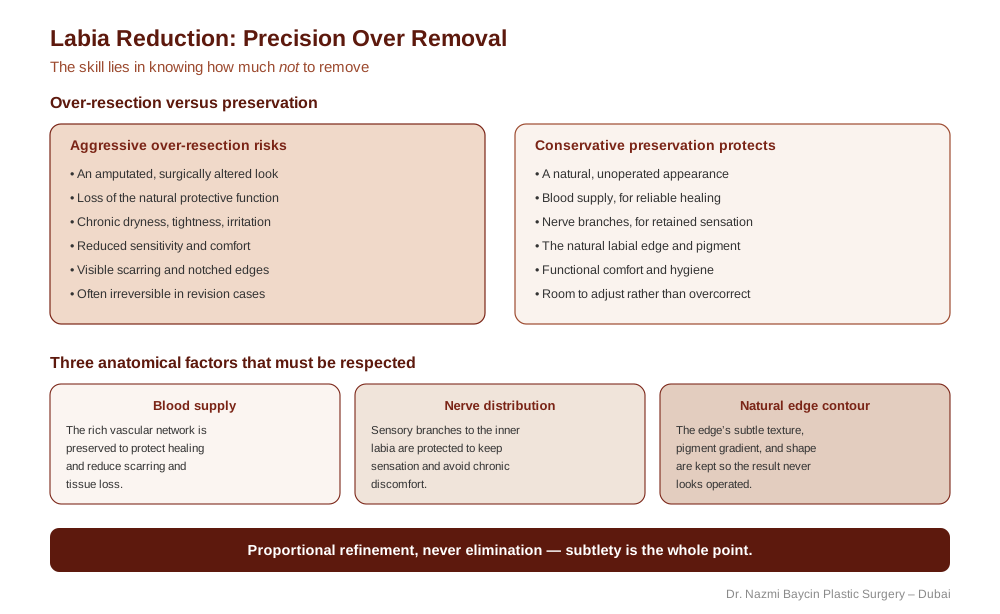
Why labia reduction is about proportional refinement and preservation, not aggressive removal — by Dr. Nazmi Baycin, Dubai.
The most common technical mistake: over-resection
The single most frequent problem seen in revision cases is excessive tissue removal. When too much labial tissue is excised, the natural protective function of the labia minora is diminished or lost, the edges can heal unnaturally tight, the vulva looks surgically altered rather than natural, and sensitivity may be compromised.
Healthy labia minora should never look amputated. The goal should always be proportional refinement, not elimination — and in revision cases, many of these functional and aesthetic problems cannot be fully reversed, which is precisely why cautious primary surgery matters so much. In intimate areas, aggressive surgery is rarely better; safe, conservative planning consistently gives the most satisfying long-term result.
The consequences of getting this wrong, and how they are corrected, are the subject of my article on labiaplasty revision surgery for scarring and asymmetry. How that restraint is translated into an actual surgical plan — margins set in millimeters, staged rather than chased — belongs to my article on how preoperative design prevents unwanted results. The table below sets out what aggressive over-resection costs against what conservative preservation protects.
| Aggressive Over-Resection Risks | Conservative Preservation Protects |
|---|---|
| An amputated, surgically altered appearance | A natural, unoperated look that ages gracefully |
| Loss of the natural protective function | Functional comfort and easier hygiene |
| Chronic dryness, tightness, or irritation | Retained sensation and everyday comfort |
| Visible scarring and notched edges | The natural labial edge, texture, and pigment |
| Problems that are often irreversible | Room to make minor adjustments rather than overcorrect |
Understanding labial anatomy is non-negotiable
A successful reduction depends on respecting three critical anatomical factors: blood supply, nerve distribution, and the natural labial edge. The labia minora have a rich vascular network, and disrupting it through careless cutting or cauterization increases the risk of delayed healing, scarring, and tissue loss.
The nerve branches supplying sensation to the inner labia require equally careful preservation, and how that is achieved — where the sensory layer sits, how it is lifted and kept intact — is a technical subject I set out in my article on preserving sensation through neurovascular anatomy. What matters here is the consequence: the further a resection goes, the more of that layer it takes, which is the anatomical reason restraint is not timidity.
In my approach, incisions are planned to protect circulation while maintaining natural pigmentation and contour along the edge, and every procedure is designed around the individual — accounting for pre-existing asymmetries, color transitions, and natural edge irregularities. This is the anatomical thinking I set out more fully in my article on the anatomical philosophy behind natural form and function, and it is central to how I approach labiaplasty in Dubai as a whole.
Preserving the natural labial edge
One of the hallmarks of a well-performed reduction is preservation of the natural labial shape. The mistakes most often seen after poorly planned surgery — angled borders, loss of the pigmentation gradient, and sharp, linear surgical lines — are exactly what make a result look operated at first glance; the most conspicuous of them is a vertically malpositioned, amputated-looking scar, which is difficult to correct once healed. The natural edge has subtle irregularities, texture, and color variation that are part of each woman’s individual anatomy, and preserving those details is what keeps the result in harmony with the surrounding structures. This mirrors the wider aesthetic philosophy that runs through modern practice: natural over noticeable, refinement over exaggeration.
Functional comfort is as important as aesthetics
Many women seek this surgery in Dubai for functional reasons rather than purely cosmetic ones. Common complaints include discomfort during exercise, pain with tight clothing, irritation during intimacy, and hygiene difficulties caused by excess or elongated tissue.
These functional issues must be taken just as seriously as the aesthetic goals, because removing tissue without restoring balance can solve one problem while creating another, such as dryness, tightness, or hypersensitivity. A properly performed procedure should improve comfort without introducing any new functional complaint; functional improvement is not a secondary benefit but a core objective of the operation.
Where symmetry fits into restraint
Perfect symmetry does not exist naturally, and most women have some baseline difference between the two sides. The reason it belongs in an essay about restraint is that chasing symmetry is one of the commonest routes to removing too much: the temptation is to keep trimming the larger side until the two match, and the tissue lost that way cannot be returned.
My answer is to treat conservative resection as the safeguard — leaving the option of a minor adjustment rather than risking an overcorrection that cannot be undone. How the two sides are actually diagnosed and planned, each with its own technique, is a separate discipline that I set out in my article on correcting asymmetric labia.
Scar placement and healing quality
Some scarring is unavoidable in any surgery, but its visibility and texture can be minimized with proper planning. Poor planning leads to thickened scars, color mismatch, and palpable ridges that can be felt or seen during daily activities and intimacy — problems that are especially troublesome in such a visible, sensitive area. I place incisions where scars can blend with the existing labial folds and color transitions, and meticulous suturing, tension control, and gentle tissue handling are essential to good scar quality. Postoperative care matters just as much: hygiene, activity restriction, and avoiding friction during early healing all contribute to soft, discreet scars. How that healing is optimized is the focus of my article on optimizing recovery and avoiding complications.
Value of experience
Honest patient selection and a frank discussion of likely outcomes are essential parts of ethical surgical practice. Where appropriate, labia reduction can be combined in a single session with other intimate procedures such as vaginal tightening, a pubic lift, hymen repair, or targeted mons fat reduction, which can improve overall harmony and reduce total recovery time — though any such combination must be planned carefully to keep safety first.
Because the tissue is delicate and highly vascular, strict aftercare is essential; rushing recovery, returning to sport too early, or neglecting hygiene raises the risk of wound separation, infection, or prolonged swelling. This is ultimately why surgeon experience matters so much in an operation with such a narrow margin for error. It calls for advanced anatomical knowledge, microsurgical precision, respect for function and sensation, and the aesthetic restraint to say no to over-aggressive requests and to explain why conservative, balanced reduction serves the patient better over time.
A successful result should not be obvious at all: it should feel comfortable, look natural, and age gracefully, restoring confidence without compromising identity — the standard anyone should expect from cosmetic surgery in Dubai. Because each patient’s anatomy and goals differ, both the surgical plan and its cost are best worked out at a consultation, and choosing a surgeon on price alone tends to raise the risk of revision — which is far less predictable than a well-planned primary operation.
FAQs about labia reduction surgery in Dubai
-
What is the most common mistake in labia reduction?
By a clear margin, the most common mistake is over-resection — removing too much tissue. When excessive labial tissue is excised, the natural protective function is reduced or lost, the edges can heal unnaturally tight, sensitivity may be affected, and the vulva can look surgically altered rather than natural. Many of these problems are difficult or impossible to reverse, which is why they so often lead to revision surgery. The safeguard is restraint: proportional refinement rather than elimination, with conservative resection that preserves the option of a small later adjustment rather than risking an overcorrection that cannot be undone.
-
Why does preserving anatomy matter so much?
Because three anatomical factors determine whether a result is safe, comfortable, and natural: blood supply, nerve distribution, and the natural labial edge. The labia minora have a rich vascular network, and disrupting it through careless cutting or cauterization raises the risk of delayed healing, scarring, and tissue loss. The sensory nerve branches must be protected, and the natural edge — its texture, pigment gradient, and subtle irregularities — is what keeps the result from looking operated. Respecting all three is what separates a refined outcome from one that merely removes tissue.
-
Will labia reduction affect sensation?
It should not, when the surgery is planned and performed carefully. What is relevant to restraint is the relationship between the two: problems with sensation, whether reduced feeling or hypersensitivity, are generally consequences of over-aggressive removal rather than of the procedure itself, so conservative resection is itself a protection. The technical detail of how the sensory layer is identified and preserved during a reduction is a separate subject, and I set it out in a dedicated article on preserving sensation through neurovascular anatomy.
-
How are natural-looking results achieved?
Natural results come from preservation and restraint rather than from removing as much as possible. That means keeping the natural labial edge with its texture, color gradient, and subtle irregularities; avoiding straight, linear, or angled surgical borders; placing incisions where scars can blend with existing folds and color transitions; and using conservative, individualized resection. The aim is proportional refinement that stays in harmony with the surrounding anatomy, so the result never looks operated. A well-performed reduction should not be noticeable — it should simply feel comfortable and look like natural, unaltered tissue.
-
Does chasing symmetry lead to removing too much?
It is one of the commonest routes to it, which is why symmetry belongs in a discussion about restraint. The temptation is to keep trimming the larger side until the two sides match, and tissue lost that way cannot be returned. My safeguard is deliberately conservative resection, so that a minor adjustment remains possible rather than an overcorrection becoming permanent. Diagnosing exactly how the two sides differ, and planning a separate technique for each, is its own discipline, and I set it out in a dedicated article on correcting asymmetric labia.


GET APPOINTMENT
Get ready to look and feel best… You deserve…
