

Key takeaways: reduction without losing sensation
- The labia minora are sensory tissue, richly supplied by branches of the dorsal nerve of the clitoris — not excess to be freely trimmed.
- Nerve density is uneven; aggressive superior resection risks the zones where sensory branches concentrate.
- The technique reduces central bulk within a preserved sensory envelope, rather than amputating tissue.
- A fine neurovascular plexus just deep to the dermis is isolated and kept intact — sensation’s lifeline.
- Tension-free, layered closure protects nerve regeneration and blood supply.
- The governing principle is restraint over resection: refine to the individual’s proportions and biological limits.
The anatomical imperative: why sensation is at stake
The labia minora are part of the vulvar sensory organ. They are densely populated with specialized mechanoreceptors and free nerve endings, and their neural supply comes largely from the dorsal nerve of the clitoris, which branches through the labial tissue. A resection that ignores this map can sever those terminal branches, and nerve density is not even across the tissue.
A cadaveric study of clitoral and vulvar nerve density measured higher nerve density in the distal than the proximal half of the labia minora — a difference that did not reach statistical significance, so it is a signal rather than a settled fact — and cautioned that the nerves can be injured by deep dissection or suture placement, so surgical awareness of these zones matters. The common error is aggressive superior resection to chase an exaggerated contour, and the result is often a subtle neuropathic change — not complete numbness, but a diminishment of erotic fine-touch discrimination. Individual variation compounds the risk.
A review of normative labial dimensions found labial length reported across a range of 5 to 100 mm and width across 1 to 60 mm, which shows how widely “normal” varies and is exactly why planning must be calibrated to each patient, not to a fixed template. Understood this way, the request shifts from “make them smaller” to “sculpt them while preserving everything that makes them feel.”
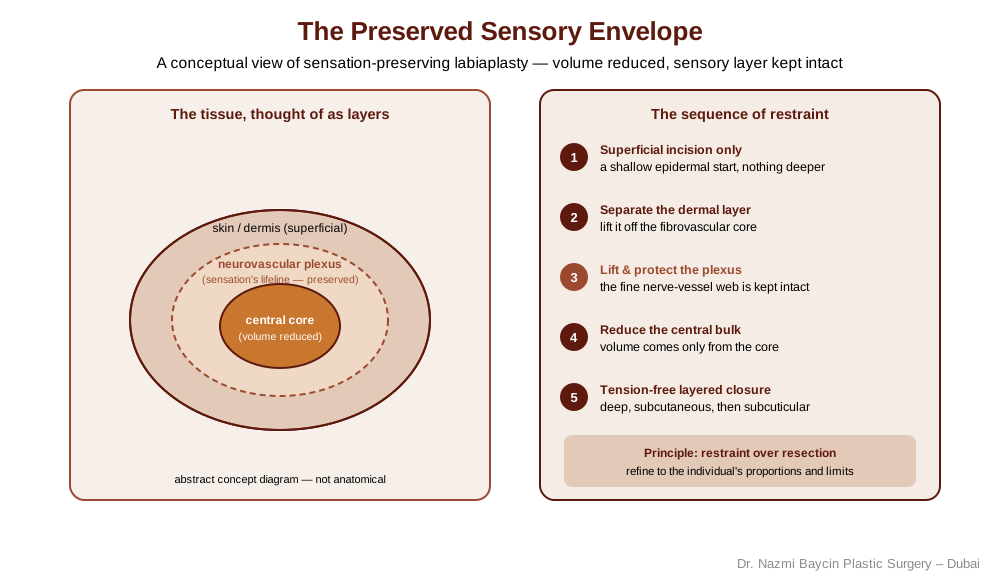
A conceptual, non-anatomical view of the preserved sensory envelope: volume is reduced from the central core while the superficial neurovascular layer is kept intact — by Dr. Nazmi Baycin, Dubai.
Technical artistry: reduction within a preserved sensory envelope
My method navigates this anatomy with reverence, and it is fundamentally different from amputation: it is a controlled volume reduction within a preserved sensory capsule. The surgery begins with a superficial epidermal incision only. I then separate the dermal layer from the underlying fibrovascular core — the labial parenchyma, which is the volume to be reduced.
The artistry lies in the dissection. Using microsurgical instruments, I isolate and lift the superficial neurovascular plexus, a fine web of vessels and nerves lying just deep to the dermis. This plexus is sensation’s lifeline. Only then do I reduce the central bulk, leaving that plexus as an intact envelope on both the anterior and posterior flaps. This is the technical detail behind a sensory-preserving labiaplasty in Dubai, where the aim is refinement without any sacrifice of feeling. The table below contrasts this approach with conventional edge amputation.
| Aspect | Preservation approach | Conventional edge amputation |
|---|---|---|
| What is removed | Central bulk (core) only | Full-thickness labial edge |
| Neurovascular plexus | Isolated, lifted, and preserved | Divided with the excised edge |
| Sensation | Fine-touch discrimination protected | Risk of neuropathic diminishment |
| Closure | Tension-free, multi-layer | Often single-layer, higher tension |
| Guiding principle | Restraint calibrated to anatomy | Contour prioritized over feeling |
Dynamic closure and the physiology of healing
The closure is not an endpoint but a critical phase of biological engineering. Tension is the nemesis of nerve regeneration and blood supply, and a tight, linear closure creates micro-ischemia that strangulates the very structures we worked to preserve. My closure is therefore a dynamic, multi-layer event. The deep connective tissues are approximated with slowly-absorbing sutures placed to bear the foundational tension, and the subcutaneous layer is closed with precise interrupted sutures to eliminate dead space. Finally, the skin edges are approximated with fine, non-reactive monofilament in a running subcuticular pattern, so they lie together without strangulation.
This layered approach lets the wound heal with a soft, supple scar that permits normal tissue mobility and stretch — healing as thoughtful as the incision.
What preservation means for recovery and long-term feel
Because the labial edge is left undivided and the closure carries no tension, the early recovery tends to be more comfortable than patients expect, and the tissue looks and behaves like refined native labia rather than a sutured margin. Swelling and tenderness settle over the first few weeks, and I ask patients to avoid friction, tight clothing, and strenuous activity while the deeper layers consolidate.
The more important measure, though, is the long-term result. Because the sensory envelope is intact, fine-touch discrimination and the natural response of the tissue are protected as healing completes, and the scar — hidden and supple — does not tether or distort the labia during movement or intimacy. This is the whole purpose of the approach: a result that is not only smaller and neater, but one that still feels entirely like your own.
Most patients return to desk work within a few days and resume exercise and intimacy over the following weeks, guided by a recovery protocol I tailor to how much reduction was performed and how your tissue is healing.
Reading the nerve map before any incision is planned
The precision of this technique begins with one specific question, asked before the operating room: where, in this particular woman, do the sensory branches concentrate, and how thick is the tissue that carries them? I assess the projection and thickness of the labia minora, the quality of the tissue, and the position of the clitoral hood, because those determine how deep the plexus sits and how much core can safely be removed beneath it.
That is the nerve-specific half of the assessment. The wider discipline of preoperative planning — dynamic mapping standing and supine, margin design in millimeters, and patient selection — is a subject in its own right, and I set it out in my article on how preoperative design prevents unwanted labiaplasty results. Where the two sides differ markedly, the plan becomes side-specific, which I cover in my article on correcting asymmetric labia.
Who this approach is designed for
The ideal candidate for a sensation-preserving reduction is someone bothered by the size, asymmetry, or protrusion of the labia minora — whether the concern is comfort during activity and clothing, irritation, or simply how the area looks — who wants refinement without risking what the tissue feels. It suits women across a wide range of anatomy, because the technique is calibrated to the individual rather than to a single target shape.
Equally important is understanding who should pause. I am cautious with patients whose expectations are shaped by heavily edited images or a wish to remove as much tissue as possible, because that instinct runs directly against the anatomy and the long-term result.
Part of my role in consultation is to align what is wanted with what is safe and lasting, and occasionally that means recommending a more conservative reduction than a patient first imagined — or, rarely, advising against surgery when the anatomy is already within the normal range and the concern is better addressed another way.
Why feeling sets the limit
There is one anatomical reason the reduction has a ceiling, and it is specific to this page: the sensory envelope is thin, it cannot be rebuilt, and every millimeter taken beyond the core is taken from tissue that carries feeling. That is the limit sensation imposes. The wider case for restraint — what over-resection costs aesthetically and functionally, and why knowing how much not to remove is the harder skill — is the subject of my article on why restraint defines a natural labia reduction, and where an earlier operation has already gone too far, the rebuilding is set out in my article on reconstructive revision after an over-aggressive labiaplasty.
My commitment is to be the steward of your long-term anatomical integrity, so refinement never comes by sacrificing feeling. To perform labiaplasty is to be entrusted not just with form, but with the continuity of sensation. Because a procedure of this precision is individualized, its planning is discussed candidly and unhurriedly in consultation.
FAQs about sensation-preserving labiaplasty in Dubai
-
Will labiaplasty reduce or change my sensation?
That is the central concern my technique is built to address. Sensation is carried by a fine neurovascular plexus lying just beneath the skin. Rather than amputating the labial edge, I reduce the deeper core and lift and preserve that plexus as an intact envelope. The aim is to refine the shape while protecting fine-touch sensation.
-
How is this different from a standard labiaplasty?
A conventional approach often trims the full-thickness edge, which divides the sensory nerves that run through it. My method removes volume from the central core instead, keeping the superficial nerve-and-vessel layer preserved. It is a controlled reduction within a sensory capsule, not an amputation of tissue.
-
Why does the closure technique matter so much?
Tension is the enemy of healing nerves and blood supply. A tight, single-layer closure can create micro-ischemia that harms the structures we worked to preserve. I close in multiple layers so the deep tissue bears the tension and the skin lies together softly, which supports a supple scar and normal stretch.
-
Can I still have a noticeable reduction if you preserve so much?
Yes. The volume that creates bulk sits in the central core, and that is exactly what is reduced. Preserving the thin superficial sensory layer does not limit how much the shape can be refined. It simply changes where the tissue is removed from.
-
What happens if too much tissue is removed?
From the point of view of sensation, the answer is simple: the envelope is thin and it cannot be rebuilt, so anything taken beyond the central core is taken from tissue that carries feeling. That is the ceiling this technique works within. What over-resection costs more broadly — the appearance, the protective function, and why those losses are so hard to reverse — I set out in a separate article on why restraint defines a natural result.
-
How do you find the nerves before you operate?
I do not find them individually — I plan around where they are known to concentrate. Nerve density is higher toward the distal labia minora, and the plexus that matters sits just deep to the dermis, so the assessment focuses on tissue thickness and projection to judge how much core can safely be removed beneath that layer. The broader preoperative planning discipline — dynamic mapping, margin design, patient selection — I set out in a separate article on preventing unwanted results.


GET APPOINTMENT
Get ready to look and feel best… You deserve…
