


Table of content
- Why might you need a tummy tuck?
- Are you a good candidate for tummy tuck?
- How does Dr. Baycin perform a tummy tuck?
- What makes Dr. Baycin’s high-definition tummy tuck unique?
- How is the recovery period after full abdominoplasty?
- What are the risks and complications of tummy tuck?
- Checklist before having tummy tuck in Dubai, UAE
- How much does a tummy tuck cost in Dubai, UAE?
- Get appointment
Most tummy tucks remove skin and tighten muscle and stop there. Mine begin where that ends. I am Dr. Nazmi Baycin, and over more than seven hundred and fifty tummy tuck procedures I have refined an approach that treats the abdomen not as something to be flattened, but as something to be sculpted — a naturally shaped belly button, a discreet scar hidden beneath the bikini line, and a subtle, athletic two-pack definition that most surgery never attempts. A tummy tuck in Dubai with me is high-definition abdominoplasty: the standard operation, elevated by detail.
The foundation is sound surgery. Performing tummy tuck in Dubai within JCI-accredited hospitals, I remove the excess skin and fat, tighten the separated abdominal muscles along the midline to rebuild a firm core, and reposition the belly button — and then I go further, shaping the result so it looks unoperated. The principle behind every step is the one that guides all my work: to restore form is to restore function.
Tummy tuck in Dubai quick facts
| Procedure detail | Tummy tuck (abdominoplasty) in Dubai |
|---|---|
| Techniques | Mini, full, or extended abdominoplasty |
| Signature detail | High-definition: two-pack effect, natural belly button |
| Anesthesia | General |
| Procedure time | 2.5–3 hours (longer for extended) |
| Hospital stay | 1–2 days |
| Muscle repair | Midline plication to flatten and narrow the waist |
| Scar | Low, hidden beneath the bikini line |
| Sutures | Hidden, dissolvable (none to remove) |
| Shower | 3–4 days |
| Downtime | Desk work typically 7–10 days; longer for physical work |
| Sport | Gradually from 3–4 weeks |
| Mini tummy tuck | ~1–1.5 hrs; desk work typically 2–3 days |
What can a tummy tuck in Dubai do for you?
A tummy tuck removes loose, excess skin and stubborn fat from the lower and middle abdomen, repairs the abdominal muscles that pregnancy or weight change have stretched apart, and restores a flatter, firmer, more toned waistline. It eliminates stretch marks on the skin that is removed, tightens the bulge that weakened muscles create, and — in my hands — leaves a natural belly button and a scar you can keep private.
The change is both physical and personal: a body that feels like your own again, and the confidence that comes with it. It is the single most effective answer to the post-pregnancy or post-weight-loss abdomen that diet and exercise simply cannot reach.
Why might you need a tummy tuck?
Abdominoplasty addresses what the gym cannot. After pregnancy or significant weight change, three things tend to happen to the abdomen that no amount of training will reverse: the skin develops stretch marks and sags, fat accumulates and resists every effort, and the abdominal muscles loosen and separate, producing a persistent bloat from within. A tummy tuck corrects all three at once — removing the lax skin and its stretch marks, taking away the excess fat, and stitching the separated muscles back together to flatten and narrow the waist.
Where stubborn fat is the main concern alongside the skin, abdominoplasty can be combined with liposuction for a more complete contour.
Are you a good candidate for a tummy tuck?
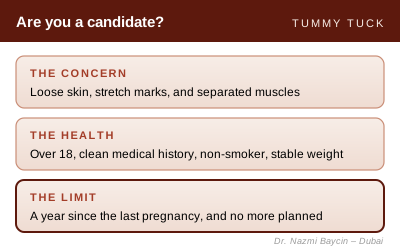 The best candidates are men and women in good general health, with a clean medical history free of systemic disease, who are troubled by loose abdominal skin and wrinkling, or by stubborn fat that diet and exercise will not shift. Most of the patients who come to me are women whose abdomen has changed after one or more pregnancies — though it is equally suited to women with abdominal sagging after major weight loss, even without pregnancy, and to men with loose, hanging abdominal skin. Older patients, whose skin has lost its elasticity, also do very well.
A few specific conditions make for the safest, most satisfying result:
- a clean medical history, free of systemic disease such as heart disease
- good overall health and medical condition
- not significantly overweight or obese
- realistic expectations, and acceptance of the surgical scar
- at least one year elapsed since the last pregnancy
- a non-smoker (or willing to stop well before surgery)
- no prior major abdominal surgery
- a previous unsatisfactory tummy tuck is not a barrier — revision is possible

Stretch marks on the removed skin are eliminated with it.
Which tummy tuck technique is right for you?
There are two core techniques — a full tummy tuck and a mini tummy tuck — and one extension of the full procedure for more extensive cases. I choose between them by assessing exactly where your concern lies relative to the belly button.
Mini tummy tuck
A mini abdominoplasty is the right choice when the problem is mild and confined to below the belly button: the abdominal muscles are not separated, the skin above the navel is elastic and looks fine, and only the skin below the navel is loose. It is a smaller procedure with a quicker recovery, but it must be the right call — a mini tummy tuck performed on someone who truly needs a full one delivers only minimal improvement.
Full tummy tuck
When the same concerns extend above the belly button — loose skin, separated muscles, a bulge that won’t flatten — a full tummy tuck is needed. It addresses the entire abdomen, from the lower border up to and above the navel, including the all-important midline muscle repair.
Extended tummy tuck
Sometimes the excess does not stop at the front. For patients who are heavier, the skin that needs removing can wrap around to the back of the waist (the flanks). An extended tummy tuck removes that additional tissue from the sides as well, for a complete, circumferential result.
| Factor | Mini tummy tuck | Full tummy tuck | Extended tummy tuck |
|---|---|---|---|
| Best for | Mild laxity below the belly button only | Loose skin & muscle separation above and below the navel | Excess that wraps around to the flanks/back |
| Muscle repair | Lower abdomen only, if needed | Full midline repair | Full midline repair |
| Belly button | Left untouched | Released and re-positioned | Released and re-positioned |
| Scar | Shorter, low | Hip to hip, bikini-hidden | Extends toward the back |
| Procedure time | ~1–1.5 hours | ~2.5–3 hours | Longer than full |
| Recovery | Desk work typically 2–3 days | Desk work typically 7–10 days | Similar to full, slightly longer |
Which column you fall into is settled by anatomy rather than preference — the width and length of any muscle separation, how the fat is distributed between the deep and superficial layers, and how well your skin recoils. I set out that three-part reading, and how it selects the operation, in my article on how abdominal anatomy decides the tummy tuck plan.
The pinch test: full or mini?
You can get a sense of which you need with a simple test. Place one hand about 1 cm above the belly button and the other at the lower border of the abdomen, then pinch the skin between them. If you can bring your hands together as you push on the upper and lower abdomen, you are most likely a candidate for a full abdominoplasty. For most patients, this simple test points to the full procedure.
How does Dr. Baycin perform a tummy tuck?

Midline muscle repair rebuilds a firm, narrow waist.
The operation is performed under general anesthesia and takes about 2.5 to 3 hours — a little longer for an extended tummy tuck — followed by a one-to-two-day hospital stay. The defining step, whichever technique is used, is rebuilding the abdominal wall along the midline.
Full abdominoplasty, step by step
I begin by removing the skin and fat from a few centimeters above the belly button down to the lower abdominal border, where it is no longer needed. I then free the belly button by cutting carefully around its inner edge — keeping it intact and in its original position — and separate the skin and fat from the muscle up to the lower ribs, exposing the abdominal wall. Next comes the crucial step: I stitch the separated muscles together along the midline. This muscle repair (diastasis recti repair) restores a youthful firmness, markedly reduces the bloat that loosened muscles cause, and narrows the waist. The published evidence is encouraging on the functional side, though it stops short of proving a gain in raw strength. A 2020 systematic review of 497 patients across seven studies found that all four studies recorded improved physical function after midline repair, and four of six other functional instruments showed significant improvement.
With the core rebuilt, I draw the skin and fat down firmly, remove the excess, and stitch the edges together — creating a new opening for the belly button and securing it in its natural position. Finally I place a small drain to prevent fluid collecting beneath the skin, and position the scar low enough to be concealed by a bikini.
Mini abdominoplasty
In a mini tummy tuck I remove the excess skin and fat below the belly button through an elliptical incision, and where the lower muscles are separated I stitch them together too. The belly button itself is left untouched, since the work is confined to the lower abdomen — and in selected cases I can still tighten the muscles above the navel without cutting around it.
What makes Dr. Baycin’s high-definition tummy tuck unique?

This photo, sent by the patient and taken at the beach, highlights the natural-looking results of Dr. Baycin’s high definition tummy tuck technique. The scar is discreetly hidden beneath the bikini line, the belly button maintains a natural appearance, and the subtle muscle column effect creates a sculpted, toned look — all key elements of Dr. Baycin’s refined approach to abdominal contouring.
Beyond the muscle tightening that every tummy tuck requires, I bring a detail-oriented, high-definition approach built on three considered elements — the things that separate a result that looks operated from one that looks natural.
Bikini-concealed incision
I plan the incision line meticulously so it sits low enough to hide beneath standard bikini bottoms or underwear, with its angle and curve tailored to your body’s natural folds. The point is simple: you should be able to wear swimwear and lingerie with complete confidence, with no visible sign that surgery was ever done.
Natural-looking belly button
One of the most telltale signs of a tummy tuck is an unnatural, overly tight navel. I avoid it by sculpting a slightly wider dimple around the belly button, recreating the way a navel looks in someone who has never had surgery — soft, symmetrical, and properly placed, blending seamlessly into the new abdominal contour.
The two-pack / muscle-column effect
This is my signature. Beyond tightening the muscles, I enhance the natural definition of the midsection by artistically shaping the subcutaneous fat layer into a subtle, column-shaped contour on either side of the belly button — typically around 10 cm wide. The effect mimics the look of toned, athletic muscle, giving a smoother, more sculpted abdomen that still reads as entirely natural and unoperated. For patients who want a more pronounced, fully defined six-pack rather than this subtle two-pack effect, abdominal etching takes the same sculpting principle further.
| Element | Standard abdominoplasty | Dr. Baycin’s abdominoplasty |
|---|---|---|
| Excess skin and fat | Removed from the lower and middle abdomen, taking any stretch marks on that skin with it. | The same — this is the foundation, not the differentiator. |
| Muscle repair | Separated muscles stitched together along the midline to flatten and narrow the waist. | The same midline repair, performed first, because every refinement above depends on a rebuilt abdominal wall. |
| Incision placement | Low and horizontal across the lower abdomen. | Planned to sit low enough to hide beneath standard bikini bottoms or underwear, with its angle and curve tailored to the body’s natural folds. |
| Belly button | Released, then secured in a new opening. | Released and repositioned, then sculpted with a slightly wider dimple around it, recreating the way a navel looks in someone who has never had surgery. |
| Subcutaneous fat layer | Not shaped. | Artistically shaped into a subtle, column-shaped contour on either side of the belly button, typically around 10 cm wide. |
| How the result reads | Flat. | Flat, with a subtle two-pack definition that mimics toned, athletic muscle — sculpted, and still entirely unoperated in appearance. |
| For a fuller six-pack | Not attempted. | The same sculpting principle taken further by abdominal etching, for patients who want pronounced definition rather than a subtle effect. |
The distinction is not that one operation is sound and the other is not. Both remove the skin, both rebuild the abdominal wall, and both reposition the navel. The high-definition approach adds a further layer of shaping on top of that foundation — and it is only possible because the foundation is done properly first.

Every tummy tuck must do three things: remove the excess skin and fat along with the stretch marks it carries, stitch the separated abdominal muscles back together along the midline, and reposition the belly button. That is the operation, and it has to be right before anything else is attempted. Across more than 750 abdominoplasties over twenty-five years, what I have refined is the layer that sits on top of it. The incision is planned to fall beneath standard bikini bottoms, its angle and curve following the body’s own folds. The navel is sculpted with a slightly wider dimple, recreating how a navel looks in someone who has never had surgery — an overly tight one is the most telltale sign of a tummy tuck. And the subcutaneous fat is shaped into a column-shaped contour either side of the midline, typically around 10 cm wide, giving a subtle two-pack definition that reads as toned muscle rather than as surgery. None of this replaces the foundation. It is only possible because the foundation is done first.
In-depth reading: the technique, the variations, and what to expect behind a tummy tuck in Dubai
A tummy tuck is one procedure with many facets — how the anatomy is read before anything is decided, how the muscle repair and navel are refined, how it is adapted for a slim frame, how separated muscles are rebuilt, and what recovery and future pregnancy really involve. These detailed articles explore each dimension in depth.
- High-definition muscle sculpting and a scar-free navel — how subtle “two-pack” definition and an internally sutured, natural belly button are added to the repair.
- The range of umbilicoplasty techniques, compared — how the published methods for reconstructing a navel differ, and why patient anatomy rather than preference decides which one applies.
- Deciding between a mini and a full approach — the anatomical factors that determine which procedure fits: the extent of muscle separation (diastasis recti) and where skin laxity sits above or below the navel.
- How the skin envelope is redraped to sculpt the waistline — why differential resection and dual-vector tightening, not the work beneath, decide whether the contour shows.
- When a front-only tuck falls short: the 360° circumferential approach — how loose skin and fat wrapping around the flanks, lower back, and buttocks calls for a belt-like lift rather than an anterior-only tummy tuck.
- How the abdominal definition is sculpted, stage by stage — why the muscle wall is rebuilt first, then fat is topographically sculpted along the muscle borders, V-line, and midline.
- Why treating the front alone leaves a boxy torso — what happens when the flanks are left untouched, and the blood-supply limits that govern how much can safely be done in one operation.
- Why skin quality, not quantity, sets the incision and scar — how tissue elasticity dictates the correct incision length and a layered, tension-managed closure, so the scar heals fine and sits low.
- The structural approach: why a layered repair holds for life — how multi-layer plication, upper reinforcement, and lateral fascial tensioning form an internal corset that resists recurrence over time.
Where does Dr. Baycin perform abdominoplasty in Dubai?
I perform every tummy tuck in a premium, JCI-accredited hospital in Dubai that meets the highest global standards for safety, cleanliness, and surgical care. Your procedure takes place in a fully equipped, advanced medical setting designed for comfort and the best possible result, with a safe, personalized approach at every step.
What is recovery after a tummy tuck like?
Recovery is more comfortable than its reputation suggests, and your own body is the best guide to your pace.
Full abdominoplasty recovery
You will be up and moving with help within three to four hours of surgery, and walking on your own by the next day. Although the procedure is done under general anesthesia, I also infiltrate a long-acting local anesthetic into the surgical area, so the first day — usually when discomfort peaks — passes without pain; any moderate ache in the following days is easily managed with medication. Most patients are surprised by how much less it hurts than they expected. You can shower after three to four days, and should avoid straining, coughing, and heavy lifting in the first week. Travel is fine after four to five days, a return to desk work typically after seven to ten days — longer if your work is physical — and sport and physical activity gradually from three to four weeks. To understand what to expect regarding sensation during recovery, see my numbness after tummy tuck in Dubai article.
Mini abdominoplasty recovery
Because it treats a smaller area, a mini tummy tuck takes about one to one-and-a-half hours, and recovery is quicker — back to everyday life in just two to three days. As for when to resume activities, listen to your body; it will tell you when it is ready. You can usually swim again after about ten to fifteen days, once the wounds have healed. To understand the full science behind how I support your healing after surgery, visit my advanced recovery protocol in Dubai article.
Download Dr. Baycin’s tummy tuck aftercare instructions
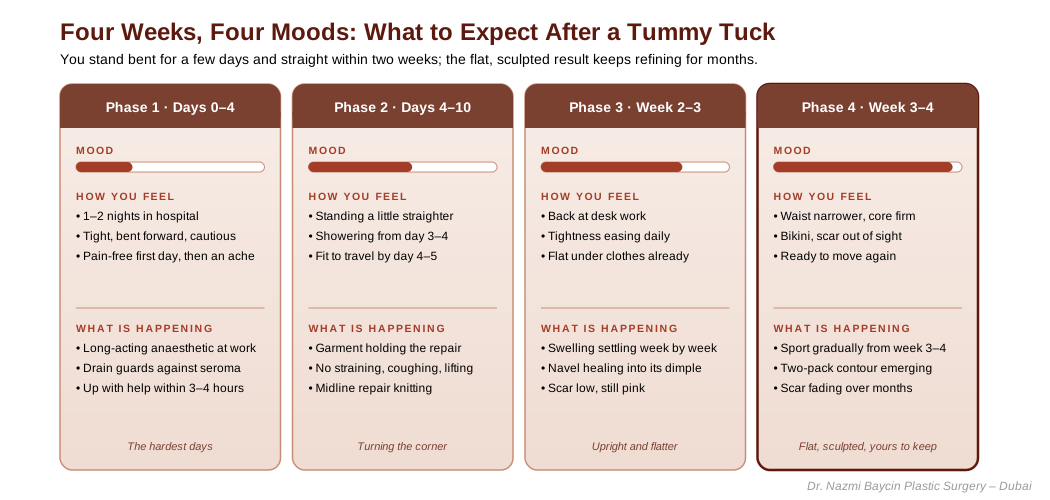
A full tummy tuck is a one-to-two-night stay and a four-week arc. You are up with help within three to four hours and walking unaided the next day; because I infiltrate a long-acting local anaesthetic, the first day passes without pain, and the ache that follows is managed with tablets while a small drain guards against fluid collecting. For the first week you walk slightly bent and avoid straining, coughing, and lifting, so the midline muscle repair can knit; showering starts on day three or four, and travel is fine by day four or five. Desk work returns at seven to ten days, the compression garment stays on for several weeks, and by the second and third weeks you are standing straight, with the swelling settling and the navel healing into its dimple. Sport comes back gradually from three to four weeks, as the two-pack contour begins to show and the low scar starts its long fade. The mood follows the posture: cautious, then relieved, then upright, then simply yours. The pace varies with personality; the shape rarely does.
Can you get pregnant after a tummy tuck?
Yes — becoming pregnant after a tummy tuck is possible and generally safe for both mother and baby. It is worth understanding, though, that pregnancy can stretch the tissues again and alter your result. With sensible planning and realistic expectations you can still achieve and keep your aesthetic goals; if you are thinking of growing your family, talk it through with me so we can plan the timing for the best outcome for both your health and your appearance.
What are the risks and complications of a tummy tuck?
A tummy tuck is a safe procedure in experienced hands, but like any surgery it carries some risks, and I believe in being candid about them. The most common is seroma — a collection of fluid under the wound, usually temporary and typically resolving on its own within one to two weeks; this is why I place a drain. Infection and bleeding are general surgical risks, both minimized by careful technique and the antibiotics I prescribe, and hematoma is uncommon when the surgery is done meticulously.
The single biggest risk factor is smoking, which slows wound healing and can cause wound separation — so stopping well before surgery matters. Diabetes and obesity can likewise impair healing. And while not a complication as such, the scar is permanent: vivid at first, it fades over a few months to a much less visible line. Where any issue does arise, it can be managed and treated.
Checklist before having tummy tuck in Dubai, UAE
IMPORTANT ! Before getting the appointment, check your medical conditions yourself.
| # | Conditions | Safety | Aesthetic Suitability |
|---|---|---|---|
| 1 | Are you over 18? | 🟢 Fit for surgery | — |
| 2 | Do you have abdominal skin laxity due to aging, pregnancy, or significant weight loss? | 🟢 Fit for surgery | 🟡 Ideal candidate |
| 3 | Do you have stretch marks on your abdomen? | 🟢 Fit for surgery | 🟡 Ideal candidate |
| 4 | Do you experience abdominal bulging due to muscle separation (diastasis recti)? | 🟢 Fit for surgery | 🟡 Ideal candidate |
| 5 | Do you have a cardiovascular problem such as heart disease or deep vein thrombosis? | 🔴 Contraindicated | — |
| 6 | Do you have pulmonary system problems such as chronic lung disease? | 🔴 Contraindicated | — |
| 7 | Do you have chronic liver disease? | 🔴 Contraindicated | — |
| 8 | Do you have a urinary system disease such as kidney failure? | 🔴 Contraindicated | — |
| 9 | Do you have a hematologic problem such as anemia or coagulopathy? | 🔴 Contraindicated | — |
| 10 | Do you have any transmitting disease through blood such as HIV? | 🔴 Contraindicated | — |
| 11 | Have you been taking anticoagulant medication? | 🔴 Contraindicated | — |
| 12 | Have you been taking psychotropic drugs? | 🔴 Contraindicated | — |
| 13 | Any drug abuse or addiction | 🔴 Contraindicated | — |
How much does a tummy tuck cost in Dubai, UAE?
Tummy tuck costs in Dubai vary from clinic to clinic and depend on several factors, ranging between 20,000 ($5,500) and 60,000 AED ($16,400).
Please note that these costs do not reflect Dr. Baycin’s personal pricing; you will be informed of the exact price during the consultation, after your condition is assessed.
For a complete overview of treatment fees, please refer to full price list of the procedures. If you are looking specifically for this procedure, you can also review pricing information.
Schedule your private consultation with Dr. BaycinWhat makes Dr. Baycin an exceptional tummy tuck surgeon in Dubai?
A tummy tuck is more than a cosmetic procedure — it is a transformation — and with more than 750 successful abdominoplasties, that is the standard Dr. Baycin holds.
- 25+ years of surgical expertise: a board-certified plastic surgeon, DHA-licensed and a member of the American Society of Plastic Surgeons (ASPS), recognized internationally for precision.
- Individually designed for your body: every tummy tuck plan is custom-built to your proportions, enhancing your natural shape while keeping balance and harmony.
- Master of modern techniques: full, mini, extended, and muscle repair — applied for a flatter, firmer, naturally sculpted abdomen, never an artificial look.
- Signature two-pack effect & natural belly button: a subtle, athletic muscle-column definition and one of the most natural-looking belly buttons in the field, avoiding the tell-tale “surgical” look.
- Faster recovery, less downtime: meticulous technique and advanced methods mean minimal scarring, reduced pain, and quicker healing.
- Absolute commitment to safety: thousands of procedures with zero major complications; safety is non-negotiable.
- Honest consultations, realistic results: every question answered, expectations set clearly, no pressure.
- Comprehensive aftercare: structured recovery plans and direct surgeon access throughout healing.
- Chosen by patients worldwide: from Europe to the GCC, patients travel to Dubai for his results.
- Trusted by high-profile clients: valued for discretion and consistently flawless outcomes.
- 750+ procedures, zero major complications: natural beauty, lasting firmness, and renewed confidence.
About Dr. Nazmi Baycin
Surgery, to me, is precision applied in service of restoration — a conviction that has guided every one of the more than 7,000 procedures I have performed over 25 years in practice. I am a DHA-licensed, board-certified plastic surgeon, trained in Turkey and based in Dubai since 2016. I operate exclusively within JCI-accredited hospitals, and hold international membership in the American Society of Plastic Surgeons (ASPS). Three techniques, in particular, have become signatures of my practice. Scarless breast augmentation, performed through a transaxillary approach that leaves no incision on the breast itself. Labiaplasty designed individually around each patient’s own anatomy, never to a standard template. And 3D customized facial bone implants, engineered through CT-based bespoke printing — a technique I currently offer as the only surgeon in Dubai providing it. My practice today spans facial rejuvenation, breast surgery, body contouring, and cosmetic genital procedures, drawing patients from across the UAE, Europe, and the wider GCC. Yet the principle guiding each of these specialties has never changed: to restore form is to restore function.
FAQs about tummy tuck in Dubai
-
What is a tummy tuck (abdominoplasty)?
A tummy tuck, or abdominoplasty, is how I restore a firm, flat abdomen by removing excess loose skin and fat and, crucially, repairing the underlying muscles that have separated or weakened. It is especially valuable after pregnancy or significant weight loss, when neither the skin nor the muscle wall recovers on its own. My approach is a high-definition one: rather than simply flattening the tummy, I sculpt a natural, athletic contour with a subtle two-pack effect and a natural-looking belly button.
-
How much does a tummy tuck cost in Dubai?
Tummy tuck costs in Dubai vary from clinic to clinic and depend on several factors, ranging between AED 20,000 and AED 60,000, depending on whether it is a mini or full abdominoplasty and whether it is combined with liposuction. These are general market figures, not Dr. Baycin’s personal rates; the precise cost is confirmed at your consultation, once your abdomen has been assessed.
-
What is the difference between a mini and a full tummy tuck?
The right one depends on how much correction you need, which is why I assess each abdomen individually. A mini tummy tuck addresses only the area below the belly button, with a shorter scar, and suits people with a small amount of loose skin and limited muscle separation there. A full tummy tuck addresses the entire abdomen, above and below the belly button, repairing the full length of the muscles and removing more skin. At consultation I recommend whichever genuinely matches your anatomy.
-
Why is repairing the abdominal muscles so important?
This is the part that a diet or exercise cannot fix, and it is central to a real result. During pregnancy or with weight gain, the two vertical abdominal muscles can separate down the middle, a condition called rectus diastasis, leaving a persistent bulge no amount of exercise will flatten. I stitch these muscles back together into a firm internal corset, which flattens the tummy and, on the published evidence, tends to improve how the abdomen performs in daily life, though measured gains in raw strength vary between patients. Repairing the foundation is what makes the result last.
-
What is a high-definition tummy tuck?
A high-definition tummy tuck goes beyond simply flattening the abdomen to sculpting a naturally athletic shape. Alongside removing skin and repairing muscle, I use refined liposuction technique to define the natural contours of the abdomen, creating a subtle two-pack effect and a toned, sculpted look rather than a flat but featureless one. The aim is a result that looks like a naturally fit abdomen, in proportion with your body, not an obviously operated one. This artistry is at the heart of how I approach the procedure.
-
Will my belly button look natural?
Yes, and this detail matters more than people realize. In a full tummy tuck, the belly button is carefully preserved and repositioned, and a poorly made one is an immediate giveaway of surgery. I take great care to create a natural-looking, subtly shaped belly button that blends seamlessly with your new contour, so nothing about the result draws the eye or looks artificial. Getting this small feature right is a big part of what separates a natural result from an obvious one.
-
Where will the scar be, and how visible is it?
I place the main incision low and horizontally across the lower abdomen, positioned so that it sits below the bikini line and is hidden by underwear or swimwear. A tummy tuck does involve a longer scar in exchange for removing the excess skin, and I am always honest about that trade-off, but its low, concealed placement means it stays private. I close with meticulous technique to give the scar the best possible chance of fading well over time.
-
Is a tummy tuck in Dubai often combined with liposuction?
Yes, very frequently, and in my high-definition approach the two work hand in hand. The liposuction refines the contour and creates the athletic definition, while the tummy tuck removes the loose skin and repairs the muscle. Combining them in a single procedure gives a far more sculpted, complete result than a traditional flattening alone. At consultation I assess how best to combine the two to achieve the natural, toned abdomen you are hoping for.
-
What is recovery after a tummy tuck like?
A tummy tuck is a major procedure, so recovery asks some patience. You will wear a compression garment for several weeks, and because the muscles are repaired, you will feel tight at first and should avoid strenuous activity and heavy lifting for several weeks while the repair heals. Most people return to desk work within about seven to ten days, longer if their work is physical, standing gradually straighter as the tightness eases. Swelling settles over the following weeks to months, and I guide you closely throughout.
-
Are the results of a tummy tuck permanent?
The results are long-lasting, particularly when your weight stays stable and you are not planning further pregnancies. The skin I remove does not return, and the muscle repair is durable. The two things that can undo it are significant weight gain and a future pregnancy, which re-stretches both skin and muscle, so I usually recommend having a tummy tuck once your weight is stable and your family is complete. For most people who keep their weight steady, the improvement lasts well over the long term.
-
Is a tummy tuck in Dubai safe, and what are the risks?
In experienced hands a tummy tuck is a safe, well-established procedure, but it is major surgery and I discuss the risks honestly. These include swelling, bruising, fluid collection, delayed wound healing along the incision, and scar quality, all of which I minimize through careful technique and attentive aftercare. Good general health, a clean medical history free of systemic disease such as heart disease, and a stable weight all support a safe procedure and the best result. Every relevant risk is discussed fully at consultation.
-
Are you a good candidate for a tummy tuck?
You are likely a good candidate if you have loose abdominal skin, separated or weakened abdominal muscles, or stubborn lower-tummy fullness, often after pregnancy or weight loss, and you are in good general health. It is best if your weight is stable and you are not planning further pregnancies, since both affect the result. A clean medical history is the foundation of safe surgery, and understanding the scar trade-off matters. At consultation we discuss your goals and design the right approach for you.
-
Can a tummy tuck in Dubai be combined with other procedures?
Yes. Beyond liposuction, a tummy tuck is often part of a broader body-contouring plan, combined with a pubic lift so the mons pubis is brought into harmony with the flattened abdomen through the same bikini-line incision, with a thigh lift, or with J-Plasma skin tightening. At consultation I assess your overall goals and recommend combining procedures only where it is safe and genuinely enhances your result.


GET APPOINTMENT
Get ready to look and feel best… You deserve…
