

Key takeaways: the reasons behind the decision
- Motivations fall into three interwoven categories: cosmetic, functional, and emotional.
- Most women present with a blend, not a single isolated concern.
- Functional symptoms — irritation, hygiene difficulty, pain — are genuinely medical.
- The emotional burden (self-consciousness, avoidance, anxiety) is real and equally valid.
- A good outcome depends on tissue preservation and protecting sensation, not aggressive resection.
- The right decision rests on stable, personal motivation and realistic expectations.
Why women consider labiaplasty
The initial consultation is a key moment of understanding. Women do not arrive at this decision lightly. They come after years, sometimes decades, of quiet accommodation — adapting their clothing, avoiding certain activities, and managing discomfort during intimacy. My role is to listen and identify whether the concerns are primarily cosmetic, functional, or, as is most common, a combination. This holistic assessment is the first step in a patient-centered approach.
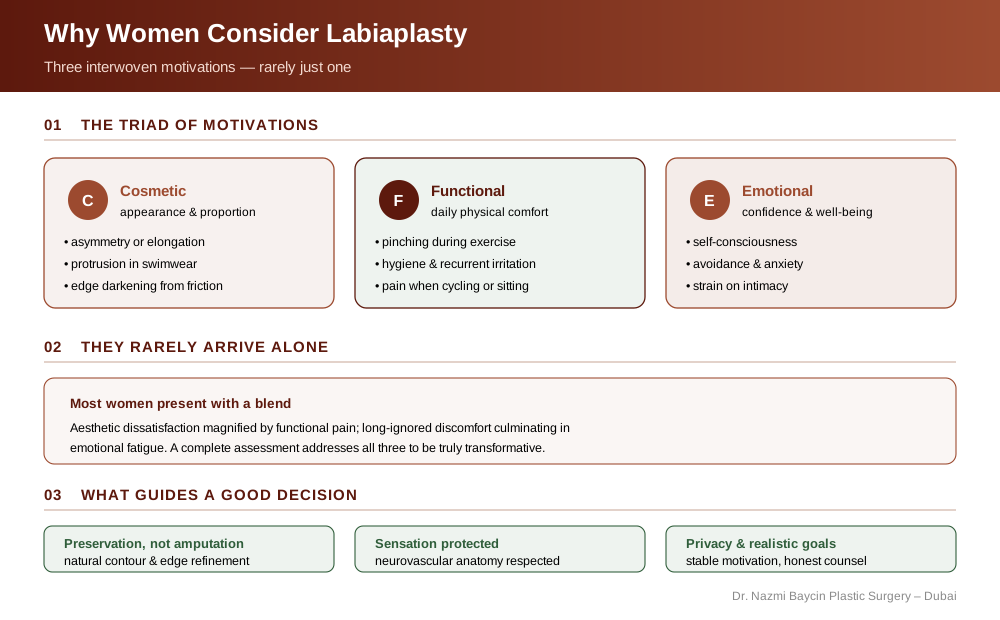
The three interwoven reasons women consider labiaplasty — cosmetic, functional, and emotional — and the principles that guide a sound decision, by Dr. Nazmi Baycin, Dubai.
Cosmetic concerns
A significant number of patients are affected by labial asymmetry or elongation, known as labia minora hypertrophy. This is not about conforming to an idealized image; it is about aligning one’s appearance with a personal sense of normalcy and comfort. Women describe distress at visible protrusion in swimwear or lingerie, or a “ballooning” appearance during activity. Some experience darkening of the labial edges from chronic friction.
A common technical error I am asked to correct is an overly simplistic resection that leaves an unnatural, amputated look or painful scar contracture. My approach is instead grounded in proportion and preservation, prioritizing natural contours and careful edge refinement.
Psychological and emotional barriers
The emotional impact is profound and very real. Women describe how self-consciousness turns into avoidance: insisting on darkness during intimacy, feeling anxious about routine medical examinations, or stepping back from exercise and clothing they once enjoyed. This constant background anxiety erodes confidence over time. The transformation after surgery is therefore not merely physical but deeply emotional.
A prospective 2025 study measuring self-perception and quality of sexual life reported significant improvements across validated psychological and functional scales after labiaplasty, reflecting exactly the emotional relief my patients describe — an honest account of outcomes is available in this 2025 study on self-perception and sexual quality of life after labiaplasty. My goal is an anatomical correction that lets patients set down long-held mental burdens and reclaim their body and intimate life without hesitation or shame.
Functional and medical concerns
For many women, the decision is driven by tangible daily discomfort that no amount of psychological adjustment can fix. This commonly includes chronic irritation and pinching during exercise, intercourse, or while wearing fitted clothing; hygiene challenges, where excess tissue traps moisture and leads to recurrent irritation; and pain during routine activities such as cycling, prolonged sitting, or using tampons. In an active lifestyle, these limitations are not minor — they interrupt exercise, work, and everyday ease. Addressing them with precision is a cornerstone of my surgical philosophy. To learn about the procedure itself, its technique and recovery, visit labiaplasty surgery in Dubai.
How the motivations interconnect
Rarely does a patient present with a single, isolated concern. More often it is a combination: aesthetic dissatisfaction magnified by functional pain, or long-ignored discomfort that has finally culminated in emotional fatigue. This is why my consultations are comprehensive — we discuss not just the anatomy, but the life being impacted. A successful outcome must address all three facets to be truly transformative. For the surgical thinking behind that natural, preservation-first result, my article on the anatomical philosophy of labiaplasty in Dubai explains the design principles in detail.
What patients realistically experience afterward
The outcome of a carefully performed labiaplasty is multidimensional. Patients report the resolution of the physical irritants that troubled them — no more pinching, simplified hygiene, and unrestricted comfort in intimacy. The emotional relief is equally significant: a new freedom in their choices, from clothing to activities they had quietly avoided. This depends on meticulous planning and execution, with close attention to scar placement, suture technique, and a supportive recovery protocol. Sensation is protected by respecting the neurovascular architecture of the tissue, which is why technique choice matters so fundamentally — a point I explore in my article on preserving sensation in labiaplasty in Dubai.
Why specialized expertise matters
This procedure requires more than general surgical skill; it demands an artistic eye for delicate anatomy and a deep understanding of functional outcomes. The risks of an inexperienced provider include over-resection, loss of sensation, visible scarring, and poor aesthetic lines. My practice is built on anatomical precision and respect for each patient’s individual form, with every incision planned to preserve natural architecture and pigmentation. Because each plan is individual, the specifics — including cost — are discussed transparently and privately at a confidential consultation. This philosophy of measured, anatomical artistry runs through all of my cosmetic surgery work in Dubai.
FAQs about the reasons for labiaplasty in Dubai
-
Is it normal to feel self-conscious about labial size or shape, and how do I know if my concerns are valid?
Labial variation is entirely normal — there is no universal standard for what labia minora should look like, and the range of natural anatomy is wide. What is not normal is persistent daily discomfort, pain during physical activity or intimacy, or a level of self-consciousness that shapes your clothing choices, avoidance of activities, or behavior during medical appointments. If any of these are present, your concern is clinically valid — not a vanity issue, and not something you simply need to accept. The starting point is a confidential consultation where your anatomy is assessed and your concerns are listened to without judgment.
-
What is labia minora hypertrophy, and is it a medical condition or simply cosmetic?
Labia minora hypertrophy refers to labial tissue that extends beyond the labia majora, either due to genetics, hormonal change, childbirth, or age-related tissue stretching. Whether it counts as medical or cosmetic is a false binary — most patients present with elements of both. Functional symptoms including chronic irritation, friction during exercise, hygiene difficulties, and discomfort during intimacy are genuinely medical. The aesthetic component — distress about visible protrusion or asymmetry — is equally real and equally deserving of consideration. A thorough consultation should address both dimensions.
-
Will labiaplasty affect sensation or sexual function?
When performed with a technique that respects the neurovascular architecture of the labial tissue — preserving the sensory nerve branches and subdermal vascular plexus — labiaplasty should not diminish sensation. In many patients, the resolution of chronic discomfort and self-consciousness during intimacy actually results in improved sexual satisfaction and confidence post-operatively. The risk of sensory loss is most significant with aggressive resection techniques that remove too much tissue or damage the sensory nerve branches at the labial edges — which is precisely why technique choice matters so fundamentally.
-
How do I know if I am a suitable candidate for labiaplasty?
Suitability is assessed across three dimensions: physical, psychological, and timing. Physically, the anatomy must present a genuine concern — either functional symptoms, aesthetic asymmetry, or both — with enough tissue present to allow meaningful correction without over-resection. Psychologically, motivations should be personal and stable, not driven by external pressure or a recent life event. Timing matters: the anatomy should be stable — ideally not planning further pregnancies in the near future, as childbirth can alter the result, and not immediately post-partum, as tissue requires time to stabilize after delivery.
-
What is recovery from labiaplasty like, and how much time do I need off?
The first 48 to 72 hours involve swelling and mild discomfort that is well-managed with prescribed analgesia and cold compress. Most women return to desk-based work within five to seven days. Physical activity, swimming, and intercourse are avoided for four to six weeks to allow complete wound healing. The final aesthetic result — with full swelling resolved and scars matured — is visible at three to six months. The recovery is more manageable than most patients anticipate, and the majority describe the discomfort as significantly less than they feared.
-
Is it possible to have labiaplasty in Dubai with complete privacy and discretion?
Yes — and this is something many patients in Dubai specifically ask about. All consultations are conducted in a private clinical setting, and the procedure itself is performed in a JCI-accredited hospital with full anesthetic care. There is no visible external evidence of the procedure, no employer notification, and the nature of the surgery means recovery at home is quiet and unremarkable. Medical records are confidential. Many of my patients travel from across the GCC and internationally for precisely this combination of high expertise and complete discretion in a private, professional environment.


GET APPOINTMENT
Get ready to look and feel best… You deserve…
