

When the labia minora are naturally thick, heavy, or prominent, the concern is rarely only aesthetic. Many women I see in Dubai experience real functional discomfort — persistent friction, pinching in clothing, and limits on athletic activity. Standard reduction techniques designed for thinner tissue often fall short here, risking bulky scars, unnatural contours, or diminished sensation. Thick labia minora are not simply a longer version of thin ones; they are an architecturally distinct structure, and they call for a technique built around volume rather than length.
Key takeaways: volume, not just length
- Thick labia minora are a distinct anatomical subtype, not a bigger version of thin tissue.
- The core problem is central volume and width, which edge trimming does not address.
- A central wedge resection reduces bulk while preserving the natural pigmented border.
- Thicker tissue carries denser vessels and nerves, so nerve-sparing dissection matters more.
- Incisions are camouflaged and closed tension-free so scars stay discreet.
- The goal is functional comfort as much as appearance — less friction, pinching, and catching.
My approach for thick labia minora in Dubai treats this as three-dimensional contouring rather than two-dimensional trimming — meticulously reducing volume and projection while preserving the delicate neuromuscular integrity and natural texture of healthy tissue. The principle is well established; the foundational 2008 description of extended central wedge resection showed that removing a wedge from the most protuberant portion, rather than trimming the edge, preserves the natural labial border and its sensation while achieving high satisfaction and reliable functional relief.
Why thick tissue demands a specialized protocol
Conventional labiaplasty often uses a linear resection along the edge. For thick tissue, that “trim” method is fundamentally mismatched to the problem: it removes length but ignores the central issue, which is volume. The result can be a shortened edge that remains thick, square, or puckered, often with a scar line sitting under tension.
Thick labia minora present a few specific challenges. The tissue bulk often carries a richer network of blood vessels and sensory nerves, so dissection has to be meticulous to preserve sensation and control bleeding.
The excess also exists in more than one dimension — not just length, but width and thickness from the base to the free edge — so correction has to address all three. And because thicker tissue behaves differently as it heals, the plan must anticipate how it will settle to prevent notching or distortion.
Edge trim versus central wedge: the core distinction
The single most important decision in a thick case, in the patients I plan for in Dubai, is where the tissue is removed from. An edge trim takes tissue from the border; a central wedge takes it from the core. For thick tissue, that difference determines the entire outcome.
| Consideration | Edge Trim (Linear Resection) | Central Wedge (Volume Reduction) |
|---|---|---|
| What is removed | Length from the border edge | Bulk from the central core |
| Natural pigmented edge | Removed, so color transitions can be lost | Preserved, keeping the natural border |
| Residual thickness | Edge can stay thick, square, or puckered | Width and thickness genuinely reduced |
| Scar and tension | Scar line sits under tension | Edges meet tension-free; scar hidden in the crease |
| Nerve preservation | Cuts across the densest edge nerves | Incisions kept away from the dense edge nerves |
This is why my planning starts from volume. I explore the reasoning behind individualized, form-and-function design more fully in my article on the anatomical philosophy of labiaplasty.
Patient-specific design for thick tissue
There is no template for thick labia minora, so every plan I design in Dubai begins with a detailed topographic analysis. I assess not just length, but the precise distribution of thickness, variations in pigmentation, and the relationship between the minora and majora — creating a unique surgical blueprint for each patient.
The cornerstone technique is central wedge resection with de-epithelialization. Rather than removing the outer edge, I excise a precisely calculated wedge from the central, less sensitive area, then bring together the outer edges — which are rich in natural pigmentation and nerve endings. This dramatically reduces bulk while maintaining the natural contour and color of the border.
In some cases I add composite refinement: a central reduction combined with a subtle tapering of the edge — not a full trim, but a delicate contouring to eliminate any residual heaviness. And where the thickness is uneven, differential thinning focuses the sculpting on the specific zones — base, mid-portion, or free edge — where it is most pronounced.
The blueprint is drawn while you are awake and in a natural position, so the final design accounts for the dynamic nature of your anatomy rather than a distorted operative one. This individualized, tissue-preserving design is the foundation of my broader approach to labiaplasty in Dubai.
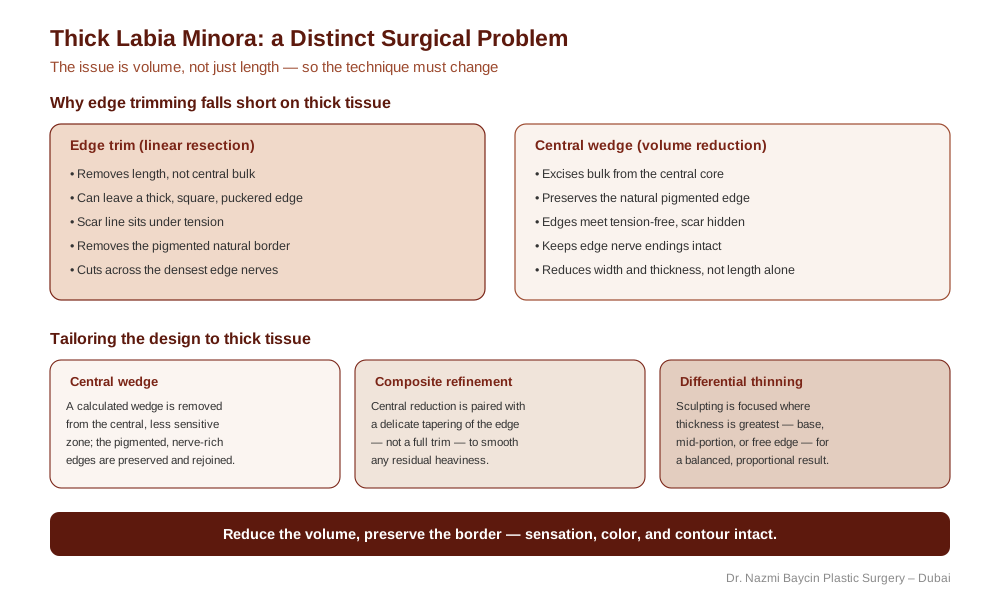
Why thick labia minora need central volume reduction rather than edge trimming, and how the design is tailored, by Dr. Nazmi Baycin, Dubai.
Preserving sensation in denser tissue
Preserving erotic and tactile sensation is the paramount functional goal, and thick tissue demands even more caution because the nerve pathways are more abundant. My technique is engineered around this principle.
I use a micro-surgical, nerve-sparing dissection, identifying and working within avascular planes and gently separating tissue layers to avoid transecting microscopic nerve bundles. The central wedge approach is particularly advantageous here, because the incision lines are placed away from the densest nerve concentrations at the labial edge.
The closure matters just as much. Fine, absorbable sutures placed in a multilayer fashion reapproximate the deep tissues, eliminating dead space and providing structural support without strangulating delicate nerves. The detailed anatomy behind this is the subject of my article on neurovascular anatomy in labiaplasty and preserving sensation.
Keeping the scar invisible
The fear of visible scarring is universal, and with thick tissue, poor technique can produce raised, pigmented, or contracted scars from excess tension. My approach is built to make scars virtually undetectable, and it starts with where the incision sits.
All incisions are placed within the natural crease where the labia minora meets the majora, or along the inner mucosal surface, so that once healed they rest in a natural shadow line. Because tissue is removed from the central core rather than the edge, the pulling tension that widens scars is eliminated and the edges come together effortlessly.
I use hair-thin sutures in a running subcuticular pattern, which places the suture material entirely beneath the surface, with no external knots to cause irritation or visible marks. How that healing is protected afterward is something I cover in my article on labiaplasty recovery and natural healing, and when a previous result needs correcting, in my article on labiaplasty revision for scarring and asymmetry.
Balancing aesthetics with biomechanical reality
The ultimate measure of success is daily life. A technically perfect but functionally uncomfortable result is a failure, so my planning always prioritizes long-term comfort and biomechanical harmony alongside appearance.
The functional benefits of reducing bulk correctly are meaningful: less friction against clothing during activity, resolved pinching and twisting as a tapered contour stops tissue catching or folding, and new comfort in activities like cycling, running, and yoga. A streamlined anatomy is also simpler to keep clean and more comfortable in all positions.
This balance is the whole point — aesthetic refinement should always enhance physical well-being, never work against it. Because every case is different, the design and its scope are best defined at a consultation with a full topographic assessment — the standard of care you should expect from any serious provider of cosmetic surgery in Dubai.
FAQs about labiaplasty for thick labia minora in Dubai
-
Why do thick labia minora need a different technique?
Because the problem is volume, not just length. Thick labia minora are bulky in width and thickness from the base to the free edge, whereas a standard edge trim only shortens the border. Trimming a thick labium can leave an edge that is still thick, square, or puckered, with a scar line under tension. The tissue also tends to carry denser blood vessels and nerves, so it needs a more careful, nerve-sparing dissection. Treating thick tissue well means reducing central volume while preserving the natural border, which is a genuinely different operation from a simple trim.
-
What is a central wedge resection?
It is a technique that removes a precisely calculated wedge of tissue from the central, less sensitive part of the labium, rather than trimming the outer edge. The pigmented, nerve-rich edges are then brought together, which preserves the natural color, contour, and sensation of the border while dramatically reducing bulk. For thick tissue this is advantageous because it addresses volume directly, keeps the incision away from the densest edge nerves, and allows a tension-free closure that heals with a discreet scar. It can be combined with subtle edge refinement when a small amount of residual heaviness remains.
-
Will I lose sensation?
Preserving sensation is the paramount functional goal, and the technique is designed around it. Thick tissue carries more abundant nerve pathways, so I use a micro-surgical, nerve-sparing dissection that works within avascular planes and avoids transecting microscopic nerve bundles. The central wedge approach helps here, because the incisions are placed away from the densest nerve concentrations at the labial edge, and the multilayer closure supports the tissue without strangulating delicate nerves. Most patients report preserved and often improved comfort, because reducing bulk relieves the friction and pinching that caused discomfort before.
-
Will the scars be visible?
The approach is built to make scars virtually undetectable. Incisions are placed within the natural crease where the labia minora meets the majora, or along the inner mucosal surface, so that once healed they rest in a natural shadow line. Because tissue is removed from the central core rather than the edge, the tension that widens scars is eliminated and the edges come together effortlessly. I also use hair-thin sutures in a running pattern beneath the surface, with no external knots to cause irritation or visible marks, which supports discreet, well-integrated healing.
-
Is this procedure functional or purely cosmetic?
For thick labia minora it is very often both. Many women seek treatment primarily because of functional discomfort — friction against clothing, pinching or twisting, and limitations during activities like cycling, running, or yoga — and reducing the bulk directly relieves these problems. At the same time, a well-designed reduction refines the contour and restores a natural, balanced appearance. My planning treats comfort and appearance as equally important, because a result that looks good but remains uncomfortable would not be a success. The aim is anatomy that both looks natural and functions comfortably in daily life.
-
Am I a good candidate?
Good candidates are women bothered by thick, heavy, or prominent labia minora, whether for functional discomfort, appearance, or both, who are in good general health with realistic expectations. Because thick tissue is anatomically distinct, the assessment focuses on the distribution of thickness, pigmentation, and the relationship between the minora and majora, rather than length alone. This is what determines whether a central wedge, composite refinement, or differential thinning — or a combination — is the right plan. The most reliable way to confirm suitability and design the approach is an in-person topographic assessment at consultation.
-
What is recovery like?
Recovery is generally well tolerated when the tissue is handled gently and closed without tension. There is usually some swelling and tenderness in the early phase, which settles over the following weeks, and I provide a personalized aftercare plan to support smooth healing. Activities that create friction or pressure are limited at first and reintroduced gradually, and the absorbable sutures do not need removal. Because the central wedge technique closes under minimal tension and keeps sutures beneath the surface, it tends to heal comfortably, with the final refined contour becoming apparent as the swelling fully resolves.


GET APPOINTMENT
Get ready to look and feel best… You deserve…
