


Table of content
- Are you a suitable candidate for a hair transplant?
- Can women have a hair transplant?
- What is the FUE technique?
- What is the advantage of the FUE method?
- How does PRP support a hair transplant?
- What is the recovery period like?
- What is FUE hair transplant without shaving?
- How much does a hair transplant cost in Dubai?
- Get appointment
Are you a suitable candidate for a hair transplant?
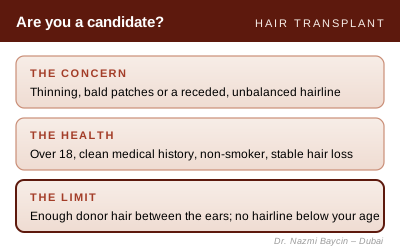
If you are a healthy adult — man or woman — with enough hair in the donor area between the ears, you may be an excellent candidate for a hair transplant. Some conditions do make the procedure unwise, though, and I am careful about them: serious chronic illness such as heart, vein, or kidney disease, uncontrolled diabetes, hemophilia, or any clotting disorder can all make it unsuitable.
I always begin with a thorough analysis of the pattern and type of your hair loss and the supply in your donor area, and I only proceed once I am confident the hair loss is suitable and there is enough donor hair to achieve a good result. Before a consultation, it helps to consider a few things:
- Whether your hair loss has stabilized, and the pattern of it.
- Whether you have a healthy donor area between the ears.
- Your general health and any chronic conditions or bleeding tendencies.
- That the goal is a natural, age-appropriate result rather than an unrealistically low or dense hairline.
Can women have a hair transplant?
Yes — hair transplantation works for both men and women. Because women do not usually experience the genetic pattern baldness that men do, the procedure is performed more often on men, but where a woman has suitable hair loss and a healthy donor area, it can restore density and reshape a hairline just as effectively. As always, it comes down to a careful assessment of the type of hair loss and the donor supply.
What is the FUE technique?
FUE stands for Follicular Unit Extraction, and it is the method I use. Individual hair follicles are carefully taken, one by one, from a donor area with plenty of hair, and moved to the areas that need more coverage. Using specialized instruments, I first gather the follicular units to be transplanted, and once I have collected enough grafts I place them into their new positions within the same session.
The same FUE follicle-by-follicle method is what I use to restore other areas too — including beard and mustache transplantation and eyebrow and eyelash restoration — each planned with the same attention to natural angle and direction.
What is the advantage of the FUE method?
The great advantage of FUE is that it leaves no noticeable marks. The tiny openings left at the donor site after each follicle is removed are practically invisible once healed — they typically close within twenty-four to forty-eight hours — so unlike older strip methods, FUE leaves no visible linear scar. That freedom means you can wear your hair short afterward without any tell-tale sign of the procedure.
How does PRP support a hair transplant?
Before I begin the transplant itself, I always incorporate PRP — platelet-rich plasma — because it genuinely improves the outcome. Your own blood plasma is rich in growth factors, and when these are injected into the area receiving the grafts, they create the ideal environment for the follicles to take hold: the growth factors act as nutrients that help the follicles bond with the scalp, and they encourage new blood vessels to form between the grafts and the scalp, which lowers the chance of graft loss. To get the most from it, I recommend at least four PRP sessions after the transplant, spaced about a month apart, to nourish the new hair and help it grow in stronger.
How does Dr. Baycin perform a hair transplant?

FUE harvesting: the harvester is kept parallel to the roots’ direction, not perpendicular to the skin.
Everything begins with the hairline, and getting its level and curve exactly right is the most important design decision of the whole procedure. I set the hairline’s level according to your age — a hairline placed lower than is natural for your age rarely looks good, however much a patient might want it — and I always mark it with a gentle curve rather than a straight line, because those two things, more than anything, are what make a transplanted hairline look natural rather than artificial.
Once the design is agreed, the technician shaves the donor area so the follicles can be collected easily, and I inject a local anesthetic there so you feel no pain during the procedure. I then work in three steps: first I collect the roots, then I make tiny incisions in the area to be treated, and finally I place the permanent roots into those incisions.
One technical detail makes a real difference to graft survival — when I harvest, I keep the harvester parallel to the direction of the roots, not perpendicular to the skin surface, which protects the follicles as they are lifted.
Is hair transplant painful?
A hair transplant is generally pain-free, thanks to the local anesthetic, and because the procedure involves only the top layers of the skin it is considered very safe and usually entirely straightforward. A good deal of your comfort comes down to the skill and care of the surgeon, and under the right conditions there are typically no side effects or health risks at all. The session itself takes around six to eight hours, and most patients happily pass the time listening to music or watching their favorite shows while I work through the three stages — collecting the follicles, making the tiny openings, and implanting each graft individually.
How many grafts will you need?
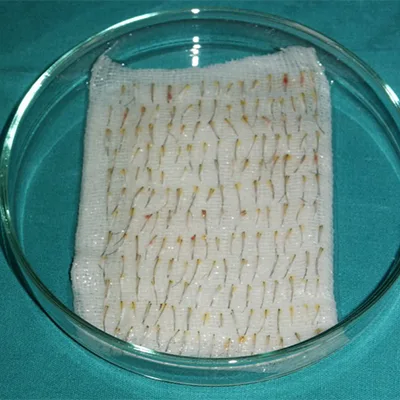
Single-hair grafts, prepared to build a natural front hairline.
I keep a careful count of the grafts in every session, and the number typically ranges from about one thousand to four thousand five hundred. How many you need depends on the hair density in your donor area and the needs of the recipient area, and the donor density in particular is crucial to the quality of the result.
Because each graft can contain one, two, or three roots, a single session can transplant a large number of individual hairs — up to around ten thousand.
There is a sensible limit, though: going beyond about four thousand five hundred grafts lengthens the procedure and can disrupt the good blood circulation the scalp needs to heal well, so if you need more than that, it is safer to split the work into a second transplant about six months later.
For cases needing more than three thousand five hundred grafts, the procedure may run across two days.
How is a natural hairline created?
The naturalness of the whole result lives at the very front. I build the leading edge of the hairline from grafts containing just a single hair, and the first eight to ten rows in particular should be single-root grafts — this is the single most important step in achieving a hairline that looks genuinely natural rather than planted. Behind that leading edge, grafts with two or three hairs are used to build density, so the hair looks full without ever betraying where the natural hairline ends and the transplant begins.

A natural hairline built from single-hair grafts.
Hair transplant before & after pictures


When will you see the final result?
Patience is a real part of this procedure. It is completely normal for the newly transplanted hairs to shed in the first few weeks — around sixty to seventy percent fall out within about three weeks — but the roots stay firmly in place, and that shedding is simply the follicles resetting before they grow. New hairs begin to sprout at about eight to twelve weeks and continue coming through and thickening over the following year, so the best time to judge the final result is around nine to twelve months after the procedure. What most determines that result is the surgeon’s skill and attention to detail — the hairline design with its natural recession at the sides, the direction each hair is implanted, and the way the crown is rooted in a whorl — because if any of those is wrong, the hair looks unnatural no matter how many grafts were placed.
The before-and-after photographs here show the kind of natural density and hairline design I aim for. As you look through them, the tell of good work is exactly what you should not be able to see — no obvious line, no pluggy tufts, just hair that looks like your own.
What is the recovery period like?
Recovery is quick and undemanding. In the first days you may notice a dry, flaky scalp with some scabbing, mainly at the donor area, and from the second day it is important to wash your head daily — the crusting lifts a little more with each wash and should be completely gone within about ten days. Most people are back to their normal routine, and able to wear a hat, about four to five days after the procedure.
How should you care following the procedure?
The recipient area, where the grafts were placed, shows very little crusting. The first couple of days are the crucial ones for the new follicles, and during that time the best thing you can do is simply follow my instructions and not worry about anything else; from the third day I will show you exactly how to wash your head. Washing once a day for the following ten days keeps the area clean and clearer by the day, and by the end of about two weeks both the donor and recipient areas have healed, with no visible marks on the scalp.
Will the new hair be permanent?
Yes. Although sixty to seventy percent of the transplanted hair sheds within the first few weeks, the roots themselves remain permanently. New hair starts to grow in at about eight to twelve weeks and continues to develop over a full year, thickening gradually toward the density you had before, which is why the result is best assessed at around nine to twelve months. Once everything has grown in, there is no need for any special care at all — you can cut, style, shape, or dye your hair exactly as you would naturally.
What is FUE hair transplant without shaving?
There is also a no-shave version of the FUE technique, which follows exactly the same steps but allows the hair to be transferred without shaving the head — an appealing option for many. It is available to any candidate found suitable after a thorough examination, with two honest caveats: the no-shave procedure takes longer than the standard shaved version, and if you have long hair there is a potential risk of losing up to around ten percent of the implants. After a full assessment I will tell you whether the no-shave approach is right for you.
Checklist before having hair transplant in Dubai, UAE
IMPORTANT ! Before getting the appointment, check your medical conditions yourself.
| # | Conditions | Safety | Aesthetic Suitability |
|---|---|---|---|
| 1 | Are you over 18? | 🟢 Fit for surgery | — |
| 2 | Would you like a lower or more balanced hairline position? | 🟢 Fit for surgery | 🟡 Ideal candidate |
| 3 | Do you have hair loss or visible bald areas on your scalp? | 🟢 Fit for surgery | 🟡 Ideal candidate |
| 4 | Do you wish to achieve a younger and more balanced facial appearance? | 🟢 Fit for surgery | 🟡 Ideal candidate |
| 5 | Do you have a cardiovascular problem such as heart disease or deep vein thrombosis? | 🔴 Contraindicated | — |
| 6 | Do you have pulmonary system problems such as chronic lung disease? | 🔴 Contraindicated | — |
| 7 | Do you have chronic liver disease? | 🔴 Contraindicated | — |
| 8 | Do you have a urinary system disease such as kidney failure? | 🔴 Contraindicated | — |
| 9 | Do you have a hematologic problem such as anemia or coagulopathy? | 🔴 Contraindicated | — |
| 10 | Do you have any transmitting disease through blood such as HIV? | 🔴 Contraindicated | — |
| 11 | Have you been taking anticoagulant medication? | 🔴 Contraindicated | — |
| 12 | Have you been taking psychotropic drugs? | 🔴 Contraindicated | — |
| 13 | Any drug abuse or addiction | 🔴 Contraindicated | — |
How much does a hair transplant cost in Dubai?
The cost of a hair transplant in Dubai depends on how large an area needs treatment and how many grafts are involved. In my practice, the starting price is AED 15,000, rising to around AED 20,000 depending on the graft number. You can see my general price list of the procedures for context, and I will give you an exact figure at consultation.
About Dr. Nazmi Baycin
Surgery, to me, is precision applied in service of restoration — a conviction that has guided every one of the more than 7,000 procedures I have performed over 25 years in practice. I am a DHA-licensed, board-certified plastic surgeon, trained in Turkey and based in Dubai since 2016. I operate exclusively within JCI-accredited hospitals, and hold international membership in the American Society of Plastic Surgeons (ASPS). Three techniques, in particular, have become signatures of my practice. Scarless breast augmentation, performed through a transaxillary approach that leaves no incision on the breast itself. Labiaplasty designed individually around each patient’s own anatomy, never to a standard template. And 3D customized facial bone implants, engineered through CT-based bespoke printing — a technique I currently offer as the only surgeon in Dubai providing it. My practice today spans facial rejuvenation, breast surgery, body contouring, and cosmetic genital procedures, drawing patients from across the UAE, Europe, and the wider GCC. Yet the principle guiding each of these specialties has never changed: to restore form is to restore function.
FAQs about hair transplant in Dubai
-
Is a hair transplant painful?
No; it is done under local anesthesia and involves only the top layers of skin, so it is pain-free and very safe. The session takes about six to eight hours.
-
How many grafts will I need?
Usually between 1,000 and 4,500 per session, depending on donor density and the recipient area; over 4,500 is best split into a second session about six months later.
-
When will I see the final result?
Transplanted hair sheds in the first few weeks (about 60–70%), new growth begins at 8–12 weeks, and the final result is seen at about 9–12 months.
-
Will the transplanted hair be permanent?
Yes; the roots remain permanently, and once grown in you can cut, style, or dye the hair normally.
-
Can it be done without shaving?
Yes, a no-shave FUE option is available for suitable candidates; it takes longer and carries up to about a 10% implant-loss risk with long hair.
-
How much does a hair transplant cost in Dubai?
In Dr. Baycin’s practice it starts at AED 15,000, rising to around AED 20,000 depending on the graft number.


GET APPOINTMENT
Get ready to look and feel best… You deserve…
