


Table of content
- What is deviated septum?
- Why does a deviated septum block your breathing?
- How is a deviated septum diagnosed?
- How does Dr. Baycin perform septoplasty?
- What are the risks and complications of septoplasty?
- How much does a septoplasty surgery cost in Dubai, UAE?
- FAQs about septoplasty in Dubai
- Get appointment
The hardest thing in septum surgery is not removing the crooked cartilage — it is knowing how much to leave behind. I am Dr. Nazmi Baycin, and across more than two hundred septoplasty procedures I have built my technique around that restraint: straightening the septum enough to restore easy breathing, while preserving the cartilage that holds the whole nose up. My septoplasty in Dubai is guided by a principle too often overlooked — that the support of the nasal roof matters as much as the airway, and that over-removing the septum is the very thing that ruins noses and forces second operations.
A deviated septum is extremely common, and when it is significant it can quietly rob you of half your breathing for years. Correcting it well restores comfortable airflow and, where the nose looks crooked because of it, a straighter shape too. Performing deviated-septum surgery in Dubai within JCI-accredited hospitals, I correct the deviation conservatively, reduce the turbinates when they have enlarged in response, and protect the structure throughout. The principle is the one that guides all my work: to restore form is to restore function.
Septoplasty in Dubai quick facts
| Procedure detail | Septoplasty in Dubai |
|---|---|
| Purpose | Functional — straightens the septum to restore breathing |
| Key principle | Conservative: <½ removed, ≥1 cm L-strut preserved |
| Often includes | Turbinate reduction (for turbinate hypertrophy) |
| Anesthesia | General (preferred for a complete correction) |
| Procedure time | About 1–1.5 hours (longer if combined) |
| Incisions | Inside the nose — no visible scar |
| Nasal pack | Both nostrils; removed at ~2 days |
| Hospital stay | Day case — home the same day |
| Downtime | 1–2 days |
| Breathing | Improves immediately; opens further over 1–2 months |
| With rhinoplasty | Combined as septorhinoplasty (form + function) |
What is a deviated septum?
The nasal septum is the wall that divides the two nasal passages down the middle — cartilage at the front, transitioning into bone as it extends about four to five centimeters back. Ideally it sits straight and vertical; when it does not, we call it a deviated septum. It is remarkably common: around seventy percent of people have some degree of deviation. A mild deviation usually causes no trouble and needs no treatment, but a more pronounced one can both affect the shape of the nose and make breathing genuinely difficult, and that is when septoplasty is needed to restore the airway. Many people who have it never realize — they have breathed this way their whole lives and assume it is normal, not knowing they are not getting enough air.
Why does a deviated septum block your breathing?
How blocked you feel tracks closely with how deviated the septum is. A significant deviation narrows one nostril while leaving the other wider, and when the deviation is severe it can cause persistent congestion and even alter the shape of the nose. C-shaped deviations are the most common, with S-shaped ones appearing from time to time.
How one blocked side leads to both (turbinate hypertrophy)

A deviated septum and the enlarged turbinate that narrows the other side.
Here is the part that surprises most patients. When one side is narrowed, airflow drops on that side and increases on the wider side — and over time the turbinate (the scroll of tissue on the side wall) on the wider side enlarges in response, trying to rebalance the flow. This is turbinate hypertrophy.
As that turbinate grows, it narrows the once-wider passage too, so a problem that began on one side ends up obstructing both — bilateral nasal airway obstruction. What started as a minor deviation can therefore progress to constant congestion and contribute to snoring. It is also why correcting the septum alone is sometimes not enough, and the enlarged turbinate must be reduced at the same time.
How is a deviated septum diagnosed?
Diagnosis rests mainly on two things: your own description of the problem and a physical examination, which together are usually enough to confirm a deviated septum. Where I need more detail about the exact type and location of the deviation before surgery, an X-ray or CT scan can add valuable information and help me plan the most precise correction.
What does Dr. Baycin aim for in septum surgery?
My goal is simple: to help you breathe easily, because clearing nasal congestion genuinely transforms quality of life. Many of the patients who come to me have already had a septoplasty elsewhere that did not fully work — left with an under-corrected septum, or a deviation that returned because of cartilage memory, and still congested. This is the single most common reason patients seek my help, and corrective septoplasty can be even more difficult than the first operation. That is exactly why it matters so much to get it right the first time, and why my aim is always to achieve the best possible outcome in a single, well-planned procedure.
How does Dr. Baycin perform septoplasty?
The nasal septum is the main support of the nasal roof, holding the surrounding cartilages in place — it is, in effect, a central pillar of the nasal skeleton, part cartilage and part bone. So when I correct a deviation, I treat every millimeter I remove with caution, because what remains is what keeps the nose standing.
Why how much septum is left matters more than how much is removed
This is the heart of safe septum surgery. During the resection I remove less than half of the septum, and I always leave a bridge of at least one centimeter in width along the front and lower part — the L-strut — without detaching its connections, because that one-centimeter bridge is strong enough to carry the nasal roof. Some surgeons believe that the more cartilage they take, the more the airway opens and the better you breathe. It is not so. The important thing is not how much cartilage is removed, but how much is left intact: true mastery is straightening the septum by removing only as much of the skewed cartilage as is needed to overcome its memory, and no more. Over-resection of the septum is one of the most common reasons a secondary rhinoplasty becomes necessary — to repair a depressed nasal roof or a drooping tip. I share this not to alarm you but to make you aware: performed on these basic principles by an experienced plastic surgeon, septoplasty does not produce such results. The published evidence supports protecting the strut: in a retrospective series of thirty patients using the validated NOSE breathing score, correcting deviation within the septal L-strut while preserving nasal support improved nasal-obstruction scores from 47 to 14 at three months, with no cases of saddle-nose collapse.
Correcting the deviation (and the turbinates)
Correcting a deviated septum usually takes about an hour, though it varies with severity. Some surgeons use local anesthesia, but I prefer general anesthesia for a more thorough, complete correction. Because deviations come in different shapes, the method is tailored to each — and where turbinate hypertrophy accompanies the deviation, I reduce the enlarged turbinate at the same time. You can go home the same day. At the end of the operation I place a nasal pack in both nostrils to hold the septum aligned in the center while it settles.
What is functional septorhinoplasty?
If you have trouble breathing, any deviated septum causing that congestion should be corrected at the same time as a rhinoplasty — and when cosmetic nose surgery is combined with the functional correction of a deviated septum, we call it septorhinoplasty. The two belong together: where the deviation also affects appearance, the nose simply will not look straight until the septal problem is fixed, which is why septoplasty is a crucial part of nasal surgery. A surgeon who reshapes the outside without correcting the septum can leave you with a nose that neither looks right nor breathes well. The aim of combining the two is a nose that is both beautiful and easy to breathe through — the true measure of a successful operation. To understand the preservation philosophy behind the rhinoplasty approach I practice, see my article on preservation rhinoplasty in Dubai, and my full approach to cosmetic nose surgery. Where a previous nose operation has already compromised both the airway and the shape, the rebuild is a different problem — I cover it in restoring breathing and shape after previous nose surgery.
| Factor | Septoplasty | Septorhinoplasty |
|---|---|---|
| Main goal | Restore breathing (functional) | Restore breathing + reshape the nose |
| Treats | Deviated septum (± turbinate) | Deviated septum + external nose shape |
| Best for | Blocked breathing, straight-looking nose | Blocked breathing with a crooked or unbalanced nose |
| External change | None intended | Yes — straighter, more balanced nose |
| Visible scar | None (internal) | None or a tiny columellar scar |
Where does Dr. Baycin perform septoplasty in Dubai?
I perform every septoplasty in a JCI-accredited, state-of-the-art hospital in Dubai that meets the highest international standards for safety and cleanliness. Your surgery takes place in a fully equipped, advanced medical environment, with precision and your wellbeing the first priorities at every step.
What is recovery after septoplasty like?
A little blood oozing from the nostrils on the first day is completely normal and settles by the next day. You will come back to see me two days after your septoplasty so I can remove the nasal pack — and once it is out, you will notice the difference in your breathing immediately. From there, as the swelling subsides day by day, the airway continues to open, and breathing becomes easier and easier over the following one to two months. There are no external stitches to remove, since the work is done inside the nose. To understand the full science behind how I support your healing after surgery, see my advanced recovery protocol in Dubai article.
Download Dr. Baycin’s septoplasty aftercare instructions
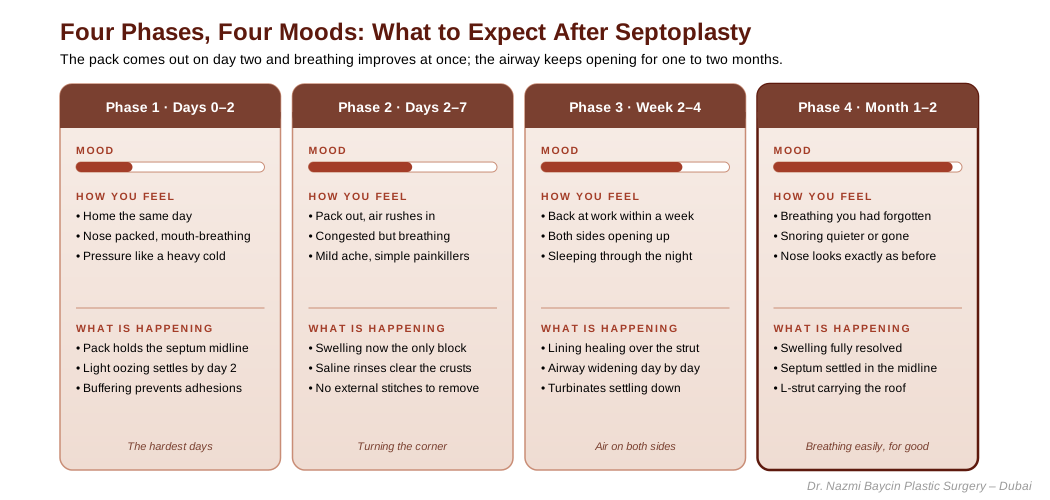
Septoplasty is one of the quickest recoveries in nasal surgery. You go home the same day with both nostrils packed, breathing through the mouth, with the pressure of a heavy cold and a little oozing that settles by the next day; intranasal buffering runs for two days to head off adhesions. On day two I remove the pack, and the difference in your breathing is immediate. What remains after that is swelling, not obstruction: saline rinses clear the crusts, there are no external stitches because all the work was inside, and most patients are back at work within a week. Over the following weeks the lining heals over the preserved L-strut and the airway widens day by day, the turbinates settling as airflow rebalances, until at one to two months the swelling is gone and the septum sits in the midline, with the outside of the nose unchanged. The mood follows: blocked and impatient, then relieved, then steadily freer, then simply breathing without thinking about it. The pace varies with personality; the shape rarely does.
What are the risks and complications of septoplasty?
Septoplasty is a safe operation, but a few specific risks are worth understanding honestly. A septal perforation — a small opening between the two nostrils through a defect in the septal lining — is rare; if it is small and causes no functional problem it can simply be left alone, while a larger one may need surgical repair.
Synechiae, adhesions of the nasal lining, can form after surgery; to prevent them I use intranasal buffering for two days, and if any do develop they are usually resolved simply by dividing the adhesion.
Active bleeding (as distinct from minor oozing) can occasionally follow turbinate reduction, particularly when scissors are used — which is why a laser or radiofrequency device for the turbinate typically avoids it.
And, as I have said, removing too much septum can change the shape of the nose and require a corrective secondary procedure. Each of these is uncommon in experienced hands, and where any complication arises it can be managed and treated effectively.
Checklist before having septoplasty in Dubai, UAE
IMPORTANT ! Before getting the appointment, check your medical conditions yourself.
| # | Conditions | Safety | Aesthetic Suitability |
|---|---|---|---|
| 1 | Are you over 18? | 🟢 Fit for surgery | — |
| 2 | Do you have nasal obstruction and breathing difficulty? | 🟢 Fit for surgery | 🟡 Ideal candidate |
| 3 | Do you experience snoring or sleep-related breathing issues? | 🟢 Fit for surgery | 🟡 Ideal candidate |
| 4 | Do you have a cardiovascular problem such as heart disease or deep vein thrombosis? | 🔴 Contraindicated | — |
| 5 | Do you have pulmonary system problems such as chronic lung disease? | 🔴 Contraindicated | — |
| 6 | Do you have chronic liver disease? | 🔴 Contraindicated | — |
| 7 | Do you have a urinary system disease such as kidney failure? | 🔴 Contraindicated | — |
| 8 | Do you have a hematologic problem such as anemia or coagulopathy? | 🔴 Contraindicated | — |
| 9 | Do you have any transmitting disease through blood such as HIV? | 🔴 Contraindicated | — |
| 10 | Have you been taking anticoagulant medication? | 🔴 Contraindicated | — |
| 11 | Have you been taking psychotropic drugs? | 🔴 Contraindicated | — |
| 12 | Any drug abuse or addiction | 🔴 Contraindicated | — |
How much does a nasal septum correction (Septoplasty) cost in Dubai, UAE?
The cost of deviated septum surgery in Dubai can vary from one clinic to another. Generally, you can expect to pay anywhere from 15,000 AED (about $4,100) to 30,000 AED (around $8,200). These figures don’t represent Dr. Baycin’s specific rates; you’ll get the exact price during your consultation after he evaluates your condition.
For a complete overview of treatment fees, please refer to full price list of the procedures.
Schedule your private consultation with Dr. BaycinWhat makes Dr. Baycin an exceptional nasal septum surgeon in Dubai?
Patients seeking septum surgery want more than a technically corrected airway — they want easy breathing, comfort, and a nose that still looks like theirs — and with more than 200 successful procedures, that is the standard Dr. Baycin holds.
- Decades of expertise: a board-certified plastic surgeon, DHA-licensed and a member of the American Society of Plastic Surgeons (ASPS), with more than 25 years of specialized surgical experience in nasal surgery.
- Personalized surgical planning: no two noses or goals are alike, so every plan respects both function and aesthetics, restoring breathing while keeping natural facial balance.
- Mastery of structure-preserving technique: correcting septal deviations with minimal disruption to surrounding tissue and a preserved supporting strut — precise alignment that improves airflow without endangering the nose.
- Faster recovery, less downtime: a refined approach that means less swelling and an earlier return to normal life than traditional techniques.
- A proven safety record: zero major complications across his nasal-septum surgeries, reassuring patients who value both results and well-being.
- Transparent consultations: clear explanations of options, outcomes, and recovery so you can decide with full understanding.
- Comprehensive aftercare: continuous follow-up support, guiding you step by step to the best healing and a lasting result.
- Trusted internationally: patients travel from Europe, the GCC, and beyond for his nasal surgery in Dubai.
- Results that improve lives: 200+ septum surgeries celebrated for restoring effortless breathing and quality of life.
- A surgeon with heart: an empathetic approach that recognizes nasal surgery affects both health and confidence.
About Dr. Nazmi Baycin
Surgery, to me, is precision applied in service of restoration — a conviction that has guided every one of the more than 7,000 procedures I have performed over 25 years in practice. I am a DHA-licensed, board-certified plastic surgeon, trained in Turkey and based in Dubai since 2016. I operate exclusively within JCI-accredited hospitals, and hold international membership in the American Society of Plastic Surgeons (ASPS). Three techniques, in particular, have become signatures of my practice. Scarless breast augmentation, performed through a transaxillary approach that leaves no incision on the breast itself. Labiaplasty designed individually around each patient’s own anatomy, never to a standard template. And 3D customized facial bone implants, engineered through CT-based bespoke printing — a technique I currently offer as the only surgeon in Dubai providing it. My practice today spans facial rejuvenation, breast surgery, body contouring, and cosmetic genital procedures, drawing patients from across the UAE, Europe, and the wider GCC. Yet the principle guiding each of these specialties has never changed: to restore form is to restore function.
FAQs about septoplasty in Dubai
-
What is septoplasty?
Septoplasty is the operation I perform to straighten a deviated nasal septum, the wall of cartilage and bone that divides the two sides of the nose. When this wall is crooked, it obstructs airflow and makes breathing difficult. It is a purely functional procedure focused on restoring easy breathing, quite distinct from a cosmetic nose job, and it does not change the outward shape of your nose. My aim is a clear airway and a lasting result, achieved while carefully preserving the nose’s support structure.
-
How much does septoplasty cost in Dubai?
The cost of deviated septum surgery in Dubai can vary from one clinic to another, and generally you can expect to pay anywhere from AED 15,000 to AED 30,000, depending on the complexity of the correction. These are general market figures, not Dr. Baycin’s personal rates; the precise cost is confirmed at your consultation, once your septum has been assessed.
-
What is a deviated septum, and what problems does it cause?
The septum is the partition of cartilage and bone that separates your two nasal passages. Ideally it sits straight down the middle, but in many people it is deviated, or crooked, either from birth or after an injury. When it is significantly off-center, it narrows one or both airways and obstructs airflow. This can cause persistent difficulty breathing through the nose, congestion, disturbed sleep or snoring, recurrent sinus problems, and even nosebleeds. Septoplasty corrects the deviation to relieve these symptoms.
-
How is septoplasty different from rhinoplasty?
This is an important distinction. Septoplasty is a functional operation performed inside the nose to straighten the septum and improve breathing; it does not alter the external appearance of the nose at all. Rhinoplasty, by contrast, reshapes the outward form of the nose for cosmetic reasons. The two are entirely different in purpose, though they can be combined in a single operation, called septorhinoplasty, when someone wants to both breathe better and change the shape of their nose.
-
How do you perform septoplasty?
I work entirely through the inside of the nose, so there is no external incision and no visible scar. Through a small internal incision, I lift the lining that covers the septum, then remove or reshape the deviated portions of cartilage and bone that are obstructing the airway, and reposition the septum to the midline. Crucially, I preserve enough of the central cartilage framework to keep the nose fully supported, then let the lining settle back into place over the corrected structure.
-
Why is preserving the nasal support structure so important?
This is central to a safe, lasting result, and it is where careful technique really matters. The septum is not just a partition; it is a key structural support for the nose. If too much cartilage is removed in the pursuit of a straight septum, the bridge or tip of the nose can lose support and gradually collapse over time, a serious complication. So I always leave an adequate framework of cartilage, known as the L-strut, intact, correcting the deviation without ever undermining the nose’s foundation.
-
Will septoplasty change how my nose looks?
No. Septoplasty is performed entirely inside the nose and is designed to improve your breathing without altering the external appearance of your nose at all. Because I preserve the essential support structure, the shape and profile you see from the outside stay the same. If you do also wish to change the look of your nose, that is a separate goal we can address by combining the septoplasty with a rhinoplasty, but on its own septoplasty leaves your appearance unchanged.
-
Can septoplasty be combined with other procedures?
Yes, and often it makes sense to. It is frequently combined with a rhinoplasty, as a septorhinoplasty, for patients who want to improve both their breathing and the shape of their nose in one operation and recovery. It is also commonly paired with turbinate reduction, since enlarged turbinates, the small structures inside the nose, often contribute to blockage alongside a deviated septum. At consultation I assess your whole airway and recommend what will best relieve your symptoms.
-
What is recovery after septoplasty like?
Recovery is quite manageable. It is a day procedure, so you go home the same day, and most people return to work within about a week. The main experience in the first days is nasal congestion and a blocked feeling, as internal swelling is normal at first, so your breathing actually improves gradually rather than instantly. I guide you through simple saltwater rinses and aftercare, and full internal healing continues over several weeks as the swelling settles and breathing steadily clears.
-
Is septoplasty painful?
Most people find it more uncomfortable than painful. It is performed under general anesthesia, so you feel nothing during surgery, and afterward the main sensation is congestion and pressure, much like a heavy cold, rather than sharp pain. Simple pain relief is usually enough to stay comfortable. The blocked-nose feeling in the first week is the main nuisance, and it eases steadily as the internal swelling goes down and the airway opens up.
-
Is septoplasty safe, and what are the risks?
In experienced hands septoplasty is a safe, well-established procedure. As with any surgery, there are small risks such as bleeding, infection, or temporary numbness of the front teeth or nose tip, which usually settles. The complication I most carefully guard against is loss of nasal support from removing too much cartilage, which is precisely why I preserve the L-strut framework. Good general health and a clean medical history further support a safe procedure and smooth recovery.
-
Are you a good candidate for septoplasty?
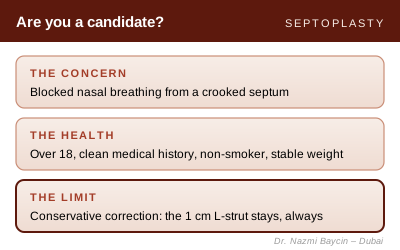
You are likely a good candidate if you have persistent difficulty breathing through your nose, congestion, disturbed sleep, or recurrent sinus problems caused by a deviated septum, and these have not resolved with medication. Good general health is important, and it is best for the nose to be fully grown, generally from later teenage years. A clean medical history is the foundation of safe surgery. At consultation I examine your septum and airway to confirm that septoplasty is the right solution for you.


GET APPOINTMENT
Get ready to look and feel best… You deserve…
