


Table of content
- Why might you consider buccal fat removal?
- What are the benefits of buccal fat removal?
- Can you preview how your face will look?
- How does Dr. Baycin perform buccal fat removal?
- What is recovery after buccal fat removal like?
- What are the risks and complications of buccal fat removal?
- Checklist before having buccal fat reduction
- How much does a buccal fat removal cost in Dubai, UAE?
- Get appointment
The shape of the face shapes how we are seen — and for some people, fullness in the cheeks can make the face look rounder, softer, or a little older than they feel. I am Dr. Nazmi Baycin, and my buccal fat removal in Dubai refines that fullness precisely, removing the deep fat pad that sits within the cheek to reveal a slimmer, more sculpted jaw and cheekbone, while keeping your expression natural and soft. The whole art of it lies in taking exactly the right amount, from exactly the right place.
That precision starts with a proper diagnosis. Performing buccal fat removal in Dubai within JCI-accredited hospitals, I first work out which layer of facial fat is actually causing the fullness — because the cheek has more than one — and only then decide how, and how much, to remove. Done well, cheek fat reduction in Dubai is a small procedure with a genuinely elegant effect. The principle is the one that guides all my work: to restore form is to restore function.
Buccal fat removal in Dubai quick facts
| Procedure detail | Buccal fat removal in Dubai |
|---|---|
| Treats | Excess deep cheek fat (buccal fat pad) causing a round, full face |
| Technique | 1 cm incision inside the mouth; laser/RF-assisted removal |
| Anesthesia | Local, with optional sedation |
| Procedure time | About 30–40 minutes (15–20 min per cheek) |
| Hospital stay | Day case — home 1–2 hours after resting |
| Scars | None visible — incision is inside the mouth |
| Stitches | Dissolvable (none to remove) |
| Aftercare | Soft foods 3–4 days; antiseptic rinse after meals ~5 days |
| Back to routine | Next day; swelling settles within ~1 week |
| Final result | 2–4 months |
Why might you consider buccal fat removal?
The face expresses so much of who we are, and its shape is a big part of that. If you have a naturally round face, even a small amount of weight gain can read as chubbiness — and sometimes as a few extra years — because the fullness of the cheeks is one of the first things the eye notices. A moderate amount of cheek fat gives a healthy, youthful look, but too much can create the soft, rounded moon-face effect that many people would rather refine.
We are all born with those lovely full baby cheeks, and for most of us the cheek fat slows its growth through childhood so that the face looks more balanced by adolescence. For some, though, that fullness carries on into adulthood, leaving a rounder face — and if that is you, and you are hoping for a more defined, sculpted look, buccal fat removal may be exactly the answer.
What are the benefits of buccal fat removal?
By removing the excess deep fat from both cheeks, buccal fat reduction refines the fullness and brings the underlying structure of the face forward. Patients choose it for a range of related benefits:
- A more balanced, harmonious facial shape.
- A softer, more refined facial expression.
- A more defined cheek and cheekbone contour.
- A slimmer, more youthful look.
- An overall sense of facial rejuvenation.
- The lift in self-confidence that comes with all of the above.
Can you preview how your face will look?
Here is a simple trick that gives you a genuinely good preview before you commit to anything. Stand in front of a mirror, and gently draw your cheeks in by biting down softly on the inside of them with your upper and lower teeth. The slimmer, more sculpted cheek line you see is very close to what buccal fat removal will give you. It is a reassuring way to picture the result for yourself, and a good starting point for the conversation we will have about whether the effect suits your face.
Are you a good candidate for buccal fat removal?
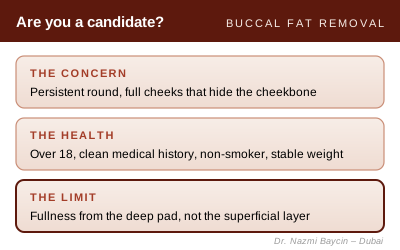 Buccal fat removal suits people with genuine fullness in the cheeks who would like a more defined, contoured face — and, importantly, whose fullness comes from the deep fat pad rather than something better treated another way. Before your consultation, it helps to consider a few things:
- Your cheeks. Do you have persistent, rounded cheek fullness that the mirror-bite preview improves?
- Your age and face. Because cheeks naturally lose a little fullness with age, I take care not to over-remove in younger patients — a conservative amount now protects you from looking gaunt later.
- Your health. A clean medical history and good general health are the foundation of safe surgery.
- Your expectations. Natural, balanced refinement — not an extreme hollowing — makes for the happiest, most lasting result.
We will assess your face together and agree on the approach that genuinely suits you. The reasoning behind that restraint — what the buccal fat pad actually does, and why over-resection accelerates midface aging — is set out in my article on why preserving buccal fat matters.
Where the heaviness sits lower down — beneath the chin and along the jawline rather than in the mid-cheek — the fat responsible is a different one, and removing the buccal pad will not address it; that is the territory of submental fat correction. And where the underlying issue is a weak jaw or chin projection making the lower face look soft rather than any excess fat at all, the answer is structural, not subtractive — see reshaping the chin profile.
How does Dr. Baycin perform buccal fat removal?

A 1 cm incision inside the mouth is enough to remove the buccal fat.
Buccal fat removal is a refined, quick procedure, and I perform it entirely from inside the mouth, so there is no scar on the skin at all. Local anesthesia, on its own or with a little sedation, is usually all that is needed to keep the area comfortable.
I begin with a small incision, about one centimeter, in the lining (mucosa) inside the cheek, which gives me direct access to the fat-pad capsule, and I then carefully separate the fat from the surrounding tissue. At this stage I use a laser or radiofrequency device to cauterize the connections of the fat pad — an important step that disconnects it cleanly and controls bleeding as I go. I then check carefully that there is no active bleeding before closing the incision with absorbable stitches. How much I take is a deliberate judgement rather than a fixed amount: I deliver only part of the central body of the pad, typically 30 to 50 percent of the accessible fat, and leave the extensions that support surrounding structures undisturbed.
Each cheek takes only about fifteen to twenty minutes. Buccal fat reduction or repositioning can also be carried out as part of a facelift, where it complements the deeper lift beautifully. The published evidence on safety is reassuring, though thin: a systematic review of eight studies, none of them clinical trials, found minor complications in around 8.5% of the 71 patients assessed for them, with no salivary-duct or facial-nerve injuries — while concluding that long-term outcome data are still lacking and that controlled studies are needed.

Both buccal fat pads after removal.
What is the difference between buccal fat removal and liposuction?
This is where understanding the anatomy really matters, because the face has two distinct layers of fat that behave quite differently. The first is the superficial layer, sitting just beneath the skin and varying in thickness across the face; the second is the deeper layer — the buccal fat pad itself — which has a specific home on the inner cheek wall, beneath the muscle, at the deepest point. Because each layer shapes the face in its own way, liposuction and buccal fat removal do genuinely different things, and neither is simply “better” than the other.
Liposuction thins the superficial fat from below the eyes down to the neck, where that layer tends to be thicker, while buccal fat removal targets the specific deep fullness within the cheek. What I do at consultation is look closely at where your facial fullness actually comes from, identify which layer is responsible, and recommend the procedure — or the combination of both — that will give you the look you have in mind.
| Factor | Buccal fat removal | Facial liposuction |
|---|---|---|
| Fat layer | Deep buccal fat pad (beneath the muscle) | Superficial fat (just under the skin) |
| Area | Mid-cheek fullness | Below the eyes down to the neck |
| Effect | Defines the cheek hollow and cheekbone | Thins a broader, thicker fat layer |
| Incision | Inside the mouth (no visible scar) | Tiny external access points |
| Combine? | Yes — the two target different fat layers and are often combined for a fuller facial-contouring result. | |
Where does Dr. Baycin perform buccal fat removal in Dubai?
I perform every buccal fat removal in a world-class, JCI-accredited hospital in Dubai that meets the highest international standards of safety and cleanliness. Your procedure is carried out with precision and full attention to your safety, in a modern, fully equipped surgical setting designed for comfort and trust. Buccal fat removal is one of several ways I refine the shape of the face; for the fuller picture of facial reshaping, see my face transformation page.
What is recovery after buccal fat removal like?
Recovery from buccal fat removal is quick and straightforward. You can go home just one to two hours after the procedure, once you have rested, and most people are back to their usual routine by the very next day. Because the incision is inside your mouth, I ask you to keep to soft foods for the first three to four days, and to rinse with an antiseptic mouthwash after meals for about four to five days to keep the area clean. The stitches are absorbable and dissolve on their own within about seven to ten days, so there is no need to come back to have them removed.
To understand the full science behind how I support your healing after surgery, see my advanced recovery protocol in Dubai article.
When will you see the final result?
Patience is part of this procedure, and it is worth knowing what to expect. Right after surgery, a little oozing and some soft-tissue swelling fill the space where the fat was, so your cheeks may actually look a touch puffier at first than they did before. That swelling and any pooled fluid usually settle within three to five days, and by the end of the first week it can seem as though nothing was done at all. Then the real change begins, slowly: over the next two to four months the space where the fat was removed gradually closes as the tissues settle together, and the new, more sculpted shape of your cheeks emerges. So the final result of your buccal fat removal is something to look forward to at around two to four months, not the first week.
Download Dr. Baycin’s buccal fat removal aftercare instructions
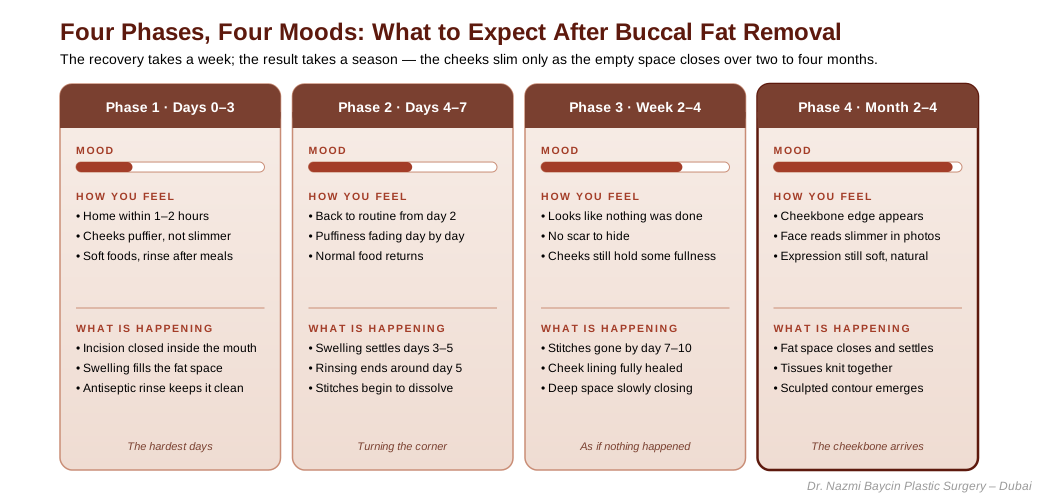
I like to be honest that buccal fat removal has two timelines, and they do not run at the same speed. The body’s part is quick. You go home one to two hours after the procedure, the incision inside the mouth is already closed with dissolving stitches, and for the first three to four days you keep to soft foods and rinse after every meal. The swelling that fills the space where the fat was settles between days three and five, the rinsing ends around day five, and by the end of the first week the stitches are dissolving and the cheek lining has healed. The mood follows a different curve. The first days can be disheartening because the cheeks look puffier, not slimmer. Then the puffiness fades and the face looks as though nothing was done, which is reassuring and slightly frustrating in equal measure. The real reward arrives over months two to four, as the empty space closes and the cheekbone quietly emerges. The pace varies with personality; the shape rarely does.
Buccal fat removal before and after pictures

Buccal fat removal before and after picture
What are the risks and complications of buccal fat removal?
I believe in being honest about risk, and buccal fat removal is, in experienced hands, a safe procedure — the complication rate reported across the 71 patients assessed in a systematic review is around 8.5%, mainly minor issues such as bleeding and infection. Bleeding is largely avoidable with careful control during surgery, and the risk of infection is kept low by antibiotics and by rinsing with an antiseptic solution after meals for the first few days.
What I want to be candid about is why this procedure demands real expertise: the buccal fat pad sits in close company with the salivary (parotid) duct, the buccal nerve, and major facial vessels, so there are genuine pitfalls if it is not done carefully. That proximity is precisely why some surgeons who are not fully confident with the anatomy avoid the procedure altogether, or steer patients away from it. With a thorough understanding of that anatomy and a careful technique, those risks are minimized — and it is exactly the kind of delicate, precise work I have built my practice around.
Checklist before having buccal fat reduction in Dubai
IMPORTANT ! Before getting the appointment, check your medical conditions yourself.
| # | Conditions | Safety | Aesthetic Suitability |
|---|---|---|---|
| 1 | Are you over 18? | 🟢 Fit for surgery | — |
| 2 | Do you have a naturally fuller or chubby facial appearance? | 🟢 Fit for surgery | 🟡 Ideal candidate |
| 3 | Would you like your cheeks to appear slimmer and more contoured? | 🟢 Fit for surgery | 🟡 Ideal candidate |
| 4 | Do you have a cardiovascular problem such as heart disease or deep vein thrombosis? | 🔴 Contraindicated | — |
| 5 | Do you have pulmonary system problems such as chronic lung disease? | 🔴 Contraindicated | — |
| 6 | Do you have chronic liver disease? | 🔴 Contraindicated | — |
| 7 | Do you have a urinary system disease such as kidney failure? | 🔴 Contraindicated | — |
| 8 | Do you have a hematologic problem such as anemia or coagulopathy? | 🔴 Contraindicated | — |
| 9 | Do you have any transmitting disease through blood such as HIV? | 🔴 Contraindicated | — |
| 10 | Have you been taking anticoagulant medication? | 🔴 Contraindicated | — |
| 11 | Have you been taking psychotropic drugs? | 🔴 Contraindicated | — |
| 12 | Any drug abuse or addiction | 🔴 Contraindicated | — |
How much does a buccal fat removal cost in Dubai, UAE?
Cheek fat removal costs in Dubai can fluctuate from clinic to clinic, usually falling between 10,000 AED (approximately $2,800) and 20,000 AED (roughly $5,500).
It’s important to note that these prices aren’t specific to Dr. Baycin. You’ll learn the exact amount during your consultation, once your condition is properly evaluated.
For a complete overview of treatment fees, please refer to full price list of the procedures.
Schedule your private consultation with Dr. BaycinWhat makes Dr. Baycin an exceptional buccal fat removal surgeon in Dubai?
For facial contouring, patients want more than a cosmetic change — they want expertise, artistry, and results that inspire confidence — and with more than 150 successful buccal fat removal procedures, that is the standard Dr. Baycin holds.
- Decades of proven mastery: more than 25 years as a board-certified plastic surgeon, DHA-licensed and a member of the American Society of Plastic Surgeons (ASPS), with a particular focus on facial harmony and sculpting.
- Personalized facial sculpting: no two faces are alike, so each procedure is tailored to enhance natural definition, for a sculpted yet balanced result that still looks like you.
- Refined, precise technique: micro-surgical methods that minimize tissue trauma, for smoother outcomes and markedly less swelling and discomfort afterward.
- Command of a delicate anatomy: deep familiarity with the salivary duct, buccal nerve, and facial vessels that surround the fat pad — the expertise this procedure genuinely requires.
- Faster recovery, minimal downtime: methods designed so most patients return to daily life within a few days.
- Safety without compromise: an outstanding safety record across a long career, applied to one of the more delicate facial procedures.
- Transparent consultations: every option, outcome, and expectation explained honestly, so you feel informed and comfortable.
- Supportive aftercare: personalized aftercare and continuous support throughout healing.
- An international reputation: patients travel from Europe, the GCC, and beyond for his facial-contouring expertise — 150+ results that look effortless and natural.
About Dr. Nazmi Baycin
Surgery, to me, is precision applied in service of restoration — a conviction that has guided every one of the more than 7,000 procedures I have performed over 25 years in practice. I am a DHA-licensed, board-certified plastic surgeon, trained in Turkey and based in Dubai since 2016. I operate exclusively within JCI-accredited hospitals, and hold international membership in the American Society of Plastic Surgeons (ASPS). Three techniques, in particular, have become signatures of my practice. Scarless breast augmentation, performed through a transaxillary approach that leaves no incision on the breast itself. Labiaplasty designed individually around each patient’s own anatomy, never to a standard template. And 3D customized facial bone implants, engineered through CT-based bespoke printing — a technique I currently offer as the only surgeon in Dubai providing it. My practice today spans facial rejuvenation, breast surgery, body contouring, and cosmetic genital procedures, drawing patients from across the UAE, Europe, and the wider GCC. Yet the principle guiding each of these specialties has never changed: to restore form is to restore function.
FAQs about buccal fat removal in Dubai
-
What is buccal fat removal?
Buccal fat removal is how I refine fullness in the cheeks, removing the deep fat pad that sits within the cheek to reveal a slimmer, more sculpted jaw and cheekbone while keeping your expression natural and soft. The whole art of it lies in taking exactly the right amount from exactly the right place. I perform it entirely through a tiny incision inside the mouth, so there is no scar on the skin at all, which makes it a small procedure with a genuinely elegant effect.
-
How much does buccal fat removal cost in Dubai?
Cheek fat removal costs in Dubai can fluctuate from clinic to clinic, usually falling between AED 10,000 and AED 20,000, depending on the surgeon’s expertise and the complexity of the case. These prices are general market figures, not Dr. Baycin’s personal rates; you’ll learn the exact amount at consultation, once your condition is properly evaluated.
-
Who is a good candidate for buccal fat removal?
Buccal fat removal suits people with genuine fullness in the cheeks who would like a more defined, contoured face, and whose fullness comes from the deep fat pad rather than something better treated another way. Good general health and a clean medical history are the foundation of safe surgery. Because cheeks naturally lose a little fullness with age, I take care not to over-remove in younger patients, since a conservative amount now protects you from looking gaunt later.
-
How is buccal fat removal in Dubai performed?
I perform it entirely from inside the mouth, so there is no scar on the skin at all. I begin with a small incision, about one centimeter, in the lining inside the cheek, which gives me direct access to the fat-pad capsule, then carefully separate the fat from the surrounding tissue. I use a laser or radiofrequency device to disconnect the pad cleanly and control bleeding, check there is no active bleeding, and close with absorbable stitches. Each cheek takes only about fifteen to twenty minutes.
-
What type of anesthesia is used during buccal fat removal?
I usually perform buccal fat removal under local anesthesia, on its own or with a little sedation, which is normally all that is needed to keep the area comfortable throughout. There is no need for general anesthesia unless the procedure is combined with a larger operation such as a facelift. Working under local anesthesia is part of what keeps this a quick, low-impact procedure with such a straightforward recovery.
-
What is the difference between buccal fat removal and liposuction?
This is where understanding the anatomy matters, because the face has two distinct fat layers. The superficial layer sits just beneath the skin, while the deep layer, the buccal fat pad, sits on the inner cheek wall beneath the muscle. Liposuction thins the superficial fat from below the eyes down to the neck, while buccal fat removal targets the specific deep fullness within the cheek. At consultation I identify which layer is responsible and recommend the right procedure, or a combination of both.
-
What is recovery after buccal fat removal like?
Recovery is quick and straightforward. You can go home just one to two hours after the procedure once you have rested, and most people are back to their routine by the very next day. Because the incision is inside your mouth, I ask you to keep to soft foods for the first three to four days and to rinse with an antiseptic mouthwash after meals for about five days. The absorbable stitches dissolve on their own within about seven to ten days.
-
When will I see the final result?
Patience is part of this procedure. Right after surgery, a little swelling fills the space where the fat was, so your cheeks may look a touch puffier at first. That settles within three to five days, and by the end of the first week it can seem as though nothing was done at all. Then the real change begins slowly: over the next two to four months the space closes as the tissues settle, and the new, sculpted shape of your cheeks emerges.
-
Will there be visible scars after buccal fat removal?
No. I make the incision entirely inside the mouth, in the lining of the cheek, so there are no visible scars on the skin at all. The stitches I use are absorbable and dissolve on their own within about seven to ten days, so there is nothing to come back and have removed. This scarless, intraoral approach is one of the reasons buccal fat removal is such an elegant, low-impact way to refine the face.
-
Is buccal fat removal in Dubai safe?
Yes, in experienced hands it is a safe procedure, with an overall complication rate reported in the literature of around 8.5%, mainly minor issues such as bleeding and infection, both of which I keep low with careful technique and antiseptic rinses. What I want to be candid about is why it demands real expertise: the fat pad sits in close company with the salivary duct, the buccal nerve, and major facial vessels. With a thorough understanding of that anatomy, those risks are minimized.
-
What are the benefits of buccal fat removal?
By removing the excess deep fat from both cheeks, I refine the fullness and bring the underlying structure of the face forward. The result is a more balanced, harmonious facial shape, a softer and more refined expression, a more defined cheek and cheekbone contour, and a slimmer, more youthful look overall. For many patients it brings a real sense of facial rejuvenation, and with it the lift in self-confidence that naturally follows a face that feels more like the one they picture.
-
Can buccal fat removal in Dubai be combined with other procedures?
Yes, and it often is, because it pairs so well with other facial-contouring work. I combine it with a chin augmentation, a facelift, double chin removal, or facial liposuction for a more balanced, refined contour in a single recovery. Because buccal fat removal and liposuction target different fat layers, combining them can address facial fullness more completely than either alone.


GET APPOINTMENT
Get ready to look and feel best… You deserve…
