


Table of content
- Arm lift in Dubai quick facts
- What can an arm lift in Dubai do for you?
- Why might you need an arm lift?
- Are you a good candidate for arm lift surgery?
- What do I aim for in your arm lift surgery?
- Where does Dr. Baycin perform arm lift surgery in Dubai?
- How does Dr. Baycin perform arm lift surgery?
- What is recovery after arm lift surgery like?
- What are the risks and complications of arm lift surgery?
- Arm lift in Dubai: suitability and safety checklist
- What are the steps of an arm lift in Dubai from consultation to surgery?
- How much does an arm lift cost in Dubai, UAE?
- What makes Dr. Baycin an exceptional arm lift surgeon in Dubai?
- About Dr. Nazmi Baycin
- FAQs about arm lift in Dubai
- What is an arm lift (brachioplasty)?
- How much does an arm lift cost in Dubai?
- Why do the upper arms lose their firmness?
- What is your selective-tension technique?
- Where will the scar be, and how visible is it?
- Is an arm lift in Dubai often combined with liposuction?
- What is recovery after an arm lift like?
- Are the results of an arm lift permanent?
- When is the right time for an arm lift in Dubai after weight loss?
- Is an arm lift in Dubai safe, and what are the risks?
- Are you a good candidate for an arm lift?
- Can an arm lift in Dubai be combined with other procedures?
- In-depth reading: techniques, scarring, and natural contour behind an arm lift in Dubai
- What patients say
- Book an arm lift consultation in Dubai
Most patients who come to me believe an arm lift is the removal of hanging skin. Some surgeons believe the same, and that single misconception is the source of nearly every unnatural result I am later asked to revise — arms that look tense, tubular, and out of proportion with the body that carries them. I see the operation differently. An arm lift in Dubai, performed properly, is not an excision; it is the sculpting of the arm’s soft tissue and the re-draping of skin with tension placed only where it belongs.
I am Dr. Nazmi Baycin, and across twenty-five years and more than seven thousand procedures I have refined arm lift surgery in Dubai into a technique built on a single principle: selective tension. The arm is not a flat surface to be pulled tight. It has grooves, curves, and depressions, and it must be treated in three dimensions if the result is to look balanced at rest and in motion. Every brachioplasty I perform in Dubai begins from that conviction — to restore form is to restore function.
Arm lift in Dubai quick facts
| Procedure detail | Arm lift (brachioplasty) in Dubai |
|---|---|
| Anesthesia | General |
| Procedure time | 2–4 hours |
| Hospital stay | Day case or one night |
| Downtime | 5–7 days |
| Light activity | ~1 week |
| Heavy lifting / sport | ~4 weeks |
| Sutures | Hidden, dissolvable (none to remove) |
| Scar location | Inner arm, concealed against the body |
| Technique | Selective-tension full or short-scar lift |
| Results | Long-lasting; stable with stable weight |
What can an arm lift in Dubai do for you?
With age, and especially after significant weight loss, the skin of the upper arm loses its elastic recoil and begins to hang along the inner arm — most visible the moment you raise your arm to shoulder height. No training corrects it, because the problem is not the muscle beneath but the skin envelope itself, and skin stretched past its limit does not return.
A brachioplasty removes that redundant skin and re-drapes what remains, restoring the long, clean line from shoulder to elbow. Where excess fat accompanies the laxity, I refine it with conservative liposculpting integrated into the lift, so the arm is not merely tighter but genuinely contoured. The aim is never a thinned, over-tightened arm; it is an arm in quiet, athletic proportion with your shoulders, chest, and back.
Why might you need an arm lift?
As we age or pass through weight changes, many people notice the skin of the upper arms beginning to sag and loosen — particularly visible in short sleeves or sleeveless tops, and exaggerated the moment the arm is raised. While this loosening is a natural part of aging, it affects younger patients too, especially after substantial weight loss, where the extra skin between elbow and armpit becomes apparent as soon as the arm lifts.
If your arms carry some excess fat but the skin is still firm and elastic, liposuction may be the better answer, since it refines the contour without leaving a scar on the arm. Knowing which of the two you truly need — a lift, or liposuction alone — is the first honest judgment I make at your consultation.
Are you a good candidate for arm lift surgery?
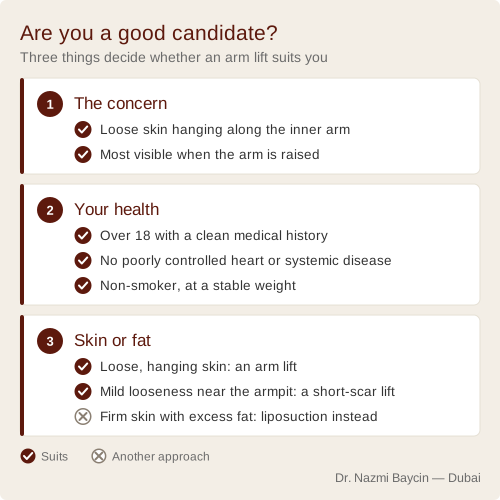 For arm lift surgery, good general health, a clean medical history, and freedom from poorly controlled systemic disease such as heart disease are the foundation — patient safety governs every decision before I ever pick up a marker. If you carry excess, loose skin on your upper arms, you can be a candidate at any age over 18; skin quality and overall health matter far more than the number on a passport.
What truly determines your candidacy, however, is the distinction between loose skin and excess fat — because the two demand entirely different operations, and choosing wrongly is how unnatural results begin.
Two further conditions protect the result: a stable weight and freedom from nicotine. After major weight loss, whether through diet and exercise or bariatric surgery, I recommend waiting until your weight has settled, so that the contour I create is the one that endures rather than one altered by further loss or regain. Smoking, vaping and other nicotine products slow wound healing and raise the risk of the incision separating, so I ask you to be nicotine-free for the period I advise around surgery. And because every arm lift leaves a permanent scar along the inner arm, or in the armpit with a short-scar lift, being comfortable with that trade-off is part of being a good candidate; I place it to stay hidden at rest, but it does not disappear.
What do I aim for in your arm lift surgery?
My aim is to help you feel at ease with your arms again — to create a more refined, aesthetically balanced shape with the most discreet scar possible. By removing excess fat and re-draping loose skin with controlled, selective tension, I can restore the arm’s natural line and, with it, a great deal of confidence.
Many patients come to me after a previous arm lift that did not go as planned. The complaint I hear most often is poor scarring left by careless, high-tension closure — and correcting it is frequently more demanding than the original operation would have been in skilled hands. This is precisely why the first attempt matters so much. I would rather we achieve the result you want once, properly, than spend years undoing an avoidable compromise.
Where does Dr. Baycin perform arm lift surgery in Dubai?
I perform your arm lift surgery exclusively within a top-tier, JCI-accredited hospital in Dubai, because the safety of the setting is inseparable from the quality of the result. Every procedure takes place in a fully equipped, premium medical center that meets the highest international standards of hygiene, monitoring, and surgical care — so your transformation begins in the safest possible hands.
How does Dr. Baycin perform arm lift surgery?
As skin loses its firmness with age, liposuction alone is no longer enough; a surgical arm lift becomes the right answer, removing both excess fat and skin to restore a tight, youthful line. The operation is carried out under general anesthesia and takes, as a rule, two to four hours depending on how much skin must be addressed. I begin by marking the redundant skin with the arm positioned to reveal it, remove the excess tissue and fat, and close in layers — using hidden, dissolvable sutures throughout, so there is nothing to remove afterwards.
How do I avoid the “over-tightened” look?
The classic error in brachioplasty is to treat the arm as a flat surface: a straight incision from armpit to elbow, the skin pulled uniformly tight and the excess cut away. That uniform, high tension flattens the inner arm’s natural curve, produces a “guitar-string” tightness on extension, and leaves a scar that widens and thickens.
My approach is the opposite. Because the greatest looseness sits in the upper third of the arm near the axilla, I concentrate the tension of closure there and release it progressively toward the elbow — following a “lazy-S” pattern that respects the arm’s natural grooves rather than a crude ellipse. This is the single most important step in avoiding an operated, over-pulled appearance.
I also treat the underlying fat as a sculpting medium, not an afterthought: rather than aggressive, indiscriminate liposuction that skeletonizes the arm, I feather it conservatively at the transition zones, the axillary fold, and the posterior arm, blending every junction so there is no tell-tale “step-off” line.
How do I keep the scar invisible?
Every excision leaves a scar — I will never promise otherwise — but its final character is largely within my control. I design the incision to fall along the inner arm, on the surface that rests against the body, so it stays hidden from the front, the side, and the back even in a sleeveless top. Then I close it to heal as a fine line: the superficial fascial system, a deep tissue layer, is re-approximated with strong dissolvable sutures that bear the fundamental tension, so the skin edges meet without strain. The skin itself is closed with fine dermal and everting sutures, and every patient receives my proven, multi-stage scar-management protocol. A scar held under constant tension widens; a scar closed without tension settles into the shadow of the inner arm and becomes virtually invisible.
Full arm lift or mini (short-scar) arm lift — which do you need?
No two arms call for the same operation. Significant laxity extending toward the elbow — common after massive weight loss — needs a full brachioplasty addressing the whole arm. Milder looseness concentrated near the armpit, with good skin elasticity, may be ideally treated by a short-scar (mini) brachioplasty that confines the incision almost entirely to the axilla. I decide between them through a dynamic pinch assessment at your consultation — manipulating the skin to simulate the postoperative result, judging skin quality, fat distribution, and where the laxity truly sits — so the technique is matched to your anatomy, never imposed from a template.
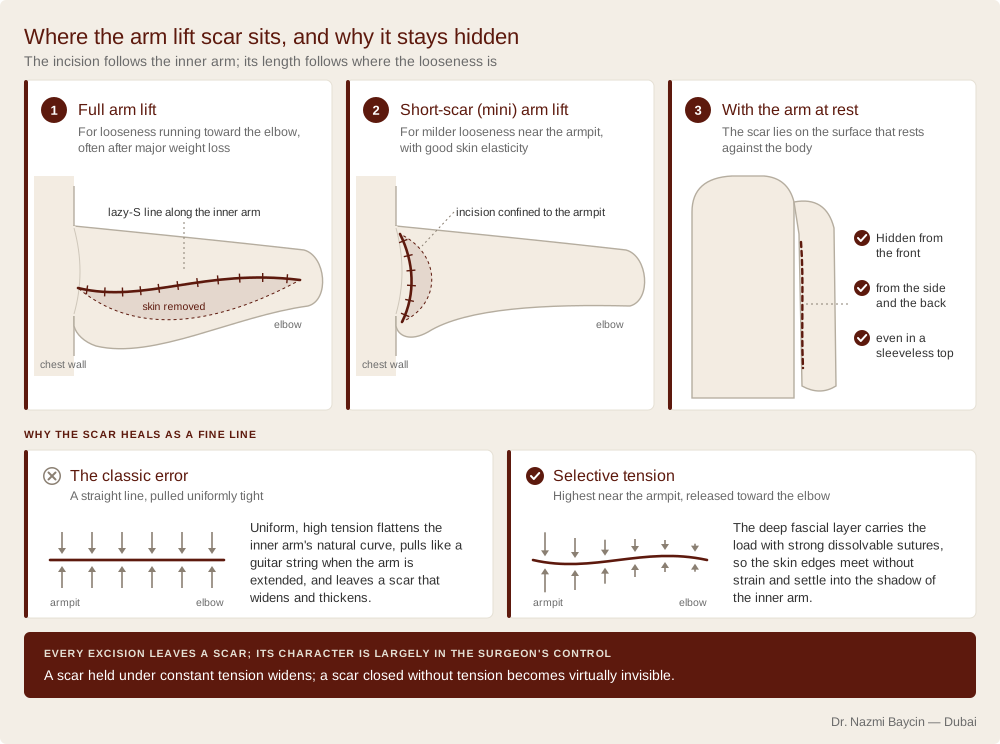
The scar of an arm lift is planned before the first incision is made. In a full arm lift it follows a lazy-S line along the inner arm, from the armpit toward the elbow, rather than a straight cut; in a short-scar lift it stays almost entirely within the armpit. Either way it sits on the surface that rests against the body, so with the arm down it is hidden from the front, the side and the back. What decides how fine it heals is tension: concentrated near the armpit, released toward the elbow, and carried by the deep fascial layer so that the skin edges meet without strain.
What is recovery after arm lift surgery like?
Recovery is more comfortable than most patients expect. Pain is typically mild and well controlled with medication; you are usually moving within two to three hours and may go home the same day, though an overnight stay is equally fine if you would prefer the rest. Some swelling and bruising along the back of the arm is normal and usually settles within one to two weeks.
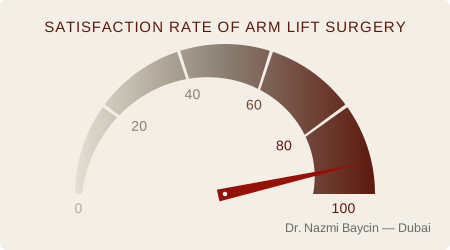
Published data show high patient satisfaction after brachioplasty.
You can travel after two to three days, shower at around the same point, and most patients return to their usual routine within a week. You will wear a compression garment on the arms for several weeks to support the tissues and control swelling. Heavy lifting and sport are best left until around four weeks — beyond that, let your body set the pace; it will tell you when to press on and when to rest.
That confidence is borne out by the outcome literature, with one honest caveat. In a retrospective series of 31 massive-weight-loss patients, overall satisfaction averaged 4.3 out of 5 — but scar appearance scored lowest of every domain measured, at 3.9. The scar is where arm lift results are won or lost, which is precisely why I place and close the incision the way I do.
To understand the full science behind how I support your healing after surgery, visit my advanced recovery protocol in Dubai article.
How will you feel after the procedure?
Recovery is emotional as well as physical. The first days bring swelling and restriction; within a week or two the arm begins to feel like your own again; and over the following months, as the fine scar fades, satisfaction tends to rise steadily. I provide every patient with a written, procedure-specific aftercare protocol so nothing is left to memory.
Download Dr. Baycin’s arm lift aftercare instructions
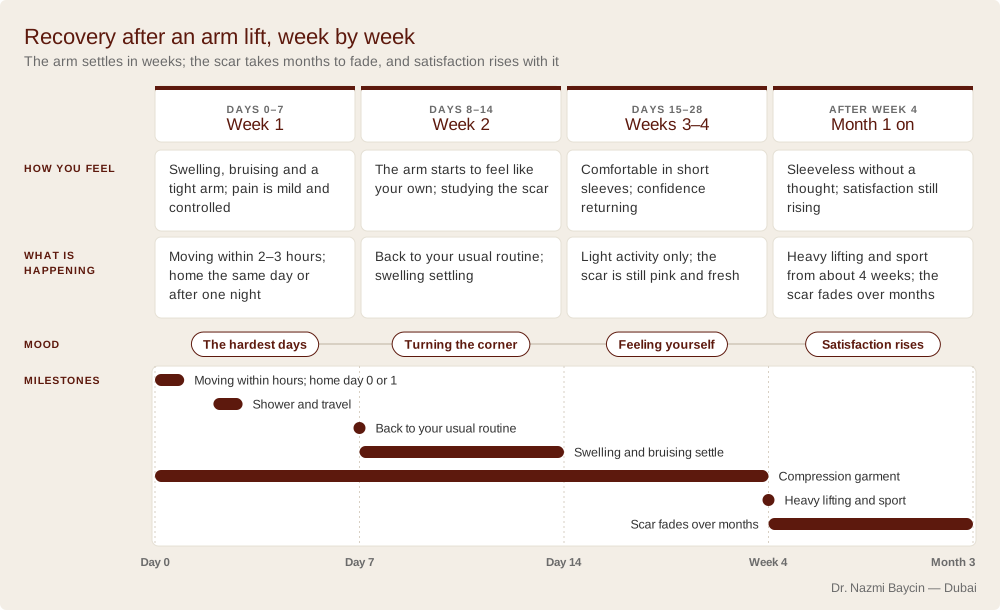
Recovery after an arm lift moves on two clocks. The body’s clock is short: you are moving within hours, home the same day or after one night, showering and travelling at two to three days, back to your routine within a week, and lifting and training again from around four weeks. The scar’s clock is long — it stays pink for weeks and fades over months — and because the scar is where arm lift results are won or lost, that is the timeline your mood follows. The first week brings swelling, tightness, and bruising along the back of the arm; in the second the arm begins to feel like your own; by the third and fourth you are comfortable in short sleeves; and from the first month on, as the line settles into the shadow of the inner arm, satisfaction tends to keep rising. The pace varies with personality; the shape rarely does.
See your private recovery timeline, day by day, after arm lift
Plan your arm lift recovery
Enter the surgery date you planned and view your own recovery calendar; then add it to your phone calendar or print it.
Your timeline appears here once you choose a date.
These are typical timings. Your own plan depends on your health, the technique used, and how you heal; always follow the instructions Dr. Baycin gives you after surgery. Nothing you enter here is sent or stored.
What are the risks and complications of arm lift surgery?
Arm lift surgery is, by the measure of the published literature, a safe procedure — but no honest surgeon calls any operation risk-free. The recognized risks include hematoma (a collection of blood in the wound) and infection, both part of any surgery and both substantially reduced by careful technique and the right medication. Wound dehiscence and delayed healing are possible, particularly in patients who are obese or who smoke. Nerve injury is rare and, when it occurs, usually causes only temporary changes in sensation. Minor asymmetries or surface irregularities between the arms can occur but are generally well tolerated, and occasionally a hypertrophic scar may warrant revision.
These risks rise in patients who are obese, diabetic, or who smoke, which is exactly why candidacy is assessed so carefully beforehand. In a healthy, non-obese patient, performed with meticulous technique, the likelihood of a significant complication is low — and should one arise, it can almost always be managed without compromising your final result.
Arm lift in Dubai: suitability and safety checklist
Important: This checklist helps you prepare for your consultation. It cannot decide whether surgery is safe or suitable for you. Please disclose your full medical history, medicines, and supplements when we meet — everything you share stays confidential.
- Discuss at consultation We plan around it together. Usually not a barrier on its own.
- Medical review The anesthesia team or a specialist reviews it, sometimes with tests or a clearance letter, before a date is confirmed.
- Postpone Surgery waits until this has changed or settled.
- Alternative advised This procedure is not the right fit; another option may suit you better.
| # | Question | Why it matters | If the answer is “NO” |
|---|---|---|---|
| 1 | Are you 18 or older? | Cosmetic body surgery is offered to adults only. | Not offered |
| 2 | Is loose, hanging skin — not just extra fat — your main concern, especially when you raise your arm? | An arm lift removes skin. Fat under firm, elastic skin is treated without a scar on the arm. | Alternative advised Arm liposuction may be enough. |
| 3 | Has your weight been stable for at least 6 months? After bariatric surgery, for longer? [CONFIRM] | Further loss or regain changes the skin again and alters the result. | Postpone Until your weight has settled. |
| 4 | Are you comfortable with a permanent scar along the inner arm, or in the armpit for a short-scar lift? | Every arm lift leaves a scar. It is placed to stay hidden at rest, but it does not disappear. | Discuss at consultation We review scar length, placement, and alternatives. |
| 5 | Can you avoid heavy lifting and straining your arms for about 4 weeks? | Tension on a healing incision can open it or widen the scar. | Postpone Choose a date that fits work, sport, or childcare. |
| # | Does this apply to you? | Why it matters | Usual next step |
|---|---|---|---|
| Medical history | |||
| 6 | Heart disease, high blood pressure, or an irregular heartbeat | General anesthesia and surgery add strain on the heart. | Medical review |
| 7 | A previous blood clot (DVT or PE), a clotting disorder, or a close relative with clots | Surgery raises clot risk; prevention is planned around your personal risk. | Medical review |
| 8 | Diabetes | Blood-sugar control affects healing along a long incision and infection risk. | Medical review |
| 9 | Asthma, other lung disease, or sleep apnea | These affect breathing during and after anesthesia. | Medical review |
| 10 | Liver or kidney disease, anemia, or a bleeding disorder | These affect how medicines are cleared, bleeding, and recovery. | Medical review |
| 11 | HIV, hepatitis B or C, or another blood-borne infection | Well-controlled infection does not automatically rule surgery out; your team plans around it. | Discuss at consultation In confidence. |
| 12 | Past problems with anesthesia, or allergy to local anesthetics, antibiotics, or latex | Arm lift is performed under general anesthesia. | Medical review |
| 13 | Major weight loss, especially after bariatric surgery (sleeve, bypass) | Low protein, iron, or vitamin levels are common afterwards and slow wound healing. | Medical review Nutrition blood tests before surgery. |
| 14 | Arm swelling or lymphedema, or previous surgery or radiation to the armpit — for example, lymph node removal for breast cancer | The incision runs near the arm’s lymph drainage; existing damage raises the risk of lasting swelling. | Medical review |
| 15 | Numbness, tingling, or weakness in your arm or hand | Skin nerves run through the inner arm; existing symptoms are recorded before surgery. | Discuss at consultation |
| 16 | A history of keloid or thick, raised scars | The scar is the main trade-off of an arm lift; your scar history shapes the plan and aftercare. | Discuss at consultation |
| 17 | A rash, skin infection, or open wound on the arms or in the armpits | Operating through affected skin raises infection risk. Rashes in skin folds are common after weight loss. | Postpone Until treated and healed. |
| 18 | Pregnant or breastfeeding | Elective surgery and anesthesia are deferred until after pregnancy and breastfeeding. | Postpone |
| Medicines and supplements | |||
| 19 | Blood thinners, aspirin, or anti-inflammatories such as ibuprofen | These increase bleeding; some are paused before surgery under medical guidance. | Medical review Never stop a prescribed medicine on your own. |
| 20 | Supplements such as fish oil, vitamin E, ginkgo, garlic, or turmeric | Several raise bleeding risk and are usually paused before surgery. | Discuss at consultation |
| 21 | Weight-loss injections such as semaglutide or tirzepatide | They slow stomach emptying, which matters for anesthesia, and mean your weight may still be changing. | Medical review |
| 22 | The contraceptive pill, hormone therapy, or prescribed testosterone | Estrogen raises clot risk; testosterone can thicken the blood. | Medical review |
| 23 | Anabolic steroids or other performance-enhancing drugs | These affect the heart, liver, blood count, and anesthesia. | Medical review Please be open with us — it stays confidential. |
| 24 | Antidepressants or other psychiatric medication | Some interact with anesthesia or pain medicines. | Medical review Keep taking them unless your prescriber advises otherwise. |
| Lifestyle and travel | |||
| 25 | Smoking, vaping, or any nicotine — including pouches, gum, or patches | Nicotine reduces skin blood flow and is a leading cause of wound separation after skin-removal surgery. | Discuss at consultation Nicotine-free recovery period is advised. |
| 26 | Recreational drug use or regular heavy drinking | These interact with anesthesia and slow healing. | Medical review |
| 27 | Flying long-haul to Dubai for surgery, or planning to fly home soon after | Long flights add to clot risk around surgery. | Discuss at consultation We plan your travel dates with you. |
| Expectations and wellbeing | |||
| 28 | Do you spend a lot of time worrying about how your arms or body look, or feel no change would be enough even when others disagree? | This can be a sign of body-image distress that surgery rarely relieves. | Discuss at consultation A supportive, private conversation. |
Medical note: A medical condition, infection, or medicine does not automatically rule out arm lift surgery. The decision depends on the diagnosis, how well it is controlled, the planned procedure, and assessment by the surgeon and anesthesia team. Never stop or change prescribed medication without advice from your treating clinician.
Aesthetic note: An arm lift (brachioplasty) removes excess skin to improve upper-arm contour and always leaves a scar, whose length and position depend on how much skin is removed. It is not a weight-loss procedure, and this checklist cannot guarantee a particular result.
Checklist medically reviewed by Dr. Nazmi Baycin, DHA-licensed plastic surgeon · Checklist last updated: 21.10.2026
What are the steps of an arm lift in Dubai from consultation to surgery?
Because an arm lift is performed under general anesthesia, the path from your first visit to your procedure follows five steps. Each one is there to confirm that surgery is both safe and right for you.
- Consultation: I assess your skin quality, fat distribution, and medical history through a dynamic pinch assessment, and we decide together whether you need a full arm lift, a short-scar lift, or liposuction alone. Consultations are paid, and this is where your exact pricing is confirmed.
- Booking the procedure: Once you decide to proceed, we reserve your surgery date. Procedures are scheduled within 2–10 days, depending on the hospital’s operating theater (OT) availability.
- Preoperative blood tests: Routine blood tests are carried out before surgery to confirm that you are in good general health for general anesthesia.
- Preoperative anesthesia consultation for clearance: The anesthesiologist reviews your test results and medical history and gives clearance for general anesthesia.
- Procedure: On the day of surgery, I mark the redundant skin with your arm positioned to reveal it, then perform the lift in a JCI-accredited hospital. The hospital stay is a day case or one night.
How much does an arm lift cost in Dubai, UAE?
The cost of an arm lift in Dubai can vary from clinic to clinic, typically falling between AED 20,000 ($5,500) and AED 50,000 ($13,600). These figures are not Dr. Baycin’s specific pricing; your exact quote is given at consultation, once he has assessed your arms in person.
For a complete overview of treatment fees, please refer to full price list of the procedures. If you are looking specifically for this procedure, you can also review pricing information.
Schedule your private consultation with Dr. BaycinWhat makes Dr. Baycin an exceptional arm lift surgeon in Dubai?
An arm lift is not the trimming of skin; it is judgment made visible — knowing how much to remove, where to place tension, and when to stop. For patients seeking the most trusted hands for arm lift surgery in Dubai, that judgment is the difference, and it is built on more than a hundred arm lifts performed to a single standard: arms sculpted into natural, balanced silhouettes, never thinned or over-tightened.
- A legacy of expertise: more than 25 years in advanced plastic surgery, board certification, DHA licensure, and international membership of the American Society of Plastic Surgeons (ASPS) — credentials that underwrite world-class standards in every operation.
- Your arms, your blueprint: no two arms are alike, so every brachioplasty is designed around your own anatomy and goals through a dynamic pinch assessment — never a fixed template. The result feels authentic: sleek, toned, and beautifully proportioned.
- Advanced surgical artistry: from selective-tension planning and the lazy-S resection pattern to integrated, conservative liposculpting, Dr. Baycin combines innovation with experience to create arms that look naturally refined — not overdone.
- Speedy recovery through technology: by adopting modern surgical techniques and tension-free closure, he minimizes downtime, reduces scarring, and accelerates healing — so you return to life feeling renewed.
- Safety beyond compromise: an unblemished safety record, with every step from pre-op to post-op managed with precision in JCI-accredited hospitals.
- Honest consultations, clear expectations: straightforward advice, realistic outcomes, and a customized plan from the first meeting — so you feel informed and empowered, never sold to.
- Support that extends beyond surgery: structured aftercare protocols and direct surgeon access make recovery smooth, comfortable, and reassuring.
- A global reputation in aesthetic surgery: patients from Europe, the GCC, and beyond choose Dubai — and Dr. Baycin — for arm lift surgery that blends safety, luxury, and artistry in one destination.
- Results that define confidence: with over 100 arm lifts performed, Dr. Baycin consistently delivers arms that look toned, youthful, and naturally balanced — results that speak louder than words.
- The human touch behind every transformation: aesthetics and empathy are inseparable here; every patient is met with respect, understanding, and genuine care, making the experience as empowering as the result.

Written and medically reviewed by
About Dr. Nazmi Baycin
DHA-licensed, board-certified plastic surgeon, Dubai
- 25+ years in practice
- 7,000+ procedures
- JCI-accredited hospitals
- ASPS international member
Surgery, to me, is precision applied in service of restoration — a conviction that has guided every one of the more than 7,000 procedures I have performed over 25 years in practice. I am a DHA-licensed, board-certified plastic surgeon, trained in Turkey and based in Dubai since 2016. I operate exclusively within JCI-accredited hospitals, and hold international membership in the American Society of Plastic Surgeons (ASPS). Three techniques, in particular, have become signatures of my practice. Scarless breast augmentation, performed through a transaxillary approach that leaves no incision on the breast itself. Labiaplasty designed individually around each patient’s own anatomy, never to a standard template. And 3D customized facial bone implants, engineered through CT-based bespoke printing — a technique I currently offer as the only surgeon in Dubai providing it. My practice today spans facial rejuvenation, breast surgery, body contouring, and cosmetic genital procedures, drawing patients from across the UAE, Europe, and the wider GCC. Yet the principle guiding each of these specialties has never changed: to restore form is to restore function.
FAQs about arm lift in Dubai
-
What is an arm lift (brachioplasty)?
An arm lift, or brachioplasty, is how I remove loose, sagging skin from the upper arms to restore a firmer, smoother, more toned contour. It is especially valuable after significant weight loss, when the skin that once stretched no longer retracts and hangs from the upper arm. I combine skin removal with careful contouring, and where helpful with liposuction, to reshape the whole arm. My aim is a naturally slimmer arm with the finest, most discreetly placed scar possible.
-
How much does an arm lift cost in Dubai?
Arm lift costs in Dubai vary from clinic to clinic and depend on several factors, ranging between AED 20,000 and AED 50,000, depending on the extent of skin removal and whether it is combined with liposuction. These are general market figures, not Dr. Baycin’s personal rates; the precise cost is confirmed at your consultation, once your arms have been assessed.
-
Why do the upper arms lose their firmness?
The most common reason is significant weight loss. When a large amount of weight comes off, the skin of the upper arms, which had stretched to accommodate it, often cannot shrink back and is left loose and hanging. The natural loss of skin elasticity with age also contributes, producing the soft sagging many people notice on the underside of the arm. Because this loose skin will not respond to exercise, an arm lift is the reliable way to restore a firm contour.
-
What is your selective-tension technique?
This is central to both a natural contour and the finest possible scar. Rather than pulling the skin uniformly tight, I concentrate the tension of closure in the upper third of the arm near the armpit, where the looseness is greatest, and release it progressively toward the elbow along a lazy-S pattern that respects the arm’s natural grooves. The deeper supporting layer, the superficial fascial system, then carries the fundamental tension, so the skin itself is closed without strain. The result is a natural, un-tightened contour and a much finer, flatter scar than a traditional high-tension closure produces. Combined with careful placement along the inner arm, it is how I keep the trade-off of a scar as discreet as possible.
-
Where will the scar be, and how visible is it?
I place the incision along the inner side of the upper arm, where it is naturally concealed when your arms are at rest by your sides. An arm lift does involve a scar in exchange for removing the loose skin, and I am always honest about this trade-off, but my selective-tension closure keeps that scar as fine and flat as possible. For smaller amounts of skin, the incision can sometimes be shorter, and I plan its length and position with you at consultation.
-
Is an arm lift in Dubai often combined with liposuction?
In selected patients, yes, and the two work well together. An arm lift removes the loose, excess skin, while liposuction removes any excess fat and refines the underlying shape of the arm. Combining them lets me both tighten the skin and sculpt a smoother, slimmer contour in a single procedure, for a more complete result than either alone. At consultation I assess whether adding liposuction will enhance the shape of your arms.
-
What is recovery after an arm lift like?
Recovery is generally manageable. You go home the same day or after one night, and most people return to desk work within about a week. You will wear a compression garment on the arms for several weeks to support the tissues and control swelling, and I advise limiting strenuous activity and heavy lifting for around four weeks so the incisions heal well.
-
Are the results of an arm lift permanent?
The results are long-lasting, especially when your weight stays stable. The excess skin I remove does not return, so the firmer, slimmer contour endures. The main thing that can affect the result over time is significant weight gain or loss, which is why maintaining a stable weight is so important, and why I generally recommend an arm lift once your weight has settled after any major loss. For most people who keep their weight steady, the improvement lasts well over the long term.
-
When is the right time for an arm lift in Dubai after weight loss?
Timing matters for a lasting result. I generally recommend waiting until your weight has been stable for a period after major weight loss, whether through diet and exercise or bariatric surgery, before undergoing an arm lift. Operating once your weight has settled means the contour I create is the one that endures, rather than being altered by further loss or regain. At consultation we discuss your weight history to confirm the timing is right for a durable outcome.
-
Is an arm lift in Dubai safe, and what are the risks?
In experienced hands an arm lift is a safe, well-established procedure, though as a skin-removal operation it carries the usual surgical considerations, which I discuss honestly. These include swelling, bruising, fluid collection, delayed wound healing along the incision, and scar quality, which my selective-tension technique is specifically designed to optimize. Good general health, a clean medical history, and a stable weight all support both a safe procedure and the best result. Every relevant risk is discussed fully at consultation.
-
Are you a good candidate for an arm lift?
You are likely a good candidate if you are over 18, have loose, sagging skin on the upper arms, often after significant weight loss or with age, that troubles you, and you are in good general health. It is best if your weight has been stable for a period, since further change can affect the result. A clean medical history is the foundation of safe surgery, and understanding the scar trade-off matters. At consultation we discuss your goals and design the right approach for you.
-
Can an arm lift in Dubai be combined with other procedures?
Yes. Beyond liposuction, an arm lift is often part of a broader body-contouring plan after major weight loss, combined with procedures such as a thigh lift or a tummy tuck, or with J-Plasma skin tightening where only mild laxity remains. At consultation I assess your overall goals and health and recommend combining procedures only where it is safe and genuinely gives you a smoother, more balanced whole-body result.
In-depth reading: techniques, scarring, and natural contour behind an arm lift in Dubai
These articles go beyond the procedure itself to show how the right arm lift is chosen for each patient and how a natural, well-healed result is protected. Each one looks at a different decision that shapes the outcome — from selecting the approach to handling the more complex skin envelope left by major weight loss.
- Arm lift vs arm liposuction: letting skin elasticity decide — why a careful snap-and-pinch assessment of skin quality determines whether liposuction alone will work or a full lift is needed.
- The art of a natural, un-tightened contour — how conservative, tension-aware planning avoids the over-tightened look and keeps the arm looking like your own.
- The extended arm lift after massive weight loss — treating the inner arm, axilla, and lateral chest as one continuous unit for a smooth arm-to-torso line.
What patients say


Book an arm lift consultation in Dubai
Get ready to look and feel best… You deserve…
