

Key takeaways: an anatomical approach to labiaplasty
- There is no single normal template — labial anatomy varies widely between individuals, and surgery must respect that diversity.
- The goal shifts from reduction to intelligent contouring, enhancing natural symmetry rather than imposing an idealized shape.
- Over-resection is the most common template-based error, risking scalloped edges and an operated-on look.
- The clitoral hood complex is a continuous extension of the labia minora — treated as one system, not a separate structure.
- Preserving blood supply and nerve pathways protects sensation, healing, and long-term tissue health.
- A layered, tension-free closure with hair-thin sutures supports fine scarring and predictable healing.
The limitation of the standardized template
Many surgeons rely on a one-size-fits-all reduction template, an approach that overlooks the intricate and highly personal anatomical variations of each patient. True mastery in this intimate field does not come from simple tissue removal; it comes from sculptural preservation and harmonious design, where each result respects and enhances the patient’s native anatomy rather than overwriting it. This is not merely a stylistic preference — it reflects the underlying science.
A scoping review of ten population-based datasets of female genital anatomy found labial length ranging from 5 to 100 mm and width from 1 to 60 mm, with protruding labia minora more common than not and left–right asymmetry common. The same review reports that differences in recruitment, inclusion criteria and measurement between those datasets made pooling impossible, so the normal range is described rather than precisely quantified. Anatomy this varied cannot be served by an assumed ideal, which is why my planning begins with the individual in front of me.
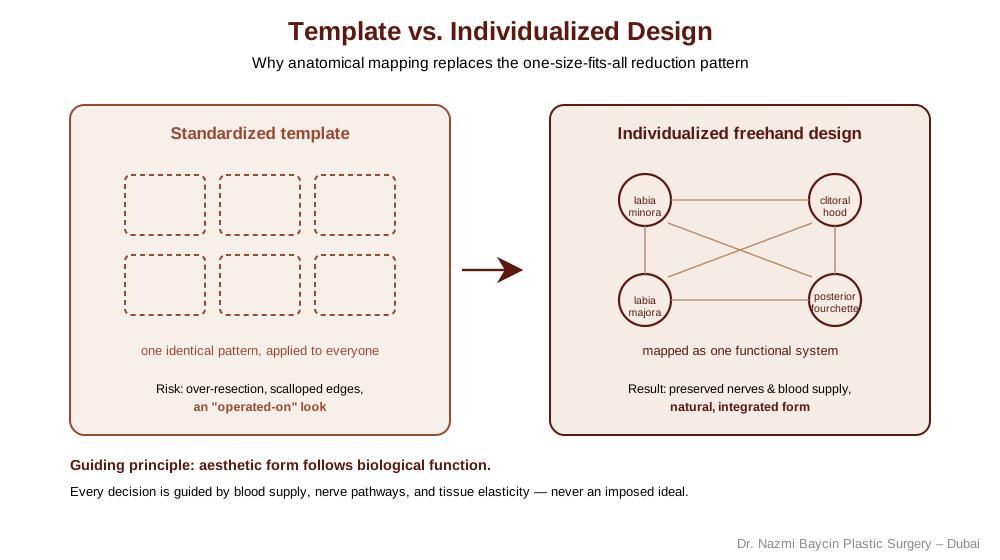
Template versus individualized design: an imposed pattern risks over-resection, while mapping the anatomical subunits as one system preserves function and natural form — by Dr. Nazmi Baycin, Dubai.
Moving beyond the template: the design failure behind a conspicuous result
Template-based labiaplasty remains a common technical shortcut despite its well-documented limitations. While efficient, it frequently produces suboptimal and visually conspicuous results, and over-resection of the labia minora is one of its most common consequences. Excessive tissue removal creates sharp, truncated edges — an appearance often described as scalloped or artificially amputated — and, more importantly, risks damaging delicate neurovascular structures.
The clitoral hood and frenulum are particularly vulnerable to unintended alteration, which can permanently affect sensitivity and disrupt aesthetic balance. The final result frequently appears unmistakably operated on rather than subtly refined, and these outcomes are what drive many patients to seek revision surgery for complications an individualized approach could have prevented.
My methodology aims to prevent this trajectory from the outset. I apply micro-surgical techniques that evaluate each anatomical subunit in detail, with blood supply, nerve pathways, and tissue elasticity guiding every surgical decision. The goal shifts from reduction to intelligent contouring — enhancing natural symmetry and proportion, never imposing an external or idealized template on the body.
Those failures each have a mechanism and a remedy, and I set them out separately in the unwanted results that follow a labiaplasty and how disciplined planning prevents them. How the two principal reduction methods compare, and why marginal trim is my primary technique in more than 95% of cases, belongs with the operation rather than the philosophy behind it — the evidence for that choice sits on my marginal trim versus wedge technique section.
A micro-surgical blueprint for individualized anatomical design
Individualization does not begin in the operating room — it begins at the consultation, where the plan is actually made. I examine the anatomy in a natural position rather than on a diagram, note the asymmetry that exists in almost every patient, and mark the intended design while discussing openly what each patient hopes to change and, just as importantly, what they wish to keep.
Two people with a superficially similar concern rarely receive the same plan, because their tissue, pigmentation, edge character, and goals differ. That conversation, unhurried and specific, is where a template is either quietly imposed or deliberately set aside. My surgical protocol follows a deliberate, sequential process that combines artistic planning with technical precision. The table below outlines its three core stages.
| Stage | What it involves | Why it matters |
|---|---|---|
| Anatomical mapping & planning | The labia minora, clitoral hood, labia majora, and posterior fourchette are assessed as a unified functional system; the design is drawn freehand, not traced from a template | Honors natural contours, pigmentation transitions, and tissue thickness, translating personal goals into a precise plan |
| Conservative tissue treatment | Tissues are treated conservatively using micro-scissors | Preserves vital blood vessels and nerve pathways, supporting sensation, healing, and long-term tissue health |
| Layered, tension-free closure | Closure in layers using hair-thin absorbable sutures | Minimizes visible scarring, supports predictable healing, and maintains the refined contours created in surgery |
This level of anatomical management defines advanced cosmetic genital surgery: the procedure enhances the entire anatomical landscape without compromising its innate function.
What a template cannot encode
A template encodes a single variable: how much tissue to remove. The anatomy in front of me presents at least five more, and none of them appears in a standard pattern.
The length and width of the labia minora vary enormously between women, and the two sides rarely match. Tissue thickness changes what an edge will do once it is cut and closed. The pigment transition along the free border decides whether removing that border refines the appearance or removes the very feature that made it look natural. The proportion between the hood and the labial edge governs whether a reduction reads as balanced or top-heavy. And beneath all of it runs a neurovascular supply that determines what can safely be touched at all.
Each of those carries consequences specific enough to deserve its own discussion: thicker tissue calls for a different surgical strategy for thick labia minora, a darker border raises the separate question of labial discoloration and how contour affects color, side-to-side difference is addressed in the correction of asymmetric labia, and the nerve supply is mapped in the neurovascular anatomy behind preserving sensation.
My concern here is the step that precedes all of them: a design has to hold every one of these variables at once, and no fixed pattern can. The discipline that follows from it — knowing how much tissue to leave rather than how much to take — is set out in why restraint rather than aggressive removal defines a natural result.
The clitoral hood complex: one structure, not two
The clitoral hood is a continuous extension of the labia minora, and treating it as a separate structure is one of the clearest signs that a template is being applied rather than a design drawn. The consequence is proportional. Reducing the labia minora without addressing a redundant hood can leave the hood looking disproportionately prominent, while over-reducing the hood in isolation exposes and destabilizes the delicate structures beneath. Balance between the two — assessed together, adjusted together — is what produces a result that reads as naturally proportioned rather than piecemeal.
Two questions follow from that, and each is substantial enough to carry its own article. Whether the hood should be included in the plan at all is set out in why the hood cannot be left out of a labiaplasty plan. How the reduction itself is carried out around the dorsal nerve is set out in the nerve-sparing technique for clitoral hood reduction.
Why the template persists
If a fixed pattern produces inferior results, it is worth asking why it remains so common. The honest answer is that it is efficient. A template is quick to teach, quick to draw, and quick to execute, and it produces a predictable operating time. It also photographs consistently, which matters more than it should in a field where results are marketed visually.
The cost of that efficiency is not carried by the surgeon. It is carried by the woman whose anatomy sits outside the pattern — and given how wide the normal range turns out to be, that is a great many women. A template does not fail loudly. It fails quietly, in millimeters, and the failure only becomes visible months later, once the tissue has settled and the shape it has settled into is not quite hers.
I would rather spend that time at the drawing stage. It is the least expensive part of the procedure and the only part that cannot be revisited afterwards without a second operation.
Philosophical commitment as the ultimate patient safeguard
The surgeon you choose remains the single most important factor shaping your outcome; technique alone does not define success. My surgical philosophy functions as a constant safeguard, with each decision reflecting a deep understanding of applied anatomy and tissue behavior, where respect for living structures always comes first.
I deliberately avoid fleeting surgical trends and technical shortcuts that sacrifice long-term function for short-term efficiency or increase the risk of unnatural aesthetics over time. This disciplined approach produces results that feel harmonious, functional, and enduring, transforming surgery into a collaborative process built on science, artistry, and ethical responsibility.
Choosing anatomical artistry over surgical assembly
Labiaplasty sits at a unique intersection of surgical science, intimate artistry, and personal trust; it requires far more than technical competence. The surgeon must understand anatomy, aesthetics, and responsibility equally, because each anatomical decision carries both functional and emotional significance, and there is no room for shortcuts.
What the operation itself involves — candidacy, anesthesia, the technique used, and the recovery timeline day by day — belongs with the procedure rather than with the thinking behind it, and is set out in full on my labiaplasty procedure in Dubai page.
In Dubai, my practice remains dedicated to this standard — moving beyond simple reduction toward personalized, harmonious anatomical design in which function is preserved and aesthetics remain refined and understated. If you seek a result defined by natural form and lasting comfort, I invite you to consult with me as a leading cosmetic surgeon in Dubai who prioritizes anatomical integrity above all.
FAQs about individualized labiaplasty design in Dubai
-
What makes my approach different from standard labiaplasty?
Most template-based techniques apply a uniform reduction pattern regardless of individual anatomy. My approach begins with detailed anatomical mapping of the labia minora, clitoral hood, labia majora, and posterior fourchette as a single functional system, so the surgical plan is designed freehand around each patient’s own anatomy rather than traced from a standard pattern.
-
What does it mean to design a labiaplasty freehand?
It means the reduction is drawn on the anatomy in front of me rather than traced from a fixed pattern. I map the labia minora, clitoral hood, labia majora and posterior fourchette, mark the intended line on both sides, and check that marking against the natural contours, the pigment transition and the thickness of the tissue before anything is removed. The drawing is the operation; the cutting follows it.
-
If labial anatomy varies so widely, what is an individualized design aiming at?
Not a target shape. Population studies record labial length between 5 and 100 mm and width between 1 and 60 mm, so no measurement defines a correct result. The design aims instead at proportion and balance within one woman: the labia minora sitting comfortably in relation to the labia majora and the hood, symmetry between the two sides, and a smooth edge that reads as her own rather than as a surgical outcome.
-
Why are the labial subunits planned as one system rather than separately?
Because they look and behave as one system. Reducing the labia minora without accounting for a redundant hood can leave the hood disproportionately prominent, while adjusting the hood in isolation exposes and destabilizes the structures it protects. Planning them together is what produces a result that reads as naturally proportioned rather than piecemeal.
-
Does an individually designed labiaplasty take longer than a template reduction?
The planning takes longer, which is the point. Marking and checking the design adds time before the operation begins, while the surgery itself is comparable in length. That front-loaded time is the least expensive part of the procedure and the part that decides the result.
-
Can I see the design before surgery?
Yes. The marking is done with you present and discussed before anything is removed, including what you want changed and, just as importantly, what you want left alone. Agreeing the plan in advance is part of the method rather than a formality.
-
Does an anti-template approach mean a different surgical technique for every patient?
No. The principle is that the technique follows the anatomy rather than habit, and in practice one method suits the large majority of cases. Which reduction method is used, and why marginal trim is my primary technique, is set out on my labiaplasty procedure page.


GET APPOINTMENT
Get ready to look and feel best… You deserve…
