


Table of content
- What can gynecomastia surgery in Dubai do for you?
- What causes gynecomastia, and what types are there?
- Which anesthesia is used for gynecomastia surgery?
- How does Dr. Baycin perform gynecomastia surgery?
- Gynecomastia surgery with vaser liposuction
- What is recovery after gynecomastia surgery like?
- What are the risks and complications of gynecomastia surgery?
- Checklist before having surgery in Dubai
- How much does a gynecomastia surgery cost in Dubai, UAE?
- Get appointment
Gynecomastia is one of the few cosmetic concerns that diet and exercise genuinely cannot fix — and for the men it affects, that helplessness is half the burden. I am Dr. Nazmi Baycin, and across more than two hundred and fifty gynecomastia surgery procedures I have learned that a flat, masculine chest depends on one thing above all: matching the technique to the tissue. My gynecomastia surgery in Dubai begins by identifying whether your enlargement is gland, fat, or both, because that is what determines whether the answer is liposuction, gland excision, or — most often — a precise combination of the two.
That distinction is the whole of a good result. Performing male breast reduction in Dubai within JCI-accredited hospitals, and with complete discretion, I remove the excess through tiny incisions that leave little or no visible scar, tighten the skin where needed, and sculpt a chest that looks naturally masculine rather than merely flattened. The principle is the one that guides all my work: to restore form is to restore function.
Gynecomastia surgery in Dubai quick facts
| Procedure detail | Gynecomastia surgery (male breast reduction) in Dubai |
|---|---|
| Technique | Matched to tissue type: liposuction, gland excision, or both |
| Signature detail | Vaser (scarless gland + fat removal, skin tightening) |
| Anesthesia | Local with sedation, or general |
| Procedure time | About 1–2 hours (45–90 min for localized cases) |
| Incisions | 3–4 mm (often scarless); small periareolar if excision needed |
| Hospital stay | Day case (overnight for extensive cases) |
| Garment | Chest compression corset for 3 weeks |
| Shower | 2 days |
| Downtime | 2–5 days; work at 3–4 days; travel at 2 days |
| Final shape | Clear after ~2 months |
| Result | Long-lasting (gland does not regrow) |
What can gynecomastia surgery in Dubai do for you?
Gynecomastia surgery reduces enlarged male breasts — whether caused by excess gland, excess fat, or both — to restore a flatter, firmer, more masculine chest, with results that are long-lasting. For most men the change is as much psychological as physical: the self-consciousness that comes with the condition, the avoidance of swimming or fitted shirts, the reluctance to be seen shirtless, all ease once the chest matches the rest of the body.
Because the removed gland tissue does not grow back, the result is durable, provided weight stays stable. It is, for the right candidate, one of the most genuinely confidence-restoring procedures in male aesthetic surgery.
What causes gynecomastia, and what types are there?
The right approach depends partly on age. In adolescence, gynecomastia often resolves on its own within one to two years, so surgery is usually not the first step for teenagers. Where treatment is needed in a younger patient — particularly in more severe cases — it should be guided by an endocrinologist, and if there is an underlying cause such as a thyroid, liver, or kidney condition, or substance use, that must be addressed first by the appropriate specialist.
When is surgery the only option?
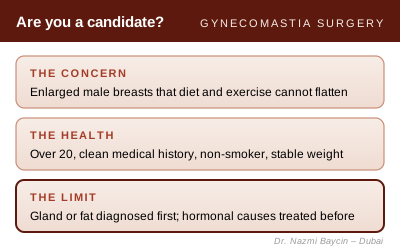 If you are past your teenage years and still have enlarged breasts with no underlying medical cause, surgery is the only effective solution — diet and exercise will not remove established gland tissue, and often cannot shift the localized fat either. A clean medical history and good general health, free of systemic disease such as heart disease, are the foundation of safe surgery. For a detailed look at how I combine excision and contouring in a single, tailored operation, see my dual-technique gynecomastia article.
It is worth naming what this operation is not. Gynecomastia is a male condition treated by removing gland and fat from a flat chest; the reduction of a woman’s breast is a different operation with different anatomy, different goals, and a different scar pattern, covered on my female breast reduction in Dubai page.
Which anesthesia is used for gynecomastia surgery?
Gynecomastia surgery can be done under either local anesthesia with deep sedation or general anesthesia, and we decide together based on the extent of the procedure and your preference. When the breast mass is small and localized, local anesthesia is usually ideal; when it covers a larger area, deep sedation or general anesthesia is the better, more comfortable choice. The operation itself usually takes around forty-five minutes to an hour and a half for localized cases, and up to about two hours for more extensive ones, depending on the technique and the amount of tissue involved.
How does Dr. Baycin perform gynecomastia surgery?
My choice of technique always comes down to three things: the type of tissue involved, the size of the breast mass, and how elastic your skin is. From those, I build the right combination for your chest.
Liposuction with the tumescent technique
Liposuction is the workhorse of gynecomastia surgery, targeting the fat that gathers on the chest. I use a fine cannula introduced through a tiny 3–4 mm incision to vacuum the fat away, and I begin by injecting a tumescent solution into the breast — this both reduces bleeding during surgery and eases pain afterward. Those small incisions heal well and usually leave no noticeable scar.
Gland excision and skin tightening
Where firm gland tissue is the problem, liposuction alone is not enough — the gland itself must be removed, which is why matching technique to tissue type matters so much. And when a large volume is removed, the skin that once covered it may not shrink to fit, leaving a degree of sagging; in those cases I remove the excess skin to tighten the chest. This can leave a faint scar, but it is kept minimal, and it is only done when skin tightening is genuinely needed.
Gynecomastia surgery with Vaser liposuction
Vaser liposuction is the most advanced approach in gynecomastia surgery, and often my preferred one. It uses ultrasound energy to break down both fat and mammary gland, so that even glandular tissue can be liquefied and removed without a skin incision — meaning no surgical scar. Just as valuably, the ultrasound energy generates gentle heat that tightens the skin as it works, which makes Vaser especially useful for men who have excess skin as well as excess tissue: it can deliver a flat, retracted, scar-free result where older techniques would have required cutting skin away. A 2025 two-centre series of 960 patients treated with Vaser liposuction and minimal-scar gland excision reported a mean patient satisfaction score of 9.4 out of 10 across all grades of gynecomastia, with minor complications in 1.7% of cases.
| Type | What is enlarged | Matched technique |
|---|---|---|
| Adipose | Excess fat tissue | Liposuction (often Vaser), scarless |
| Glandular | Firm mammary gland tissue | Gland removal — by Vaser liquefaction or minimal excision |
| Mixed (most common) | Both fat and gland | Combined liposuction + gland removal; skin tightening if needed |
In-depth reading: technique, diagnosis & correction behind a gynecomastia surgery in Dubai
How the result is actually engineered — the technique that separates a sculpted chest from a flat one, the diagnosis that dictates the plan, and how a poor outcome is put right:
- What gynecomastia is actually made of — gland, superficial fat and deep fat, how each gives itself away on examination, and why the mix decides the approach before any technique is chosen.
- Why excision and contouring must work together — how the firm gland and the surrounding fat are handled as two different problems to build a masculine, athletic chest rather than a flat one.
- The three pillars that prevent the crater deformity — precise gland management, artistic liposculpting, and strategic scar placement, and why neglecting any one leaves a hollow, operated look.
- Glandular, fatty, or mixed: the three types — how the diagnosis is made and why each type calls for a different balance of removal and sculpting.
- Why an ultrasound scan decides the plan before surgery — how pre-operative imaging separates true glandular tissue from fat, catches what palpation misses, and dictates whether the answer is liposuction, excision, or both.
- Correcting a crater deformity or asymmetry after previous surgery — staged scar release and micro-droplet fat grafting to rebuild a chest left hollow or uneven by an over-resective first operation.
- Where the chest fits into whole-torso male contouring — why the chest is sculpted before the abdomen, and how abdominal etching and high-definition sculpting differ for the male form.
Where does Dr. Baycin perform gynecomastia surgery in Dubai?
I perform every gynecomastia surgery in a premium, JCI-accredited hospital in Dubai that maintains the highest global standards of safety and hygiene, and the experience is discreet, professional, and private from start to finish. Your procedure takes place in a fully equipped, modern surgical center built for advanced care and comfort.
What is recovery after gynecomastia surgery like?

The compression garment is worn for three weeks to shape the chest.
Recovery is quick and straightforward for most men. You can go home the same day, and any pain is mild and easily managed with painkillers. You can shower just two days after surgery, return to work after about three to four days, and travel as early as two days afterward — though, as always, the best guide to your pace is your own body. The one essential is the compression garment: you should wear a chest corset continuously for three weeks, as it presses the skin onto its new contour and helps reduce swelling. Some swelling and bruising are normal and fade within a few weeks, and the final shape of your chest becomes clear after about two months. To understand the full science behind how I support your healing after surgery, see my advanced recovery protocol in Dubai article.
Download Dr. Baycin’s gynecomastia aftercare instructions
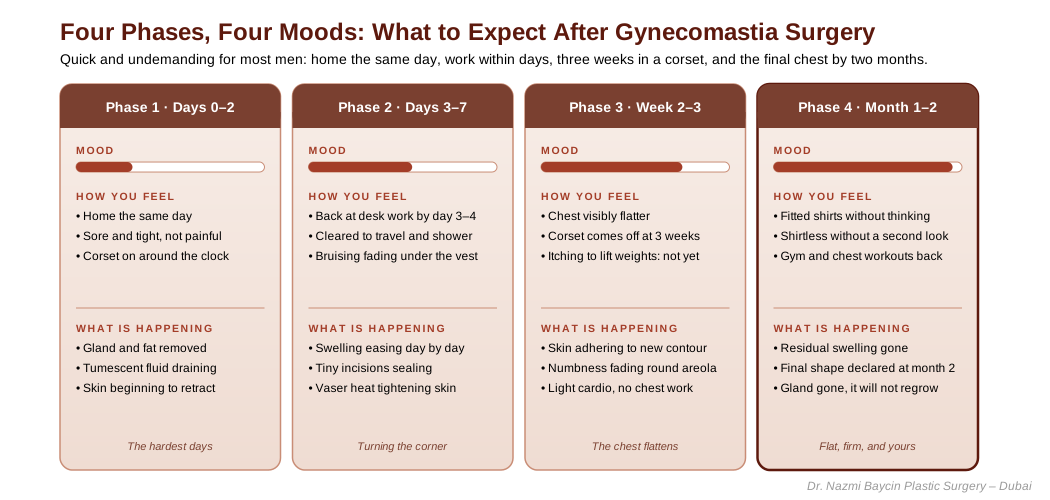
Recovery after gynecomastia surgery is quick and straightforward for most men. You go home the same day, and what you feel is soreness and tightness rather than pain. The one essential is the compression corset: worn continuously for three weeks, it presses the skin onto its new, flatter contour and keeps swelling down. You can shower and travel from day two and are usually back at desk work by day three or four, though heavy exercise and chest workouts wait three to four weeks. Over the second and third weeks the chest flattens visibly as the skin adheres and any numbness around the areola fades, and the corset comes off. The final shape declares itself at about two months, when the last swelling has gone; because the gland does not regrow, that shape is yours to keep provided your weight stays stable. The mood follows: constrained in the vest, relieved at work, pleased in the mirror, and finally at ease in a fitted shirt. The pace varies with personality; the shape rarely does.
What are the risks and complications of gynecomastia surgery?
Gynecomastia surgery is generally very safe, with no serious risks in experienced hands, though as with any operation minor risks exist. A hematoma — a collection of blood in the wound — can occasionally occur after removing a large volume of tissue in one block, but careful control of bleeding during surgery usually prevents it. The risk of infection is low and reduced further by antibiotics. The most common issue is asymmetry: if fat removal is uneven or incomplete, a small difference between the two sides can remain, which may need a minor correction afterward — one more reason that careful, tissue-matched technique matters.
Checklist before having gynecomastia surgery in Dubai
IMPORTANT ! Before getting the appointment, check your medical conditions yourself.
| # | Conditions | Safety | Aesthetic Suitability |
|---|---|---|---|
| 1 | Are you over 20 years old? | 🟢 Fit for surgery | — |
| 2 | Do you have enlarged male breast tissue (gynecomastia)? | 🟢 Fit for surgery | 🟡 Ideal candidate |
| 3 | Would you like a flatter, more masculine chest contour? | 🟢 Fit for surgery | 🟡 Ideal candidate |
| 4 | Do you have excess fat deposits in the chest area? | 🟢 Fit for surgery | 🟡 Ideal candidate |
| 5 | Do you have endocrine disorders that may cause hormonal imbalance? | 🔴 Contraindicated | — |
| 6 | Do you have a cardiovascular problem such as heart disease or deep vein thrombosis? | 🔴 Contraindicated | — |
| 7 | Do you have pulmonary system problems such as chronic lung disease? | 🔴 Contraindicated | — |
| 8 | Do you have chronic liver disease? | 🔴 Contraindicated | — |
| 9 | Do you have a urinary system disease such as kidney failure? | 🔴 Contraindicated | — |
| 10 | Do you have a hematologic problem such as anemia or coagulopathy? | 🔴 Contraindicated | — |
| 11 | Do you have any transmitting disease through blood such as HIV? | 🔴 Contraindicated | — |
| 12 | Have you been taking anticoagulant medication? | 🔴 Contraindicated | — |
| 13 | Have you been taking psychotropic drugs? | 🔴 Contraindicated | — |
| 14 | Any drug abuse or addiction | 🔴 Contraindicated | — |
How much does a gynecomastia surgery cost in Dubai, UAE?
The price of gynecomastia surgery in Dubai can differ quite a bit depending on the clinic you choose. Typically, you’re looking at a range from 15,000 AED (approximately $4,100) to 40,000 AED (roughly $11,000).
It’s important to note that these prices don’t reflect Dr. Baycin’s individual rates. You’ll learn the exact cost during your consultation, once he evaluates your condition.
For a complete overview of treatment fees, please refer to full price list of the procedures. If you are looking specifically for this procedure, you can also review pricing information.
Schedule your private consultation with Dr. BaycinWhat makes Dr. Baycin an exceptional gynecomastia surgeon in Dubai?
Men seeking gynecomastia surgery want more than a cosmetic fix — they want confidence restored and masculinity redefined — and with more than 250 successful procedures, that is the standard Dr. Baycin holds.
- 25+ years of proven mastery: a board-certified plastic surgeon, DHA-licensed and an ASPS member, at the forefront of male chest contouring with more than two decades of refined expertise.
- A personalized, patient-centered approach: no two men present the same way, so each surgical plan is built around the patient’s anatomy and goals to restore natural masculine contours.
- Pioneering, tissue-matched techniques: precise gland removal, micro-liposuction, and scar-minimization combined according to tissue type, reducing trauma and irregularity for smooth, natural results.
- Faster recovery, minimal downtime: refined methods that get most men back to daily life within days, with little disruption.
- An uncompromising safety record: no major complications across thousands of surgeries, which is why men travel from across the GCC and Europe for this sensitive procedure.
- Honest, transparent consultations: every step explained, expectations set realistically, and no unnecessary interventions.
- Comprehensive post-surgical care: tailored aftercare, open communication, and continuous support through healing.
- A global reputation for excellence: a name synonymous with world-class gynecomastia surgery in Dubai.
- Transformations that restore confidence: 250+ procedures known for their natural, masculine finish and lasting effect.
- Compassion alongside expertise: a genuine understanding of the emotional weight gynecomastia carries, with discretion and respect throughout.
About Dr. Nazmi Baycin
Surgery, to me, is precision applied in service of restoration — a conviction that has guided every one of the more than 7,000 procedures I have performed over 25 years in practice. I am a DHA-licensed, board-certified plastic surgeon, trained in Turkey and based in Dubai since 2016. I operate exclusively within JCI-accredited hospitals, and hold international membership in the American Society of Plastic Surgeons (ASPS). Three techniques, in particular, have become signatures of my practice. Scarless breast augmentation, performed through a transaxillary approach that leaves no incision on the breast itself. Labiaplasty designed individually around each patient’s own anatomy, never to a standard template. And 3D customized facial bone implants, engineered through CT-based bespoke printing — a technique I currently offer as the only surgeon in Dubai providing it. My practice today spans facial rejuvenation, breast surgery, body contouring, and cosmetic genital procedures, drawing patients from across the UAE, Europe, and the wider GCC. Yet the principle guiding each of these specialties has never changed: to restore form is to restore function.
FAQs about gynecomastia surgery in Dubai
-
What is gynecomastia?
Gynecomastia is the enlargement of the male breast, and it is far more common than most men realize, affecting a large proportion of men at some point in life. It can arise from excess fat, from genuine growth of the breast gland, or from a combination of the two, and it often causes real self-consciousness. Whatever its cause, my aim with surgery is the same: a flat, firm, naturally masculine chest that lets a man feel at ease again.
-
How much does gynecomastia surgery cost in Dubai?
The price of gynecomastia surgery in Dubai can differ quite a bit depending on the clinic you choose, typically ranging from AED 15,000 to AED 40,000. These are general market figures, not Dr. Baycin’s personal rates; the precise cost is confirmed at your consultation, once your chest has been assessed and the right technique determined.
-
Why does diagnosing the tissue type matter so much?
Because it determines the entire operation, and getting it wrong gives a poor result. Gynecomastia comes in three forms: mostly fatty, mostly glandular, or a mix of both. Fatty tissue responds well to liposuction, but firm glandular tissue does not, and no amount of liposuction alone will remove it. So before I choose a technique, I diagnose exactly which tissue is responsible, because matching the method to the tissue is what delivers a genuinely flat chest. Where a muscular chest wall or a thick fat layer makes that reading less certain, I confirm it with an ultrasound scan before deciding.
-
How do you perform gynecomastia surgery in Dubai?
I match the method to the tissue. For fatty enlargement, I use Vaser liposuction, which melts and removes fat precisely while helping the skin retract. For glandular tissue, which liposuction cannot address, I remove the firm gland directly through a small, well-hidden incision at the edge of the areola. Most men have a mix of both, so I frequently combine the two in one operation. In severe cases with significant loose skin, I also remove excess skin for a flat result.
-
Will gynecomastia surgery leave a visible scar?
Scarring is minimal and very discreet. When I remove glandular tissue, I place the incision at the edge of the areola, where the natural change in skin color hides it beautifully, and the liposuction access points are tiny. I close with hidden, absorbable stitches. Only in severe cases with a lot of excess skin are longer incisions needed, and even then they are planned carefully. For most men, the scars settle to become very difficult to notice.
-
Is the result of gynecomastia surgery permanent?
Yes, when the glandular tissue is properly removed, the result is generally permanent, because that gland does not grow back. This is another reason the correct diagnosis matters so much: if firm gland is left behind and only fat is removed, the problem can appear to persist or return. Significant weight gain can still add fat to the chest, so maintaining a stable weight helps preserve your result, but the glandular correction itself is lasting.
-
What is recovery after gynecomastia surgery like?
Recovery is quicker than most men expect. You go home the same day, and most return to desk work within about three to four days. You will wear a compression garment continuously for three weeks, which is important, as it reduces swelling and helps the skin retract smoothly against the chest. Some swelling and bruising in the first week or two is normal and settles steadily. I usually advise waiting about three to four weeks before returning to heavy exercise and chest workouts.
-
Is gynecomastia surgery painful?
No, it is a comfortable procedure. It is performed under either local anesthesia with deep sedation or general anesthesia, so you feel nothing during the surgery itself, and afterward most men report only mild soreness or tightness rather than real pain, easily managed with simple pain relief. The compression garment also adds a reassuring sense of support in the early days. Because I use hidden, absorbable stitches, there is nothing to remove later, which spares you any added discomfort during healing.
-
Can gynecomastia come back after surgery?
Once the glandular tissue is properly removed, it does not regrow, so true gynecomastia does not typically return. What can happen is that significant weight gain adds fat to the chest, or that certain medications, steroids, or hormonal changes prompt new tissue, so I always discuss any underlying or contributing cause with you. Where an ongoing factor such as a medication is involved, addressing it alongside surgery protects your long-term result and reduces the chance of recurrence.
-
Are you a good candidate for gynecomastia surgery?
You are likely a good candidate if you have persistent male breast enlargement that troubles you, particularly when it has not resolved on its own, and you are in good general health. A clean medical history is the foundation of safe surgery, and I always look into possible underlying causes, since some cases are linked to medications or hormonal factors worth addressing. Ideally your weight is stable, and it helps if you understand that the technique is matched to your tissue type.
-
Will surgery leave my chest looking natural?
That is exactly the goal, a flat, firm, naturally masculine chest rather than an obviously operated one. I take care to contour the chest smoothly, avoiding an overly hollowed or dished appearance around the nipple, which can happen when too much tissue is removed without attention to shape. By blending the treated area gently into the surrounding chest and using Vaser to help the skin retract evenly, I aim for a result that looks like a naturally athletic chest.
-
Can gynecomastia surgery in Dubai be combined with other procedures?
Yes. Because the fatty component is treated with Vaser liposuction, gynecomastia surgery combines naturally with liposuction of the flanks or abdomen for a more complete upper-body contour in a single recovery. Many men choose to refine the whole torso at once. At consultation I assess your chest and body goals together and recommend combining procedures only where it is safe and genuinely enhances your overall result.


GET APPOINTMENT
Get ready to look and feel best… You deserve…
