

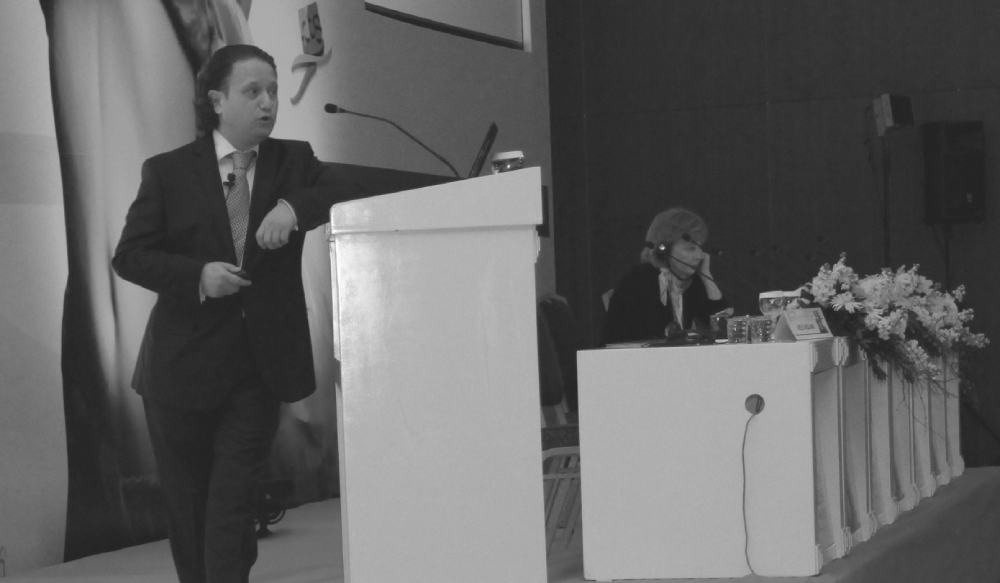
Dr. Nazmi Baycin presenting his original rhinoplasty technique, Bone Chips and Diced Cartilage: An Anatomically Adopted Graft for the Nasal Dorsum, at the 16th Congress of the International Society of Aesthetic Plastic Surgery (ISAPS) in 2002. Presenting original surgical concepts at an international scientific congress reflects active academic involvement, peer recognition, and a longstanding commitment to advancing rhinoplasty through evidence-based innovation.
A surgeon’s philosophy: to restore form is to restore function
“To restore form is to restore function.” This single idea runs through everything I do, and it is worth explaining, because it is the opposite of how cosmetic surgery is often sold. I do not believe beautiful and functional are competing goals — in the human body, they are almost always the same goal seen from two sides. A nose rebuilt to breathe well tends to look right; a breast reconstructed to sit naturally tends to feel right; an eyelid that closes properly is also the one that looks rested. When I plan an operation, I am not chasing an image imposed from outside, but the version of your own anatomy that works as it was meant to. Beauty, in my hands, is what happens when form and function are brought back into agreement.
Experience earned over 25 years and 7,000+ procedures
There is no substitute for having done the work — many times, across the full range of what plastic surgery encompasses. Over more than twenty-five years I have performed over seven thousand procedures, spanning the face, the breast, the body, and the most delicate reconstructive and aesthetic work. That breadth matters more than it might seem: a surgeon who has spent years in reconstruction — rebuilding tissue after trauma, cancer, or congenital difference — brings a different depth to purely cosmetic work, because he understands how tissue heals, how blood supply behaves, and where the limits truly lie. Since moving to Dubai in 2016, I have operated only in JCI-accredited hospitals, because the standard of the setting is inseparable from the safety of the result.
Credentials and training
Dr. Baycin qualified in medicine at the Ege University Faculty of Medicine in İzmir, Turkey, and is board-certified by the Turkish Board of Plastic Surgery — one of the most rigorous surgical training traditions in the world. He holds a Dubai Health Authority license to practice in the UAE, and operates only within JCI-accredited hospitals. He is an international member of the American Society of Plastic Surgeons and belongs to the International Society of Aesthetic Plastic Surgery (ISAPS), The Rhinoplasty Society, the Circle for Aesthetic Surgery, and the International Society of Cosmetology and Cosmetic Gynecology — memberships that place his work within the international mainstream of the specialty and hold it to that standard.
Three signature techniques
Every experienced surgeon develops approaches that become their own. Three in particular define Dr. Baycin’s practice:
- Scarless transaxillary breast augmentation — placing the implant through a hidden incision in the armpit, so there is no scar on the breast itself.
- Individualized labiaplasty — a bespoke, anatomy-led approach rather than a single template applied to every patient.
- CT-based, 3D-customized facial implants — used in chin augmentation and face transformation, designed from a patient’s own CT scan so the implant fits the individual bone precisely.
Each reflects the same instinct: fit the surgery to the person, not the person to the surgery.
A published author and academic contributor
Dr. Baycin is not only a practicing surgeon but a contributor to the surgical literature. His bibliography, listed in full below, spans reconstructive and aesthetic surgery from the mid-1990s onward — from flap survival and craniofacial reconstruction to nasal and eyelid surgery. Among these, the paper “Bone chips and diced cartilage: an anatomically adopted graft for the nasal dorsum,” published in Aesthetic Plastic Surgery in 2004 (PMID 15116277), describes a technique for rebuilding the bridge of the nose and reflects the kind of problem-solving he brings to the operating room. He has presented his work at international congresses, including the 16th Congress of ISAPS, and maintains a public academic profile at academia.edu. For a patient, the significance is simple: this is a surgeon who has been examined by his peers, and who continues to think about surgery as a discipline, not just a service.
Artistry: the surgeon as sculptor
Plastic surgery sits at an unusual meeting point of medicine and art, and the aesthetic eye is not an optional extra — it is part of the skill. Whether designing a hairline with a natural curve, judging the projection of a chin against the rest of a profile, shaping labia to a balanced proportion, or setting the angle of a single transplanted follicle, the technical act and the aesthetic judgment happen in the same moment. Dr. Baycin approaches the face and body the way a sculptor approaches a form — reading proportion, light, and line — which is why his social handle, fittingly, is @artistsurgeon. The goal is never an obvious result, but one so natural that it looks like something you were simply born with.
Honesty as a standard of care
The most important thing a surgeon can offer, before any technique, is the truth. Dr. Baycin is known among his patients for telling them what a procedure can and cannot realistically achieve — for setting expectations honestly, for declining to over-operate, and for recommending against surgery when it is not in a patient’s genuine interest. That candor extends even to how this practice reports itself: the figures cited on this page deliberately exclude certain procedures rather than inflate a total. It is the same honesty that shapes each consultation, where the aim is an informed decision rather than a persuaded one. A patient who understands exactly what lies ahead is a patient who heals with confidence.
- The effect of diosmine on venous flap survival. 1995, Girne.
- The effect of pentoxifylline on survival of random pattern skin flaps. 1995, Girne.
- A rare skin tumor: Leiomyosarcoma. Bursa, 1996
- Tessier No:7 cleft in association with left paramedian mandibular cleft, Bursa, 1996
- Keratoacanthoma : Presentation of 13 cases. Bursa, 1996
- The effects and outcomes of hydroxyapatite, porous polyethylene and silicone elastomer on bone, Annual Meeting of Plastic Surgery. Antalya, 1997.
- Malignant melanoma arising on palmoplantar keratoderma. Antalya, 1997.
- Cystic hygroma on the left cheek. Antalya, 1997.
- Paget’s disease of the maxilla. Ankara, 1998.
- Technetium Tc-99m sestamibi for non-invasive monitoring of muscle flap survival. Istanbul, 1999.
- Bone chips and diced cartilage: An anatomically adopted graft for the nasal dorsum. 16th Congress of ISAPS, Istanbul, 2002.
- Advanced labiaplasty techniques, Istanbul, 2011.
- Synergistic effects of deferoxamine and verapamil in prevention of distal flap necrosis. Trakya Üniversitesi Tıp Fakültesi Dergisi, 11(1,2,3) 237-240, 1994
- The effect of diosmine on venous flap survival. Trakya Üniversitesi Tıp Fakültesi Dergisi, 12(1,2,3): 37-39, 1995.
- The effect of pentoxifylline on survival of random pattern skin flaps. Trakya Üniversitesi Tıp Fakültesi Dergisi, 12(1,2,3): 41-43, 1995
- Keratoacanthoma: Diagnosis and treatment. Trakya Üniversitesi Tıp Fakültesi Dergisi, 13(3):17-23, 1996
- 2 Years experience on mandibular fractures. Trakya Üniversitesi Tıp Fakültesi Dergisi, 14(1):25-31,1997
- A rare skin tumor: Leiomyosarcoma. Cerrahpaşa Tıp Dergisi 28(3):166-169,1997
- Cystic hygroma of the cheek (A case report). Trakya Üniversitesi Tıp Fakültesi Dergisi, 15(2):111-115, 1998
- Therapeutic approach to frontal sinus fractures. Turkish Journal of Trauma & Emergency Surgery, 5(2):128-131, 1999
- Reconstruction of orbital blow-out fractures bone defects with porous polyethylene implants. Turkish Journal of Trauma
& Emergency Surgery, 5(3):175-179, 1999 - Correction of “Saddle nose” deformities with cartilage grafts. Trakya Üniversitesi Tıp Fakültesi Dergisi, 16(1):29-33, 1999
- Gluteal fasciocutaneous V-Y advancement flap for reconstruction of sacral pressure sores. Trakya Üniversitesi Tıp Fakültesi Dergisi, 16(1):35-38, 1999
- Gold weight implanting in order to restore upper eyelid functions in facial paralysis. Cerrahpaşa Tıp Dergisi, 30(2):159-162, 1999
- Repair with “Fricke flap” in full thickness upper eyelid loss. Cerrahpaşa Tıp Dergisi, 30(2):167-170, 1999
- The repair of soft tissue defect on the distal leg with partial soleus muscle flap. Cerrahpaşa Tıp Dergisi, 30(2):187-190, 1999
- Perialar crescentic advancement flap for reconstruction of the upper lip defects. Istanbul University Medical Faculty Journal, 62(2):123-128, 1999
- Lower trapezius muscle flap for reconstruction of auriculo-temporal tissue defect after tumor resection. Trakya Üniversitesi Tıp Fakültesi Dergisi, 16(3): 135-139, 1999
- Malignant melanoma in association with palmoplantar keratoderma. European Journal of Plastic Surgery, 22(1):49-50, 1999
- Surgical management of the lower lip cancers. Trakya Üniversitesi Tıp Fakültesi Dergisi, 18(2):101-109, 2001
- Our experiences for the surgical treatment of the nasal skin carcinoma. Trakya Üniversitesi Tıp Fakültesi Dergisi, 14(2):109-114, 1997
- Bone chips and diced cartilage: An anatomically adopted graft for the nasal dorsum. Aesthetic Plastic Surgery, 28(1), 8-12, 2004
- Turkish Society of Plastic Reconstructive and Aesthetic Surgeons
- International Society of Aesthetic Plastic Surgery (ISAPS)
- American Society of Plastic Surgeons (ASPS)
- Circle for Aesthetic Surgery
- The Rhinoplasty Society
- International Society of Cosmetology and Cosmetic Gynecology
- Turkish Business Council, Healthcare Committee


