


Table of content
- Why might you need ear surgery?
- What is the best age for ear correction surgery?
- How will I perform the otoplasty?
- Can I see otoplasty before and after pictures?
- What is recovery after otoplasty like?
- What are the risks and complications of ear surgery?
- Checklist before having otoplasty in Dubai, UAE
- How much does an otoplasty cost in Dubai, UAE?
- Get appointment
The real test of an ear correction is not how the ears look the week after surgery, but whether they still look that way years later. I am Dr. Nazmi Baycin, and across more than three hundred otoplasty procedures I have built my technique around the one thing that determines durability: the memory of the cartilage. My otoplasty in Dubai does not simply pull the ears back with a stitch — it reshapes and, where needed, weakens the cartilage itself, so the correction holds against the natural spring of the ear rather than slowly surrendering to it.
That distinction is the whole of a lasting result. Prominent ears, asymmetry, and other shape concerns can all be corrected to sit in natural balance with the face — and because the incision is hidden behind the ear, the scar is invisible. Performing ear surgery in Dubai within JCI-accredited hospitals, and often with you awake and holding a mirror to approve the shape as I work, I aim for ears that look like they were always meant to be that way. The principle is the one that guides all my work: to restore form is to restore function.
Otoplasty in Dubai quick facts
| Procedure detail | Otoplasty (ear correction) in Dubai |
|---|---|
| Technique | Cartilage reshaped & weakened, then fixed (not suture-only) |
| Best age | From ~6 years; any age in adulthood |
| Anesthesia | Local (adults); local + sedation for children |
| Patient input | Awake, mirror-guided approval during surgery |
| Procedure time | ~30 minutes per ear |
| Incision | Hidden behind the ear |
| Stitches | Internal + absorbable (none to remove) |
| Hospital stay | Day case — home the same day |
| Bandage | 3 days, then removed at follow-up |
| Bruising / swelling | Fades in 7–10 days |
| Protect from trauma | For 3 months (cartilage sets at ~3 months) |
Why might you need ear surgery?
The ear is not only a functional organ; it is part of how we present ourselves to the world, and its appearance matters as much as its function. While there are many ear deformities, the most common reason people seek otoplasty is prominent ear deformity — ears that stick out further than usual, with the natural folds flatter than they should be. It is worth dispelling a common worry: the position of the baby in the womb, or how a child sleeps after birth, has no bearing on this at all. Many parents try headbands hoping to coax the ears into shape, but because of the cartilage’s memory, these rarely make any real difference. Otoplasty corrects the deformity itself — and for many people, the lift it gives to confidence and well-being is just as significant, with no more need to hide the ears behind one’s hair.
What is the best age for ear correction surgery?
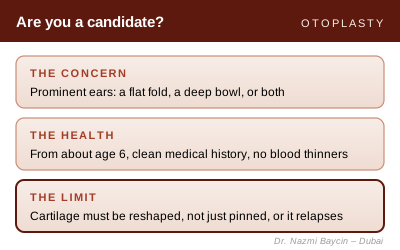
The ideal age for cosmetic ear surgery is around six years old. By that age the ear has reached most of its adult size, and correcting the shape before a child starts school spares them the self-consciousness that can follow when classmates begin to comment — something that can genuinely affect a child’s self-esteem and emotional development. That said, if that window passes, otoplasty can be done just as successfully later in life, at any age you feel ready. There is no upper limit; the cartilage of an adult ear responds well to reshaping.
Will the correction last?
Yes — provided the cartilage is reshaped rather than simply tied back. Ear cartilage carries a spring-like memory, and a correction that only holds the ear in a new position leaves that force intact to reassert itself over months. This is why I reshape and, where necessary, weaken the cartilage before securing it with permanent sutures, so the stitches are stabilizing a shape the ear already accepts. A 2026 review of 18 studies covering 1,590 otoplasty patients and 3,060 ears reported a pooled recurrence rate of 2.8% and a revision rate of 2.1% across the published literature, with suture extrusion the most commonly reported complication at 5.4%.
The biomechanics behind relapse — why it happens, who is most at risk, how early and late relapse differ, and how a revision is planned after a failed correction elsewhere — are covered in full in my article on why ear pinning relapses and how cartilage memory is controlled.
| Factor | Cartilage scoring / reduction | Threads / suture-only |
|---|---|---|
| What is done to the cartilage | The cartilage is scored or incised along the line of the intended fold, weakening it so it bends into a new shape. | The cartilage is left intact. Permanent sutures are placed behind the ear to pull it into a folded position and hold it there. |
| What holds the result | The reshaped cartilage itself, with sutures supporting it. | The sutures alone. If they fail or loosen, the cartilage has nothing to keep it folded. |
| Best suited to | Thicker, stiffer, less malleable cartilage that will not hold a fold by suture tension alone — more common in adults. | Softer, more pliable cartilage that accepts a fold readily — more common in children. |
| Characteristic drawback | More technically demanding, and over-scoring risks visible ridges or sharp edges in the cartilage. | Suture extrusion, where a permanent stitch works its way toward the surface — the most commonly reported complication in the published series. |
| Cost | Higher, reflecting the technique | Lower |
| Reliability | ||
| What the evidence shows | Less than the debate suggests. A 2024 systematic review and meta-analysis found no significant difference between cartilage reduction and cartilage-scoring techniques for recurrence or reoperation (odds ratio 0.92, 95% CI 0.53–1.60, p = 0.766), nor for hematoma or wound infection. Another 2020 systematic review concluded that cartilage-sparing outcomes appear superior — while stating plainly that the underlying studies are of low quality, and that a personalized approach often requires a combination of both. | |
A note on reading the comparison. This is a genuine and unresolved debate rather than a settled question, and the honest summary is that the direct comparison does not show one technique beating the other. What the literature does consistently show is that the cartilage in front of the surgeon — how thick, how stiff, how willing to hold a fold — matters more than allegiance to either method.
How does Dr. Baycin perform otoplasty?
Ear correction surgery is usually performed under local anesthesia. For children under fifteen I prefer local anesthesia combined with sedation; in adults, local anesthesia alone is generally enough to numb the area and keep you comfortable throughout. In my practice, otoplasty takes around thirty minutes per ear.
| Factor | Local anesthesia | Local anesthesia with sedation | General anesthesia |
|---|---|---|---|
| When Dr. Baycin uses it | Adults and older teenagers — the standard choice | Children under fifteen, and adults who prefer not to be aware | Young children who cannot lie still, and otoplasty combined with another procedure |
| Your state during surgery | Awake; the ears are numb | Drowsy or lightly asleep, breathing on your own; little or no memory of the procedure | Fully unconscious, breathing supported by the anesthetist |
| Mirror check during surgery | Yes — you view the ears and approve the shape before the correction is finished | Not possible; the surgeon judges the shape and symmetry alone | Not possible |
| Why it suits that patient | The operation is behind the ear, short, and comfortable when numb, so being awake costs nothing and gains real-time input | Removes anxiety and keeps a child or nervous adult still for the thirty minutes per ear | Needed when a child cannot cooperate or when several procedures are done in one sitting |
| Pain during the procedure | None beyond the anesthetic injections; light pressure or touch may be felt | None; the injections are given after sedation begins | None |
| Who administers it | The surgeon, by injection around the ear | Anesthetist gives the sedation; surgeon numbs the ear | Anesthetist |
| Setting | JCI-accredited hospital | JCI-accredited hospital | JCI-accredited hospital |
| Fasting beforehand | Not usually required | Required, as for general anesthesia | Required, typically from midnight before surgery |
| Waking and going home | Immediate; home within an hour or two once the bandage is on | Awake within minutes; home within two to three hours | Effects wear off within a few hours; home the same day |
| Escort needed to go home | Advisable | Required | Required |
| Common after-effects | None beyond the surgery itself | Brief drowsiness | Grogginess for a few hours; occasionally nausea or a sore throat |
| Suitability | Most adults; needs a patient who can lie still for the duration | Children from around six upward, and anxious adults | Requires pre-operative medical clearance; chosen on the anesthetist’s assessment for young children |
| Effect on the surgical result | None on the technique — but the mirror check is the surest way to match the result to your expectations | None | None — the choice is about comfort and stillness during surgery, not the outcome |
Once the anesthetic has taken effect, I make a discreet incision behind the ear. Through it I access the cartilage and reshape it to overcome its tendency to spring back — thinning, softening, or strategically weakening it so it can be folded into a more natural, stable position. Where the cartilage is particularly thick or rigid, I remove a small portion so the ear can be repositioned without excessive tension. Once the contour is right, I place internal sutures to secure the reshaped cartilage and hold the correction long-term. Because the incision sits behind the ear and is closed with discreet absorbable stitches, there are no visible external sutures, no stress of stitch removal, and minimal scarring.

Prominent ears are a cartilage problem, not a skin problem — removing skin does not move an ear, and there are two distinct ways the underlying shape goes wrong. In the first, the antihelix, the curved ridge just inside the rim, never folded as it should during development, so the upper ear has nothing holding it back; the correction is to score the cartilage along the line of that fold, reshape it, and hold the new position with permanent sutures placed behind the ear. In the second, the conchal bowl at the centre of the ear has grown too large and pushes the whole ear away from the head; here the excess bowl cartilage is reduced, or the bowl is set back toward the skull, so the ear sits closer without being flattened against it. The two rarely occur alone. Judging which is driving the prominence, and by how much, is what decides the plan — because correcting one and ignoring the other leaves an ear that is improved but still not right. Whichever combination is needed, the incision sits in the natural crease behind the ear and nothing of the work shows from the front.
Why you stay awake with a mirror in hand
There is a real advantage to operating under local anesthesia: you stay awake and take part. I give you a mirror so you can see the shape of the ear during surgery and tell me what you think, and I only consider the correction finished once you have looked and approved it yourself. Few aspects of cosmetic surgery allow this kind of real-time collaboration, and it is one of the surest ways I know to deliver a result that matches your expectations exactly.
The surgical stages of otoplasty
In sequence, an otoplasty proceeds through four clear stages: first, marking the skin to be removed behind the ear; second, internal stitching to reshape the cartilage into its new contour; third, closing the skin with hidden, absorbable sutures; and finally, a healed incision concealed in the crease behind the ear.

Step by step otoplasty: 1- Marking the skin to be removed, 2- Internal stitching to reshape the cartilage, 3- Skin closure with hidden and absorbable sutures, 4- Healed surgical incision
In-depth reading: the anatomy, technique, aesthetics, and longevity behind otoplasty in Dubai
Otoplasty is a single procedure with many dimensions — which structures cause the prominence, how the cartilage is sculpted and in what order, how a natural shape is preserved, how children and adults differ, and why a well-built correction lasts. These detailed articles explore each dimension in depth.
- The three subunits of the auricular framework, and what goes wrong with each — the antihelical fold, the conchal bowl and the lobule as separate anatomical problems, and why the lobule is the one most often left out.
- The four-step surgical sequence, and why the order matters — anterior scoring, conchal setback, stabilizing sutures and symmetry, with the reason each step has to precede the next.
- How to avoid the over-corrected, pinned-back look — why aggressive setback creates a stiff, surgical appearance, and how a softer, natural projection is achieved instead.
- How cartilage behaves differently in children and adults — what the differences in cartilage stiffness and healing mean for timing, technique, and recovery at each age.
- Why some ears re-protrude, and how cartilage memory is controlled — the biomechanics of relapse, early versus late patterns, and how revision is planned after a failed correction.
Can I see otoplasty before and after pictures?


Before and after: the prominent ear brought into natural position.
The before-and-after photographs here show a range of prominent-ear corrections, with the ears brought into natural balance with the face and the scar hidden behind the ear in every case. The aim throughout is the same: a result that looks unoperated.
Where does Dr. Baycin perform otoplasty in Dubai?
I perform every otoplasty in a JCI-accredited, high-quality hospital in Dubai that meets strict international standards for safety and hygiene. Your ear surgery takes place in a fully equipped, advanced medical setting, with natural results and patient safety the first priorities at every step.
What is recovery after otoplasty like?
You can go home the same day as your ear surgery — there is no need to stay overnight. Some mild discomfort is normal for a couple of days and is easily eased with painkillers. A bandage holds the ears in their new position for the first three days, and I will see you on the third day to remove it, after which you can shower. Some bruising and swelling are to be expected and fade on their own within about seven to ten days.
The most important thing during recovery is to protect your ears from any knock or trauma for the first three months: if the ears are injured before the cartilage has fully healed, the shape can revert, which is not a health risk but could mean a second otoplasty to correct. At around three months the cartilage settles into its permanent shape, and from then on it is stable — the ear will hold its form even against the occasional knock. To understand the full science behind how I support your healing after surgery, see my advanced recovery protocol in Dubai article.
Download Dr. Baycin’s otoplasty aftercare instructions
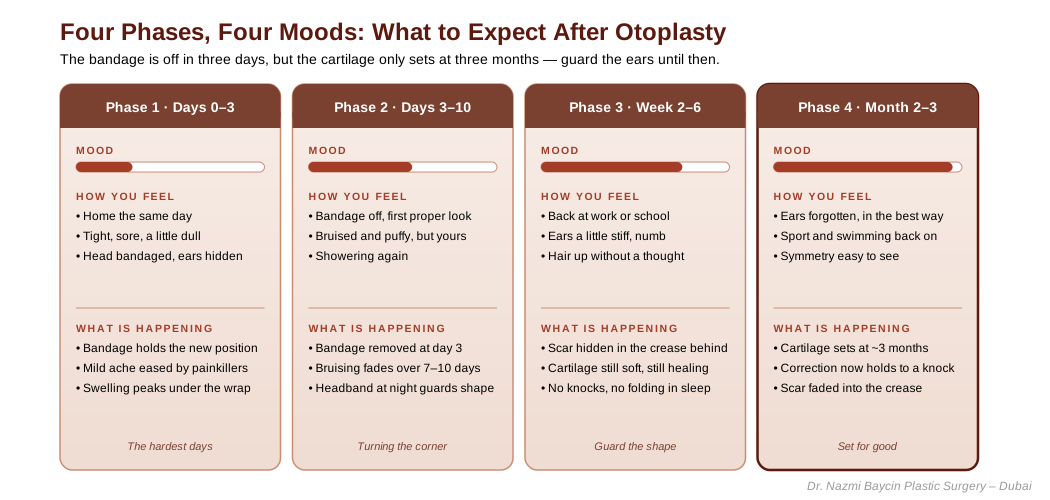
Otoplasty recovery is short on the calendar and long on patience. You go home the same day with a bandage holding the ears in their new position; the first two or three days are sore and tight, and sleeping upright is the main awkwardness. I remove the bandage on the third day, after which you can shower, and bruising and swelling fade over the next seven to ten days. Most people are back at work or school within a week, with a supportive headband worn continuously at first and then at night. From the second week the shape is plainly visible and the scar is settling into the crease behind the ear; what remains is protection, because the cartilage does not set into its permanent shape until about three months, and a knock before then can undo the correction. The mood follows: discomfort in the first days, relief when the bandage comes off, a guarded confidence through the first month, and by the third month ears you no longer think about. The pace varies with personality; the shape rarely does.
What are the risks and complications of ear surgery?
Otoplasty is a safe procedure, but as with any operation a few risks deserve honest mention. A hematoma — a collection of blood in the wound — is avoidable with careful control of bleeding during surgery. Infection is rare after ear surgery and reduced further by antibiotics.
Hypertrophic scars or keloids can occasionally form depending on a person’s genetic skin tendencies, and where healing is poor there are effective treatments to improve the scar; fortunately, because the scar lies behind the ear, it is hidden in any case.
Asymmetry or recurrence can happen within the first three months, usually after accidental trauma, and may occasionally need a second procedure — which is exactly why protecting the ears and not folding them while sleeping matters so much in that early window.
Very rarely the body reacts to an internal suture and forms a small, persistent spot, resolved simply by removing the stitch; because I use long-lasting soluble sutures, such reactions are uncommon. Where any complication does arise, it can usually be managed and treated easily.
Checklist before having otoplasty in Dubai, UAE
IMPORTANT ! Before getting the appointment, check your medical conditions yourself.
| # | Conditions | Safety | Aesthetic Suitability |
|---|---|---|---|
| 1 | Are you over 6 years old (or an appropriate surgical age)? | 🟢 Fit for surgery | — |
| 2 | Do your ears appear prominent or protruding? | 🟢 Fit for surgery | 🟡 Ideal candidate |
| 3 | Would you like your ears to appear less prominent and more natural? | 🟢 Fit for surgery | 🟡 Ideal candidate |
| 4 | Do you have a cardiovascular problem such as heart disease or deep vein thrombosis? | 🔴 Contraindicated | — |
| 5 | Do you have pulmonary system problems such as chronic lung disease? | 🔴 Contraindicated | — |
| 6 | Do you have chronic liver disease? | 🔴 Contraindicated | — |
| 7 | Do you have a urinary system disease such as kidney failure? | 🔴 Contraindicated | — |
| 8 | Do you have a hematologic problem such as anemia or coagulopathy? | 🔴 Contraindicated | — |
| 9 | Do you have any transmitting disease through blood such as HIV? | 🔴 Contraindicated | — |
| 10 | Have you been taking anticoagulant medication? | 🔴 Contraindicated | — |
| 11 | Have you been taking psychotropic drugs? | 🔴 Contraindicated | — |
| 12 | Any drug abuse or addiction | 🔴 Contraindicated | — |
How much does an otoplasty cost in Dubai, UAE?
The price of cosmetic ear surgery in Dubai can differ quite a bit from clinic to clinic. Typically, you’re looking at a range between 10,000 AED ($2,800) and 30,000 AED ($8,200), influenced by various factors — chiefly whether the operation reshapes the cartilage or simply sutures it, which is what decides whether the correction lasts.
Dr. Baycin’s own fee sits within that range, and the exact figure is confirmed at consultation once your cartilage has been assessed.
For a complete overview of treatment fees, please refer to full price list of the procedures. If you are looking specifically for this procedure, you can also review pricing information.
Schedule your private consultation with Dr. BaycinWhat makes Dr. Baycin an exceptional ear correction surgeon in Dubai?
Patients seeking ear correction want more than a change of shape — they want confidence and the freedom to feel at ease in their own appearance — and with more than 300 successful procedures, that is the standard Dr. Baycin holds.
- 25+ years of surgical mastery: a board-certified plastic surgeon, DHA-licensed and a member of the American Society of Plastic Surgeons (ASPS), with deep specialization and decades of refined experience.
- Personalized care for every patient: no two ears are alike, so each procedure is tailored to the individual’s anatomy and expectations for symmetry and natural balance.
- Special techniques for natural, lasting results: refined cartilage-reshaping methods that overcome cartilage memory and reduce discomfort, downtime, and recovery, while keeping scarring hidden.
- Real-time results with your input: performed under local anesthesia so you stay conscious, view your ears in a mirror mid-surgery, and approve the result before it is finished.
- Technology that supports healing: modern, less invasive methods that reduce tissue trauma and speed your return to daily life.
- Safety above all: an impeccable record across thousands of aesthetic surgeries, built on meticulous planning and execution.
- Clear, honest consultations: every technique explained, expectations set realistically, and decisions made with full clarity.
- Dedicated aftercare: structured follow-up and direct surgeon access throughout healing.
- A reputation that crosses borders: patients travel from Europe, the Middle East, and beyond for his ear correction in Dubai.
- Empathy in every procedure: an approach to ear correction as a journey toward renewed confidence, met with compassion and artistry.
About Dr. Nazmi Baycin
Surgery, to me, is precision applied in service of restoration — a conviction that has guided every one of the more than 7,000 procedures I have performed across 25 years in practice. I am a DHA-licensed, board-certified plastic surgeon, trained in Turkey and based in Dubai since 2016. I operate exclusively within JCI-accredited hospitals, and hold international membership in the American Society of Plastic Surgeons (ASPS). Three techniques, in particular, have become signatures of my practice. Scarless breast augmentation, performed through a transaxillary approach that leaves no incision on the breast itself. Labiaplasty designed individually around each patient’s own anatomy, never to a standard template. And 3D customized facial bone implants, engineered through CT-based bespoke printing — a technique I currently offer as the only surgeon in Dubai providing it. My practice today spans facial rejuvenation, breast surgery, body contouring, and cosmetic genital procedures, drawing patients from across the UAE, Europe, and the wider GCC. Yet the principle guiding each of these specialties has never changed: to restore form is to restore function.
FAQs about otoplasty in Dubai
-
What is otoplasty?
Otoplasty, or ear correction surgery, is how I reshape prominent or protruding ears to sit closer to the head in a natural, balanced position. Most often the issue is an underdeveloped fold in the cartilage or an over-deep bowl of the ear, which pushes it outward. I correct this by reshaping the cartilage itself rather than simply pinning the ear back, so the result looks natural from every angle and holds its new shape durably over the long term.
-
How much does otoplasty cost in Dubai?
Otoplasty prices in Dubai can differ from clinic to clinic, and typically you’re looking at a range between AED 10,000 and AED 30,000, influenced by various factors including the complexity of the correction. Dr. Baycin’s own fee sits within that range, and the precise figure is confirmed at your consultation, once your ears have been assessed.
-
How is otoplasty in Dubai performed?
The key to a natural, lasting result is reshaping the cartilage rather than simply pulling the ear back. I make a small incision behind the ear, in the natural crease where it meets the head, then reshape the cartilage, sometimes gently scoring or weakening it so it folds smoothly, and secure the new shape with permanent sutures. Because I recreate the natural fold rather than just tethering the ear, the correction looks natural and resists springing back.
-
Will otoplasty leave a visible scar?
No, the scar is hidden. I place the incision behind the ear, in the natural fold where the ear meets the side of the head, so it is completely concealed from view. I close with fine sutures, and the fine line that remains settles within this hidden crease, becoming very difficult to see even on close inspection. This discreet placement is a deliberate part of achieving a result that looks entirely natural.
-
What is the best age for otoplasty?
The ears reach almost their full adult size by about six years of age, so surgery can be considered safely from around that point onward, and doing it before a child starts school can spare them teasing. That said, otoplasty is by no means limited to children; I perform it just as successfully on teenagers and adults, and it is never too late. The right timing is really a personal decision, which we discuss together.
-
Is otoplasty painful?
No, it is a comfortable procedure. It is performed under local anesthesia in adults, often with light sedation, or under general anesthesia for young children, so nothing is felt during the surgery itself. Afterward, most people report only mild tenderness or a feeling of tightness rather than real pain, easily managed with simple pain relief. Wearing the supportive headband in the early days also protects the ears and adds a reassuring sense of security while they heal.
-
What is recovery after otoplasty like?
Recovery is quick and straightforward. You go home the same day, and most people return to work or school within about a week. There will be some swelling and mild bruising at first, which settles steadily. The main thing to remember is the supportive headband: I ask you to wear it continuously for the first week to protect the ears and hold their new position, then usually just at night for a few weeks more to secure the result.
-
How soon can I fly after otoplasty?
Many of my ear-correction patients travel to Dubai for surgery, so this comes up often. Otoplasty is a day case under local anesthesia, and the ear is not connected to the pressurized structures of the middle ear that flying affects, so the flight itself is not the constraint. What matters is the follow-up: I remove the bandage on the third day, so I ask patients to stay until after that appointment. Beyond it, the practical concerns are protecting the ears from knocks in transit and keeping the supportive headband in place. Anyone planning a longer flight or an onward journey should tell me at consultation so we can time the surgery around it.
-
Can otoplasty correct just one ear?
Yes. If only one ear is prominent, I can operate on that side alone, though I always assess both ears together, because the goal is balance and symmetry between them. Sometimes achieving that harmony means making a subtle adjustment to the other ear as well, so the two match naturally. At consultation I examine both sides carefully and plan whatever will bring them into the most natural, even proportion with each other and your face.
-
Is otoplasty in Dubai safe?
In experienced hands otoplasty is a safe, well-established procedure, but I always discuss the minor risks honestly. These include temporary swelling and bruising, and, uncommonly, infection of the cartilage or a suture working loose, both of which are minimized with careful technique and good aftercare. Following the guidance on wearing your supportive headband is an important part of protecting the result and reducing any risk of the shape relapsing. Good general health supports a smooth, safe recovery.
-
Are you a good candidate for otoplasty?
You, or your child, may be a good candidate if prominent or protruding ears cause self-consciousness, and you are in good general health. For children, I look for the ears having reached near-adult size, usually from around six, and for the child being cooperative and keen. A clean medical history is the foundation of safe surgery. Above all, otoplasty suits anyone, at any age, who would simply feel more comfortable with their ears in a more natural position.
-
What is the difference between otoplasty and earlobe surgery?
They address different parts of the ear. Otoplasty reshapes the ear cartilage to correct prominent or protruding ears, whereas earlobe repair and reduction deals specifically with the soft earlobe, mending splits and tears or reshaping oversized lobes. If your concern is the overall shape or prominence of the ear, otoplasty is what you need; if it is the lobe alone, earlobe surgery is the answer. The two can also be combined where both apply.


GET APPOINTMENT
Get ready to look and feel best… You deserve…
