


Table of content
- Why might you want to change your face?
- What is face transformation — and what is realistic?
- Why does Dr. Baycin take the psychological side so seriously?
- What is the difference between a feminine and a masculine face?
- What does facial feminization surgery involve? (male to female)
- What does facial masculinization surgery involve? (female to male)
- Checklist before having facial feminization or masculinization surgery in Dubai, UAE
- How much does a face transformation surgery cost in Dubai, UAE?
- Get appointment
Few procedures in plastic surgery are as personal, or as profound, as changing the face. I am Dr. Nazmi Baycin, and as a plastic surgeon practicing in Dubai, I offer face transformation in Dubai — including facial feminization and facial masculinization surgery — for people who wish to bring their outer appearance into harmony with who they feel themselves to be. Whether you are considering male-to-female feminization or female-to-male masculinization, my approach centers on you: your goals, your anatomy, and your journey.
This is careful, staged, deeply individual work, and honesty is at the heart of it. Performing face transformation surgery in Dubai within JCI-accredited hospitals, I will guide you through what is genuinely possible, tailor every technique to create a natural, harmonious result that aligns with your identity, and support you from the first consultation through recovery and beyond. The principle is the one that guides all my work: to restore form is to restore function.
Why might you want to change your face?
Face transformation is one of the rarer and more involved undertakings in plastic surgery — only a small number of surgeons perform it, and I have had the privilege of doing so a number of times. People come to it for very different, deeply personal reasons, and each is valid:
- Simply wishing to look different, for one’s own reasons.
- Wishing to bring a feminine appearance to the face — facial feminization surgery, often as part of a male-to-female journey.
- Wishing to bring a masculine appearance to the face — facial masculinization surgery, often as part of a female-to-male journey.
Whatever brings you here, my role is to understand your goal, tell you honestly what surgery can and cannot achieve, and help you reach a result that feels authentically yours.
What is face transformation — and what is realistic?
Films have led many people to believe a face can be completely swapped for someone else’s, and now and then someone arrives hoping to become the mirror image of a favorite celebrity. I remember, years ago, a man who asked me to make him look like a famous film actor; I had to decline, because that expectation simply wasn’t realistic — transformations of that kind belong to science fiction. I am a surgeon, not a magician, and I would rather be honest with you from the outset than promise the impossible.
What I can do is a great deal. For patients who want to change their appearance without chasing a specific face, the results are natural variations of their own features — and the more procedures undertaken, and the more freedom you give me to reshape, the greater the change can be. There are excellent 3D simulation tools that can show you a preview of how your face might change before surgery, which can be genuinely helpful. But designing a face on a screen and creating it in living tissue are two very different things, and no honest surgeon can guarantee the final result will match a simulation exactly.
Why does Dr. Baycin take the psychological side so seriously?
Because a face change is significant and, in bony terms, largely irreversible, I ask every patient to reflect carefully on their expectations and their reasons before we begin — mental readiness matters just as much as physical health, and how satisfied you feel afterward depends enormously on what you expected.
Based on those expectations, I find candidates tend to fall into two groups. The first arrives with a single rigid, exact image they must become; because I cannot conjure an exact replica of a picture in someone’s mind, a person with fixed expectations is likely to be disappointed, and in that case I will not proceed — it would not be fair to them.
The second is open to a range of outcomes, wanting a meaningful change but flexible about the details; these patients are almost always pleased, and with them I can design a look that truly aligns with their wishes. This honest screening protects you, and it is a part of the care I take most seriously.
The published evidence affirms how meaningful this surgery can be when done thoughtfully: a systematic review and meta-analysis of 19 studies covering 1,837 patients undergoing facial gender-affirming surgery — almost all of them trans women — found statistically significant improvement across every quality-of-life domain measured, including psychological satisfaction and satisfaction with the surgical result.
Are you ready for face transformation? A readiness checklist
Before your consultation, it helps to reflect honestly on a few things — not as hurdles, but so that we can plan something that truly serves you:
- Your goal. Are you open to a natural change that suits your face, rather than an exact copy of a specific person?
- Your health. A clean medical history and good general health are the foundation of safe surgery.
- Your timeline. Are you comfortable proceeding step by step, giving yourself time to adapt between stages?
- Your support. Do you have the personal support around you that any significant surgery deserves?
- Your expectations. Do you understand that results are natural variations of your own features, refined over one or more stages?
We will go through all of this together, unhurried and in confidence, and proceed only when the plan feels right for you.
What defines the shape and gender of a face?
A face is defined by five elements, and the near-infinite ways they combine are what make every face unique. Understanding them is how I plan any transformation.
Facial bone structure
Bone is the scaffold of the face, and the bones that shape it are the lower jaw (mandible), upper jaw (maxilla), cheekbones (zygoma), nasal bone, and forehead bone. The lower jaw can be widened or narrowed, its rear angle sharpened or smoothed and rounded, its height adjusted, and the chin reduced or augmented and moved forward or back — you can read more on the chin surgery page. The upper jaw can be advanced or set back, and the distance between the upper teeth and nose adjusted. The cheekbones can be reduced or augmented, and their arch widened or narrowed. The nasal bone can be reduced or built up, narrowed or widened, and the tip reshaped and rotated — the rhinoplasty page covers this in detail. The forehead bone can only be augmented, not reduced: because it protects the brain, thinning it would leave it more fragile against trauma, so I am candid that reduction is not something I will do.
Facial muscles
The muscles are the only dynamic part of the face — they drive every expression, from opening the eyes to smiling and speaking. Because altering a muscle also alters its function, only minor changes are advisable here, so as to preserve the movement and expression that make a face alive.
Fat volume and distribution
Fat volume shapes how full or lean a face looks, and it can be adjusted in both directions. To reduce fullness, liposuction and buccal fat removal work well; to add volume where a face looks too lean, fat transfer restores fullness. The lips can be made fuller with fat or filler injection too.
Skin characteristics
Skin can be refined in several ways: tightening the skin of the cheeks and eyelids for a more youthful look, reshaping the eye — including softening or opening its shape, or lifting its outer corner for a real change in expression — thinning an over-full lip, or even transferring a nevus (mole) from elsewhere on the body onto the face where it suits the design.
Hair characteristics
Hair frames the face, and it can be adjusted too. Hair transplantation adds density — not only to the scalp but to the eyebrows, beard, and mustache — while laser hair removal reduces it, and eyebrows can be widened or narrowed to suit the overall balance.
What is the difference between a feminine and a masculine face?
Much of what the eye reads as “feminine” or “masculine” comes down to a set of consistent anatomical differences, and understanding them is the key to a natural transformation:
- Forehead: the gap between eyebrows and hairline is wider in men, so the male forehead looks taller; the bony ridge above the eyes is also more prominent in men.
- Eyebrows: female brows are more arched and sit higher above the eye; male brows are straighter and lower.
- Eyes: because the brow-ridge is heavier in men, male eyes appear more deep-set; female eyelids appear more open, male eyelids relatively less so. (Eye-shape and lid refinements are detailed on the eyelid surgery page.)
- Nose: female noses are typically smaller and narrower, with the tip rotated a little more upward; male noses are larger and wider.
- Cheeks: women tend to have more prominent cheekbones and a fuller fat layer; male cheeks are flatter.
- Lips: female lips appear fuller, and the distance between upper lip and nose is shorter than in men.
- Jaw: the male jaw is wider and stronger with a sharper angle; the female jaw is narrower and softer, with a smoother, rounded angle.
| Feature | Typically feminine | Typically masculine |
|---|---|---|
| Forehead | Shorter, smoother, no heavy ridge | Taller, with a prominent brow ridge |
| Eyebrows | Higher and more arched | Lower and straighter |
| Eyes | More open appearance | More deep-set |
| Nose | Smaller, narrower, tip rotated up | Larger, wider, straighter |
| Cheeks | Higher, fuller cheekbones | Flatter cheeks |
| Lips | Fuller, shorter lip-to-nose distance | Thinner, longer lip-to-nose distance |
| Jaw | Narrower, softer, rounded angle | Wider, stronger, sharper angle |
What does facial feminization surgery involve? (male to female)

- Lowering the hairline with hair transplantation to create a narrower forehead.
- Brow lifting, reshaping, and narrowing to raise and arch the brow.
- Reshaping the eyes for a more open appearance.
- Reshaping the nose to a smaller, narrower, softly upturned form.
- Augmenting the cheeks, with bone or fat, for fuller, higher cheekbones.
- Augmenting the lips for fullness.
- Reducing and reshaping the jaw for a softer, rounder angle.
What does facial masculinization surgery involve? (female to male)

- Placing a bone implant beneath the brow to build a more prominent forehead ridge.
- Widening the eyebrows with hair transplantation.
- Fat transfer above the eye for a fuller, heavier upper-eye region.
- Reshaping the nose to a larger, straighter form.
- Reducing cheek fat and bone for a flatter, stronger cheek.
- Reducing the lips for a thinner lip line.
- Placing a jaw implant to create a stronger, squarer jaw.
Why does Dr. Baycin recommend a step-by-step approach?
A sudden, radical change to the face can be surprisingly hard to live with at first — even a change you very much wanted can unsettle your sense of yourself while you adjust. For that reason, whenever the goal allows, I recommend moving forward step by step rather than all at once. Proceeding in stages gives you the time to grow comfortable with each change and to settle into your evolving reflection, and it gives us the chance to decide together what, if anything, you would like to refine at the next stage. It is the gentler path, both emotionally and surgically, and in my experience it leads to happier, more settled results.
Can I see a face transformation before and after?

The photograph here shows a result one year after a third session of staged face reshaping, following several procedures undertaken gradually over time — among them hair transplantation, a forehead lift, brow work, ear correction, fat injection, nose reshaping, lip contouring, eyelid refinement, and some liposuction. It is a good illustration of how a natural, harmonious change is built patiently, in stages, rather than in a single operation.
What is recovery after face transformation like?
Because face transformation is really a tailored combination of procedures rather than one operation, recovery depends entirely on what is done and in which stage. Soft-tissue refinements such as fat transfer or filler settle quickly, while bony work — jaw, cheek, or forehead — asks for more time and patience as swelling resolves and the new contours emerge over the following weeks and months. At each stage I will give you a clear, personalized recovery plan and the aftercare to match it, and my advanced recovery protocol in Dubai underpins how I support your healing throughout.
Download Dr. Baycin’s face transformation aftercare instructions
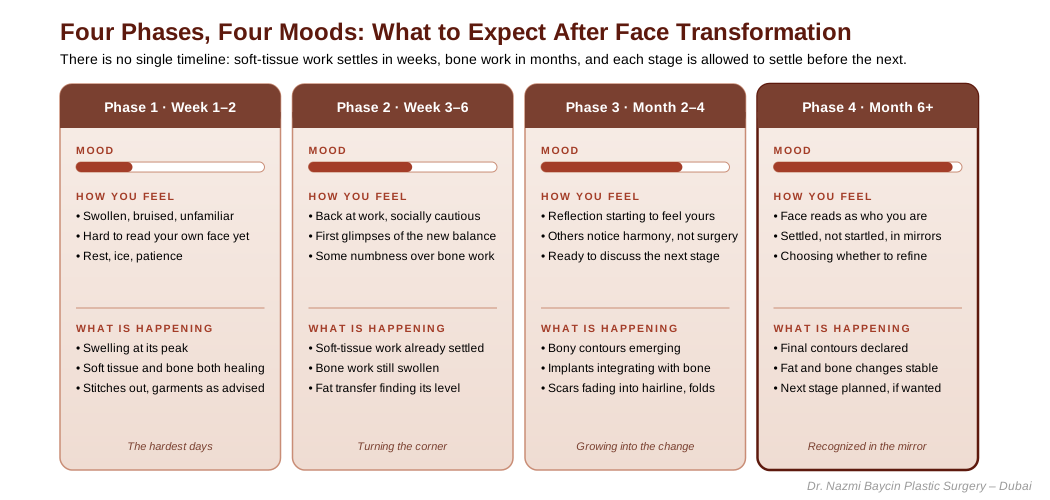
Because face transformation is a tailored combination of procedures rather than one operation, I can only describe the shape of the recovery, not a fixed calendar. The first fortnight is the swollen, bruised stretch in which your own face is hard to read, and it is the same whether the stage involved fat transfer or a jaw implant. From the third week the two timelines part: soft-tissue refinements have largely settled, while bony work on the jaw, cheeks or forehead is still swollen and a little numb. Over months two to four the new bony contours emerge and the scars fade into the hairline and the natural folds, and by six months the stage has declared itself and we can decide together what, if anything, to refine next. The mood follows: disorientation at first, then the first glimpses of the intended balance, then a reflection that slowly becomes yours, and finally the quiet of being recognized in the mirror. The pace varies with personality; the shape rarely does.
Checklist before having facial feminization / masculinization or change surgery in Dubai, UAE
IMPORTANT ! Before getting the appointment, check your medical conditions yourself.
| # | Conditions | Safety | Aesthetic Suitability |
|---|---|---|---|
| 1 | Are you over 18? | 🟢 Fit for surgery | — |
| 2 | Would you like your facial appearance to look more feminine or more masculine? | 🟢 Fit for surgery | 🟡 Ideal candidate |
| 3 | Would you like to improve or reshape one or more facial features? | 🟢 Fit for surgery | 🟡 Ideal candidate |
| 4 | Do you have a cardiovascular problem such as heart disease or deep vein thrombosis? | 🔴 Contraindicated | — |
| 5 | Do you have pulmonary system problems such as chronic lung disease? | 🔴 Contraindicated | — |
| 6 | Do you have chronic liver disease? | 🔴 Contraindicated | — |
| 7 | Do you have a urinary system disease such as kidney failure? | 🔴 Contraindicated | — |
| 8 | Do you have a hematologic problem such as anemia or coagulopathy? | 🔴 Contraindicated | — |
| 9 | Do you have any transmitting disease through blood such as HIV? | 🔴 Contraindicated | — |
| 10 | Have you been taking anticoagulant medication? | 🔴 Contraindicated | — |
| 11 | Have you been taking psychotropic drugs? | 🔴 Contraindicated | — |
| 12 | Any drug abuse or addiction | 🔴 Contraindicated | — |
How much does a face transformation surgery cost in Dubai, UAE?
The cost of face transformation in Dubai varies widely, because it depends entirely on which procedures are involved and how many stages you choose — a single procedure has its own price, while a combined or staged plan scales with it. As a broad guide the range runs from about AED 15,000 ($4,100) to AED 200,000 ($55,000), but these are general market figures, not my personal rates; I will set out the exact cost for your specific plan at consultation.
You can see my general price list of the procedures for context.
Schedule your private consultation in Dubai todayWhat makes Dr. Baycin an exceptional face transformation surgeon in Dubai?
Face transformation asks more of a surgeon than technical skill alone — it asks for honesty, artistry, and genuine care for the person behind the request. That is the standard Dr. Baycin brings.
- Rare experience in a rare field: one of relatively few plastic surgeons to have performed full face-transformation surgery, with command of the entire facial toolkit — bone, muscle, fat, skin, and hair.
- Honest, protective consultations: clear about what surgery can and cannot achieve, and willing to decline when expectations are unrealistic — because your well-being matters more than the operation.
- A respectful, affirming approach: care that centers your identity and your goals, offered with dignity and without judgment.
- 25+ years of surgical expertise: a board-certified plastic surgeon, DHA-licensed and a member of the American Society of Plastic Surgeons (ASPS).
- A staged, patient-centered philosophy: a step-by-step path that lets you adapt to each change and refine as you go.
- Artistry grounded in anatomy: a deep understanding of what makes a face read as feminine or masculine, applied to create natural, harmonious results.
- Care in JCI-accredited hospitals: every procedure performed to the highest international standards of safety and hygiene.
- Support at every stage: personalized recovery plans and direct access throughout a journey that is as emotional as it is physical.
About Dr. Nazmi Baycin
Surgery, to me, is precision applied in service of restoration — a conviction that has guided every one of the more than 7,000 procedures I have performed over 25 years in practice. I am a DHA-licensed, board-certified plastic surgeon, trained in Turkey and based in Dubai since 2016. I operate exclusively within JCI-accredited hospitals, and hold international membership in the American Society of Plastic Surgeons (ASPS). Three techniques, in particular, have become signatures of my practice. Scarless breast augmentation, performed through a transaxillary approach that leaves no incision on the breast itself. Labiaplasty designed individually around each patient’s own anatomy, never to a standard template. And 3D customized facial bone implants, engineered through CT-based bespoke printing — a technique I currently offer as the only surgeon in Dubai providing it. My practice today spans facial rejuvenation, breast surgery, body contouring, and cosmetic genital procedures, drawing patients from across the UAE, Europe, and the wider GCC. Yet the principle guiding each of these specialties has never changed: to restore form is to restore function.
FAQs about face transformation in Dubai
-
What is face transformation surgery?
Face transformation is how I reshape the fundamental features of the face to bring them into harmony with who a person truly is. It includes both facial feminization surgery, which softens features toward a more feminine appearance, and facial masculinization surgery, which strengthens them toward a more masculine one. Rather than a single operation, it is a carefully planned combination of procedures working on bone, fat, and soft tissue, designed together so the result is balanced, natural, and authentically your own.
-
How much does face transformation cost in Dubai?
Because face transformation is a tailored combination of procedures rather than a single operation, its cost varies widely with the specific plan, from the number of areas addressed to whether bone work is involved. For that reason a precise figure is set out for your individual plan at consultation rather than quoted as a fixed price. These are individualized surgical plans, so the fee reflects exactly what your transformation involves.
-
What is the difference between facial feminization and masculinization?
They move the face in opposite directions, guided by the features we tend to read as feminine or masculine. In feminization, I soften the bone and soft tissue: reducing a prominent brow ridge, refining the jaw and chin to a softer shape, raising the brow, and softening the nose. In masculinization, I strengthen those same structures: enhancing the jaw and chin, building a more defined brow and cheeks. Each plan is built around the individual face rather than a template.
-
Which procedures are included in face transformation?
It draws on a whole toolkit, combined to suit each face. The bony framework may be reshaped through forehead and brow surgery, jaw contouring, and chin reshaping. The soft tissues are refined with rhinoplasty, cheek adjustment, and procedures such as buccal fat removal. Others, like hairline lowering or Adam’s apple reduction, target specific features. At consultation we choose the combination that achieves your goals.
-
Why is the forehead and brow area so important?
Because it is one of the strongest signals of a masculine or feminine face, and getting it right transforms the whole upper third. In many people assigned male, the brow ridge above the eyes is pronounced and the forehead slopes backward, which reads as masculine. In feminization I reduce that bony prominence and reshape the forehead to a smoother, more vertical contour, then often raise the brow position. In masculinization, I can build definition here instead. Small millimeters make a striking difference.
-
How do you plan a face transformation?
Carefully, and always as a whole rather than feature by feature in isolation. I begin by understanding exactly how you wish to be seen, then assess your facial structure and plan the combination of procedures that will move the whole face toward that goal in balance. Where bone work is involved, advanced imaging helps me plan with precision before surgery. Sometimes the work is best staged across more than one operation, and I map that path out clearly with you from the start.
-
Is face transformation done in one surgery or several stages?
It depends on how much is being done, and I plan this honestly with you. Some patients achieve their goals in a single combined operation, while for others it is safer and better to stage the work across two or more sessions, allowing full healing between them. Staging can also make recovery more manageable. There is no single right answer; the plan follows your anatomy, your goals, and what can be done safely at once, which we decide together.
-
Will I still look like myself after face transformation?
Yes, and that is central to how I approach this work. My aim is never to erase your identity but to bring your face into harmony with who you are, so the result looks authentic and natural rather than mask-like. I reshape and refine the features you already have rather than replacing them with someone else’s. Most patients feel that they look more like themselves, not less, because their reflection finally matches their sense of who they are.
-
Is face transformation surgery safe?
In experienced hands these are safe, well-established procedures, though they are significant surgery and I discuss the risks fully and honestly. Because a transformation may combine several procedures, careful planning around what can safely be done together, and sometimes staging the work, is itself an important safety measure. Good general health, free of systemic disease, is the foundation, and I take a thorough medical history. Performed thoughtfully and in the right setting, the risks are well understood and manageable.
-
How long is recovery after face transformation?
Recovery depends on which procedures are combined, and I set clear expectations before we begin. Swelling and bruising are expected, most pronounced in the first one to two weeks and then easing steadily; bony procedures such as forehead or jaw work generally involve more swelling and a longer settling period than soft-tissue refinements. The face continues to refine over the following months, with the final result emerging gradually. I guide you closely through each stage of healing with a clear aftercare plan.
-
Does face transformation genuinely improve wellbeing?
The evidence here is strong and, to me, deeply meaningful. Studies of facial feminization surgery show high patient satisfaction and clear improvements in quality of life, because the face is so central to how we are perceived and to how we feel seen. For many people, aligning the face with their identity relieves a profound and long-standing distress. I never treat this as merely cosmetic; it is about helping someone feel recognized when they look in the mirror.
-
Are you a good candidate for face transformation?
You may be a good candidate if you wish to bring your facial features into harmony with your gender identity, you are in good general health, and you have a clear, realistic sense of the changes you are seeking. A clean medical history is the foundation of safe surgery. Most importantly, this is a deeply personal decision, so the consultation is an unhurried, honest conversation in which we explore your goals together and design a plan that genuinely serves them.


GET APPOINTMENT
Get ready to look and feel best with facial transformation surgery… You deserve…
