

Key takeaways: the ethics of the decision
- The first question is whether to operate, not how — judgment precedes technique.
- A patient seeks care, which sometimes means being refused; a client seeks a product.
- Every procedure carries non-negotiable risk; benefit must clearly outweigh it.
- Surgeons detect body dysmorphic disorder poorly by impression alone — validated screening is the responsible default.
- The philosophy of less is more preserves natural identity — enhancement, not erasure.
- A responsible refusal is redirection, not dismissal — explanation, options, and referral.
This essay is about how the decision to operate is made — before the operation, in the consulting room, with the patient in front of me. How expectations arrive there in the first place, shaped by filters, trends and curated feeds, is a separate question, which I take up in my article on navigating patient expectations in the age of social media. The decisions that begin once the incision has been made, when the anatomy does not match the plan, are a different discipline again, and I set those out in my article on surgical decision-making under uncertainty.
The illusion of simple consent: beyond the customer being right
A common and dangerous misconception is that plastic surgery is a consumer service where patient desire is the sole governing principle. That reduces the surgeon to a technician and the procedure to a transaction. My philosophy rejects it utterly. True informed consent is not a signature on a form; it is a shared journey of understanding. It is my responsibility to probe beyond the stated request — why now, what is the true source of the dissatisfaction, and what does the patient believe this change will bring them.
The ethical imperative lies in distinguishing a patient from a client: a client seeks a product; a patient seeks care, which sometimes means being refused. I have declined procedures when the motivation was rooted in external coercion, a partner’s ultimatum, or the pursuit of an unattainable ideal no scalpel can provide. To operate under such conditions is not surgery; it is an exploitation of vulnerability, and it invariably leads to poor outcomes. The first critical decision is to determine whether the person before me is seeking a surgical solution to a problem that is, at its heart, not surgical at all.
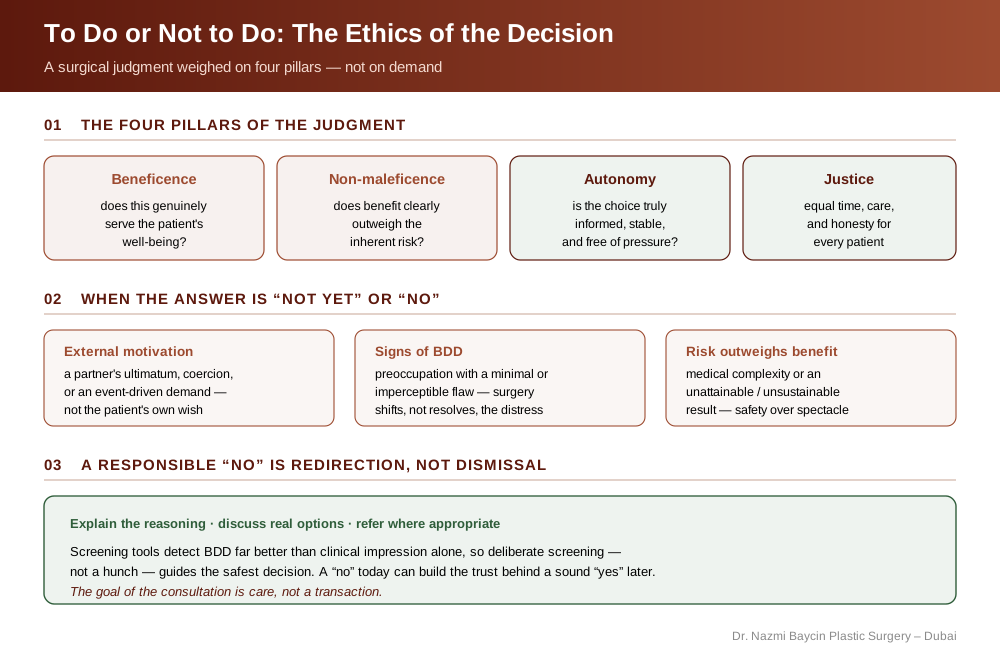
The ethical framework behind the decision to operate — the four pillars, the situations that call for restraint, and the responsible refusal that redirects rather than dismisses — by Dr. Nazmi Baycin, Dubai.
The scales of judgment: weighing benefit against fundamental risk
The core of surgical ethics is the balance between beneficence and non-maleficence. Every procedure, however minor, carries the immutable risk of anesthesia, infection, scarring, and nerve injury. The ethical equation is simple in concept yet complex in practice: does the potential benefit significantly and justifiably outweigh this inherent harm? This is where technical skill must bow to wisdom. Performing an elective, multi-procedure mega-surgery on a medically complex patient may be technically feasible, but is it ethically defensible when the risk profile escalates exponentially?
My principle is to prioritize safety over spectacle, always. Similarly, operating on a patient whose perceived flaw is minimal or non-existent to the objective eye is profoundly harmful: it reinforces a pathological self-view and can trigger a cycle of perpetual, dissatisfying surgeries.
Why clinical impression is not enough
The difficulty is that this judgment cannot be made by instinct alone, and there is good evidence for that. A multicentre prospective study of 597 patients across three academic and private facial plastic and oculoplastic practices screened all of them with a validated questionnaire and asked the surgeon, separately, to judge after each consultation whether that patient was likely to have body dysmorphic disorder. Overall, 58 patients — 9.7% — screened positive. Among those presenting for cosmetic surgery the figure was 13.1%, against 6.7% of reconstructive patients: roughly twice the odds.
The detection result is the sobering one, and it needs its denominator stated. Only 402 of the 597 were assessed both ways, by questionnaire and by their surgeon. Within that group, 43 patients screened positive, and the surgeons correctly identified two of them. Not two-thirds, not two in five: two. Across the same 402, surgeons suspected the condition in 16 patients, 4.0%. The positive likelihood ratio for surgeon impression came out at 1.19, with a confidence interval running from 0.28 to 5.07 — an interval that includes 1, which is to say the result is consistent with clinical impression carrying no diagnostic value at all.
It is worth being precise about what the questionnaire does — it flags risk rather than making a diagnosis, and a positive screen is a reason to explore further, not a verdict. It is worth being equally precise about what the study measured: unaided impression, recorded without any instrument, in a subgroup that excludes a third of the cohort, and in facial and oculoplastic practice rather than body or breast surgery. Even allowing for all of that, the distance between what a validated instrument catches and what experienced clinical judgment catches is wide enough that routine screening, referral, and counseling — not the scalpel, and not instinct — are the ethical response. I would rather be told by a form what my own impression would have missed.
The philosophy of surgical restraint: when less is more
In a culture that often equates more with better, the most powerful tool in a surgeon’s arsenal can be restraint. Less is more is not a marketing slogan; it is an ethical commitment to preserving a patient’s natural identity. The goal is enhancement, not erasure — refinement, not reconstruction into someone else. This requires resisting two temptations: the surgeon’s own artistic ego and the pressure to maximize intervention.
When a patient requests a dramatic, hyperbolic change, my ethical and artistic duty is to guide them toward a result that appears natural, harmonious, and sustainable as they age. To do otherwise is to create a living artifact that may satisfy a momentary trend but becomes a source of future distress. True aesthetic success is measured not by dramatic change, but by the seamless integration of improvement — where the result is so natural it seems it was always meant to be. This commitment to measured, anatomical artistry defines my approach to cosmetic surgery work in Dubai, where the objective is always to reveal, not to replace.
The question of justice: access, equity, and the surgeon’s role
Plastic surgery exists within a broader social context that raises questions of justice. While much of our work is elective, we must remain mindful of the privilege it represents. This awareness shapes practice in tangible ways. It compels me to dedicate a portion of my work to pro-bono reconstructive cases — repairing cleft lips, treating post-traumatic deformities, and performing breast reconstruction for cancer patients.
This is not charity; it is a realignment of the scales, a reminder of surgery’s foundational purpose: to restore form and function where it has been lost. Justice in consultation also means providing the same depth of time, attention, and ethical consideration to every patient, regardless of the procedure’s scale or cost, and discussing value and cost with complete transparency so financial decisions are made without pressure or obscurity.
The integrity of the refusal
Ultimately, the question of whether to operate defines the moral boundary of our profession. The ability to decline is the cornerstone of surgical integrity. It is a declaration that our authority derives from knowledge and ethics, not commercial appetite. It protects the patient from themselves and the surgeon from becoming a mere instrument of will. A refusal today can build the trust that leads to a successful, transformative operation tomorrow. It establishes the surgeon not as a vendor, but as a guardian — a partner in a deeply personal journey whose primary allegiance is to the patient’s long-term well-being. In the end, our legacy is not etched solely in the results we create, but in the judgments we make and the patients we choose, with wisdom and conscience, to help.
FAQs about the ethics of plastic surgery decision-making in Dubai
-
What does informed consent actually mean in plastic surgery, and is signing the form enough?
A signature is the legal record of consent, not the consent itself. True informed consent is a process — a dialogue that may span more than one consultation — in which the patient genuinely understands the procedure, the realistic range of outcomes, the risks, and the alternatives including doing nothing. It also means the patient’s decision is free of coercion, made in a stable emotional state, and grounded in a realistic expectation of what surgery can deliver. A surgeon who rushes this process to reach the operating room faster has not obtained meaningful consent, regardless of what documents were signed.
-
How do you identify when a patient’s motivation is not appropriate for surgery?
By listening more carefully to what is not being said. Patients with appropriate motivation typically describe a specific, longstanding concern about a feature that they feel is disproportionate, and their language is about themselves — how they feel in certain situations, how they see themselves in photographs. Patients whose motivation is problematic often describe what someone else has said about them, reference a specific external event as the trigger, or articulate an expectation that the change will resolve a relationship, professional, or psychological problem that extends far beyond appearance. Neither conversation condemns the patient — it is clinical information that determines the right next step.
-
How would a surgeon know if a patient has body dysmorphic disorder?
Honestly, not reliably by judgment alone — and the evidence on this is uncomfortable reading for surgeons. In a multicentre study, 597 patients were screened with a validated questionnaire, and 402 of them were also assessed separately by their surgeon after the consultation. Within that doubly assessed group, 43 screened positive on the questionnaire and the surgeons correctly identified two of them. That is why I regard a validated screening instrument as part of a responsible consultation rather than an optional extra. A positive screen is not a diagnosis and does not end the conversation; it is a reason to slow down, explore further, and involve a psychological professional before any decision about surgery is made.
-
Can a surgeon ever refuse to operate on medical rather than ethical grounds?
Yes, frequently. Medical grounds for declining include uncontrolled systemic conditions that make anesthesia risk unacceptable, recent weight change or smoking history that would significantly impair healing, unrealistic anatomical limitations that make the requested result physiologically impossible, or a skin condition that contraindicates safe wound healing. These refusals are not rejections of the person — they are protections of the outcome. A surgeon who operates knowing these conditions exist is not being generous; they are setting the patient up for a poor or dangerous result.
-
Does a surgeon’s personal aesthetic preference ever justify refusing to operate?
Only if operating would cause harm — not because the surgeon disagrees with the patient’s taste. A surgeon is not obligated to perform every technically possible operation; they are not a technician without judgment. If a requested result is anatomically unsound, will accelerate aging rather than reverse it, or is so divergent from natural anatomy that it cannot be maintained without perpetual intervention, declining on these grounds is appropriate and ethical. If the objection is purely personal preference — the surgeon would choose a different size, a different shape — this does not justify refusal, but it does justify an honest conversation about alternatives.
-
If a surgeon declines to operate, what should happen next?
The conversation should not end there. A responsible declination is accompanied by a clear explanation of the reasoning, an honest discussion of what options do exist, and — where appropriate — a referral to a colleague with a different skill set or perspective, or to a psychological support professional. Declining surgery is not dismissal; it is redirection. In many cases, patients who have been declined and referred appropriately return months later with a clearer, healthier perspective and proceed to an excellent surgical outcome. The relationship between surgeon and patient is not necessarily ended by a refusal — it is sometimes deepened by one.


GET APPOINTMENT
Get ready to look and feel best… You deserve…
