

Key takeaways: revision means reconstruction
- Revision is a reconstructive problem, not a second reduction.
- The core philosophy is to rebuild and restore, often by adding tissue rather than removing it.
- The commonest failures are over-resection, scarring, asymmetry, and sensory loss.
- Fat grafting and local flaps restore volume, length, and a protective cushion.
- Sensation and protective function are prioritized, not sacrificed for appearance.
- Ethical honesty matters — a good revision surgeon will decline a case that cannot be safely improved.
The need for this work is documented in the specialist literature. A 2019 French comparative study of labia minora reduction examined complications, revision surgeries and results, comparing procedures carried out for functional indications against those carried out for aesthetic ones. I cite it for what it establishes rather than for a number: revision after a primary labiaplasty is a recognized outcome that the surgical literature tracks and reports, not a rare curiosity. That is exactly the territory this reconstructive approach is designed to address.
Recognizing when a primary labiaplasty has failed
Deciding to pursue revision is a significant step, and it starts with accurately diagnosing what went wrong. The table below summarizes the four failures I most often correct and what each involves.
| Failure Mode | What It Looks Like | Consequence |
|---|---|---|
| Over-resection | Labia minora left unnaturally short or absent | Chronic dryness, irritation, exposure of sensitive structures |
| Scarring & contracture | Straight-line scars, notching, thickened ridges | Pain and an unmistakably surgical appearance |
| Significant asymmetry | Pronounced left-right discrepancy from uneven resection | Disrupted harmony and functional discomfort |
| Sensory disturbance | Numbness, hypersensitivity, or painful neuromas | Nerve injury from aggressive or thermal dissection |
Over-resection is the most devastating of these — the so-called amputated look, where excessive removal leaves the labia minora unnaturally short or absent, producing chronic dryness, irritation, and exposure of sensitive structures. It usually stems from a surgeon prioritizing an extreme, minimalist ideal over anatomical preservation. Visible scarring and contracture — straight-line scars, notching, and thickened ridges — are the tell-tale signs of a simplistic trim technique and closure under tension, and they can be genuinely painful.
Significant asymmetry, while never entirely avoidable given that natural symmetry is rare, becomes a problem when uneven resection creates pronounced discrepancies. And sensory disturbances point to nerve injury. During consultation in Dubai I examine scar maturity, tissue quality, and residual blood supply, because that diagnostic phase is what makes a realistic, stepwise plan possible. It also protects the patient from a rushed second operation that could deepen the original damage.
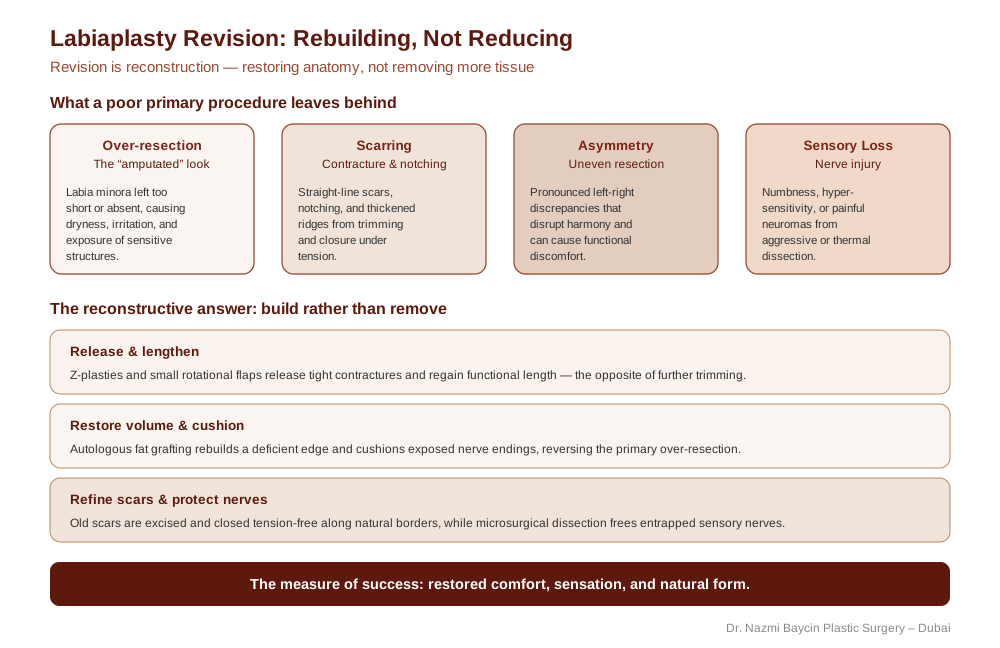
The four common failures of a poor primary labiaplasty and the reconstructive answer — releasing contractures, restoring volume, and protecting sensation by building rather than removing — by Dr. Nazmi Baycin, Dubai.
A reconstructive philosophy: building rather than removing
The core principle of revision work is replacement and restoration. When tissue has been lost, the task is to find ways to rebuild it, and the techniques are tailored to the specific defect.
For over-resection and tight contours, the solution is rarely simple stretching; I often use local tissue rearrangement such as Z-plasties or small rotational flaps to release contractures and regain functional length, and in cases of severe deficiency I may use autologous fat grafting, transferring a patient’s own fat to add volume and cushioning to the labial edge. This judiciously adds rather than removes, directly reversing the primary mistake.
For deforming scars, my strategy is precise excision of the old scar followed by a multi-layered, tension-free closure, realigning the wound edges along the natural pigmentation borders and using deep dissolving sutures to bear tension so the surface heals imperceptibly.
For asymmetry and volume loss, correction is a matter of artistic balance — differential fat grafting or careful mobilization of local tissue to create visual harmony, aiming not for enforced mirror-image symmetry but for a balanced, natural-looking result where minor variations appear innate. This is the same principle behind correcting vertical malposition for natural contours, where balance matters more than rigid symmetry.
The critical role of sensation and functional protection
A labiaplasty that sacrifices sensation and protective function is a failure, regardless of how it looks. In revision surgery I therefore prioritize neuroanatomy, using microsurgical techniques to dissect carefully through scar tissue while avoiding — and, where possible, releasing — entrapped sensory nerves. It is the same respect for the neurovascular anatomy behind preserved sensation that should guide any primary procedure in the first place.
The restorative techniques themselves help here: fat grafting, for instance, provides a protective cushion over sensitive neural endings that were left exposed by over-resection. The ultimate measure of success in my Dubai practice is a patient regaining both comfort and confident intimacy, not simply a better appearance in a mirror. This is why I treat the sensory and functional result as inseparable from the aesthetic one, rather than as an afterthought.
Why the choice of surgeon is paramount
Revision of this kind is not a procedure for every cosmetic surgeon; it demands a particular skillset. It requires a reconstructive mindset — the ability to think in terms of rebuilding compromised anatomy rather than reducing it further. It requires real experience with scar biology, meaning a working understanding of how to operate within and re-vascularize scarred tissue. It requires surgical patience and precision, including the willingness to stage the work if a single operation would risk further compromise. And it requires ethical honesty: the courage to decline a case when the expected outcome cannot meet a patient’s goals or when the risks outweigh the benefits.
That blend of art, science, and ethics is what genuine revision work in Dubai depends on. For anyone considering a primary procedure who wants to understand the techniques that prevent these complications in the first place, it is worth reviewing the principles behind a well-planned labiaplasty in Dubai, where anatomical preservation is the priority from the outset.
A collaborative path to restoration
If you are living with the physical and emotional discomfort of a poorly executed labiaplasty, it helps to know that correction is often possible. The journey begins with a compassionate, detailed consultation, where we examine your anatomy, discuss your experience, and design a personalized plan — one that is honest about what can and cannot be safely restored.
That kind of careful, reconstructive approach is what you should expect from a cosmetic surgery clinic in Dubai that takes intimate reconstruction seriously. Because every case is different, both the surgical plan and its cost are best discussed confidentially at that consultation, tailored to your specific anatomy and goals. The aim of revision surgery in Dubai is to help you regain not just a natural appearance, but comfort, confidence, and a sense of wholeness.
FAQs about labiaplasty revision in Dubai
-
How is revision labiaplasty different from a primary procedure?
A primary labiaplasty reduces and reshapes tissue that is present, whereas revision usually deals with tissue that has been over-removed, scarred, or distorted. The mindset is therefore reconstructive rather than reductive — the goal is to rebuild and restore what was lost, often by adding tissue through fat grafting or rearranging local tissue with flaps, rather than removing more. It also demands attention to scar biology and nerve preservation that a straightforward primary case may not. In short, revision is a more complex, restoration-focused operation with a different set of priorities.
-
What problems from a previous labiaplasty can be corrected?
The most common issues addressed are over-resection, with labia left too short or absent, painful or visible scarring and contracture, significant asymmetry from uneven resection, and sensory disturbances such as numbness, hypersensitivity, or painful neuromas. Each is diagnosed carefully during consultation, along with an assessment of scar maturity, tissue quality, and blood supply. Not every problem can be fully reversed, but many can be meaningfully improved with the right reconstructive techniques, and a realistic, stepwise plan is built around what the tissue will safely allow.
-
Can tissue that was removed in the first surgery be rebuilt?
To an extent, yes. While removed tissue cannot literally be put back, its function and contour can often be reconstructed. Local tissue rearrangement, such as Z-plasties or small rotational flaps, can release tight contractures and regain functional length, and autologous fat grafting can add volume and cushioning to a deficient edge. These techniques rebuild a more natural, comfortable contour and can protect exposed sensitive structures. The degree of restoration possible depends on how much healthy tissue remains and the quality of the scarring, which is why a careful individual assessment is essential.
-
Will revision surgery restore lost sensation?
Revision prioritizes the protection and, where possible, the recovery of sensation. Microsurgical dissection through scar tissue is used to avoid and sometimes release entrapped sensory nerves, and restorative techniques like fat grafting can cushion neural endings that were left exposed. Whether sensation fully returns depends on the extent and nature of the original nerve injury, which is not always reversible. The realistic aim is to relieve painful symptoms such as hypersensitivity or neuromas and to improve comfort, with any sensory recovery assessed honestly rather than promised in advance.
-
Is scarring from the first procedure permanent?
Existing scars cannot be erased, but they can very often be substantially improved. The approach is to excise the old, problematic scar and close the area in multiple layers, tension-free, realigning the edges along natural borders and letting deep dissolving sutures bear the tension so the surface heals as a fine, hidden line. This can transform a visible, painful, or contracted scar into something far less noticeable and more comfortable. Scar maturity is assessed first, since operating at the right time gives the best chance of a refined result.
-
How long should I wait before having revision surgery?
Timing matters, because operating on immature, actively healing scar tissue can compromise the result. Generally, it is best to wait until the tissues have settled and scars have matured, which typically takes several months to around a year after the original surgery, though the ideal window varies by individual. During that time, the tissue quality, scar maturity, and blood supply are monitored, and the reconstructive plan is refined. Waiting for the right moment is often what allows a single, well-planned revision to succeed rather than risking a premature attempt.
-
What if my case cannot be fully corrected?
Honesty is a core part of responsible revision surgery. In some cases the safest and most ethical course is to set realistic expectations, stage the work over more than one procedure, or occasionally to advise against surgery if the likely outcome would not justify the risks. The priority is always to avoid making the situation worse. A thorough consultation will make clear what is realistically achievable for your specific anatomy, so that any decision to proceed is based on a genuine prospect of meaningful improvement rather than an unrealistic promise.


GET APPOINTMENT
Get ready to look and feel best… You deserve…
