

Labial discoloration and hyperpigmentation are among the most common yet least openly discussed aesthetic concerns in female intimate surgery. Many women are surprised to learn that uneven color, darkened edges, or patchy pigmentation of the labia minora are not medical abnormalities — but they can still cause real aesthetic dissatisfaction, self-consciousness, and intimacy-related anxiety. In selected patients, labiaplasty is not only a contouring procedure but an effective surgical way to improve visible hyperpigmentation when non-surgical options fail or are inappropriate. The decisive factor is where the pigment actually sits.
Key takeaways: color follows anatomy
- Labial pigmentation is usually normal, not a disease, but can still affect confidence.
- In many women the darkest pigment sits at the distal, free edge of elongated labia minora.
- Creams and lasers are limited and cannot remove pigment held in redundant tissue.
- Labiaplasty does not bleach; it removes the most pigmented edge, so remaining tissue looks lighter.
- The right candidate has edge-concentrated pigment, not diffuse whole-vulva darkening.
- Final color matures gradually over months as healing completes.
I frequently see women in Dubai who initially seek help for darkening of the labia but are actually ideal candidates for labiaplasty because of the anatomical source of the discoloration. Understanding that source is what separates a realistic plan from a disappointing one.
Why labial discoloration and hyperpigmentation occur
Among the women I treat in Dubai, labial skin is hormonally sensitive and structurally different from the surrounding genital tissue. Pigmentation can develop from several overlapping influences: genetic melanin distribution, hormonal and pubertal changes, pregnancy and childbirth, chronic friction, aging-related tissue elongation, and inherited skin characteristics.
In many women the darkest pigmentation is concentrated at the distal edges of elongated labia minora, not spread uniformly across the vulva. This distinction is critical, because it determines whether surgery can meaningfully improve the appearance of color. The elongation itself is well characterized: a 2017 review of the causes and biology of labia minora hypertrophy sets out the embryological, cytological, and biochemical features of these structures and the discomfort women report from them. Two things in that review are worth stating plainly: it found insufficient data to establish that labial hypertrophy is inherited, pointing instead to an association with transient local inflammation before birth or around puberty, and it does not examine pigmentation. The pattern of pigment distribution I describe here comes from clinical examination, not from that literature.
When creams and lasers are not the right answer
Topical depigmenting agents and energy-based devices are widely marketed for intimate discoloration in Dubai, but for this indication they have real limitations. Labial skin is thin and highly sensitive, aggressive treatment risks scarring or uneven pigment, recurrence is common, and color improvement is often minimal and temporary.
When the hyperpigmentation lives primarily in excess labial tissue, no cream or laser can remove it effectively — because the pigment resides in tissue that is anatomically redundant. This is where labiaplasty becomes a structural solution rather than a purely superficial one.
How labiaplasty improves labial color
Labiaplasty does not bleach the skin. Instead, it removes the most pigmented portions of the labia — typically the outer and distal edges, where melanin concentration is highest.
By reshaping the labia, the darkened margins are excised, the remaining tissue is usually lighter, the color becomes more uniform, and the labia appear smaller and smoother. For many patients the color improvement is as meaningful as the change in size. The table below summarizes why an anatomical approach outperforms surface treatments when pigment is edge-concentrated.
| Approach | What It Targets | Best Suited To |
|---|---|---|
| Topical creams | Surface melanin only, not deeper or redundant tissue | Mild, superficial, diffuse pigment — with modest, often temporary effect |
| Laser or energy devices | Surface pigment, with heat energy on delicate skin | Selected diffuse cases, accepting recurrence and pigment-change risk |
| Trim labiaplasty | Physically removes the most pigmented free edge | Edge-concentrated pigment in elongated or redundant labia minora |
Candidate selection: who benefits most
Not every woman in Dubai with labial discoloration is a surgical candidate. The best candidates for color improvement through labiaplasty have elongated or protruding labia minora, darkened edges compared with the base, asymmetry with uneven pigmentation, or functional complaints such as irritation, friction, or hygiene difficulty.
Women with diffuse pigmentation affecting the entire vulva, including the labia majora and perineum, may not see significant color change from labiaplasty alone. In those cases, surgery should focus on contour and comfort rather than pigment correction — and being honest about that distinction is part of responsible planning. That design philosophy, in which anatomy dictates the plan, is something I discuss further in my article on the anatomical philosophy of labiaplasty.
Surgical technique and its impact on color
When the primary concern is color, technique selection is decisive rather than optional. In the majority of patients seeking improvement in labial color, pigment is concentrated along the free labial edge, where hormonal influence, friction, and chronic exposure are greatest. That anatomical reality makes one approach clearly the most logical.
For this indication I strongly favor the trim technique, a preference based on both anatomical consistency and long-term aesthetic outcomes. Unlike approaches that preserve the pigmented edge, the trim technique directly addresses the source of the pigmentation rather than trying to camouflage it. When executed precisely, it produces predictable color improvement while preserving normal labial proportions and texture.
Meticulous planning is essential. I design the excision to follow the natural labial contour, avoiding straight-line cuts that can look artificial. Tissue handling is gentle, and closure uses fine, tension-free suturing for smooth healing and even color transitions along the new edge. Preserving sensation matters just as much as appearance, which is why the neurovascular map guides every incision — a subject I cover in my article on neurovascular anatomy and preserving sensation in labiaplasty. For patients whose main motivation is color rather than size, the trim technique offers the most reliable and permanent result, and you can review my broader approach to labiaplasty in Dubai to understand how it is customized to each anatomy.
Healing, scar quality, and color maturation
Postoperative healing plays a major role in the final color outcome. Labial tissue heals exceptionally well when handled properly, but poor technique can leave edge discoloration, hypertrophic scarring, or irregular pigment.
I use tension-minimizing suturing, atraumatic handling, and precise incision placement so the labia heal with smooth color transitions. Over several months, postoperative redness fades and the labial tone settles into a lighter, more uniform appearance. Final color is not immediate: true pigment harmony emerges gradually as vascularity normalizes and scar maturation completes. Getting that healing phase right is central to the result, which is why I place so much emphasis on optimizing labiaplasty recovery and natural healing.
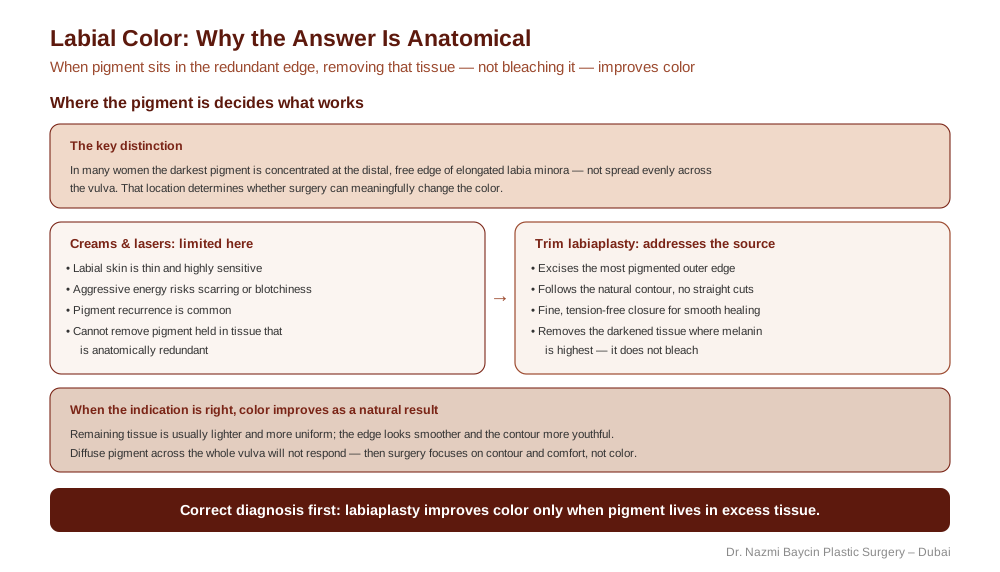
Why labial color improvement depends on where the pigment sits, and how trim labiaplasty addresses edge-concentrated pigment, by Dr. Nazmi Baycin, Dubai.
Psychological and intimate benefits
Women who undergo labiaplasty for pigment-related concerns often report benefits well beyond appearance: greater confidence in intimate settings, less self-consciousness, more comfort in fitted clothing or swimwear, and an improved overall body image.
These outcomes reinforce that labiaplasty is not about conforming to a single aesthetic ideal, but about restoring comfort and confidence in one’s own body. Those benefits are frequently underestimated until after healing, and they are a large part of why women choose the procedure, as I explore in my article on the cosmetic, functional, and emotional reasons women choose labiaplasty.
Combining labiaplasty with other procedures
Sometimes labial hyperpigmentation is part of a broader concern involving the mons or the vaginal opening. When appropriate, labiaplasty can be combined with other procedures to improve overall harmony, and combining them can reduce total recovery time and anesthesia exposure compared with staging them separately. Patients often consider this for postpartum changes or personal aesthetic goals.
A mons pubis reduction removes excess fat or tissue from the pubic mound to improve contour when fullness or pigment is present. Vaginal tightening, such as perineoplasty, addresses the pelvic floor for better harmony with labial reshaping, and hymen repair is sometimes paired with labiaplasty for comprehensive rejuvenation. Any combination is planned around your anatomy and goals, to enhance overall symmetry rather than adding procedures for their own sake.
A permanent, anatomical solution when the diagnosis is right
Labial hyperpigmentation is common, normal, and deeply personal. When the discoloration is caused by excess labial tissue, labiaplasty offers a permanent, anatomical solution that non-surgical treatments cannot match. The key is correct diagnosis, conservative surgical planning, and respect for the delicate nature of intimate anatomy.
When performed for the right reasons and on the right patient, labiaplasty can improve not only shape and comfort but also color balance and lasting confidence. That assessment is best made in person, at a confidential consultation with an experienced cosmetic surgery clinic in Dubai, where anatomy and expectations are discussed together rather than focusing on color alone.
FAQs about labial discoloration and labiaplasty in Dubai
-
Is labial hyperpigmentation something to worry about medically?
In the great majority of cases, no. Darkening or uneven color of the labia is usually a normal variation influenced by genetics, hormones, pregnancy, friction, and aging, rather than a disease. It is extremely common and, on its own, is not a sign of anything harmful. That said, any new, changing, or irregular pigmented spot should always be assessed in person to rule out a skin lesion needing separate evaluation. When the pigmentation is longstanding and simply a cosmetic concern, it can be treated as an aesthetic issue.
-
Can creams or lasers lighten the labia instead of surgery?
They can help in some diffuse, superficial cases, but they have real limits for this indication. Labial skin is thin and highly sensitive, so aggressive treatment risks scarring or patchy, uneven pigment, and the color improvement is often modest and temporary with a tendency to recur. Most importantly, when the darkest pigment sits in excess tissue at the free edge of the labia, no cream or laser can remove pigment that lives in tissue which is anatomically redundant. In that situation a surface treatment cannot reach the source, whereas removing that edge can.
-
Does labiaplasty bleach or whiten the skin?
No. Labiaplasty does not bleach or chemically lighten anything. It improves color by physically removing the most pigmented portions of the labia, typically the outer, distal edge where melanin concentration is highest. Once those darker margins are excised, the remaining tissue is usually naturally lighter and the color looks more uniform. The color change results from removing the darkest tissue, not from any lightening agent, which is why the effect is reliable and lasting when the pigment is concentrated in the edge that is removed.
-
How do I know if I am a good candidate for color improvement?
The best candidates have elongated or protruding labia minora with pigment concentrated at the darker edges compared with the base, often with some asymmetry, and sometimes with functional issues such as irritation, friction, or hygiene difficulty. If your darkening is confined to the redundant edge, removing that tissue can meaningfully improve color. If instead the pigment is spread diffusely across the whole vulva, including the outer lips and perineum, labiaplasty alone will not change the overall color much, and surgery would then be aimed at contour and comfort rather than pigment. An in-person assessment is the only way to tell which pattern you have.
-
Why do you prefer the trim technique for discoloration?
Because for this specific concern the trim technique directly addresses the source. In most women seeking color improvement, the pigment is concentrated along the free edge of the labia, exactly the tissue the trim technique removes. Approaches that preserve that edge may reduce size but leave the darkest tissue in place, so they do less for color. With contour-following excision and fine, tension-free closure, the trim technique produces predictable color improvement while keeping natural proportions and texture. When color is the priority and the pigment is edge-concentrated, trimming is the most logical, reliable choice.
-
When will I see the final color result?
Not immediately, and it is important to expect a gradual change. In the early weeks there is normal postoperative redness and swelling along the healing edge, which can make it hard to judge color at first. Over the following months the redness fades, vascularity normalizes, and the scar matures, and it is during this period that the labial tone settles into its lighter, more uniform final appearance. True pigment harmony therefore emerges gradually rather than on day one. Careful, tension-free technique and good aftercare support smooth healing and the best possible color transition along the new edge.
-
Will the surgery affect sensation or function?
The goal is to improve appearance and color while fully preserving normal sensation and function. This depends on respecting the neurovascular anatomy of the area, using precise incision placement, gentle tissue handling, and conservative removal of only the redundant, pigmented tissue. When performed carefully and without over-resection, the trim technique refines shape and color without compromising sensation or comfort. Preserving the delicate nerve and blood supply is a central priority of the planning, so conservative design matters as much for function as for the aesthetic result.


GET APPOINTMENT
Get ready to look and feel best… You deserve…
