


Table of content
- Why might you need a thigh lift?
- How does Dr. Baycin perform an inner thigh lift?
- How does Dr. Baycin perform a posterior thigh lift?
- What is recovery after a thigh lift like?
- What are the risks and complications of a thigh lift?
- Checklist before having thigh lift in Dubai, UAE
- How much does a thigh lift cost in Dubai, UAE?
- FAQs about thigh lift in Dubai
- Get appointment
Loose skin on the inner thighs is one of the few cosmetic problems that is also a daily physical nuisance — the skin rubs as you walk, causing sweating, chafing, and rashes that no cream truly fixes. I am Dr. Nazmi Baycin, and my thigh lift in Dubai removes that excess skin and fat to restore a firmer, smoother, more comfortable thigh, ending the rubbing and giving the lower body a toned, proportionate line. For many women, it is genuinely the best — and sometimes the only — solution to a problem that diet and exercise cannot reach.
What makes a thigh lift succeed is matching the technique to your particular pattern of looseness, rather than applying one method to everyone. Performing thigh lift surgery in Dubai within JCI-accredited hospitals, I choose between an inner or a posterior approach, and between horizontal and vertical designs, according to where and how far your skin has descended — and I place every scar as discreetly as the correction allows. The principle is the one that guides all my work: to restore form is to restore function.
Thigh lift in Dubai quick facts
| Procedure detail | Thigh lift in Dubai |
|---|---|
| Treats | Loose, sagging inner or posterior thigh skin |
| Technique | Matched to pattern: horizontal / vertical inner, or posterior |
| Scar | Hidden in the groin fold or buttock crease |
| Often with | Liposuction (in selected patients) |
| Anesthesia | General (or local with sedation) |
| Procedure time | About 2–3 hours |
| Hospital stay | 1 day (home the next day) |
| Sutures | Hidden, dissolvable (none to remove) |
| Shower | 2–3 days |
| Downtime | 5–7 days; better in 7–10 days; travel in 3–4 days |
| Sport / heavy lifting | From ~4 weeks |
Why might you need a thigh lift?
As we age and our weight fluctuates, the inner thighs are often the first place to loosen and sag — and the effect is more than cosmetic. Sagging inner-thigh skin rubs together while walking, which is uncomfortable in itself and, especially in a skirt, leads to sweating and rashes. For loosening of this kind, a thigh lift is frequently the best and sometimes the only effective solution. It can also be part of a comprehensive body lift after significant weight loss, which is why post-bariatric patients troubled by inner-thigh looseness so often find it helpful. Loose skin after major weight loss rarely stops at the thighs, and where the upper arms are affected too, an arm lift for post-weight-loss upper-arm laxity is usually staged alongside it within the same overall plan.
Thigh lift or liposuction: which do you need?
Not every thigh needs a lift, and I will always recommend the least invasive option that will actually work. If you have fat deposits on the inner thighs but your skin still has good elasticity and no significant sagging, liposuction alone when skin elasticity is still good may be enough — and it leaves no surgical scar. But once the skin has lost its elasticity with age or weight loss, removing the fat alone would leave the skin even looser; in those cases a combination of fat removal and skin tightening — a true thigh lift — gives a far better result. Deciding honestly between the two is the most important conversation we will have at consultation.
Where the laxity is mild and the skin still has some recoil, patients often ask about energy-based tightening instead. I address that boundary directly in my article on why J-Plasma prevents new laxity but cannot remove existing skin redundancy — it is an adjunct to excisional surgery, never a substitute for it.
| Factor | Thigh lift (thighplasty) | Liposuction alone |
|---|---|---|
| Best for | Loose, sagging skin with lost elasticity | Fat deposits with good skin elasticity |
| What it does | Removes excess skin + fat and tightens | Removes fat only |
| Scar | A scar, hidden in the groin or buttock fold | No surgical scar |
| After weight loss | Usually needed — skin will not retract | Not enough on its own if skin is loose |
Are you a good candidate for a thigh lift?
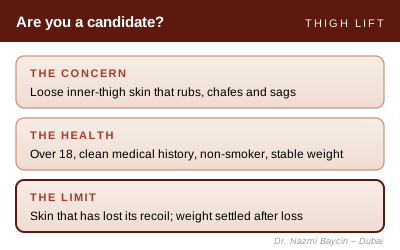 A clean medical history and good general health, free of systemic disease such as heart disease, are the foundation of safe thigh lift surgery, and the starting point of every assessment I make. The ideal candidate has loose or sagging skin on the thighs — usually from aging, major weight loss, or genetics — that has not responded to diet and exercise, together with realistic expectations of what surgery can achieve. Because risk factors such as smoking and diabetes matter a great deal for healing in this area, I will go through your health honestly with you, and ask smokers to stop well before surgery, so that we proceed only when it is safe and worthwhile.
How does Dr. Baycin perform an inner thigh lift?
The inner thigh is one of the areas that most clearly shows the signs of aging and weight loss, and the degree of sagging varies a great deal from person to person — which is exactly why I use two different designs, chosen to match how far the looseness extends.
Horizontal inner thigh lift (the hidden groin-fold scar)
For looseness concentrated in the upper inner thigh, I use a horizontal thigh lift. I remove the excess skin just below the groin fold, then lift the lower edge and stitch it to the upper edge at the fold — which places the scar along the groin crease, where I can design it to stay hidden under a bikini. For carefully selected patients, combining this with liposuction enhances the result further.
Vertical inner thigh lift (for sagging toward the knee)
When the loose skin sags further down the inner thigh, toward the knee, a horizontal lift alone is not enough — the tightening has to work in two directions. In these cases I add a vertical component, and for severely loose skin this two-dimensional approach yields a much smoother, more even result down the length of the thigh.
How does Dr. Baycin perform a posterior thigh lift?
A posterior thigh lift addresses loose skin on the back of the thighs. I begin with an incision along the fold that separates the buttock from the thigh, then carefully separate the skin-and-fat layer from the underlying muscle so the skin can be lifted freely. I draw the skin upward as far as it will go and remove the excess skin and fat — and, crucially, before closing I anchor the lower edge to the buttock muscle, which is what keeps the lift from descending again and makes the result last. The incision is then closed with hidden, absorbable stitches, so the scar sits tucked in the buttock fold and there is nothing to remove later.
In-depth reading: the technique, the scar, and what shapes a thigh lift in Dubai
A thigh lift is as much about how the scar is engineered as how the contour is restored — how tension is controlled, how the incision is planned around movement, how the knee transition is handled, and how the whole procedure balances shape against function. These detailed articles explore each dimension in depth.
- Why liposuction can’t fix inner-thigh laxity after weight loss — why post-weight-loss thigh sag is a structural failure, not fat, and how the vector of laxity decides between a horizontal, vertical, or spiral lift.
- Why some thigh-lift scars widen — and how tension engineering prevents it — how biomechanical tension, gait, and humidity drive scar widening, and why deep fascial anchoring to a stable ligament, not the skin, protects a fine scar.
- Balancing contour, scar position, and functional mobility — how a movement-aware plan weighs the aesthetic result against comfort and how the thigh actually works in daily life.
- Mastering the transition zone from thigh to knee — how laxity that extends down toward the knee is handled so the correction blends smoothly rather than stopping abruptly.
- Body contouring after massive weight loss — how a thigh lift fits into the wider, staged plan for reshaping the body after major weight loss.
Where does Dr. Baycin perform thigh lift surgery in Dubai?
I perform every thigh lift in a JCI-accredited, high-standard hospital in Dubai that meets top international guidelines for safety and hygiene. Your surgery takes place in a fully equipped, modern environment, with patient safety and surgical precision the first priorities at every step.
What is recovery after a thigh lift like?
Your thigh lift is done under general anesthesia and usually takes about two to three hours, and you can go home the following day. Any discomfort is usually mild to moderate and well controlled with the painkillers I prescribe, and you will be up and moving within just a few hours of surgery — early movement is good for healing. You can shower two to three days afterward, and most people feel noticeably better within seven to ten days, with any inner-thigh swelling and bruising fading over the same period. There is no need to ask when to resume your routine — your body will tell you when to push and when to ease off; most patients can travel within three to four days, and return to heavy lifting and sport at about four weeks. Because I always use hidden, absorbable stitches, there is nothing to remove. To understand the full science behind how I support your healing after surgery, see my advanced recovery protocol in Dubai article.
Download Dr. Baycin’s thigh lift aftercare instructions
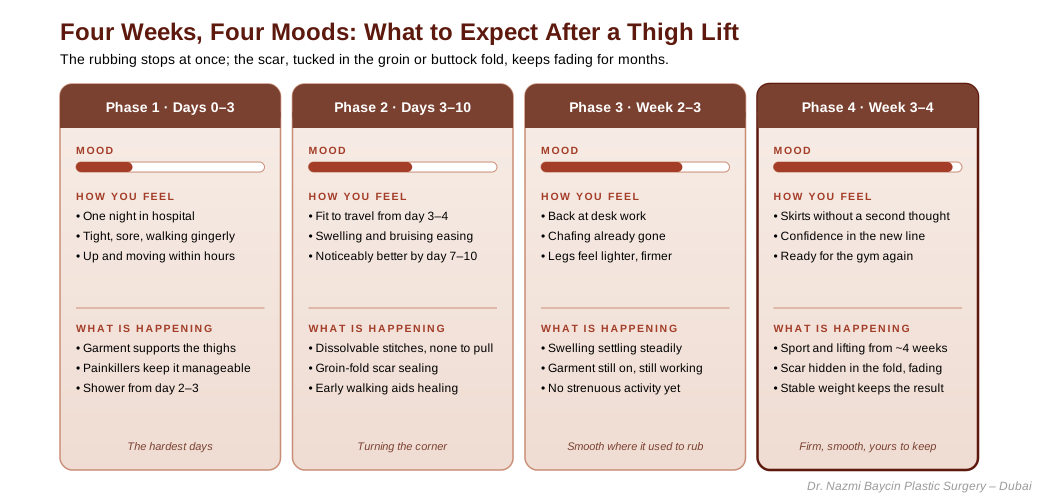
A thigh lift is a one-night stay and a four-week arc. You are up and walking within hours of surgery, because early movement is what protects the wound in this mobile area, and home the next day in a compression garment, with the discomfort mild to moderate and controlled by the painkillers I prescribe. Showering starts on day two or three; most patients can travel by day three or four, and feel noticeably better by day seven to ten as the inner-thigh swelling and bruising fade. Because the stitches are hidden and dissolvable, nothing is removed, and the scar sits in the groin fold or buttock crease from the first day. Desk work returns around the second week, and I ask you to hold off strenuous exercise and heavy lifting until about four weeks. The mood follows the same curve: guarded and gingerly at first, relieved once travel is possible, then the quiet pleasure of walking without the rubbing, and finally the confidence of a firmer line. The pace varies with personality; the shape rarely does.
What are the risks and complications of a thigh lift?
A thigh lift is a safe procedure in the right hands, but the inner thigh is a demanding area to heal, so a few risks deserve honest mention. Smoking, diabetes, and obesity all reduce blood flow to the skin and raise the chance of wound separation (dehiscence), skin necrosis, and infection — which is why I ask patients to stop smoking at least one to two weeks before surgery, and use antibiotics to lower the infection risk.
A seroma, a collection of fluid within the wound, can occur but usually settles on its own within a couple of weeks. Because the skin is tightened under tension here, scars can occasionally widen or migrate and may need a minor revision; the scar is always visible at first but fades over time, and most patients are very pleased with the trade.
Reassuringly, the published evidence is encouraging: a retrospective series of 46 post-bariatric patients who had a medial thigh lift with concomitant liposuction reported no major systemic complications, and no hematoma, seroma, infection, or skin necrosis — three wound separations and two areas of deepithelialization were the only complications recorded — concluding that liposuction and early mobilization are key to a smooth recovery. It is a single-centre series with no comparison group, so it shows what is achievable in careful hands rather than proving one technique better than another. Where any complication does arise, it can be managed and treated effectively.
Checklist before having thigh lift in Dubai, UAE
IMPORTANT ! Before getting the appointment, check your medical conditions yourself.
| # | Conditions | Safety | Aesthetic Suitability |
|---|---|---|---|
| 1 | Are you over 18? | 🟢 Fit for surgery | — |
| 2 | Do you have skin laxity in the thigh area due to aging or significant weight loss? | 🟢 Fit for surgery | 🟡 Ideal candidate |
| 3 | Would you like a tighter and more contoured thigh appearance? | 🟢 Fit for surgery | 🟡 Ideal candidate |
| 4 | Do you have a cardiovascular problem such as heart disease or deep vein thrombosis? | 🔴 Contraindicated | — |
| 5 | Do you have pulmonary system problems such as chronic lung disease? | 🔴 Contraindicated | — |
| 6 | Do you have chronic liver disease? | 🔴 Contraindicated | — |
| 7 | Do you have a urinary system disease such as kidney failure? | 🔴 Contraindicated | — |
| 8 | Do you have a hematologic problem such as anemia or coagulopathy? | 🔴 Contraindicated | — |
| 9 | Do you have any transmitting disease through blood such as HIV? | 🔴 Contraindicated | — |
| 10 | Have you been taking anticoagulant medication? | 🔴 Contraindicated | — |
| 11 | Have you been taking psychotropic drugs? | 🔴 Contraindicated | — |
| 12 | Any drug abuse or addiction | 🔴 Contraindicated | — |
How much does a thigh lift cost in Dubai, UAE?
The cost of a thigh lift in Dubai can really vary depending on the clinic you choose, typically falling between 20,000 AED (around $5,500) and 50,000 AED (about $13,600).
Keep in mind that these costs aren’t Dr. Baycin’s personal rates; you’ll find out the precise price during your consultation once your condition is assessed.
For a complete overview of treatment fees, please refer to full price list of the procedures. If you are looking specifically for this procedure, you can also review pricing information.
Schedule your private consultation with Dr. BaycinWhat makes Dr. Baycin an exceptional thigh lift surgeon in Dubai?
Sculpted, comfortable legs take more than a routine procedure — they take expertise, precision, and artistry — and with more than 100 successful thigh lifts, that is the standard Dr. Baycin holds.
- A legacy of excellence: 25+ years in plastic surgery, DHA-licensed and a member of the American Society of Plastic Surgeons (ASPS), with an unwavering commitment to safety and refined body-contouring technique.
- Every patient a unique plan: no two bodies are alike, so each thigh lift is matched to the patient’s own shape and proportions for a natural, never artificial, result.
- Technique matched to the problem: from horizontal and vertical inner-thigh lifts to posterior lifts, the design is chosen to fit your pattern of looseness while keeping scars discreet and results lasting.
- Technology that puts patients first: modern surgical tools that reduce tissue trauma and speed recovery, for less discomfort and smoother healing.
- Safety beyond compromise: thousands of aesthetic surgeries with zero major complications, and patient safety as the foundation of every decision.
- Clarity through honest consultations: every option explained — including when liposuction alone is the better choice — with realistic outcomes and recovery set out clearly.
- Post-operative care you can count on: structured aftercare and direct surgeon access through the whole of healing.
- Chosen by patients worldwide: patients travel from Europe and across the Gulf for his thigh lift results in Dubai.
- Proven outcomes, time and again: 100+ thigh lifts delivering natural, harmonious, lasting contours.
- More than surgery — an experience of care: aesthetics matched with empathy, professionalism, and respect for the confidence this transformation brings.
About Dr. Nazmi Baycin
Surgery, to me, is precision applied in service of restoration — a conviction that has guided every one of the more than 7,000 procedures I have performed over 25 years in practice. I am a DHA-licensed, board-certified plastic surgeon, trained in Turkey and based in Dubai since 2016. I operate exclusively within JCI-accredited hospitals, and hold international membership in the American Society of Plastic Surgeons (ASPS). Three techniques, in particular, have become signatures of my practice. Scarless breast augmentation, performed through a transaxillary approach that leaves no incision on the breast itself. Labiaplasty designed individually around each patient’s own anatomy, never to a standard template. And 3D customized facial bone implants, engineered through CT-based bespoke printing — a technique I currently offer as the only surgeon in Dubai providing it. My practice today spans facial rejuvenation, breast surgery, body contouring, and cosmetic genital procedures, drawing patients from across the UAE, Europe, and the wider GCC. Yet the principle guiding each of these specialties has never changed: to restore form is to restore function.
FAQs about thigh lift in Dubai
-
What is a thigh lift (thighplasty)?
A thigh lift, or thighplasty, is how I remove loose, sagging skin from the thighs to create a firmer, smoother, and more toned contour. It most often addresses the inner thighs, though the outer and back of the thigh can also be treated. It is especially valuable after major weight loss, when the skin has lost its elasticity and no longer retracts on its own. My aim is a naturally firm result with the scar placed as discreetly as possible.
-
How much does a thigh lift cost in Dubai?
Thigh lift costs in Dubai vary from clinic to clinic and depend on several factors, ranging between AED 20,000 and AED 50,000, depending on the extent of the lift and whether it is combined with liposuction. These are general market figures, not Dr. Baycin’s personal rates; the precise cost is confirmed at your consultation, once your thighs have been assessed.
-
Why do thighs lose their firmness?
The most common reason is significant weight loss. When a large amount of weight comes off, the skin that was stretched to accommodate it often cannot shrink back, leaving loose, hanging folds on the inner thighs in particular. The natural loss of skin elasticity with age also plays a part. This loose skin can cause not just self-consciousness but real physical problems, such as chafing, irritation, and difficulty with exercise or clothing, all of which a thigh lift is designed to resolve.
-
Why do women and men choose a thigh lift in Dubai?
The reasons are both physical and emotional, and both matter. Loose inner-thigh skin can rub and chafe painfully, cause irritation or hygiene difficulty, and make exercise and certain clothing uncomfortable. Alongside this, the sagging appearance can affect confidence, particularly for someone who has worked hard to lose a great deal of weight and wants their body to reflect that achievement. A thigh lift addresses both the discomfort and the contour, which is why it can be so rewarding.
-
How do you perform a thigh lift in Dubai?
I tailor the approach to how much skin needs to come off. For the inner thigh, I remove the excess skin and tighten what remains, placing the incision in the groin crease where it is naturally hidden. When there is a larger amount of loose skin extending further down the leg, the incision may need to extend down the inner thigh to remove it fully. I often combine the lift with liposuction to refine the contour and remove excess fat at the same time.
-
Where will the scars be, and how visible are they?
Discreet scar placement is central to how I plan this. For most inner-thigh lifts, I place the incision in the natural groin crease, where it is well hidden by underwear or swimwear. When more extensive skin removal is needed, the scar may extend down the inner thigh, where it is positioned to stay as concealed as possible. A thigh lift does involve a longer scar than some procedures, and I am always honest about this trade-off: the scar is exchanged for firmer, smoother skin.
-
Is a thigh lift in Dubai often combined with liposuction?
Yes, very frequently, and the two complement each other well. A thigh lift removes loose, excess skin, while liposuction removes stubborn fat and refines the underlying shape. Combining them lets me both tighten the skin and sculpt the contour in a single procedure, for a smoother, more complete result than either could achieve alone. At consultation I assess whether adding liposuction will enhance your outcome, which it often does, particularly in the thighs.
-
What is recovery after a thigh lift like?
Recovery asks a little patience, since the thighs are a mobile, weight-bearing area. You will wear a compression garment for several weeks to support the tissues and control swelling, and I advise limiting strenuous activity and taking care with movement in the early weeks so the incisions heal well. Most people return to desk work within about two weeks, with swelling settling steadily over the following weeks. I guide you closely through each stage, as good aftercare protects the result.
-
Are the results of a thigh lift permanent?
The results are long-lasting, especially when your weight stays stable. The excess skin I remove does not return, so the firmer contour endures. The main thing that can affect the result over time is significant weight gain or loss, which is why maintaining a stable weight is so important, and why I generally recommend a thigh lift once your weight has settled after any major loss. For most people who keep their weight steady, the improvement lasts well over the long term.
-
When is the right time for a thigh lift after weight loss?
Timing matters for the best result. I generally recommend waiting until your weight has been stable for a period after major weight loss, whether through diet and exercise or bariatric surgery, before undergoing a thigh lift. Operating once your weight has settled means the contour I create is the one that lasts, rather than being altered by further loss or regain. At consultation we discuss your weight history to confirm the timing is right for a durable outcome.
-
Is a thigh lift in Dubai safe, and what are the risks?
In experienced hands a thigh lift is a safe, well-established procedure, though as a skin-removal operation it carries the usual surgical considerations, which I discuss honestly. These include swelling, bruising, fluid collection, delayed wound healing along the incision, and scar quality, all of which I minimize through careful technique and attentive aftercare. Because the inner thigh is a mobile area, wound care matters, and I guide you through it closely. Good general health, a clean medical history, and a stable weight all support a safe result.
-
Are you a good candidate for a thigh lift?
You are likely a good candidate if you have loose, sagging skin on the inner or outer thighs, often after significant weight loss, that troubles you physically or emotionally, and you are in good general health. It is best if your weight has been stable for a period, since further change can affect the result. A clean medical history is the foundation of safe surgery, and understanding the scar trade-off matters. At consultation we discuss your goals and confirm the right approach for you.
-
Can a thigh lift in Dubai be combined with other procedures?
Yes. Beyond liposuction, a thigh lift is often part of a broader body-contouring plan after major weight loss, combined with procedures such as a tummy tuck, or with J-Plasma skin tightening where mild laxity remains. At consultation I assess your overall goals and health and recommend combining procedures only where it is safe and genuinely gives you a smoother, more balanced whole-body result in a single recovery.


GET APPOINTMENT
Get ready to look and feel best… You deserve…
