


Table of content
- Why might you need liposuction?
- Are you a good candidate for liposuction?
- Which areas can liposuction treat?
- How does Dr. Baycin perform liposuction?
- What is recovery after liposuction like?
- What are the risks and complications of liposuction?
- Checklist before having liposuction in Dubai
- How much does a liposuction cost in Dubai, UAE?
- Get appointment
Liposuction is often sold as fat removal. I see it as sculpture. I am Dr. Nazmi Baycin, and across more than eight hundred liposuction procedures I have come to treat the body not as a set of problem areas to be emptied, but as a form to be refined — slimmer lines, yes, but also the harmonious curves that move naturally with you. My liposuction in Dubai is built on that distinction, and on the technology that makes it possible: Vaser ultrasound liposuction, often combined with J-Plasma skin tightening, for a result that is smooth, natural, and lasting.
The difference between fat removal and sculpture lies in restraint and precision. Performing liposuction in Dubai within JCI-accredited hospitals, I work in the deeper fat planes, monitor the thickness of what remains, and remove a deliberately conservative volume — because a safe, even result is worth far more than an aggressive one. The principle is the same one that guides all my work: to restore form is to restore function.
Liposuction in Dubai quick facts
| Procedure detail | Liposuction in Dubai |
|---|---|
| Techniques | Vaser (ultrasound), power-assisted, tumescent |
| Skin tightening | J-Plasma (Renuvion) option at the same session |
| Anesthesia | Local (small areas) or general (larger areas) |
| Procedure time | 30 minutes – 3 hours |
| Hospital stay | Day case; one night for large-volume cases |
| Safe fat removal | ≤5–6% body weight (Dr. Baycin aims 2–4%) |
| Incisions | 3–4 mm, hidden in folds/creases |
| Sutures | Dissolvable / minimal (none to remove) |
| Downtime | 1–3 days |
| Swelling resolves | True shape emerges from ~15–20 days |
| Swimming | From ~15 days |
| Results | Permanent (fat cells removed do not return) |
What can liposuction in Dubai do for you?
Liposuction permanently removes stubborn, diet-resistant fat from specific areas and reshapes the body’s contour — not to make you thinner in a general sense, but to bring proportion to areas that resist every effort. It is a sculpting tool, not a weight-loss method: most suited to people at or near a healthy weight who carry localized fat pockets that diet and exercise simply will not move.
Done well, with the right technique and patient, the change is significant and lasting — and because Vaser energy also stimulates collagen and skin retraction, the result is not just slimmer but smoother and more toned.
Why might you need liposuction?
Our body shape reflects our genetics, and it can differ stubbornly from the shape we want. You might follow a disciplined diet and exercise routine for years and still struggle with fat deposits that will not shift — and even at a healthy weight, certain areas can feel out of proportion with the rest of you. Where that is the case, liposuction offers a precise, permanent way to restore balance to the silhouette. For some patients, liposuction is the whole answer; for others it is one element of a wider plan, considered alongside my other body-contouring procedures to reshape the figure as a whole.
Are you a good candidate for liposuction?
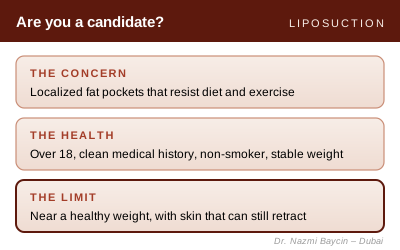
Good general health is the foundation: a clean medical history and the absence of systemic disease, such as heart conditions, are essential. The ideal candidate is not necessarily overweight, but carries localized fat deposits in specific areas; those who are overweight can also benefit, but usually after losing some weight first. Liposuction is not a way to lose a few pounds or look generally slimmer — it is designed to reshape and refine contour. In short, it works best for people at or slightly above a normal weight, with fat that accumulates in specific areas rather than evenly across the body.
How does skin elasticity affect your result?
The condition of your skin matters as much as the fat beneath it. When fat is removed, the skin must retract over the new, smaller contour — and firm, elastic skin does this readily, shrinking back smoothly. With age, particularly after about 45, skin loses some of that elasticity and may not retract as completely. Where skin is loose or its elasticity reduced, combining liposuction with a skin-tightening method such as J-Plasma gives a far better result. The order in which the two are applied matters as much as the decision to combine them, which I explain in my article on when tightening prevents secondary skin laxity. Assessing your skin quality is part of how I determine the right plan for you.

Fat removal is only half the operation; the skin has to follow. At consultation Dr. Baycin assesses skin elasticity by pinch test, alongside age, fat pattern and the shape you are after, and that assessment — not the device — decides the route. Elastic skin over localized fat retracts fully on its own, so liposuction alone is enough. Where elasticity has reduced, typically after 45, Vaser sculpting is paired with J-Plasma in the same session through the same 3–4 mm ports, so the skin contracts onto the new contour with no extra scar. True excess, hanging skin will not tighten with any energy device; the honest answer is an arm lift or tummy tuck, with liposuction refining around it. And a lean, elastic patient who wants visible definition is a candidate for high-definition sculpting or abdominal etching, with the caveat that crispness lasts only as long as the skin can hold it. Most patients fall in the first two columns; being told plainly when the third applies is what protects the result.
| Factor | Liposuction alone | Vaser + J-Plasma | Excision + liposuction | High-definition sculpting |
|---|---|---|---|---|
| Skin | Elastic; retracts fully | Mild laxity, or 45+; retracts incompletely | True excess, hanging; will not retract | Lean and elastic |
| Typical patient | Localized, diet-resistant pockets at a stable weight | Same, with early skin loosening | After major weight loss or pregnancy | Low body fat, developed muscle, wants definition |
| What is done | Deep-plane Vaser or power-assisted removal | Vaser to sculpt, J-Plasma to contract the skin, same session | Arm lift or tummy tuck removes skin; liposuction refines | Vaser along muscle lines; abdominal etching where wanted |
| Incisions | 3–4 mm, hidden in creases | The same ports; no extra scar | A planned, placed scar line | 3–4 mm; navel and creases |
| Downtime | 1–3 days; day case | A few days; one shared recovery | 1–2 weeks; overnight stay | A few days; garment for weeks |
| Read more | — | When tightening prevents secondary laxity | Arm lift · Tummy tuck | Who is a candidate |
Which areas can liposuction treat?

Common areas treated by liposuction.
Liposuction can address almost any area where unwanted fat collects. The most common are the face (cheeks and neck, including a double chin); the body (abdomen, back, buttocks, chest, and waist); and the extremities (upper arms, thighs, and inner knees). On the upper arms, liposuction refines contour beautifully where skin tone is good; where there is also loose, hanging skin, arm contouring with an arm lift may be the better route, and I will tell you honestly which you need. Patterns differ by sex: women tend to accumulate fat around the hips, thighs, abdomen, and waist, while men more often see it in the belly, waist, and chest. Both traditional and Vaser liposuction handle these effectively. On the abdomen, note the distinction in goal: reducing a fatty layer is a different operation from etching muscle definition into a lean one, and if visible definition is what you are after, abdominal etching for a defined six-pack is the procedure that does it.
How much fat can safely be removed?
There is a limit, and I respect it strictly. The convention most often quoted is a maximum of about 5–6% of body weight — for a 70 kg person, roughly four liters of fat — and in my own practice I deliberately aim lower, at about 2–4%, which is one of the reasons I have not encountered major complications.
The more useful answer, though, is that no single figure is safe for everyone. The real limit is set by your physiology: your body surface area, your lean mass, your preoperative hemoglobin, the fluid and lidocaine load going in, and what the aspirate looks like as the operation proceeds. That reasoning, and the evidence behind it, is the subject of my article on where the safe limit for fat removal actually sits. On this page, what matters is the practical consequence: I plan conservatively, and I stop when the tissue tells me to rather than when a target volume is reached.
Which liposuction techniques does Dr. Baycin use?
The instrument matters as much as the hand. I select the technique to suit the area, the fat, and your skin — and increasingly that means ultrasound-assisted Vaser, the approach at the heart of my body-sculpting work. To understand the artistic philosophy that guides how I sculpt the body in motion, see my article on the 4D concept: sculpting for motion, light and angle.
Vaser liposuction
Vaser liposuction is the most refined tool in modern body contouring. It uses ultrasound (sound energy) to selectively emulsify fat cells while sparing the surrounding vessels, nerves, and connective tissue, after which the liquefied fat is gently aspirated through a fine cannula. Two advantages follow from this selectivity. First, the heat generated stimulates collagen production, encouraging the skin to tighten and smooth over the new contour. Second, because the procedure is precise and largely bloodless, the incisions are tiny — often needing just a single stitch, if any — with markedly less swelling, bruising, and downtime than traditional methods. As for the published evidence: a 2022 retrospective series of 261 patients treated across 783 areas over fifteen years reported an overall complication rate of 4.6% at a minimum of six months’ follow-up, with contour irregularity at 1.9% and seroma at 0.8%, and 86% of patients saying they would recommend the procedure.
Vaser’s precision is what makes true definition work possible, but that same precision is where restraint matters most: taking too much superficial fat produces an artificial, over-cut look rather than an athletic one, a failure mode I set out in why over-etching ruins abdominal definition. Whether a patient is suited to that kind of sculpting at all depends on body-fat percentage and muscle development, which I cover in who is a candidate for high-definition six-pack sculpting.
| Factor | Vaser (ultrasound) liposuction | Traditional liposuction |
|---|---|---|
| Selectivity | Selectively melts fat while sparing blood vessels, nerves, and connective tissue | Non-selective; disrupts surrounding tissue along with fat |
| Bleeding | Largely bloodless, with noticeably less bruising | More bleeding and more bruising |
| Skin retraction | Ultrasound heat stimulates collagen, helping the skin tighten over the new contour | Minimal skin retraction |
| Downtime | Faster recovery — many patients return to routine within a few days | Longer recovery, with more swelling |
Evidence note: a 2022 single-surgeon series of 261 patients reported a 4.6% overall complication rate for Vaser. It had no comparison arm, so it does not by itself establish that Vaser outperforms traditional liposuction.
Power assisted liposuction
For power-assisted liposuction I make a small incision, about 3–4 mm, near the treatment area and insert fine cannulas — 2, 3, or 4 mm in diameter — just beneath the skin. The cannula, connected to a vacuum aspirator, is moved gently back and forth to break up the fat, which is then drawn away as tiny, disintegrated particles. It is an efficient, controlled method, well suited to many areas.

Schematic of the liposuction cannula technique.
Tumescent technique & J-Plasma skin tightening
Whichever method I use, I begin by infiltrating a tumescent solution — the tumescent technique — which dramatically reduces both bleeding during surgery and pain afterward. Where skin laxity is a concern, I can also apply J-Plasma (Renuvion) at the same time for additional skin tightening, contracting the subdermal tissue for a firmer result. This combination — Vaser to sculpt, J-Plasma to tighten — is the foundation of my 360° body-contouring work.
How does Dr. Baycin perform liposuction?
I begin by marking a map on your body to guide the procedure. The anesthesia is matched to the extent of treatment — local for smaller areas, general for larger ones; limited areas are treated as a day case. I then infiltrate the tumescent solution to minimize bleeding and discomfort, and make a small 3–4 mm incision just large enough for the cannula, placed in a deep fold, a joint surface, or an area covered by a bikini so that any mark is hidden.
The key to a smooth surface is to work in the deeper fat layers and to check the thickness of the remaining fat continuously — this is what prevents the dimpling and irregularity that mar poorly executed liposuction. If skin tightening is wanted, I apply J-Plasma at this stage. Finally, I close the tiny incisions with a few small stitches; placed discreetly, the marks fade within a few months.

A smooth liposuction result is decided less by the device than by the layer the cannula works in. Beneath the skin lie two fat layers separated by Scarpa’s fascia. Volume comes out of the deep layer, where fat can be removed generously without the surface following every stroke; the superficial layer is deliberately left as an even blanket a few millimetres thick, because it is what lets the skin retract onto a cushion rather than adhere to muscle. Throughout, I check the remaining thickness by pinch test and stop when the tissue tells me to, not when a target volume is reached — over-thinning the superficial layer is what produces dimpling, ridges, fibrosis and the over-cut “etched” look that is hard to revise. This deep-plane, conservative approach — removing 2–4% of body weight against a conventional ceiling of 5–6% — is the reason I have not encountered major complications across more than 800 liposuction procedures, all performed in JCI-accredited hospitals in Dubai.

Before and after outer-thigh liposuction.
In-depth reading: technique, safety, and recovery behind a liposuction in Dubai
These in-depth guides explain how liposuction is actually planned and performed — from how much fat can be removed safely to how tissue type, technique, and skin behavior shape the final contour. Together they show why a natural, lasting result depends far more on surgical judgment and restraint than on the device used.
- Why 360° liposuction needs circumferential precision — why the abdomen, flanks, waist, and back must be treated as one continuous unit, and how planning around the whole torso rather than one wall is what actually narrows the waist.
- The feminine endpoint of high-definition liposuction — why sculpting a female torso means aiming at flowing curves and a defined waist rather than the angular etching the technique was built around.
- How definition goals differ for men and women — why the same sculpting technique is mapped to a different pattern depending on the patient, and how the aesthetic target changes the surgical plan.
- How tissue type changes liposuction technique and outcomes — why dense fibrous fat and soft fat behave very differently under the cannula, and how the tissue itself dictates the device, cannula, and approach.
- Why the surgeon’s hand matters more than the VASER machine — why a clean, even result comes from the surgeon’s judgment about where fat should stay and how much the skin can support, not from the technology on its own.
- The safety protocols behind tightening the skin after fat removal — the temperatures at which collagen contracts, and the parameters that keep subdermal energy delivery within safe limits.
- How liposuction affects fat metabolism and long-term storage — what happens to the body’s fat storage once cells are removed, why liposuction is a contouring procedure and not a weight-loss method, and how results are kept stable.
- Preventing and managing post-liposuction fibrosis — how early scar tissue and firmness are headed off during healing, and why timely intervention is what protects the final contour.
Where does Dr. Baycin perform liposuction in Dubai?
I perform every liposuction in a premium, JCI-accredited hospital in Dubai that meets the highest international standards of safety and cleanliness. Your procedure takes place in a fully equipped, modern surgical environment built for advanced care and precise, safe results.
What is recovery after liposuction like?
Recovery is usually quick, and the best guide is your own body. After a smaller procedure you can go home the same day; where a significant volume of fat has been removed, a one-night stay is essential for your safety. Most patients shower and return to normal life after two to three days, adjusting activity to how they feel rather than to a fixed schedule.
Swelling and bruising are expected, along with some itching, tightness, and a temporary feeling of hardness in the treated areas. At first it may even look as though no fat was removed — this is normal; the swelling is simply filling the space the fat occupied. That swelling begins to subside around 15–20 days, and your true new shape emerges over the following weeks; bruising fades within 5–15 days, and you can swim again after about 15 days, once the small incisions have healed. To understand the full science behind how I support your healing after surgery, visit my advanced recovery protocol in Dubai article.
Download Dr. Baycin’s liposuction aftercare instructions
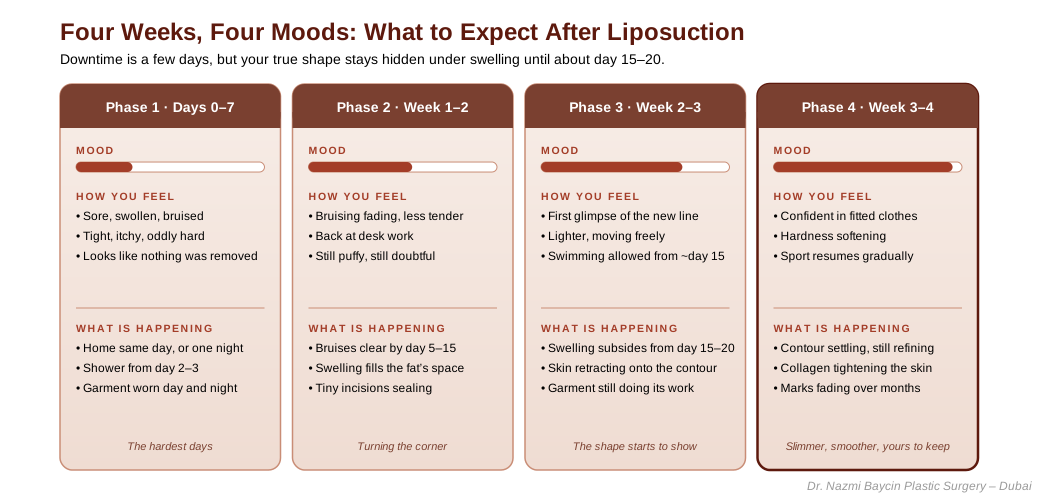
Liposuction recovery moves faster than the mirror suggests. You go home the same day, or after one night if a larger volume was removed, and shower from day two or three. The first week is sore, swollen and bruised, and the treated areas feel tight, itchy and oddly hard; at this stage it can look as though nothing was taken, because swelling is filling the space the fat occupied. Bruising fades between days 5 and 15, desk work resumes within a few days, and the small incisions seal within two weeks, so swimming is allowed from about day 15. Swelling begins to subside around day 15–20, and that is when the new line first shows; the compression garment keeps working for several weeks while Vaser’s collagen effect helps the skin retract onto the contour. The mood follows the same arc: doubt in week one, relief in week two, the first real glimpse in week three, and by week four the confidence to wear what you had been avoiding. The pace varies with personality; the shape rarely does.
Will my liposuction results be permanent?
Yes — and the reason is biological. Liposuction removes fat cells permanently, because the number of fat cells is essentially fixed in adulthood: it rises through childhood and adolescence, then levels off, and thereafter the cells change mainly in size, not number, as you gain or lose weight. When liposuction removes the fat cells from an area, the count in that area drops and stays down; the remaining cells do not multiply to replace them.

How fat redistributes after liposuction if weight is gained.
This is why the result lasts. If you gain weight afterward, it is the existing cells enlarging — and because the treated area now has fewer of them, new fat distributes more evenly across the body rather than rebuilding in the treated spot. The area you sculpted will only ever gain in proportion to the rest of you. Maintaining a stable weight keeps the result looking its best, but the fundamental change is permanent. Sharply defined results are the exception to watch: they depend on skin quality as much as fat, and where the skin is thin or inelastic the crispness can soften over time, which I explain in why some sculpted results fade more quickly than others.
What are the risks and complications of liposuction?
No surgery is entirely without risk, but careful technique, the right medication, and sound patient selection keep liposuction’s risks low and patient satisfaction high. I group the risks into two kinds.
Medical risks
Soft-tissue infection is uncommon, and antibiotics are prescribed to reduce it further. The more serious medical risks — disturbances of fat metabolism, fluid and electrolyte imbalance, and vascular complications — belong to large-volume work, and they are the reason I keep removal deliberately conservative. Why volume, fluid shift and operative time govern those risks, and how the individual threshold is calculated, is set out separately in my article on where the safe limit for fat removal actually sits.
Cosmetic risks
The cosmetic risks — asymmetry and surface irregularity — depend heavily on the surgeon’s skill and judgment: how much fat is removed, and how evenly. Working in the deep plane and continuously monitoring fat thickness is how I prevent these contour problems. Sun exposure can also cause darkening or hyperpigmentation of the healing skin, so it is best avoided until swelling has fully resolved. Handled with care, liposuction offers a significant, lasting improvement to the body’s shape.
Checklist before having liposuction in Dubai, UAE
IMPORTANT ! Before getting the appointment, check your medical conditions yourself.
| # | Conditions | Safety | Aesthetic Suitability |
|---|---|---|---|
| 1 | Are you over 18? | 🟢 Fit for surgery | — |
| 2 | Would you like your body shape to look more refined and aesthetically balanced? | 🟢 Fit for surgery | 🟡 Ideal candidate |
| 3 | Do you have localized fat deposits in specific areas of your body? | 🟢 Fit for surgery | 🟡 Ideal candidate |
| 4 | Do you have a cardiovascular problem such as heart disease or deep vein thrombosis? | 🔴 Contraindicated | — |
| 5 | Do you have pulmonary system problems such as chronic lung disease? | 🔴 Contraindicated | — |
| 6 | Do you have chronic liver disease? | 🔴 Contraindicated | — |
| 7 | Do you have a urinary system disease such as kidney failure? | 🔴 Contraindicated | — |
| 8 | Do you have a hematologic problem such as anemia or coagulopathy? | 🔴 Contraindicated | — |
| 9 | Do you have any transmitting disease through blood such as HIV? | 🔴 Contraindicated | — |
| 10 | Have you been taking anticoagulant medication? | 🔴 Contraindicated | — |
| 11 | Have you been taking psychotropic drugs? | 🔴 Contraindicated | — |
| 12 | Any drug abuse or addiction | 🔴 Contraindicated | — |
At or near a healthy weight · localized, diet-resistant fat pockets · good skin elasticity (or willing to combine skin tightening) · good general health, no uncontrolled systemic disease · realistic expectations (sculpting, not weight loss) · non-smoker or willing to pause.
How much does a liposuction cost in Dubai, UAE?
Liposuction costs in Dubai can vary quite a bit from one clinic to another, and several factors come into play. Generally, you can expect to pay anywhere from 15,000 AED (around $4,100) to 50,000 AED (about $13,600). The final price often hinges on how much fat you want to remove and the specific area being treated. Additionally, the type of anesthesia and the duration of your hospital stay can also influence the overall cost.
It’s important to note that these prices don’t reflect Dr. Baycin’s individual pricing; you’ll receive the exact amount during your consultation after he assesses your condition. Also, keep in mind that Vaser liposuction typically costs 20-30% more than the traditional techniques mentioned earlier.
For a complete overview of treatment fees, please refer to full price list of the procedures. If you are looking specifically for this procedure, you can also review pricing information.
Schedule your private consultation with Dr. BaycinWhat makes Dr. Baycin an exceptional liposuction surgeon in Dubai?
Liposuction rewards experience, precision, and artistry above all — and with more than eight hundred liposuction procedures behind him, that is the standard Dr. Baycin works to.
- Decades of surgical mastery: more than 25 years in aesthetic surgery; a board-certified plastic surgeon, DHA-licensed, and a member of the American Society of Plastic Surgeons (ASPS).
- Specialized expertise in body sculpting: focused on modern techniques including Vaser liposuction and high-definition/4D sculpting, for natural, balanced results matched to each patient’s anatomy.
- Personalized treatment strategies: every procedure begins with a customized surgical plan built around the patient’s goals, for results that enhance confidence and body harmony.
- Cutting-edge, minimally invasive methods: advanced technologies that reduce tissue trauma, minimize scarring, and speed recovery.
- Proven safety & consistent results: an impeccable record with zero major complications, underpinned by a deliberately conservative, safety-first approach to fat volume.
- Transparent, in-depth consultations: clear communication of every option, with realistic expectations and no unnecessary interventions.
- Comprehensive post-surgical care: structured recovery protocols and direct access for any concern.
- International reputation for excellence: patients from across the UAE, the GCC, and beyond, who value confidentiality, precision, and premium care.
About Dr. Nazmi Baycin
Surgery, to me, is precision applied in service of restoration — a conviction that has guided every one of the more than 7,000 procedures I have performed over 25 years in practice. I am a DHA-licensed, board-certified plastic surgeon, trained in Turkey and based in Dubai since 2016. I operate exclusively within JCI-accredited hospitals, and hold international membership in the American Society of Plastic Surgeons (ASPS). Three techniques, in particular, have become signatures of my practice. Scarless breast augmentation, performed through a transaxillary approach that leaves no incision on the breast itself. Labiaplasty designed individually around each patient’s own anatomy, never to a standard template. And 3D customized facial bone implants, engineered through CT-based bespoke printing — a technique I currently offer as the only surgeon in Dubai providing it. My practice today spans facial rejuvenation, breast surgery, body contouring, and cosmetic genital procedures, drawing patients from across the UAE, Europe, and the wider GCC. Yet the principle guiding each of these specialties has never changed: to restore form is to restore function.
FAQs about liposuction in Dubai
-
What is liposuction?
Liposuction is how I permanently remove stubborn pockets of fat that resist diet and exercise, sculpting a smoother, more balanced body contour. It is not a weight-loss operation but a contouring one: I reshape specific areas such as the abdomen, flanks, thighs, arms, and neck. Because the fat cells I remove are gone for good, the results are lasting. My focus is always on a natural, proportionate shape rather than simply taking away volume, so the result looks like your body at its best.
-
How much does liposuction cost in Dubai?
Liposuction prices in Dubai can differ from clinic to clinic, and generally you can expect to pay anywhere from AED 15,000 to AED 50,000, depending on the number of areas treated and whether it is combined with another procedure. These are general market figures, not Dr. Baycin’s personal rates; the exact cost is confirmed at your consultation, once the areas to be treated and your goals have been assessed.
-
What is Vaser liposuction, and how is it different?
Vaser is the advanced, ultrasound-assisted technique I use, and it differs meaningfully from traditional liposuction. It uses gentle ultrasound energy to loosen and emulsify the fat before removal, which lets me work more precisely and gently on the surrounding tissue, nerves, and vessels. This means smoother results, less bruising, and an easier recovery. Just as importantly, the energy encourages the overlying skin to retract, which is a real advantage for a firm, even contour.
-
What is liposculpture or high-definition liposuction?
Liposculpture is the artistic side of what Vaser makes possible. Rather than only removing fat, I use the precision of Vaser to sculpt and define the underlying shape, gently accentuating the natural lines of the body and, where wanted, the definition of the muscles beneath. This is why I think of it as liposculpture rather than plain fat removal. The aim is an athletic, natural-looking contour that suits your frame, not an obviously operated result. Where that definition is the point of the operation rather than a by-product, abdominal etching for a defined six-pack is the procedure that owns it.
-
Which areas can be treated with liposuction?
Liposuction is versatile and works almost anywhere stubborn fat collects. Commonly I treat the abdomen and waist, the flanks or love handles, the hips and thighs, the upper arms, the back, and the chest, as well as smaller, delicate areas such as under the chin and the neck. Because Vaser is precise, it is well suited to both large areas and fine detailing. At consultation I assess which areas will give you the most balanced overall result.
-
Is the fat removal permanent?
Yes. The fat cells I remove during liposuction are gone permanently and do not grow back, so the treated areas are lastingly reshaped. That said, the fat cells remaining in your body can still enlarge if you gain significant weight, so maintaining a stable weight is what preserves your result over the long term. Because the overall number of fat cells in the treated area is reduced, those areas tend to stay proportionately slimmer even if your weight fluctuates a little.
-
Is liposuction a weight-loss procedure?
No, and I am always clear about this. Liposuction is a body-contouring procedure, not a way to lose weight. It is designed to remove localized, stubborn pockets of fat that persist despite a healthy diet and exercise, refining your shape rather than reducing the number on the scale. The best candidates are already at or near a stable, healthy weight and simply want to address specific areas that will not respond to their efforts. It sculpts; it does not slim overall.
-
Is liposuction in Dubai often combined with skin tightening?
Yes, and this is one of the most valuable combinations I offer. Removing fat can sometimes leave the overlying skin a little loose, especially where skin elasticity has reduced. By pairing liposuction with J-Plasma (Renuvion) skin tightening, applied through the same tiny incisions, I firm the skin over the newly contoured area in a single procedure. The result is smoother and tighter than liposuction alone could achieve, with no additional scarring and one shared recovery.
-
Will liposuction leave scars?
Scarring is minimal. I perform liposuction through very small incisions, just a few millimeters, placed discreetly within the natural creases and contours of the body wherever possible. These tiny access points heal to become very difficult to notice once settled. I close with care, and because the incisions are so small, the trade-off between removing fat and leaving a mark is heavily in your favor, which is a large part of liposuction’s appeal compared with more invasive surgery.
-
What is recovery after liposuction like?
Recovery is quicker than most people expect, particularly with the gentler Vaser technique. You go home the same day, and most people return to desk work within a few days. You will wear a compression garment for several weeks, which is important, as it controls swelling and helps the skin retract smoothly to the new contour. Some swelling and bruising in the first week or two are normal and settle steadily, with the final shape emerging over the following weeks to months.
-
Is liposuction in Dubai safe?
In experienced hands liposuction is a safe, well-established procedure, and the Vaser technique’s precision adds a further margin of safety by being gentler on the surrounding tissues. As with any surgery, minor risks such as swelling, bruising, temporary numbness, or contour irregularity are possible, and I keep these low through careful technique and proper patient selection. Good general health, a clean medical history, and a stable weight all support both a safe procedure and the best possible result.
-
Are you a good candidate for liposuction?
You are likely a good candidate if you are at or near a stable, healthy weight, in good general health, and troubled by specific pockets of stubborn fat that resist diet and exercise. Good skin elasticity helps the skin retract smoothly, though pairing with J-Plasma can address mild laxity. A clean medical history is the foundation of safe surgery. Realistic expectations matter too: liposuction refines and contours your shape, and understanding that is part of being happy with your result.
-
Can liposuction in Dubai be combined with other procedures?
Yes, very often. Beyond J-Plasma skin tightening, I frequently combine liposuction with a tummy tuck for fuller abdominal contouring — an approach taken further in combining muscle repair with artistic fat removal — or use the harvested fat for a fat transfer to enhance another area. It also pairs naturally with gynecomastia surgery. At consultation I assess your whole-body goals and recommend combining procedures only where it is safe and genuinely enhances your result.


GET APPOINTMENT
Get ready to look and feel best… You deserve…
