


Table of content
- Why might you consider an eyebrow or eyelash transplant?
- What should you know about eyelash transplant?
- What should you know about eyebrow transplant?
- How does Dr. Baycin perform the procedure?
- What is the recovery period like?
- What is the aftercare?
- How much do an eyebrow transplant and eyelash restoration cost in Dubai?
- Get appointment
Why might you consider an eyebrow or eyelash transplant?
Both eyebrows and eyelashes are essential to facial beauty, shaping how we look far out of proportion to the small amount of hair they contain. Full, well-shaped brows and lashes tend to enhance a face, while sparse or thinning ones can detract from it — and a number of things can cause that sparseness, among them vitamin and mineral deficiencies, genetics, permanent makeup, and injuries such as burns or tissue loss.
In these situations, a transplant of hair to the brows or lashes can genuinely help restore the area. One honest point to hold in mind, though: brow and lash hair has a distinct thickness, length, and curvature, and there is no other hair on the body that matches those traits exactly — so transplanted hair may not look or behave quite like your original brows or lashes. It will not be as flawless as what nature gave you, which is exactly why I ask patients to think it through and manage expectations before deciding.
What should you know about eyelash transplant?
With eyelashes in particular, it is important to understand that transplanted hair will not quite match your existing lashes. Natural lashes have a consistent length and curve, whereas body hair does not: hair from areas such as the underarm or pubic region is closest in thickness to the lower-eyelid lashes, and scalp hair is more similar to the upper-eyelid lashes — but the curve of body hair is not uniform, so it will never align perfectly with a natural lash line. Because there is simply no exact match anywhere on the body, we work with the closest option.
For that reason, I find it helps to think of eyelash patients in two groups. The first genuinely need the procedure: where an injury has caused tissue loss on the eyelid and left lashes missing, transplantation makes real sense, because even lashes that are not flawless are a significant improvement on none at all.
The second group want it for aesthetic reasons — those with naturally sparse lashes hoping for a fuller look; here the procedure is technically possible, but because the transplanted hair will not resemble natural lashes, satisfaction can be lower. This is precisely why I encourage you to reflect honestly on your expectations before we meet: if they align with what is realistically achievable, I can help you well.
What should you know about eyebrow transplant?
An eyebrow transplant is, in principle, quite similar to a scalp hair transplant, with some important technical differences. The hair taken from the back of the head is usually a good match for the brows in both thickness and color, which helps the result blend. One thing to expect is that the transplanted hairs keep growing as scalp hair does, so you will need to trim them from time to time. The real secret to a natural-looking brow, though, lies in the fine details of placement, and there are several things I pay close attention to:
- Using single-hair follicles, so the brow looks delicate rather than tufted.
- Setting each follicle’s curve to follow the natural curve of the surrounding hairs.
- Placing the follicles to create a precise, clean border line.
- Laying the follicles at very acute angles to the skin surface, as brow hair naturally grows.
- Designing the direction of the follicles to match each region of the brow.
Get these right and the brow looks entirely natural; get them wrong and it never quite convinces — which is why this is such meticulous work.
Are you a suitable candidate for an eyebrow or eyelash transplant?
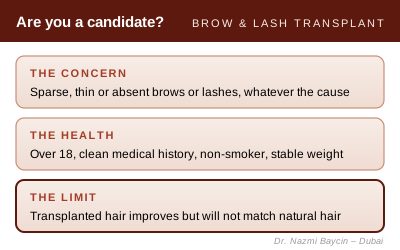 The best candidates are healthy adults with sparse, thin, or absent brows or lashes — whether from genetics, permanent makeup, or injury — who come with realistic expectations. Before a consultation, it helps to reflect on a few things:
- Your reason. Is the sparseness from injury or tissue loss, or is it aesthetic? Both can be treated, but the first tends to bring the greater sense of improvement.
- Your expectations. Do you understand that transplanted brow or lash hair improves the area but will not be identical to natural hair?
- Your upkeep. Are you comfortable trimming transplanted brow hair periodically, since it keeps growing?
- Your health. A clean medical history and good general health are the foundation of safe surgery.
If your expectations align with what is realistically achievable, I can help you very effectively — and we will talk all of this through honestly.
How does Dr. Baycin perform the procedure?
The eyebrow and eyelash transplant is done under local anesthesia and involves three main stages. First, I harvest the follicles: once I have injected the local anesthetic and the donor area is completely numb, I carefully collect each follicle using the FUE technique, taking somewhere between fifty and four hundred follicles depending on the area to be treated — a process that usually takes thirty to sixty minutes.
Second, I create the tiny recipient incisions, and this is the stage that most shapes the result: their pattern sets the direction and appearance of the brows or lashes, so the alignment, angulation, and density all have to be judged with a very skilled hand, which again takes about thirty to sixty minutes. Finally, I place the harvested follicles into the incisions, rotating each one so that the natural curve of the hair runs parallel to the existing hairs — meticulous work that takes anywhere from one to two hours.
The same follicle-by-follicle FUE precision, with its careful attention to angle and direction, is what I bring to beard and mustache transplantation and to scalp hair transplant too.
What is the recovery period like?
You are free to leave the clinic right after the procedure. I will prescribe an antibiotic and some pain relief, and it is important to take the antibiotics consistently for a week as a precaution against infection. In the first couple of days you may feel a slight burning sensation, and if any pain develops the painkillers will ease it easily. You can also expect some swelling and bruising around the eyes, which tends to peak in the first two days and then subsides fairly quickly, and most people are able to return to work the following week. After that, it is completely normal for all the transplanted hair to shed within two to three weeks — the roots remain safe and sound — with new hair beginning to grow from those roots in about two to three months, and the real result becoming clear at around five to six months.
What is the aftercare?
The aftercare is simple. I will see you for a follow-up two days after the procedure, and at that visit we will gently wash the area together and show you how to look after it yourself in the days that follow. The main thing to be careful about is sun exposure — I ask you to avoid the sun and to use a good sun-protection cream for the next two months — but beyond that, there is very little special care needed.
How much do an eyebrow transplant and eyelash restoration cost in Dubai?
The cost of an eyebrow transplant or eyelash restoration in Dubai varies from clinic to clinic and depends chiefly on how many hairs you need. In my practice, the price is around AED 12,000. You can see my general price list of the procedures for context, and I will give you an exact figure at consultation.
About Dr. Nazmi Baycin
Surgery, to me, is precision applied in service of restoration — a conviction that has guided every one of the more than 7,000 procedures I have performed over 25 years in practice. I am a DHA-licensed, board-certified plastic surgeon, trained in Turkey and based in Dubai since 2016. I operate exclusively within JCI-accredited hospitals, and hold international membership in the American Society of Plastic Surgeons (ASPS). Three techniques, in particular, have become signatures of my practice. Scarless breast augmentation, performed through a transaxillary approach that leaves no incision on the breast itself. Labiaplasty designed individually around each patient’s own anatomy, never to a standard template. And 3D customized facial bone implants, engineered through CT-based bespoke printing — a technique I currently offer as the only surgeon in Dubai providing it. My practice today spans facial rejuvenation, breast surgery, body contouring, and cosmetic genital procedures, drawing patients from across the UAE, Europe, and the wider GCC. Yet the principle guiding each of these specialties has never changed: to restore form is to restore function.
FAQs about eyebrow transplant and eyelash restoration in Dubai
-
Will a transplanted eyebrow or eyelash look exactly like natural hair?
No. Brow and lash hair has a unique thickness, length, and curve that no body hair matches exactly, so a transplant improves the area but will not be identical to natural hair — which is why realistic expectations matter.
-
Where does the donor hair come from?
Usually the back of the scalp, which matches brow thickness and color well; for lashes, scalp hair is closest to the upper-lid lashes and finer body hair to the lower-lid lashes.
-
Do I need to trim a transplanted eyebrow?
Yes. Transplanted brow hair keeps growing like scalp hair, so it needs occasional trimming.
-
How many follicles are needed?
Typically 50 to 400 follicles, depending on the area being treated.
-
When will I see the final result?
Transplanted hair sheds within 2–3 weeks (the roots remain), new growth begins at 2–3 months, and the result is clear at about 5–6 months.
-
How much does it cost in Dubai?
Around AED 12,000, depending on the number of hairs needed.


GET APPOINTMENT
Get ready to look and feel best… You deserve…
