


Table of content
- What can chin augmentation in Dubai do for you?
- Chin augmentation with implants
- Chin augmentation with osteotomy
- How does Dr. Baycin use 3D imaging and custom implants?
- 3D Simulation of chin augmentation: Before & after comparison
- What is recovery after chin augmentation like?
- Checklist before having chin augmentation in Dubai, UAE
- How much does a chin augmentation cost in Dubai, UAE?
- FAQs about chin augmentation in Dubai
- Get appointment
The chin is the quiet architect of the face. It anchors the profile, defines the jawline, and lends the lower face its balance — and when it is underprojected, no amount of work on the nose or cheeks will fully settle the picture. Chin augmentation in Dubai exists to restore that balance, and I approach it differently from most. I am Dr. Nazmi Baycin, and I am the only surgeon in Dubai who designs each chin implant from the patient’s own CT scan — a bespoke, 3D-printed implant shaped to fit your facial bone exactly, rather than a stock implant trimmed to approximate it. That distinction is not cosmetic.
Over twenty-five years and more than four hundred chin augmentations, I have learned that the difference between a natural result and an obvious one lies in fit — an implant that matches the underlying bone to the millimeter sits stably, looks like skeleton rather than addition, and avoids the malposition that drives most complications. Performing chin augmentation in Dubai within JCI-accredited hospitals, I plan every case in three dimensions before I ever make an incision, guided by a single principle: to restore form is to restore function.
Chin augmentation in Dubai quick facts
| Procedure detail | Chin augmentation in Dubai |
|---|---|
| Technique | 3D CT-designed custom implant (or osteotomy) |
| Implant | Bespoke, printed from your own CT scan |
| Anesthesia | General |
| Procedure time | ~1 hour |
| Hospital stay | Day case (no overnight stay) |
| Incision | Inside the mouth (no external scar) or submental |
| Sutures | Dissolvable (none to remove) |
| Downtime | 1–2 days |
| Jaw garment | 1 week |
| Swelling resolves | 7–10 days |
| Initial result | Visible immediately; refines over weeks |
What can chin augmentation in Dubai do for you?
A well-judged chin augmentation strengthens a weak or receding chin, sharpens the jawline, and brings the lower face into proportion with the nose and cheeks. Seen in profile, it is often the single change that makes everything else look “right” — which is why it pairs so naturally with rhinoplasty in profile work.
The aim is never a larger chin for its own sake; it is harmony, the sense that the feature always belonged. Because the implant I use is designed from your own anatomy, the enhancement reads as your own bone — defined, balanced, and entirely natural from every angle.
Why might you need chin augmentation?
The structure, shape, and size of the facial bones differ from person to person, and they shape how the whole face is read. A chin that sits too far back unbalances the profile and can make an otherwise average nose look prominent — the combination sometimes described as “bird-face deformity,” an underdeveloped chin paired with a beak-like nasal profile.
Correcting the profile as a whole is called profiloplasty, and chin augmentation is one of its key components, frequently combined with rhinoplasty to enhance the side view. If you are not sure whether the feature that bothers you is the nose or the chin, I set that question out in my article on why a recessed chin makes an ordinary nose look large. When several features contribute to the imbalance, the chin is best judged as one element of a full facial transformation rather than in isolation. Beyond aesthetics, significant jaw discrepancies can cause functional problems with chewing; in those cases maxillofacial surgery — a branch of plastic surgery — addresses the underlying skeletal relationship.
Are you a good candidate for chin augmentation?
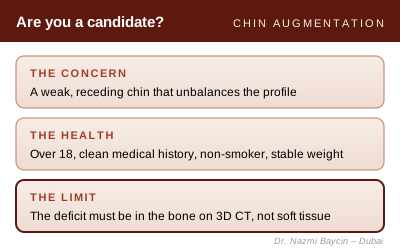 You are likely a good candidate if you feel your chin is weak or out of proportion with the rest of your face, you are in good general health, and your expectations are realistic. A clean medical history matters, because patient safety governs every decision I make before surgery. The best way to know whether an implant — and what shape of implant — suits you is a 3D assessment of your facial bones, which shows us together exactly what a given correction will achieve before anything is decided.
It is worth being clear about what this procedure does not treat. Where the softness under the jaw is fullness rather than a shortfall in bone — a heavy neckline over an adequately projected chin — no implant will correct it, and the answer is removing submental fullness instead. Where the roundness sits higher, in the mid-cheek, the deep cheek fat is responsible and deep cheek fat reduction is the more direct route. The 3D assessment is what separates these cases, because it shows the skeleton beneath the soft tissue.
What surgical techniques are used for chin augmentation?
The chin can be enhanced in two fundamentally different ways: by adding a custom implant in front of the bone, or by cutting and advancing the bone itself (an osteotomy). Both have their place, and the right choice depends on your anatomy and the degree of correction needed.
Chin augmentation with osteotomy (sliding genioplasty)
This technique is more complex and more demanding. I make a 3–4 cm incision on the inner side of the lower lip, lift the soft tissue from the chin bone, and use a powered saw to free a section of bone, which I then move forward to increase projection and fix with screws. Its advantage is that the scar is hidden inside the mouth, with no external mark. Its drawbacks are real: it is intricate and labor-intensive — which is why many surgeons avoid it — and the surgical time is longer than with an implant.
Which of the two your anatomy actually calls for is not a matter of preference but of measurement. I set out the full diagnostic reasoning — and the cephalometric findings that point to one operation rather than the other — in my article on comparison of a chin implant and a sliding genioplasty.
Chin augmentation with implants (chin implant surgery)
Implant placement is the most popular and most direct method, and the one I most often recommend because, with a bespoke implant, it is both precise and minimally invasive. The chin bone is reached either from inside the mouth or from just beneath the chin, the implant is positioned against the bone and secured with screws, and the result is immediate and stable.
With a CT-designed implant, the fit is exact — which is the single most important factor in a natural, long-lasting result. If you want to know how closely the finished implant reproduces the plan you approve — and why the preview is a specification rather than a picture — I set that out in my article on chin implant accuracy, from plan to result.
| Factor | 3D custom implant | Osteotomy (sliding genioplasty) |
|---|---|---|
| Invasiveness | Lower | Higher (bone cut) |
| Surgical time | Shorter (~1 hr) | Longer |
| Scar | None (intraoral) or submental | Hidden intraoral |
| Best for | Most projection deficits | Large/complex skeletal cases |
| Precision | Exact (CT-designed) | Surgeon-judged intra-op |
Intraoral vs. submental approach — which scar, which risk?
When an implant is used, it can be placed through one of two routes. The intraoral approach uses a 3–4 cm incision inside the lower lip, leaving no visible scar — but the mouth’s rich bacterial environment carries a slightly higher infection risk. The submental approach uses a 3–4 cm incision in the skin just beneath the jawline, creating a pocket directly over the bone; it is generally easier and carries a lower infection risk, but it leaves a small scar beneath the chin. I choose between them based on your anatomy, your implant, and which trade-off serves your result best.
How does Dr. Baycin use 3D imaging and custom implants?

A custom implant designed from the patient’s own 3D CT scan.
Chin augmentation has been transformed by 3D imaging and custom implant printing, and this is the heart of my practice. From an advanced 3D CT scan I build a precise digital model of your facial bones, then design an implant that fits your unique anatomy exactly — not a stock shape adapted in the operating room, but a bespoke implant printed for you.
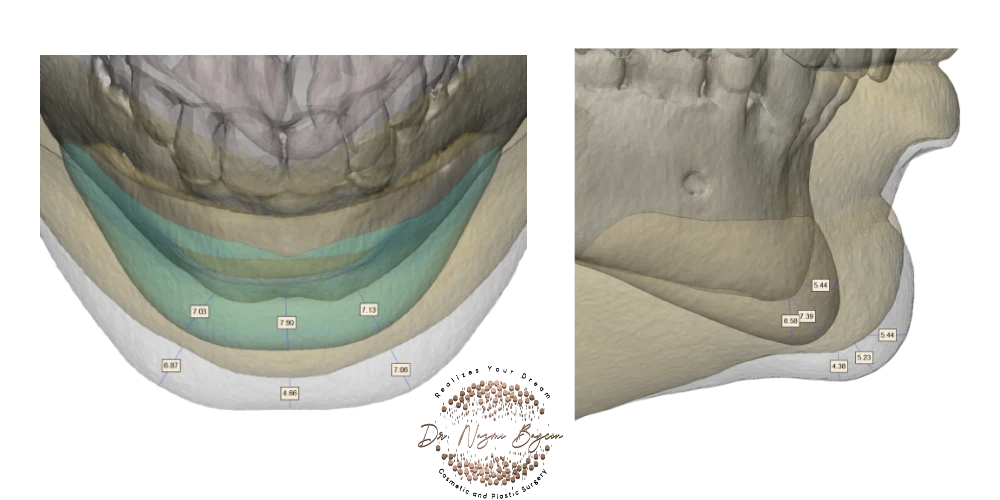
A multi‑layered 3D analysis demonstrating the predictable soft‑tissue response to customized chin augmentation. The top‑view and side‑view panels sequentially overlay four critical anatomical layers: the native facial bone structure, the precisely adapted chin implant, the pre‑operative soft‑tissue envelope (baseline contour), and the post‑operative soft‑tissue position (simulated outcome). This advanced biomechanical simulation, derived from high‑resolution CT data, allows me to predict exactly how the soft tissues will drape over the underlying implant architecture – eliminating post‑operative surprises and ensuring that the final result aligns flawlessly with the patient’s aesthetic goals. By quantifying soft‑tissue thickness, elasticity, and skeletal support, this digital twin methodology transforms chin augmentation from an art of approximation into an engineering science of certainty, delivering reproducible, natural‑looking results for patients seeking precision chin augmentation in Dubai.
The result is greater precision, a more natural outcome, fewer complications, and a faster recovery. To understand how 3D CT imaging guides the precise planning of chin surgery, see my 3D CT imaging for facial surgical planning article, and for the full method, 3D technology in chin implant surgery.
3D Simulation of chin augmentation: Before & after comparison
The simulation below is a real patient model. You can select the visualization mode using the button on the left, which allows you to view the model with or without soft tissue and compare before-and-after states. You can also change the viewing angle by moving the mouse by clicking and dragging inside the frame.
Why a CT-designed implant lowers your risk
This is where bespoke design earns its place. The problems specific to implant-based augmentation are malposition, the need for revision, and infection, and each of them has the same root: an implant that does not sit flush against the bone it is meant to extend. A gap between implant and bone is a space the implant can shift within, and a space fluid can collect in. Designing the implant from your own CT scan is how I close that gap before the operation rather than trying to compensate for it during one. How the pocket is dissected and the implant secured is a subject in its own right, which I set out in my article on why the pocket and fixation decide whether a chin implant holds its position. I should be plain that this is reasoning about mechanism: no trial has compared custom-designed implants against stock ones head to head, and I present it as the judgement this whole method rests on rather than as a proven result.
| Factor | Stock (off-the-shelf) implant | CT-designed custom implant |
|---|---|---|
| Design basis | Generic shape manufactured in a handful of fixed sizes | Designed from your own 3D CT scan and printed for your bone alone |
| Fit to the bone | Approximate; the inner surface follows an average chin, not yours | Inner surface is a negative of your bone, matched to the millimeter |
| Adjustment in the operating room | Often trimmed or carved by hand to improve the fit | None needed; the fit is decided before the incision is made |
| Dead space under the implant | Gaps between implant and bone are common wherever contours differ | Eliminated by design; the implant sits flush across its whole footprint |
| Malposition / shifting | A gap is a space the implant can rotate or migrate within | No gap to move within; stability comes from the fit as well as the screws |
| Fluid collection and infection substrate | Dead space can collect fluid, which is a medium for infection | Flush contact leaves no reservoir for fluid to pool in |
| Fixation | Screws placed through an implant that may rock on an uneven bed | Screw positions planned on the model; the implant is fixed against a bed it already matches |
| Facial asymmetry | Symmetric by manufacture; cannot correct a chin bone that is not | Each side designed independently, so an asymmetric bone can be balanced |
| Load on the bone beneath | Poor fit concentrates pressure at contact points, the setting in which underlying bone resorption is described | Load spread evenly across the full contact surface |
| Edge visibility and palpability | Edges may be felt or seen where the implant lifts off the bone | Edges feathered into the bone surface on the model, so the transition is smooth |
| Predictability of the result | Judged from a size chart and the surgeon’s estimate | Previewed in soft-tissue simulation; what you approve is a specification, not a picture |
| Revision likelihood | Revision is most often for malposition or a visible edge, both fit-related | The fit-related causes of revision are addressed in the design stage |
| Lead time | Available immediately | Several weeks for CT scan, design approval, and printing |
| Cost | Lower | Higher, reflecting imaging, design, and manufacture |
| Evidence base | Long track record; the reference against which other methods are judged | No head-to-head trial against stock implants; the advantages above are reasoning about mechanism, not a proven result |

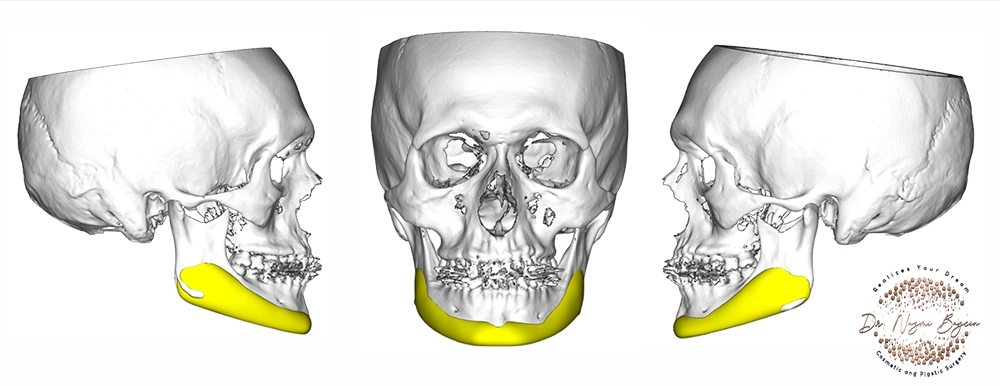
The image shows a 3D print of the patient’s facial bone structure, which is in a 1:1 ratio with the patient’s real measurements. On the left side, the inner surface of the implant is visible. On the right side, the exact fit of the implant on the bone surface is shown.

The picture shows the implant properly placed on the chin through the submental incision and secured with two screws.
Can the jawline be enhanced at the same time?
Sometimes the chin alone is not the whole story — balanced, defined lower-face proportions may call for enhancement of the entire jawline. For those patients a 3D custom jawline implant is the more complete solution, restoring harmony across the whole lower face.
Chin projection is only one part of the picture — a lasting result depends on how the chin relates to the jaw angles and the neckline. I explain this whole-face thinking in detail in my article on the structural philosophy of total jawline harmony. You can preview the effect through soft-tissue simulation before deciding, and read the full detail in my guide to 3D customized jawline implant surgery in Dubai.
Where does Dr. Baycin perform chin augmentation in Dubai?
I perform every chin augmentation in a premium, JCI-accredited hospital in Dubai that meets the highest international standards for safety and hygiene. Your surgery takes place in a fully equipped, advanced medical environment — because outstanding results and uncompromising safety are inseparable.
What is recovery after chin augmentation like?
Chin augmentation is a day procedure — you go home the same day. I provide prescriptions for antibiotics and pain relief; the surgery itself is not especially painful, but the medication keeps the first days comfortable. If your incision is inside the mouth, you will use an antiseptic mouthwash for four to five days and keep to soft foods during that time. You will wear a supportive jaw garment for a week, and any swelling typically settles within seven to ten days. The initial result is visible immediately, refining as the swelling resolves.

Side view of the face before the chin implant surgery

Side view of the face after the chin implant surgery
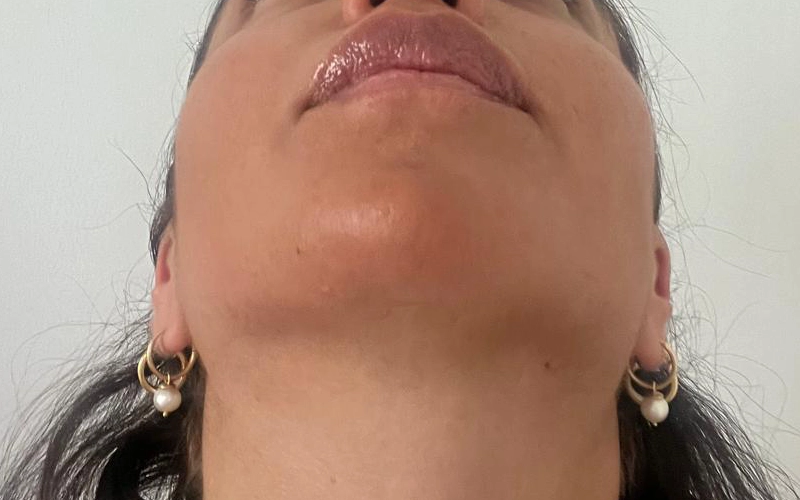
The scar in the submental region had completely disappeared four months after the surgery.
To understand the full science behind how I support your healing after surgery, visit my advanced recovery protocol in Dubai article.
Download Dr. Baycin’s chin augmentation aftercare instructions
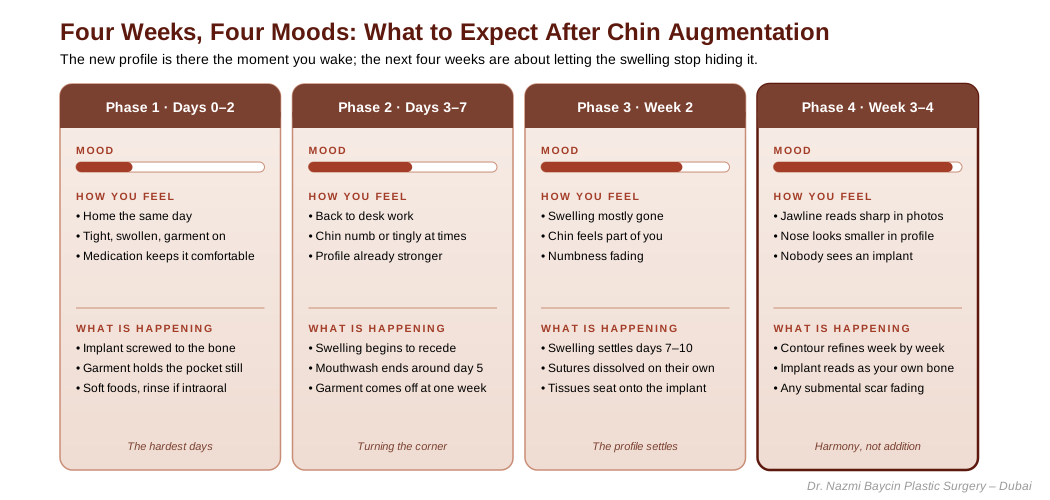
Chin augmentation is unusual among the operations I perform in that the result is there before the recovery begins. You go home the same day with the implant fixed to the bone and a jaw garment holding everything still; for the first day or two the chin feels tight and swollen, and if I have gone in through the mouth you keep to soft foods and an antiseptic rinse. By day three most people are back at a desk, the mouthwash finishes around day five, and the garment comes off at one week. Swelling settles between days seven and ten, the sutures dissolve on their own, and over weeks three and four the contour refines as the tissues seat onto the implant. The mood runs behind the body: the first days feel like a lot for a small operation, then the profile appears from under the swelling, and by the end of the month the chin simply reads as yours. The pace varies with personality; the shape rarely does.
What are the risks and complications of chin augmentation?
Chin augmentation is a safe procedure in experienced hands, but no operation is without risk. The recognized risks include infection, hematoma, temporary numbness of the lower lip or chin from irritation of the mental nerve, asymmetry, and — specific to implants — malposition or shifting that can require revision.
There is a trade-off worth stating plainly: implant-based augmentation carries a higher rate of infection and wound breakdown than techniques that move the bone instead, and the risk varies markedly with the surgical route used.
This is precisely why I design each implant from your own CT scan and choose the access route case by case. An implant that seats exactly on the bone leaves no dead space to shift within or to harbor infection, which is my rationale for the bespoke approach — reasoning about mechanism rather than a result proven head to head. Careful patient selection, sterile technique, and the right surgical route for each patient reduce the remaining risks to a low level, and where any issue arises it is almost always correctable.
Checklist before having chin augmentation
IMPORTANT ! Before getting the appointment, check your medical conditions yourself.
| # | Conditions | Safety | Aesthetic Suitability |
|---|---|---|---|
| 1 | Are you over 18? | 🟢 Fit for surgery | — |
| 2 | Do you have a chin that appears disproportionate to your overall facial profile? | 🟢 Fit for surgery | 🟡 Ideal candidate |
| 3 | Would you like your chin to appear larger, smaller, or better balanced? | 🟢 Fit for surgery | 🟡 Ideal candidate |
| 4 | Do you have a cardiovascular problem such as heart disease or deep vein thrombosis? | 🔴 Contraindicated | — |
| 5 | Do you have pulmonary system problems such as chronic lung disease? | 🔴 Contraindicated | — |
| 6 | Do you have chronic liver disease? | 🔴 Contraindicated | — |
| 7 | Do you have a urinary system disease such as kidney failure? | 🔴 Contraindicated | — |
| 8 | Do you have a hematologic problem such as anemia or coagulopathy? | 🔴 Contraindicated | — |
| 9 | Do you have any transmitting disease through blood such as HIV? | 🔴 Contraindicated | — |
| 10 | Have you been taking anticoagulant medication? | 🔴 Contraindicated | — |
| 11 | Have you been taking psychotropic drugs? | 🔴 Contraindicated | — |
| 12 | Any drug abuse or addiction | 🔴 Contraindicated | — |
How much does a chin augmentation cost in Dubai, UAE?
Chin augmentation prices in Dubai can really differ from one clinic to another, influenced by a variety of factors such as surgeon’s experience, implant design technology, and ranges from about 20,000 AED ($5,500) to 80,000 AED ($22,000). Keep in mind that these figures don’t represent Dr. Baycin’s specific rates; you’ll get the exact price during your consultation after he evaluates your situation.
For a complete overview of treatment fees, please refer to full price list of the procedures. If you are looking specifically for this procedure, you can also review pricing information.
Schedule your private consultation with Dr. BaycinWhat makes Dr. Baycin an exceptional chin augmentation surgeon in Dubai?
With more than four hundred successful chin augmentations, I have set a benchmark in Dubai for precision and aesthetic balance — and the reason patients travel to me is simple: the implant is designed for their face, not adapted to it.
- 25+ years of surgical expertise: a DHA-licensed, board-certified plastic surgeon and member of the American Society of Plastic Surgeons (ASPS), bringing decades of experience to every procedure.
- Leader in 3D facial bone modeling & bespoke implant technology: a pioneer of CT-based 3D facial bone modeling and custom-printed implant design — and the only surgeon in Dubai offering it — creating ultra-personalized chin implants that fit each patient’s anatomy with unmatched precision.
- Personalized treatment for every face: every plan is matched to the patient’s own proportions, for results that are both striking and authentic.
- Precision in profile balancing: the chin is assessed holistically against the nose, jawline, and neck, for seamless symmetry from every angle.
- Master of advanced techniques: implant and osteotomy methods alike, applied for precision, stability, and long-term satisfaction.
- Safety beyond compromise: thousands of aesthetic procedures with zero major complications; patient safety at the center of the practice.
- Honest, transparent consultations: every option explained, expectations set realistically, and unnecessary procedures avoided.
- Exceptional post-operative care: personalized aftercare and direct surgeon access throughout recovery.
- A global destination for chin augmentation: patients from Europe, the GCC, and beyond choose Dubai for his results.
- Preferred by public figures and international clients: a reputation for discretion and flawless results.
- Proven results that speak volumes: 400+ successful chin augmentations, known for natural definition and lasting harmony.
About Dr. Nazmi Baycin
Surgery, to me, is precision applied in service of restoration — a conviction that has guided every one of the more than 7,000 procedures I have performed over 25 years in practice. I am a DHA-licensed, board-certified plastic surgeon, trained in Turkey and based in Dubai since 2016. I operate exclusively within JCI-accredited hospitals, and hold international membership in the American Society of Plastic Surgeons (ASPS). Three techniques, in particular, have become signatures of my practice. Scarless breast augmentation, performed through a transaxillary approach that leaves no incision on the breast itself. Labiaplasty designed individually around each patient’s own anatomy, never to a standard template. And 3D customized facial bone implants, engineered through CT-based bespoke printing — a technique I currently offer as the only surgeon in Dubai providing it. My practice today spans facial rejuvenation, breast surgery, body contouring, and cosmetic genital procedures, drawing patients from across the UAE, Europe, and the wider GCC. Yet the principle guiding each of these specialties has never changed: to restore form is to restore function.
FAQs about chin augmentation in Dubai
-
What is chin augmentation?
Chin augmentation is how I strengthen a weak or receding chin to restore balance to the face, sharpen the jawline, and bring the lower face into proportion with the nose and cheeks. The chin is the quiet architect of the face, anchoring the profile, so correcting it often makes everything else look right. I perform it using a CT-designed 3D custom implant shaped to fit your exact facial bone, so the enhancement reads as your own skeleton rather than an addition.
-
What is 3D custom (bespoke) chin implant surgery?
It is chin augmentation using an implant I design from your own CT scan and have 3D-printed to fit your bone precisely, and I am the only surgeon in Dubai offering it. From an advanced 3D CT scan I build a digital model of your facial bones, then design an implant for your unique anatomy rather than trimming a stock shape in the operating room. The exact fit improves the aesthetic result and lowers the malposition, revision, and infection risks seen with stock implants.
-
How much does chin augmentation cost in Dubai?
Chin augmentation prices in Dubai can really differ from one clinic to another, influenced by a variety of factors, and range from about AED 20,000 to AED 80,000. These figures are general market rates, not Dr. Baycin’s specific pricing; you’ll get the exact price at your consultation, after your situation is evaluated.
-
What surgical techniques are used for chin augmentation in Dubai?
The chin can be enhanced in two fundamentally different ways: by adding a custom implant in front of the bone, or by cutting and advancing the bone itself in an osteotomy. I most often recommend the bespoke implant because, with a CT-designed fit, it is both precise and minimally invasive, and the result is immediate and stable. An osteotomy, or sliding genioplasty, is more complex and demanding, and I reserve it for larger or more complex skeletal cases where advancing the bone is the better correction.
-
Will chin augmentation leave a visible scar?
Usually not. When I place the implant through the inside of the mouth, using an incision in the lower lip, there is no external scar at all. The alternative submental route uses a small incision beneath the jawline, which leaves a discreet scar that fades over time; in one of my patients it had completely disappeared four months after surgery. I choose between the two routes based on your anatomy, your implant, and which trade-off serves your result best.
-
Is chin augmentation in Dubai safe, and what are the risks?
In experienced hands it is very safe, though no operation is without risk. The recognized risks include infection, hematoma, temporary numbness of the lower lip or chin, asymmetry, and, specific to implants, malposition or shifting. There is a trade-off worth stating plainly: implants carry a higher rate of infection and wound breakdown than techniques that move the bone instead, and the risk varies markedly with the surgical route used. This is why I design each implant from your own CT scan and choose the access route case by case, so the implant seats exactly on the bone with no dead space to shift within.
-
How long is recovery after chin augmentation?
Chin augmentation is a day procedure, so you go home the same day, with just one to two days of downtime. I provide antibiotics and pain relief; the surgery itself is not especially painful, but the medication keeps the first days comfortable. If your incision is inside the mouth, you’ll use an antiseptic mouthwash and keep to soft foods for four to five days. You’ll wear a supportive jaw garment for a week, and swelling settles within seven to ten days. The initial result is visible immediately.
-
How do you use 3D imaging and custom implants?
This is the heart of my practice. From an advanced 3D CT scan I build a precise digital model of your facial bones, then design an implant that fits your unique anatomy exactly, printed for you rather than adapted in the operating room. I plan every case in three dimensions before I ever make an incision. The result is greater precision, a more natural outcome, fewer complications, and a faster recovery, because the technology addresses the failure modes that make an implant shift or become infected in the first place.
-
Can chin augmentation in Dubai be combined with a nose job?
Yes, and it often is. Correcting the profile as a whole is called profiloplasty, and chin augmentation is one of its key components, frequently combined with rhinoplasty to enhance the side view. It is particularly effective for a recessed chin paired with a prominent nose, the combination sometimes described as bird-face deformity, where correcting both together settles the whole profile far better than treating either feature alone.
-
Can the whole jawline be enhanced, not just the chin?
Yes. Sometimes the chin alone is not the whole story, and balanced, defined lower-face proportions call for enhancement of the entire jawline. For those patients I design a 3D custom jawline implant, a more complete solution that restores harmony across the whole lower face. You can preview the effect through soft-tissue simulation before deciding, which lets us agree on the result together before anything is finalized.
-
Are you a good candidate for chin augmentation?
You are likely a good candidate if you feel your chin is weak or out of proportion with the rest of your face, you are in good general health, and your expectations are realistic. A clean medical history matters, because patient safety governs every decision I make before surgery. The best way to know whether an implant suits you, and what shape of implant, is a 3D assessment of your facial bones, which shows us together exactly what a given correction will achieve before anything is decided.
-
Why does a CT-designed implant lower your risk?
The problems specific to implant-based augmentation are malposition, the need for revision, and infection, and each of them has the same root: an implant that does not sit flush against the bone it is meant to extend. A gap between implant and bone is a space the implant can shift within, and a space fluid can collect in. A CT-designed implant is built to seat precisely on your bone, which closes that gap before the operation rather than compensating for it during one. I should be plain that this is reasoning about mechanism rather than a finding proven head to head, and it is why I plan every case in three dimensions before I operate.


GET APPOINTMENT
Get ready to look and feel best… You deserve…
