


Table of content
- Breast lift in Dubai quick facts
- What can a breast lift in Dubai do for you?
- Why might you need a breast lift?
- Are you a good candidate for breast lift surgery?
- How does Dr. Baycin measure and grade breast sagging?
- Which breast lift technique is right for you?
- Where does Dr. Baycin perform breast lift surgery in Dubai?
- What is recovery after a breast lift like?
- Can you breastfeed after a breast lift?
- What are the risks and complications of a breast lift?
- Breast lift in Dubai: suitability and safety checklist
- What are the steps of a breast lift in Dubai from consultation to surgery?
- How much does a breast lift cost in Dubai, UAE?
- What makes Dr. Baycin an exceptional breast lift surgeon in Dubai?
- About Dr. Nazmi Baycin
- FAQs about breast lift in Dubai
- What is a breast lift (mastopexy)?
- How much does a breast lift cost in Dubai?
- How do you decide which breast lift technique to use?
- What are the different degrees of sagging?
- What scars does a breast lift leave?
- Will a breast lift make my breasts bigger?
- Can a breast lift in Dubai be combined with implants?
- Will a breast lift affect the nipple or sensation?
- What is recovery after a breast lift like?
- How long do the results of a breast lift last?
- Are you a good candidate for a breast lift?
- Can a breast lift in Dubai be combined with other procedures?
- In-depth reading: techniques, scar quality and skin laxity behind breast lift in Dubai
- What patients say
- Book a breast lift consultation in Dubai
The first question almost every woman asks me about a breast lift is about the scar — and rightly so. I am Dr. Nazmi Baycin, and across more than three hundred breast lift procedures I have built my approach around a simple principle: the incision should never be larger than the degree of sagging demands. A breast lift in Dubai with me is not one fixed operation but a graded one, matched precisely to your anatomy — so a woman with mild sagging leaves with only a fine scar around the areola, and no one carries more scar than her case actually requires.
That judgment is the heart of mastopexy. A breast lift restores a youthful, lifted shape by removing excess skin and reshaping the breast tissue beneath, and the art lies in choosing the least invasive technique that will still hold the result. Performing breast lift surgery in Dubai within JCI-accredited hospitals, I plan each lift around your measurements, your degree of sagging, and your wishes for size — preserving sensation and minimizing scarring throughout. The principle is the one that guides all my work: to restore form is to restore function.
Breast lift in Dubai quick facts
| Procedure detail | Breast lift (mastopexy) in Dubai |
|---|---|
| Technique | Matched to ptosis: periareolar, vertical-scar or inverted-T lift |
| With implant | Optional, where volume is also to be restored |
| Anesthesia | General (+ long-acting local infiltration) |
| Procedure time | 2–3 hours |
| Hospital stay | 1 day |
| Scar | Around the areola (± vertical line to the fold, ± short horizontal line in the fold) |
| Sutures | Hidden, dissolvable (none to remove) |
| Shower | ~2 days |
| Downtime | 4–5 days; swelling fades in ~10 days |
| Swimming | From ~2 weeks |
| Final shape | Settles over ~6 months |
| Breastfeeding | Usually preserved |
What can a breast lift in Dubai do for you?
A breast lift raises and reshapes breasts that have begun to sag, repositioning the nipple to a natural height, tightening loose skin, and restoring a firmer, more youthful contour proportionate to your body. It does not primarily change size — it changes shape and position — though where volume has also been lost, it can be combined with an implant to restore fullness at the same time.
The result is breasts that sit higher and look fuller and more youthful, brought into balance with the rest of your figure. For many women the change is as much about confidence as contour: clothes fit better, and the silhouette feels like their own again.
Why might you need a breast lift?
Breasts lose their lift for reasons largely outside a woman’s control — pregnancy and breastfeeding, weight loss, the natural effects of age and gravity, and genetics all stretch the skin and ligaments that once held the breast high. As that support slackens, the breast descends and the nipple drops below the crease beneath the breast, giving a deflated, sagging look that no amount of exercise can correct, because the muscle sits behind the breast rather than within it. A breast lift is the one reliable way to restore the breast to a higher, firmer position — with or without added volume, depending on what has been lost.
Are you a good candidate for breast lift surgery?
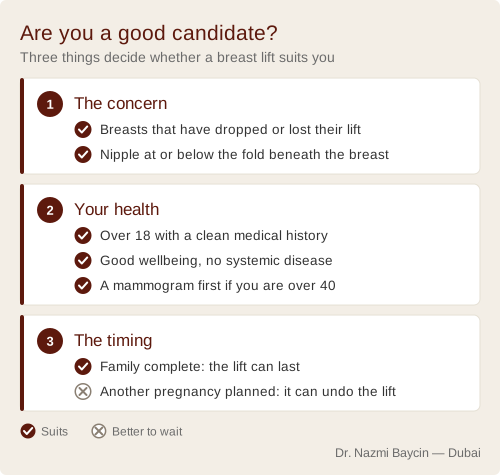 A clean medical history and good overall health — including mental wellbeing and freedom from systemic disease such as heart disease — are the foundation of safe breast lift surgery, and the starting point of every assessment I make.
Beyond that, any woman troubled by loss of breast volume or sagging can consider a lift, at any age over 18. My aim is always the same: symmetrical breasts with a natural shape, proportionate to your body. Some difference between the two sides is normal in every woman, and where that difference is more pronounced it is planned for within the lift itself — often by removing different amounts of skin on each side, or by grading the two breasts separately.
If you are over 40, I advise a mammogram before surgery as a sensible precaution.
Timing matters as well: a breast lift is best done once your family is complete, because a later pregnancy can stretch the breast again and change its shape, although the lift has minimal effect on the mammary glands, so most women can still breastfeed afterward. For the same reason, I ask that your weight has been stable for at least six months, since weight change alters breast volume and lets the breast drop again. If you smoke or use any form of nicotine, I advise a nicotine-free period around surgery, as nicotine reduces blood flow to the nipple and skin edges and can delay healing. And if your breasts have lost volume as well as lift, a lift alone may leave them looking deflated; in that case we can restore fullness with an implant in the same operation.
How does Dr. Baycin measure and grade breast sagging?
Good planning begins with measurement, not guesswork. I start from your body measurements, comparing your current size with the size you would like, which also reveals any asymmetry between the two sides — differences in size and shape from one breast to the other are very common and entirely normal. To grade the degree of sagging precisely, I use the position of the nipple relative to the submammary fold (the crease beneath the breast) as my reference point, assessing how far the nipple sits below that line. That measurement is what determines the right technique — and, with it, how much scar your particular lift will leave.
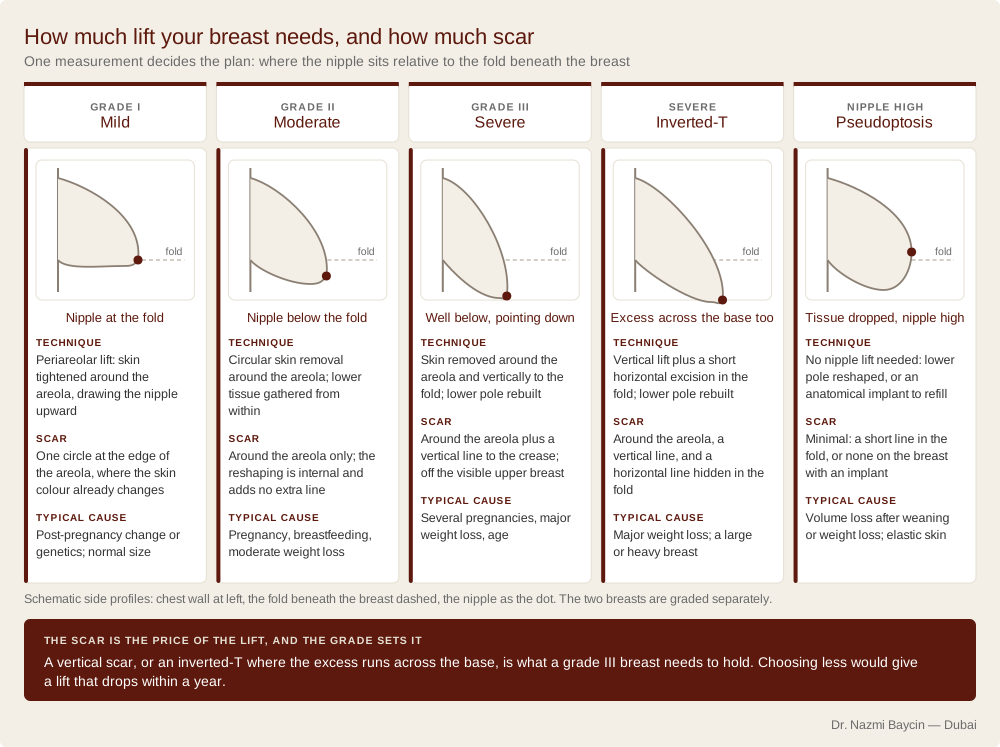
Sagging is graded, not guessed. I measure where the nipple sits relative to the submammary fold, and that one measurement sets both the technique and the scar. In grade I ptosis the nipple sits at the fold and tightening the skin around the areola is enough, leaving a single circular scar where the skin color already changes. In grade II it has dropped below the fold; skin is removed around the areola and the lower breast tissue gathered from within, so the scar is still around the areola only. In grade III the nipple points downward well below the crease, and skin must come out both around the areola and vertically to the fold for the lift to hold — the vertical scar is the price of a result that lasts, and it stays off the visible upper breast. Where the excess skin also runs across the base of the breast, most often after major weight loss or in a large, heavy breast, a short horizontal scar is added in the fold, giving an inverted-T. Pseudoptosis is the pattern where the breast has emptied and descended but the nipple has not dropped; it needs lower-pole reshaping or an anatomical implant, not a nipple lift. The two breasts are graded separately, and asymmetry is planned into the lift rather than discovered afterwards.
| Degree of sagging | Nipple position (the measurement) | Typical cause | Technique | Resulting scar |
|---|---|---|---|---|
| Mild (grade I) | At the level of the fold | Early post-pregnancy change, genetics; normal size | Periareolar lift — skin tightened around the areola, drawing the nipple upward | A single circular scar around the areola |
| Moderate (grade II) | Below the fold | Pregnancy and breastfeeding, moderate weight loss | Circular skin removal around the areola + lower-pole tissue gathered from within | Around the areola only |
| Severe (grade III) | Well below the fold, pointing downward | Several pregnancies, major weight loss, age | Areolar + vertical skin removal to the fold + lower-pole reshaping | Around the areola + a vertical line to the crease |
| Severe (grade III) with horizontal excess | Well below the fold, with loose skin also running across the base of the breast | Major weight loss; a large or heavy breast | Areolar + vertical skin removal + a short horizontal removal in the fold (inverted-T) + lower-pole reshaping | Around the areola + a vertical line + a horizontal line hidden in the fold |
| Pseudoptosis | At or above the fold; tissue has descended without the nipple | Volume loss after weaning or weight loss; elastic skin | Lower-pole reshaping, or an anatomical implant to restore volume — no nipple lift | Minimal: a short line in the fold, or none on the breast with an implant |
How to read this table: The nipple position sets the grade; within grade III, the direction of the excess skin decides between the vertical and the inverted-T pattern. The two breasts are read separately, so each side can need a different row.
Breast sagging self-check: find your likely grade
Which breast lift technique is right for you?
Choosing the right technique is the most important part of planning a breast lift, and it follows directly from the degree of sagging and the size of the breast. The general rule is simple and worth stating plainly: the more sagging there is, the more incision — and therefore scar — the correction requires. My job is to achieve the lift you want with the least scar your case allows.
Mild sagging: the periareolar (around-the-areola) lift
For mild sagging in a breast of normal size, it is usually enough to tighten the excess skin around the nipple, which draws the nipple upward into a higher, more youthful position. This leaves only a single circular scar around the edge of the areola, where it blends into the natural color change of the skin and is easily concealed. It is the least-scarring lift, and for the right candidate it is all that is needed.
Moderate to severe sagging: the vertical-scar lift
When sagging is more pronounced, more skin must be removed to hold the lift. For moderate sagging, I remove excess skin around the areola in a circular pattern, then gather the lower breast tissue to create the lifting effect — leaving a scar around the areola only. For greater sagging, I remove excess skin both around the areola and vertically down to the submammary fold, and reshape the lower breast tissue beneath; this leaves a scar around the areola and a vertical line from the areola down to the crease. The vertical scar is the trade-off for a lift that a periareolar approach alone could not hold — and even then, it fades over time and stays off the visible upper breast. Where the excess skin also runs horizontally, the vertical lift is extended into an inverted-T, described next.
Severe sagging with horizontal excess: the inverted-T lift
When the excess skin runs across the base of the breast as well as down its length, most often after major weight loss or in a large, heavy breast, a vertical closure alone would leave a gathered fold of skin at the bottom of the breast. In that case I add a short horizontal scar hidden in the crease beneath it, giving an inverted-T, or anchor, pattern: around the areola, a vertical line down to the fold, and a horizontal line within the fold.
I choose it by measurement, not habit. With you standing, I assess how much skin would remain bunched at the lower end of a vertical closure. Where that excess is small, the vertical lift is enough and the horizontal scar is avoided; where it is large, the inverted-T is what lets the skin lie smooth instead of being forced together. The horizontal line sits in the crease, where the breast itself covers it, and like every lift I perform, the closure is carried by deep internal support rather than by skin tension, which is what keeps the scar fine as it matures. How this applies after major weight loss is set out in my articles on breast lift after massive weight loss without implants and breast lift with implants after massive weight loss.
Stages of breast lift surgery

Surgical stages of breast lift: 1- Incision marking, 2- Removal of excess skin, 3- Tightening of the lower pole tissue, 4- Skin closure
Do you need a breast lift with an implant?
After several pregnancies or significant weight loss, many women find their breasts have not only sagged but lost volume — and in that case a lift alone may leave them looking deflated. Adding a breast implant during the lift restores that lost fullness and, with the right choice of implant, can enhance the lift itself: an anatomical (teardrop) implant lifts and tightens better than a round one, adding volume while supporting the new shape with minimal extra scarring. If volume is part of what you want to restore, I will discuss combining your lift with breast implant surgery in Dubai at consultation. If, on the other hand, you are considering removing existing implants rather than adding one, that is a different candidate and a different operation with its own planning — see breast implant removal in Dubai, where any accompanying lift is assessed around the tissue that remains.
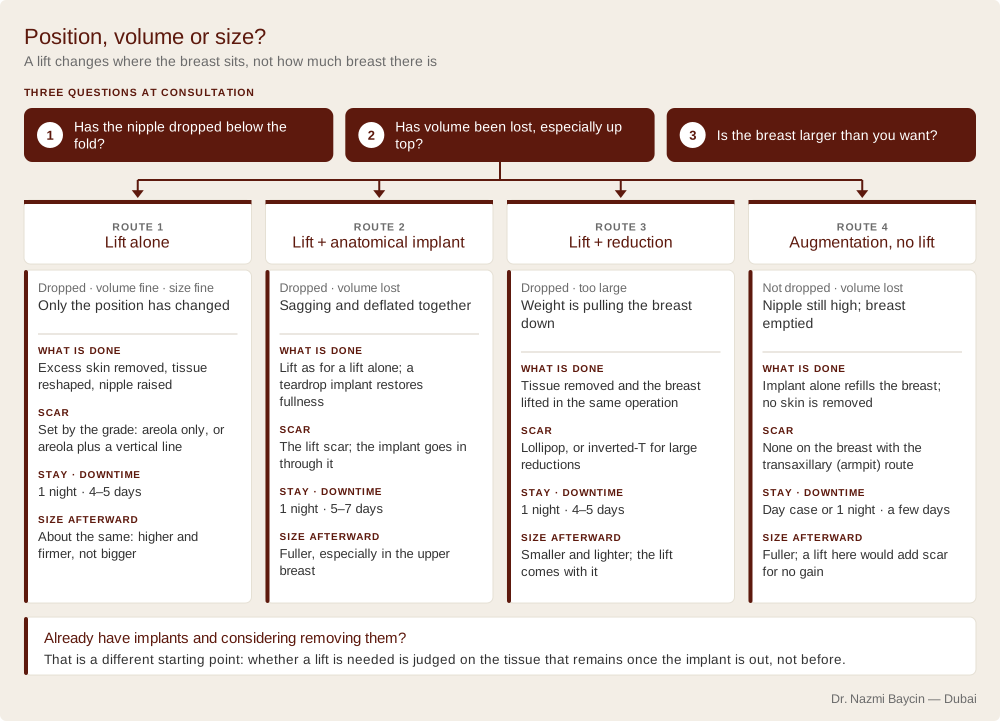
A lift changes where the breast sits, not how much breast there is — so the plan starts with which of three things has actually changed. Where only the nipple has dropped, a lift alone restores position at roughly the same size. Where the breast has both dropped and emptied, typically after pregnancies or weight loss, Dr. Baycin combines the lift with an anatomical (teardrop) implant, which supports the lift while refilling the upper breast, placed through the lift incision with no extra scar. Where the breast has dropped because it is too heavy, the answer is a lift built into a reduction. And where volume has gone but the nipple has stayed high, a lift would add scar for no gain; augmentation alone, through the transaxillary route with no scar on the breast, refills it. Women who already have implants and are considering removing them start from a different place, since whether a lift is needed can only be judged on the tissue that remains once the implant is out. Sorting these apart at consultation is what keeps every woman from carrying more surgery than her breast needs.
| What has changed | Operation | Scar added | Stay · downtime | Read more |
|---|---|---|---|---|
| Nipple dropped; volume and size fine | Lift alone | Set by the grade: areola only, areola + vertical line, or inverted-T | 1 night · 4–5 days | This page |
| Nipple dropped and volume lost | Lift + anatomical implant | The lift scar; implant placed through it | 1 night · 5–7 days | Breast augmentation · After weight loss |
| Nipple dropped and breast too large | Lift built into a reduction | Lollipop, or inverted-T for large reductions | 1 night · 4–5 days | Breast reduction · When a lift needs a reduction |
| Volume lost; nipple still high | Augmentation, no lift | None on the breast (transaxillary) | Day case or 1 night · a few days | Breast augmentation |
| Existing implants to be removed | Explant; lift judged on remaining tissue | Depends on the tissue after removal | Assessed individually | Implant removal |
Where does Dr. Baycin perform breast lift surgery in Dubai?
I perform every breast lift in a premium, JCI-accredited hospital in Dubai that follows the highest international standards for safety and cleanliness. Your procedure takes place in a fully equipped, modern surgical setting designed for the best possible care, with patient safety the first priority at every step.
What is recovery after a breast lift like?
A breast lift is performed under general anesthesia and takes about two to three hours, depending on the shape of your breasts, and you will be up and moving within three to four hours. Although you are asleep for the surgery, I also infiltrate a long-acting local anesthetic into the area, so the first day — usually when discomfort would peak — passes without pain; any mild ache over the following days is easily managed with medication, and you go home the next day. Some swelling and occasional bruising are normal and fade within about ten days, and you can shower a couple of days after surgery.
Because I use absorbable, hidden stitches, there is nothing to remove. Most patients return to desk work within about four to five days and can fly in the same window, and swimming is fine after about two weeks, once the wounds have healed. A supportive surgical bra is worn for several weeks while the breasts settle, and strenuous activity and heavy lifting are avoided during that time. Your breasts settle into their final shape over about six months. To understand the full science behind how I support your healing after surgery, see my advanced recovery protocol in Dubai article.
Download Dr. Baycin’s breast lift aftercare instructions
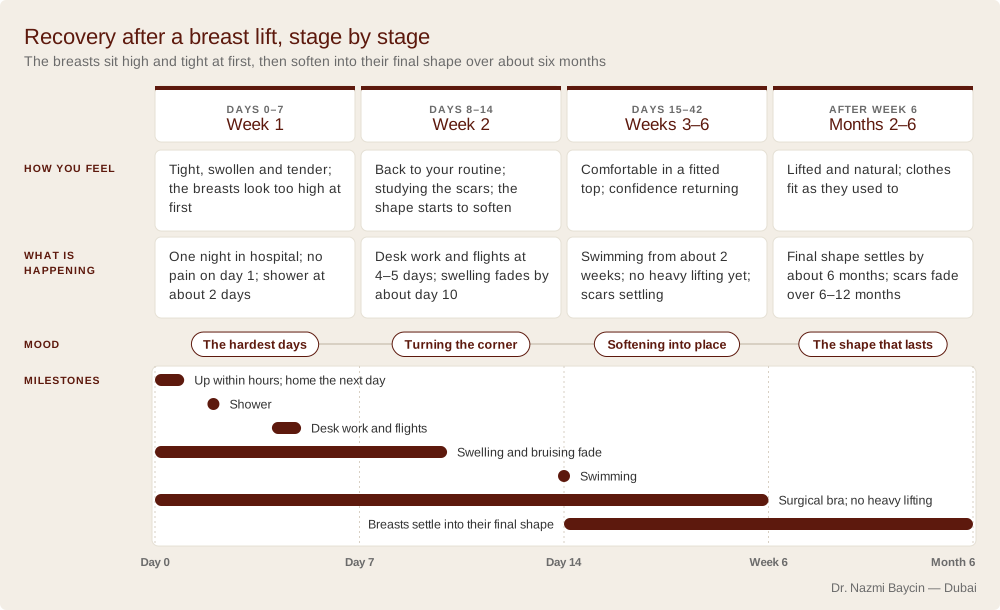
Recovery after a breast lift is a settling, not a healing alone, and it is worth knowing that in advance. The body’s milestones come quickly: up and moving within hours, home after one night, showering at two days, back at a desk or on a flight by day four or five, swelling gone by around ten days, and swimming from two weeks. What takes longer is the shape. In the first week the breasts sit high and tight — higher than they will stay — and that, together with the fresh scars, is when most women question the decision. By the second week the shape begins to soften; by the sixth the scars are settling and confidence has returned; and over the following months, as the breasts drop into their final position by about six months and the scars fade over six to twelve, what remains is a lifted, natural shape that lasts. The pace varies with personality; the shape rarely does.
See your private recovery timeline, day by day, breast lift
Plan your breast lift recovery
Enter the surgery date you planned and view your own recovery calendar; then add it to your phone calendar or print it.
Your timeline appears here once you choose a date.
These are typical timings. Your own plan depends on your health, the technique used, and how you heal; always follow the instructions Dr. Baycin gives you after surgery. Nothing you enter here is sent or stored.
Can you breastfeed after a breast lift?
A breast lift is usually recommended for women who are not planning further pregnancies, since pregnancy can change the breast’s shape again. That said, life is not always predictable — and the reassuring news is that a breast lift generally has minimal effect on the mammary glands, so most women can still breastfeed afterward, including those who also have silicone implants. The one thing to keep in mind is that a pregnancy after your lift may alter the breast’s shape, which is simply something to weigh if you are still considering children.
What are the risks and complications of a breast lift?
Like any operation, a breast lift carries some risk, and I believe in being candid about it. Infection, hematoma (blood pooling in the wound), and seroma (fluid collection) are the general surgical risks, and all are minimized by careful technique and the appropriate medication. Minor asymmetry between the two sides can also occur and is usually easily addressed.
The variable patients ask about most is the scar. Genetics, age and skin quality all play some part in how a scar matures, but they are not the main determinant — how much tension the closure has to carry is. That is a surgical variable, and it is why I plan every lift to transfer the load onto deep internal support rather than onto the skin; I set out the mechanics in my article on breast lift scar quality and tension management. Surgical scars look reddish at first and then fade to blend with your skin over six to twelve months, and in some cases a poorly matured scar may call for a minor revision.
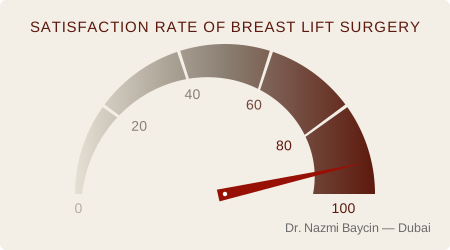
Patient satisfaction rate after the procedure
The published evidence is broadly reassuring, with the usual caveats about its quality. A systematic review pooling 1,888 mastopexy patients across 41 studies found the two most frequent complication categories to be scar-related problems, at 3%, including hypertrophic or unaesthetic scars, and nipple–areola problems at 2.9%, including distortion, asymmetry and reduced sensation — which is why minimizing both is central to how I plan every lift. It is worth knowing that none of the 41 included studies were randomized or controlled, and 35 of them were retrospective. On satisfaction, a 2026 systematic review of patient-reported outcomes after mastopexy concluded that the procedure delivers high rates of patient satisfaction and improved quality of life — though it drew on only 10 studies and 510 patients, and its authors state plainly that inconsistent reporting across those studies significantly limited what could be pooled. Where any issue does arise, it can be managed and treated effectively.
Breast lift in Dubai: suitability and safety checklist
Important: This checklist helps you prepare for your consultation. It cannot decide whether surgery is safe or suitable for you. Please disclose your full medical history, medicines, and supplements when we meet — everything you share stays confidential.
- Discuss at consultation We plan around it together. Usually not a barrier on its own.
- Medical review The anesthesia team or a specialist reviews it, sometimes with tests or a clearance letter, before a date is confirmed.
- Postpone Surgery waits until this has changed or settled.
- Alternative advised This procedure is not the right fit; another option may suit you better.
| # | Question | Why it matters | If the answer is “NO” |
|---|---|---|---|
| 1 | Are you 18 or older? | Cosmetic breast surgery is offered to adults only. | Not offered |
| 2 | Is your main concern sagging — breasts or nipples sitting lower than you would like — rather than size alone? | A lift changes position and shape, not size. | Alternative advised If the nipple is still high, augmentation alone; if the breast is too large, a reduction. |
| 3 | Are you comfortable with a scar around the areola — and, for more sagging, a vertical line or an inverted-T? | The degree of sagging sets the scar; the least scar that will hold the lift is chosen. | Discuss at consultation Each breast is graded and planned separately. |
| 4 | Has your weight been stable for at least 6 months? | Weight change alters breast volume and lets the breast drop again. | Postpone Until your weight has settled. |
| 5 | Have you completed your family, or are you comfortable that a future pregnancy may change the result? | Pregnancy can stretch the breast again. Breastfeeding is usually still possible after a lift. | Discuss at consultation |
| 6 | Are you comfortable that nipple sensation may change, usually temporarily, and that minor asymmetry can remain? | The nipple is moved on its own blood and nerve supply; most sensation changes settle. | Discuss at consultation |
| # | Does this apply to you? | Why it matters | Usual next step |
|---|---|---|---|
| Medical history | |||
| 7 | Heart disease, high blood pressure, or an irregular heartbeat | General anesthesia and surgery add strain on the heart. | Medical review |
| 8 | A previous blood clot (DVT or PE), a clotting disorder, or a close relative with clots | Surgery raises clot risk; prevention is planned around your personal risk. | Medical review |
| 9 | Diabetes | Blood-sugar control affects healing along the incisions and infection risk. | Medical review |
| 10 | Asthma, other lung disease, or sleep apnea | These affect breathing during and after anesthesia. | Medical review |
| 11 | Liver or kidney disease, anemia, or a bleeding disorder | These affect how medicines are cleared, bleeding, and recovery. | Medical review |
| 12 | HIV, hepatitis B or C, or another blood-borne infection | Well-controlled infection does not automatically rule surgery out; your team plans around it. | Discuss at consultation In confidence. |
| 13 | Past problems with anesthesia, or allergy to local anesthetics, antibiotics, or latex | This procedure uses general anesthesia plus long-acting local anesthetic. | Medical review |
| 14 | A breast lump, nipple discharge, skin change, or any breast change that has not yet been checked | Any unexplained change must be assessed before breast surgery. | Medical review Assessed before surgery is planned. |
| 15 | Aged 40 or over without a recent mammogram, or screening not up to date for your risk | Current imaging gives a clear baseline before surgery. | Medical review A mammogram maybe requested before surgery if you are over 40. |
| 16 | A personal or strong family history of breast or ovarian cancer, or a known gene change such as BRCA | This shapes your screening plan and the surgical decision. | Medical review |
| 17 | Previous breast surgery — implants, a reduction, a lift, or a biopsy | Earlier incisions can affect the nipple’s blood supply and change which technique is safe. | Medical review Removing implants? See implant removal. |
| 18 | A rash, infection, or wound on the breasts or in the fold beneath them | Operating through affected skin raises infection risk. Fold rashes are common under heavier breasts. | Postpone Until treated and healed. |
| 19 | A history of keloid or thick, raised scars | Scar problems are the most common issue after a lift; your scar history shapes the plan and aftercare. | Discuss at consultation |
| 20 | Pregnant, breastfeeding, or stopped breastfeeding within the last few months | Breast volume and shape keep changing for some months after breastfeeding ends. | Postpone |
| Medicines and supplements | |||
| 21 | Blood thinners, aspirin, or anti-inflammatories such as ibuprofen | These increase bleeding; some are paused before surgery under medical guidance. | Medical review Never stop a prescribed medicine on your own. |
| 22 | Supplements such as fish oil, vitamin E, ginkgo, garlic, or turmeric | Several raise bleeding risk and are usually paused before surgery. | Discuss at consultation |
| 23 | Weight-loss injections such as semaglutide or tirzepatide | They slow stomach emptying, which matters for anesthesia, and mean your weight may still be changing. | Medical review |
| 24 | The contraceptive pill, hormone therapy, or prescribed testosterone | Estrogen raises clot risk; testosterone can thicken the blood. | Medical review |
| 25 | Anabolic steroids or other performance-enhancing drugs | These affect the heart, liver, blood count, and anesthesia. | Medical review Please be open with us — it stays confidential. |
| 26 | Antidepressants or other psychiatric medication | Some interact with anesthesia or pain medicines. | Medical review Keep taking them unless your prescriber advises otherwise. |
| Lifestyle and travel | |||
| 27 | Smoking, vaping, or any nicotine — including pouches, gum, or patches | Nicotine reduces blood flow to the nipple and skin edges, raising wound-healing problems. | Discuss at consultation Nicotine-free recovery period is advised. |
| 28 | Recreational drug use or regular heavy drinking | These interact with anesthesia and slow healing. | Medical review |
| 29 | Flying long-haul to Dubai for surgery, or planning to fly home soon after | Long flights add to clot risk around surgery. | Discuss at consultation We plan your travel dates with you. |
| Expectations and wellbeing | |||
| 30 | Do you spend a lot of time worrying about how your breasts or body look, or feel no change would be enough even when others disagree? | This can be a sign of body-image distress that surgery rarely relieves. | Discuss at consultation A supportive, private conversation. |
Medical note: A medical condition, infection, or medicine does not automatically rule out a breast lift. The decision depends on the diagnosis, how well it is controlled, the planned procedure, and assessment by the surgeon and anesthesia team. Never stop or change prescribed medication without advice from your treating clinician.
Aesthetic note: A breast lift (mastopexy) raises and reshapes the breasts by removing excess skin and repositioning the nipple where needed; it does not add volume on its own. Where fullness is also wanted, an implant can be discussed. Scars, sensation, and symmetry vary between individuals, and this checklist cannot guarantee a particular result.
Checklist medically reviewed by Dr. Nazmi Baycin, DHA-licensed plastic surgeon · Checklist last updated: 21.10.2026
What are the steps of a breast lift in Dubai from consultation to surgery?
Because a breast lift is performed under general anesthesia, the path from your first visit to your procedure follows five steps. Each one is there to confirm that surgery is both safe and right for you.
- Consultation: I measure your breasts, grade the degree of sagging on each side, and decide with you whether a lift alone is enough or an implant or reduction should be added (how I make the reduction call from measurements is in my article on combining a breast lift with a reduction). If you are over 40, I will also ask for a mammogram. Consultations are paid, and this is where your exact pricing is confirmed.
- Booking the procedure: Once you decide to proceed, we reserve your surgery date. Procedures are scheduled within 2–10 days, depending on the hospital’s operating theater (OT) availability.
- Preoperative blood tests: Routine blood tests are carried out before surgery to confirm that you are in good general health for general anesthesia.
- Preoperative anesthesia consultation for clearance: The anesthesiologist reviews your test results and medical history and gives clearance for general anesthesia.
- Procedure: On the day of surgery, I mark the incisions for the technique your grade of sagging requires, then perform the lift in a JCI-accredited hospital. The hospital stay is 1 day.
How much does a breast lift cost in Dubai, UAE?
Breast lift prices in Dubai can differ significantly from clinic to clinic, with costs ranging from 20,000 AED ($5,500) to 50,000 AED ($13,600), depending on various factors.
It’s important to note that these amounts don’t reflect Dr. Baycin’s personal pricing; you’ll learn the exact cost during your consultation after assessing your needs.
For a complete overview of treatment fees, please refer to full price list of the procedures. If you are looking specifically for this procedure, you can also review pricing information.
Schedule your private consultation with Dr. BaycinWhat makes Dr. Baycin an exceptional breast lift surgeon in Dubai?
A breast lift asks for artistry and judgment as much as technique — and with more than 300 successful procedures, that is the standard Dr. Baycin holds.
- 25+ years of specialized mastery: a board-certified plastic surgeon, DHA-licensed and a member of the American Society of Plastic Surgeons (ASPS), among the most trusted names in cosmetic breast surgery.
- Bespoke for every patient: every breast lift is planned around the woman’s measurements and goals, for natural, proportionate contours that enhance her individuality rather than override it.
- The least scar the case allows: technique matched precisely to the degree of sagging — from a single periareolar scar to a vertical or inverted-T lift — so scarring is never more than necessary.
- Technology that supports healing: modern tools and techniques that reduce tissue trauma, shorten recovery, and smooth the healing process.
- Safety beyond compromise: an impeccable record across thousands of aesthetic surgeries with no major complications.
- Honest, transparent consultations: every option explained, expectations set realistically, and a clear plan agreed together.
- Comprehensive aftercare: structured follow-up and direct surgeon access throughout recovery.
- A global destination for excellence: patients travel from Europe, the Middle East, and beyond for his breast lift results in Dubai.
- 300+ lifts, natural results: youthful, lifted contours and consistently satisfied patients.
- Artistry with compassion: an empathetic approach that recognizes a breast lift is about restoring confidence, not just contour.

Written and medically reviewed by
About Dr. Nazmi Baycin
DHA-licensed, board-certified plastic surgeon, Dubai
- 25+ years in practice
- 7,000+ procedures
- JCI-accredited hospitals
- ASPS international member
Surgery, to me, is precision applied in service of restoration — a conviction that has guided every one of the more than 7,000 procedures I have performed over 25 years in practice. I am a DHA-licensed, board-certified plastic surgeon, trained in Turkey and based in Dubai since 2016. I operate exclusively within JCI-accredited hospitals, and hold international membership in the American Society of Plastic Surgeons (ASPS). Three techniques, in particular, have become signatures of my practice. Scarless breast augmentation, performed through a transaxillary approach that leaves no incision on the breast itself. Labiaplasty designed individually around each patient’s own anatomy, never to a standard template. And 3D customized facial bone implants, engineered through CT-based bespoke printing — a technique I currently offer as the only surgeon in Dubai providing it. My practice today spans facial rejuvenation, breast surgery, body contouring, and cosmetic genital procedures, drawing patients from across the UAE, Europe, and the wider GCC. Yet the principle guiding each of these specialties has never changed: to restore form is to restore function.
FAQs about breast lift in Dubai
-
What is a breast lift (mastopexy)?
A breast lift, or mastopexy, is how I raise and reshape breasts that have begun to sag, restoring a firmer, more youthful position. I remove excess, stretched skin, lift the breast tissue, and reposition the nipple to a natural height, tightening the breast into a firmer shape. It is often sought after pregnancy, breastfeeding, weight loss, or with age, all of which can cause the breasts to droop. My aim is a natural, lifted shape achieved with the least scarring possible for your case.
-
How much does a breast lift cost in Dubai?
Breast lift costs in Dubai vary from clinic to clinic and depend on several factors, ranging from AED 20,000 to AED 50,000, depending on the degree of lift required and whether it is combined with an implant. These are general market figures, not Dr. Baycin’s personal rates; the precise cost is confirmed at your consultation, once your breasts have been assessed and a plan agreed.
-
How do you decide which breast lift technique to use?
This is central to how I approach a breast lift, because the right technique depends entirely on how much your breasts have sagged. Rather than applying one method to everyone, I match the technique to your degree of sagging, known as ptosis, always choosing the approach that achieves the lift you need with the least scarring possible. For mild sagging a small, discreet incision may be enough, while more significant sagging needs a more involved lift. Assessing this precisely is the key to a natural result.
-
What are the different degrees of sagging?
Surgeons describe breast sagging, or ptosis, in degrees, and identifying yours guides the whole plan. In mild ptosis the nipple sits at the level of the breast fold; in moderate ptosis it has dropped below it; and in significant, or severe, ptosis the nipple points downward well below the fold. There is also a related condition where the breast tissue itself has descended without much nipple drop. Determining exactly which pattern you have is what lets me choose the least, most appropriate lift.
-
What scars does a breast lift leave?
The scars depend on the technique your degree of sagging requires, and I always aim for the least. For mild sagging, a single circular scar sits around the edge of the areola, where the skin color already changes. For moderate sagging, the scar is still around the areola only, because the lifting effect comes from gathering the lower breast tissue internally rather than from a longer incision. For severe sagging, a vertical line from the areola down to the breast fold is added, because that much skin has to be removed for the lift to hold, and where the excess also runs across the base of the breast, a short horizontal scar is hidden in the fold, giving an inverted-T. I place all incisions carefully so they fade well, exchanging a scar for a firmer, lifted shape.
-
Will a breast lift make my breasts bigger?
On its own, a breast lift does not significantly change your breast size; it lifts and reshapes the tissue you already have into a firmer, higher position, rather than adding volume. Many women are perfectly happy with this, regaining a youthful shape at a similar size. If you would also like more fullness, particularly in the upper part of the breast, I can combine the lift with an implant, and if you feel you are too large, it can instead be paired with a reduction.
-
Can a breast lift in Dubai be combined with implants?
Yes, and this is a very common and effective combination. When breasts are both sagging and smaller than a woman would like, or have lost upper fullness after pregnancy, I combine the lift with a breast augmentation in a single procedure. The lift raises and reshapes the breast, while the implant restores volume and upper fullness, together giving a result neither could achieve alone. At consultation I assess whether adding an implant will help you reach the shape you are hoping for.
-
Will a breast lift affect the nipple or sensation?
During a lift I reposition the nipple to a natural, higher position while keeping it attached to its blood and nerve supply, which preserves its health and, in the great majority of cases, its sensation. Some temporary change in nipple sensitivity can occur as things heal and usually settles. I take great care with this aspect, because a natural-looking, well-positioned nipple with preserved sensation is an important part of a good, natural result, and I discuss it fully with you beforehand.
-
What is recovery after a breast lift like?
Recovery is generally manageable. You stay one night and go home the next day, and most women return to desk work within about four to five days. You will wear a supportive surgical bra for several weeks to support the breasts as they settle, and I advise avoiding strenuous activity and heavy lifting during that time so the tissues heal well. Some swelling and bruising in the first weeks is normal and settles steadily, with the breasts softening into their natural, lifted shape over the following months.
-
How long do the results of a breast lift last?
A breast lift gives long-lasting results, restoring a firmer, more youthful shape that endures for many years. That said, no lift can stop the natural processes of aging and gravity entirely, so some gradual settling over time is normal. You can help preserve your result by maintaining a stable weight and wearing good support, and future pregnancy can affect it. The one case where a lift does not last is a heavy breast lifted without reducing its weight; why that fails, and when I add a reduction, is in my article on combining a breast lift with a reduction. For most women the improvement is durable and highly satisfying well into the long term.
-
Are you a good candidate for a breast lift?
You are likely a good candidate if your breasts sag or droop, your nipples sit low, or you have lost firmness and shape after pregnancy, breastfeeding, weight loss, or with age, and you are in good general health. If you also want more volume, a lift can be combined with an implant. It is often best to have completed your family, as pregnancy can affect the result. A clean medical history is the foundation of safe surgery, and we design the right approach together at consultation.
-
Can a breast lift in Dubai be combined with other procedures?
Yes. Beyond combining it with an implant for added fullness, a breast lift is often paired with a breast reduction where a woman wants to be lifted and smaller, or where the breast is too heavy for a lift alone to hold (I explain that decision in my article on combining a breast lift with a reduction), or included in a broader mommy makeover alongside body procedures such as a tummy tuck. At consultation I assess your overall goals and health and recommend combining procedures only where it is safe and genuinely enhances your result in a single recovery.
In-depth reading: techniques, scar quality and skin laxity behind breast lift in Dubai
A breast lift after major weight loss is a fundamentally different operation from a routine lift — and the right approach depends on how much breast volume remains and whether an implant is needed to restore it. Scar quality follows its own rules, governed less by skin type than by how the load is carried, and a heavy breast may need a reduction before any lift can hold. These pages go deeper into each path.
- Why scar quality is set by tension, not skin type — how transferring the load to a deep internal support lets the skin close without strain, and why the shortest scar is often the wrong goal.
- When a lift alone is not enough — combining the lift with a reduction — why a lift fails in a heavy breast, the measurements that decide whether weight must be removed, and why an anchor scar under low tension outlasts a shorter one under load.
- Rebuilding volume and support after major weight loss — without implants — how auto-augmentation and an internal support scaffold restore upper-pole fullness using your own tissue, for durable results in deflated, stretched skin.
- When an implant is needed after weight loss — combining lift and volume — how a stable internal platform is built first, then an implant added, when the volume deficit is too great for autologous tissue alone.
- Removing implants, not adding them — when explant changes the plan — the conditions that call for permanent implant removal and what removal means for the shape of the breast afterward.
What patients say


Book a breast lift consultation in Dubai
Get ready to look and feel best… You deserve…
