


Table of content
- Are you a good candidate for breast reduction?
- How is the breast reduction procedure performed?
- How is the recovery period after breast reduction?
- Can you feed your baby after breast reduction?
- What are the risks and complications of breast reduction?
- Checklist before having breast reduction surgery in Dubai
- How much does a breast reduction surgery cost in Dubai, UAE?
- FAQs about breast reduction in Dubai
- Get appointment
For many women, breasts that are too large are not a cosmetic concern but a daily physical burden — and relieving that burden is one of the most rewarding operations I perform. I am Dr. Nazmi Baycin, and across more than three hundred breast reduction procedures I have seen how completely the surgery can change a life: the back, neck, and shoulder pain that no painkiller fully touched, the grooves cut by bra straps, the rashes and the limits on activity — all lifted, along with the weight itself. My breast reduction in Dubai is designed to deliver that relief and, at the same time, a breast that looks naturally proportioned to your body.
The art lies in the design. A reduction is not simply about removing tissue; it is about deciding how much to take, and from exactly where, so the nipple sits at its proper height and the new breast looks like it was always yours. Performing breast reduction in Dubai within JCI-accredited hospitals, I plan each operation in three dimensions and choose the technique — and therefore the scar — that fits your degree of reduction, preserving nipple sensation and blood supply throughout. The principle is the one that guides all my work: to restore form is to restore function.
Breast reduction in Dubai quick facts
| Procedure detail | Breast reduction in Dubai |
|---|---|
| Technique | 3D-designed; scar matched to reduction (lollipop or inverted-T) |
| Preserves | Nipple sensation and blood supply |
| Anesthesia | General (+ long-acting local infiltration) |
| Procedure time | About 3 hours (longer for very large reductions) |
| Drain | Fine suction drain for 1–2 days |
| Hospital stay | 1 day |
| Sutures | Hidden, dissolvable (none to remove) |
| Shower | 2–3 days |
| Downtime | 4–5 days; swelling fades in 7–10 days |
| Swimming | From ~2 weeks |
| Final shape | Settles over ~6 months |
What can breast reduction in Dubai do for you?
Breast reduction removes excess breast tissue, fat, and skin to bring overly large breasts into natural proportion with your body — and for most women the relief is as much physical as aesthetic. It eases the chronic back, neck, and shoulder pain that large breasts impose, corrects the postural strain they cause, lifts the bra-strap grooving, and clears the skin irritation and rashes beneath the breast. To understand the bio-mechanical case for breast reduction as genuine pain relief — why reducing the load lets the spine return to a more neutral, comfortable posture — see my the effect on posture and spinal alignment article.
The aesthetic result matters too: lighter, higher, naturally shaped breasts that fit your frame, restoring comfort in clothing and confidence in your own body. For many women it is both a medical and a personal transformation.
Are you a good candidate for breast reduction?
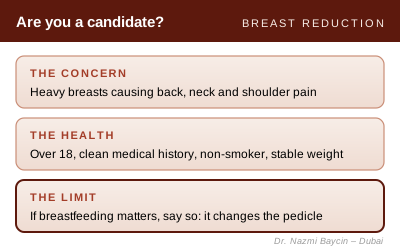
A clean medical history and good general health, free of systemic disease such as heart disease, are the foundation of safe breast reduction, and the starting point of every assessment I make. Beyond that, you are likely a good candidate if you have enlarged breasts that cause shoulder and back pain, postural problems, or skin irritation and rashes beneath the breast — the classic burden of breast hypertrophy. But the reasons need not be physical: many women choose breast reduction simply to bring their proportions into balance and improve their body image, and that is an equally valid reason. As long as your overall health permits, there is no age limit for the procedure.
If your concern is position rather than weight — breasts that have dropped but are essentially the right size — the operation you need is a lift, not a reduction; that candidate is served by a lift without reduction in Dubai instead. And where enlarged breast tissue affects a man rather than a woman, the assessment and the operation differ again, and are covered on my male breast tissue reduction in Dubai page.
How does Dr. Baycin perform breast reduction?
The goal of every breast reduction is the same — breasts that are symmetrical, naturally shaped, and proportionate to your body — but reaching it well takes careful, individual design. I plan each reduction in three dimensions, working from a single guiding question: how much tissue needs to be removed, and from which part of the breast, to reposition the nipple correctly? The answer to that question is what determines the technique I choose, rather than fitting every woman to one fixed method.

The single decision that shapes a breast reduction is how much tissue to remove — because everything else follows from it. The nipple is not cut off and repositioned; it stays on a pedicle, a column of living breast tissue that carries its blood supply and nerves while it is lifted to its proper height. A mild, one-cup reduction needs only a short pedicle and a small scar, and leaves sensation and breastfeeding largely untouched. As the reduction grows, the pedicle lengthens and the scar extends from a lollipop to an inverted-T; what protects sensation and milk supply is the pedicle keeping nerves and ducts intact beneath the areola, so the risk rises only where a longer pedicle or, in extreme gigantomastia, a free nipple graft is needed.
| Factor | Mild (about one cup) | Moderate (one to two cups) | Large (gigantomastia) |
|---|---|---|---|
| Typical patient | Athletic, proportion-seeking | Classic hypertrophy with pain, grooving and posture strain | Very heavy breasts, long-standing symptoms |
| Scar pattern | Around the areola, often with a short vertical line | Lollipop — areola plus a vertical line | Inverted-T — areola, vertical line and a line in the fold |
| How the nipple is carried | Short pedicle; small move | Full pedicle; lifted to its proper height | Long pedicle; free nipple graft only in extreme cases |
| Nipple sensation outlook | Usually preserved; brief numbness can settle | Usually preserved; temporary change common, recovering over months | Greater risk; depends on pedicle length and design |
| Breastfeeding outlook | Best outlook — ducts beneath the areola kept on a short pedicle | Possible; depends on the pedicle keeping gland beneath the areola | Least predictable; not possible after a free nipple graft |
| Procedure time / stay | About 3 hours / 1 day | About 3 hours / 1 day | Longer / 1 day |
What size and shape should you aim for?
Choosing a target size is a conversation, and it helps to be precise about terms. When I talk about cup size I mean the breast itself, and a B-plus to C cup is generally what most women find both natural and comfortable. Many patients describe what they want in bra size, but bra size actually measures the circumference of the chest at nipple level — it grows with your back measurement and does not accurately reflect breast size at all. And because every woman’s frame is different, there is no single ideal size; the right size is the one that balances your proportions, which we decide together.
Which scar will your breast reduction leave?

The lollipop (vertical) scar — for mild to moderate reductions.

The inverted-T (anchor) scar — for large reductions.
Every breast reduction leaves some scar, and I design the incision to keep it as discreet as the reduction allows. Techniques are classified by how the nipple is moved and the scar they leave. All reductions leave a circular scar around the areola, because the areola itself is reduced; most also have a vertical scar running downward, creating what is called a lollipop-shaped scar; and larger reductions add a horizontal scar in the fold beneath the breast, making an inverted-T shape. The choice follows your starting size, the amount of reduction, and your expectations: for a mild to moderate reduction, the lollipop (vertical) technique gives the best result with the least scar, while a large reduction needs the inverted-T to remove and reshape the greater volume safely. Where the two breasts differ in size or shape to begin with — which is common — I address it during the same operation, adjusting the resection on each side so the result is as symmetrical as your starting anatomy allows.
| Factor | Lollipop (vertical) scar | Inverted-T (anchor) scar |
|---|---|---|
| Best for | Mild to moderate reduction | Large reduction of larger breasts |
| Scar pattern | Around the areola + a vertical line down | Around the areola + vertical + horizontal line in the fold |
| Tissue removed | Moderate volume | Greater volume, with more skin reshaping |
| Trade-off | Least scar; suited to smaller reductions | More scar, but needed to reshape large reductions safely |
How is the breast reduction procedure performed?
Breast reduction is performed under general anesthesia and takes about three hours, a little longer for very large reductions. To prevent blood from pooling in the breast and causing a hematoma, I place a fine suction drain that stays in for about one to two days. You will be up and moving within three to four hours of surgery, and stay in hospital for a day as a sensible precaution. Although you are asleep for the operation, I also infiltrate a long-acting local anesthetic into the surgical area, so the first day — usually when discomfort would peak — passes comfortably; any mild pain over the following days is easily managed with medication.
In-depth reading: the functional and technical side of the breast reduction in Dubai
These articles go deeper than the overview above — how the operation protects the nipple, preserves sensation, relieves symptoms, and what shapes the result:
- Protecting the nipple’s blood supply against necrosis — why nipple survival is a microvascular discipline: perforator-based pedicle design, tension-free insetting, and the perfusion checks that prevent necrosis.
- How surgical technique shapes scarring and healing — what determines where scars fall and how they mature — incision pattern, closure tension, and the healing choices made during surgery and recovery.
- Matching technique to anatomy in very large (gigantomastia) breasts — how the surgical plan changes when resection weights are extreme and free-nipple-graft decisions come into play.
- How pedicle choice affects nipple sensation and nerve preservation — the pedicle as a neural corridor, why the superomedial approach is often preferred for sensation, and how feeling typically recovers over 18–24 months.
- The mini reduction for athletic, proportion-seeking patients — why a modest one-to-two-cup reduction is a different operation from a standard one, and how upper-pole fullness is preserved.
- Why results sometimes relapse — tissue memory and skin elasticity — why a minority of results drift over time, the roles of skin quality and internal support, and how the technique is planned to last.
Where does Dr. Baycin perform breast reduction in Dubai?
I perform every breast reduction in a JCI-accredited, high-standard hospital in Dubai that meets the highest international protocols for safety and hygiene. Your procedure takes place in a fully equipped, modern surgical environment, with patient safety and surgical excellence the first priorities at every step.
What is recovery after breast reduction like?
Recovery is usually manageable, without too much disruption to everyday life. Some swelling and occasional bruising are normal and fade within seven to ten days, and you can shower just two to three days after surgery. Your body is the best guide to your pace — it will tell you when to do more and when to ease off — and most patients return to work, light activity, and even flying within a few days. Because I use absorbable, hidden stitches, there is nothing to remove. Swimming is fine after about two weeks, once the wounds have healed. Over the following months the breasts settle a little under gravity, the fold beneath the breast regains its natural shape, and the scars steadily fade — with the final form usually settled by about six months. To understand the full science behind how I support your healing after surgery, see my advanced recovery protocol in Dubai article.
Download Dr. Baycin’s breast reduction aftercare instructions
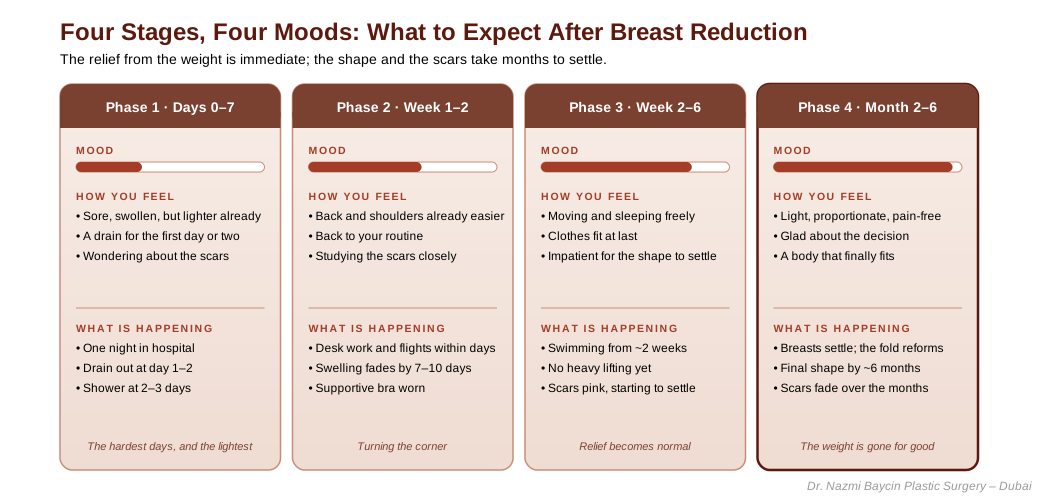
Recovery after breast reduction is unusual among the operations I perform, because the main benefit arrives before the healing has: the weight is gone the moment you wake, and most women feel their back and shoulders ease within days, long before the shape has settled. The body’s milestones are quick — one night in hospital, the drain out at a day or two, showering at two to three days, back at a desk or on a flight within a few days, swelling gone by seven to ten, swimming from two weeks. What takes longer is the rest: the breasts settle a little under gravity, the fold beneath them reforms, and the scars fade steadily, with the final form usually settled by about six months. So the mood curve starts higher than for most surgery and climbs from there — sore but lighter in the first week, easier by the second, moving and sleeping freely by the sixth, and by the second month onward a body that finally fits. The pace varies with personality; the shape rarely does.
Can you breastfeed after breast reduction?
Often, yes — but I would rather you hear the honest figure than a reassurance. A 2024 systematic review and meta-analysis of 33 studies found that women who have had a breast reduction are about 3.5 times more likely to be unable to breastfeed than women who have not. What decides which side of that line you fall on is not simply how much tissue I remove, but how the nipple is carried: when it stays on a pedicle that keeps the milk ducts beneath the areola intact, the pathway from gland to nipple is preserved, and lactation usually remains possible. Where a very large reduction forces a longer pedicle, the margin narrows, and in the rare cases that need a free nipple graft the ducts are divided and breastfeeding is not possible. It is worth keeping in perspective that many women have difficulty breastfeeding without any surgery, and that the studies themselves are inconsistent in how they define success. If breastfeeding matters to you, tell me at consultation: it changes the pedicle I choose and the way I plan the operation.
What are the risks and complications of breast reduction?
Like any surgery, breast reduction carries some risk, and the main risk factors are worth being candid about: smoking, diabetes, obesity, and very large breast size. Smoking in particular slows healing and raises the chance of wound separation and tissue loss, so I strongly advise stopping at least a week before surgery.
Infection and hematoma (a collection of blood in the wound) can usually be avoided with careful technique and the right medication, and seroma (fluid collection) is uncommon. Some scarring is inevitable, but I design every incision to minimize it; occasionally, depending on how your skin heals, a minor scar revision may be worthwhile.
Minor differences in size or shape between the two breasts can also remain — perfect mirror-image symmetry is not a realistic goal in any breast surgery. Where any issue does arise, it can be managed and treated effectively.
Set against these manageable risks is one of the strongest benefit profiles in plastic surgery: published outcome studies consistently report substantial gains in quality of life, self-esteem, and mental health after reduction, alongside relief of the physical symptoms. I set out that evidence, and its limits, in my article on how reducing breast weight relieves back and neck pain.
Checklist before having breast reduction in Dubai
IMPORTANT ! Before getting the appointment, check your medical conditions yourself.
| # | Conditions | Safety | Aesthetic Suitability |
|---|---|---|---|
| 1 | Are you over 18? | 🟢 Fit for surgery | — |
| 2 | Do your breasts appear enlarged or disproportionately large? | 🟢 Fit for surgery | 🟡 Ideal candidate |
| 3 | Do you experience discomfort, pain, or functional problems due to breast size? | 🟢 Fit for surgery | 🟡 Ideal candidate |
| 4 | Do you have a cardiovascular problem such as heart disease or deep vein thrombosis? | 🔴 Contraindicated | — |
| 5 | Do you have pulmonary system problems such as chronic lung disease? | 🔴 Contraindicated | — |
| 6 | Do you have chronic liver disease? | 🔴 Contraindicated | — |
| 7 | Do you have a urinary system disease such as kidney failure? | 🔴 Contraindicated | — |
| 8 | Do you have a hematologic problem such as anemia or coagulopathy? | 🔴 Contraindicated | — |
| 9 | Do you have any transmitting disease through blood such as HIV? | 🔴 Contraindicated | — |
| 10 | Have you been taking anticoagulant medication? | 🔴 Contraindicated | — |
| 11 | Have you been taking psychotropic drugs? | 🔴 Contraindicated | — |
| 12 | Any drug abuse or addiction | 🔴 Contraindicated | — |
How much does a breast reduction cost in Dubai, UAE?
Breast reduction prices in Dubai can vary quite a bit from clinic to clinic, typically ranging from 20,000 AED ($5,500) to 60,000 AED ($16,400), influenced by several factors.
Keep in mind that these amounts don’t reflect Dr. Baycin’s personal rates. You’ll find out the precise cost during your consultation after your condition is assessed.
For a complete overview of treatment fees, please refer to full price list of the procedures. If you are looking specifically for this procedure, you can also review pricing information.
Schedule your private consultation with Dr. BaycinWhat makes Dr. Baycin an exceptional breast reduction surgeon in Dubai?
A breast reduction is both a functional operation and an aesthetic one, and doing both well takes experience and judgment — the standard Dr. Baycin has built over more than 300 procedures.
- Extensive surgical experience: a board-certified plastic surgeon, DHA-licensed and a member of the American Society of Plastic Surgeons (ASPS), with more than 25 years of experience and hundreds of successful breast reductions.
- A customized, non-template design: never a standard technique, but a fully individualized plan built around each patient’s anatomy, proportions, and goals, for a result that looks natural and balanced.
- Advanced, function-preserving technique: methods that prioritize the preservation of nipple sensation and blood supply while minimizing scarring — balancing beauty with well-being.
- Scar-minimizing approach: meticulous, reduced-incision technique with careful tissue handling, for smoother contours and faster, less visible healing.
- Proven safety and high satisfaction: 300+ breast reductions with no major complications, defined by uncompromising safety and consistent results.
- Comprehensive consultations: every step explained, expectations set realistically, decisions made without pressure.
- Supportive post-operative care: structured follow-up, clear recovery protocols, and direct surgeon access for any concern.
- An international reputation: patients travel from across the UAE, GCC, Europe, and beyond for his natural, discreet results.
- Trusted with discretion: a confidential approach valued by public figures and private patients alike.
- Empathy with expertise: recognizing how personal this decision is, and supporting each patient with compassion and complete confidentiality.
About Dr. Nazmi Baycin
Surgery, to me, is precision applied in service of restoration — a conviction that has guided every one of the more than 7,000 procedures I have performed over 25 years in practice. I am a DHA-licensed, board-certified plastic surgeon, trained in Turkey and based in Dubai since 2016. I operate exclusively within JCI-accredited hospitals, and hold international membership in the American Society of Plastic Surgeons (ASPS). Three techniques, in particular, have become signatures of my practice. Scarless breast augmentation, performed through a transaxillary approach that leaves no incision on the breast itself. Labiaplasty designed individually around each patient’s own anatomy, never to a standard template. And 3D customized facial bone implants, engineered through CT-based bespoke printing — a technique I currently offer as the only surgeon in Dubai providing it. My practice today spans facial rejuvenation, breast surgery, body contouring, and cosmetic genital procedures, drawing patients from across the UAE, Europe, and the wider GCC. Yet the principle guiding each of these specialties has never changed: to restore form is to restore function.
FAQs about breast reduction in Dubai
-
What is breast reduction surgery?
Breast reduction, or reduction mammaplasty, is how I remove excess breast tissue, fat, and skin to make overly large breasts smaller, lighter, and naturally proportionate to your body. For most women the relief is as much physical as aesthetic, easing the strain that heavy breasts impose. I design each reduction in three dimensions, deciding how much tissue to take and from exactly where, so the nipple sits at its proper height while I preserve its sensation and blood supply and keep scarring to a minimum.
-
How much does breast reduction cost in Dubai?
Breast reduction prices in Dubai can vary quite a bit from clinic to clinic, typically ranging from AED 20,000 to AED 60,000, influenced by several factors including the complexity and the amount of reduction. These are general market figures, not Dr. Baycin’s personal rates; the precise cost is confirmed at consultation after your condition is assessed.
-
Does breast reduction relieve back and neck pain?
For most women with large breasts, yes, and it is one of the most rewarding parts of this operation for me. By removing the excess weight, I relieve the back, neck, and shoulder pain, the bra-strap grooving, and the postural strain that breast hypertrophy imposes. The published evidence behind that relief — what has been measured, and how firmly — I set out in my article on how reducing breast weight relieves back and neck pain.
-
What scars does a breast reduction leave?
Every reduction leaves some scar, and I design the incision to keep it as discreet as the reduction allows. All reductions leave a circular scar around the areola, because the areola itself is reduced. Most also add a vertical line downward, creating a lollipop-shaped scar, and larger reductions add a horizontal scar in the fold beneath the breast, making an inverted-T. I use the least-scarring pattern your degree of reduction allows, and the scars steadily fade over the following months.
-
How is the breast reduction in Dubai procedure performed?
I perform breast reduction under general anesthesia, and it takes about three hours, a little longer for very large reductions. I design the reduction in three dimensions to decide how much tissue to remove and from where, then reshape the breast and reposition the nipple. To prevent blood pooling, I place a fine suction drain for one to two days. Although you are asleep, I also infiltrate a long-acting local anesthetic, so the first day passes comfortably, and you stay in hospital for a day.
-
How long is recovery after breast reduction?
Recovery is usually manageable without too much disruption to everyday life. Some swelling and occasional bruising are normal and fade within seven to ten days, and you can shower just two to three days after surgery. Most patients return to work, light activity, and even flying within a few days, and swimming is fine after about two weeks once the wounds have healed. Because I use hidden, absorbable stitches, there is nothing to remove, and the breasts settle into their final shape over about six months.
-
Will I still have nipple sensation after breast reduction?
Preserving nipple sensation and blood supply is a priority in every reduction I plan, and I choose my technique specifically to protect the nerves and circulation to the nipple. Some temporary change in sensation can occur as the tissues heal, which is normal and usually settles as you recover. Because I design each operation around repositioning the nipple safely rather than fitting you to one fixed method, protecting its function is built into the plan from the very start.
-
Can I breastfeed after a breast reduction?
Often, yes, but I give you the honest figure: a 2024 meta-analysis of 33 studies found that women who have had a reduction are about 3.5 times more likely to be unable to breastfeed than women who have not. What protects breastfeeding is not the amount removed but the pedicle — keeping the nipple attached to the milk ducts beneath the areola. Only in very large reductions, and especially after a free nipple graft, does that pathway become unreliable. If breastfeeding matters to you, tell me at consultation, and I will plan the pedicle around it.
-
Is breast reduction in Dubai safe?
Yes, in experienced hands it is very safe, and I am candid about the main risk factors: smoking, diabetes, obesity, and very large breast size. Smoking in particular slows healing, so I strongly advise stopping at least a week before surgery. Infection and hematoma can usually be avoided with careful technique and the right medication, and seroma is uncommon. Where any issue does arise, it can be managed and treated effectively, and good patient selection reduces these risks further.
-
Am I a good candidate for breast reduction?
A clean medical history and good general health, free of systemic disease such as heart disease, are the foundation of a safe reduction and my starting point. Beyond that, you are likely a good candidate if you have enlarged breasts causing shoulder and back pain, postural problems, or skin irritation beneath the breast. The reasons need not be physical, though: many women choose reduction simply to bring their proportions into balance, and that is equally valid. As long as your health permits, there is no age limit.
-
What size and shape should I aim for?
Choosing a target size is a conversation we have together, and it helps to be precise. When I talk about cup size I mean the breast itself, and a B-plus to C cup is what most women find both natural and comfortable. Many patients describe what they want in bra size, but bra size actually measures the chest circumference at nipple level and does not reflect breast size accurately. Because every woman’s frame differs, the right size is the one that balances your proportions.
-
Can breast reduction in Dubai be combined with other procedures?
Yes, and combining procedures can be efficient and effective within a single recovery when it is medically safe. I sometimes pair a breast reduction with a tummy tuck or liposuction for a more complete body contour. Where the two breasts differ in size or shape to begin with, which is common, I address that during the same operation. At your consultation I assess your health and goals and only recommend combining procedures where I am confident it is safe.


GET APPOINTMENT
Get ready to look and feel best… You deserve…
