

Key takeaways: correcting vertical malposition
- Vertical malposition is a vertical, “amputated”-looking scar — a technique problem, not a patient-anatomy problem.
- It typically follows a generic trim technique applied without respecting individual anatomy and tension vectors.
- Two common misjudgments: disregarding the pre-puce line and skipping dynamic simulation before cutting.
- Revision is reconstruction, not further reduction — the aim is to re-orient the scar to a hidden horizontal lie.
- The method is deconstruct → re-plan → re-orient, tailored to the existing defect.
- Dissatisfaction after primary labiaplasty is more common than outcome data suggest, so surgeon choice is critical.
Vertical malposition: the hallmark of a simplistic technique
The labia minora are delicate, three-dimensional structures whose free edge should have a gentle, irregular contour that lies horizontally within the natural folds. Vertical malposition occurs when the post-surgical scar runs in a stark, vertical direction, creating an “amputated” appearance in which the labia look abruptly shortened from front to back, often with a visible scar and a sense of unnatural tightness. Patients describe a “chopped off” look, and some experience discomfort during intimacy.
This is typically the direct result of applying a generic trim technique without accounting for the individual’s unique anatomy and the critical vectors of skin tension. It is worth being honest about how often this happens: a 2020 content analysis of twelve websites advertising revision labiaplasty concluded that unsatisfactory results, from the patient’s point of view, are far from uncommon — an inference drawn from the growth of that market rather than from outcome data, since none of the twelve sites published any.
Key technical misjudgments
In my practice, I see this complication arising from a few specific misjudgments that I take care to avoid. The most common is disregarding anatomic landmarks — in particular, failing to respect the pre-puce line, the natural superior border where the labia minora meet the clitoral hood; an incision that ignores this landmark distorts the entire geometry. The second is skipping dynamic simulation: many surgeons omit a step I consider mandatory, which is to simulate the final closure with forceps before making a single cut, so the precise direction of pull is visualized and the upward traction that leads to vertical scarring is avoided.
My method for revision: restoring anatomy, not just removing tissue
Correcting vertical malposition is one of the most challenging aspects of my revision practice, because it is not a matter of further reduction but a careful reconstruction — the same reconstructive mindset I bring to correcting scarring and asymmetry after a poor primary procedure more broadly. The goal is to re-orient the scar from a vertical pull to a relaxed, horizontal position hidden within the natural sulcus, and the method proceeds in three stages, shown in the infographic below.
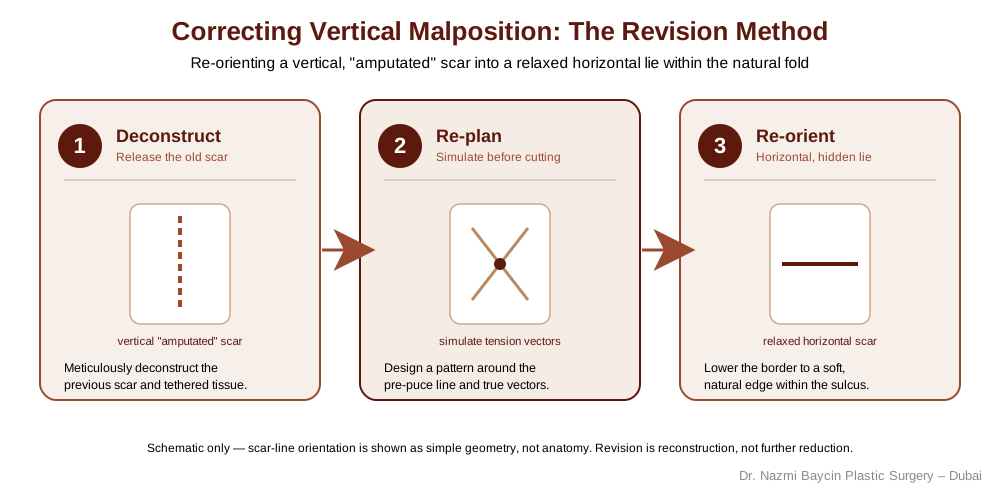
The revision method — deconstruct, re-plan, then re-orient a vertical scar into a relaxed horizontal lie within the natural fold (schematic, not anatomical) — by Dr. Nazmi Baycin, Dubai.
First comes deconstruction — meticulously releasing the previous scar and any tethered tissue. Then precision planning — designing a pattern that, when closed, lowers the entire border and re-creates a soft, natural edge, mapped around the pre-puce line and the true tension vectors. Finally, re-orientation, in which the artistry lies in the angle and depth of the incisions, since a miscalculation here can repeat the original error. My focus throughout is on releasing tension and allowing the tissue to find its natural, anatomical lie.
What I assess before agreeing to revise
Not every unsatisfactory result should be revised immediately, and a careful pre-revision assessment is where honesty matters most. The single most important factor is tissue reserve: how much labial substance the first surgery left behind. Where adequate tissue remains, the deconstruct–re-plan–re-orient method can restore a natural edge in one stage.
Where the labia were severely over-resected, I say so plainly — the correction may need to be staged, more conservative in its promises, or focused on releasing tension and softening the scar rather than recreating a fold that no longer has the substance to form. I also examine the quality and maturity of the existing scar, map any areas of altered sensation or tenderness, and compare the two sides carefully, because asymmetric defects need asymmetric plans. Photographs are reviewed with the patient so we agree, precisely, on what is being corrected and what a realistic outcome looks like.
This assessment protects patients from the second most common error I see after a poor labiaplasty: a hasty second operation that repeats the logic of the first. Emotion plays a real role here as well. Many women arrive distressed and eager to erase the result immediately, and part of my responsibility is to slow the decision down. A revision planned on settled, mature tissue — with clear eyes and realistic goals agreed in advance — succeeds far more predictably than one planned in the first raw weeks of disappointment.
Why this happens: a failure of surgical philosophy
Too often, labiaplasty is approached with a reductionist mindset — viewed as mere excess-skin removal using a simple linear excision — which ignores the fundamental principles of respect for anatomy and preservation of function. The trim technique, while appropriate in some select cases, is often applied indiscriminately; without accounting for how the superior and inferior edges will come together under tension, vertical malposition is almost a guaranteed outcome.
My philosophy is different: I approach each labiaplasty, primary or revision, as a unique architectural project, spending a significant part of the consultation analyzing the patient’s specific anatomy — the thickness of the labial edge, the pigmentation, and the relationship to the clitoral hood and labia majora — and planning the incision to follow the natural folds so the final scar is concealed and the contour is graceful.
This avoidance of a cookie-cutter technique is what sets the foundation for a natural-looking outcome, and it is detailed in the anatomical principles behind labiaplasty in Dubai.
Trim technique vs individualized planning
| Aspect | Generic trim technique | Individualized planning |
|---|---|---|
| Scar orientation | Often vertical — “amputated” look | Relaxed and horizontal, within the natural fold |
| Anatomic landmarks | Pre-puce line may be disregarded | Incision planned around the pre-puce line |
| Tension vectors | Not simulated before cutting | Simulated with forceps before any incision |
| Edge & contour | Can look abruptly shortened | Soft, irregular, natural free edge |
| Approach | Applied indiscriminately | Tailored to the individual’s anatomy |
Healing after revision: protecting the new geometry
A well-planned revision also has to be protected while it heals, because the early weeks decide whether the re-oriented scar keeps its relaxed horizontal lie. Closure is done with fine absorbable sutures, so nothing needs to be removed.
For the first days I advise gentle hygiene, cool compresses in short intervals, and loose clothing that eliminates friction over the healing edge. Straddle activities such as cycling are postponed for about four weeks, and intimacy for about six, so no traction is placed on the new scar line before it has gained strength. Because the revised scar now lies along the natural fold rather than across it, everyday movement works with the closure instead of against it — one more reason the re-orientation itself is the heart of the correction. The edge softens progressively, and the settled contour is usually apparent within a few months. I review healing personally at each stage, so any early tendency toward tightness is addressed long before it can influence the final lie of the scar.
Choosing your revision surgeon: the most critical decision
If you are seeking correction — or choosing carefully the first time so that you never need one — the surgeon you choose will determine your result, because this is intimate, permanent surgery. I encourage patients to look beyond marketing and scrutinize a surgeon’s gallery of results with a critical eye: are the labial edges horizontal and irregular, are the scars invisible, and does the overall appearance look natural?
In my clinic, the consultation is an in-depth educational session — I use diagrams and explain the reasoning behind each technique, so you understand what went wrong and how it can be corrected. Because a revision is individually mapped to your existing anatomy, no plan is drawn until I have examined the settled result of your previous surgery in person. This restorative philosophy is central to my wider work as a board-certified plastic surgeon in Dubai.
FAQs about correcting vertical malposition in labiaplasty in Dubai
-
What is vertical malposition after labiaplasty?
It is a result in which the healed scar runs vertically rather than resting horizontally within the natural fold. This gives an abruptly shortened appearance, as though the labia had been cut short, sometimes with a visible scar, a feeling of tightness, and discomfort during intimacy. It reflects how the tissue was planned and closed, not the anatomy of the patient.
-
Why does vertical malposition happen?
It usually follows a generic trim technique applied without respecting individual anatomy and the direction of skin tension. Two frequent causes are disregarding the pre-puce line (the natural border where the labia minora meet the clitoral hood) and not simulating the closure before cutting, which allows upward traction that pulls the scar into a vertical orientation.
-
Can vertical malposition be corrected?
In most cases, yes — but the correction is a reconstruction, not simply removing more tissue. The previous scar is deconstructed, a new pattern is planned around the correct landmarks and tension vectors, and the border is lowered so the scar is re-oriented into a relaxed, hidden horizontal lie. The aim is a soft, natural edge and comfortable function.
-
Is revision labiaplasty more difficult than the first surgery?
Generally yes. Revision means working within scarred, altered tissue where normal landmarks may be distorted, so it demands careful re-mapping of the anatomy and precise judgment about the angle and depth of incisions. A miscalculation can repeat the original error, which is why revision is approached as meticulous reconstruction rather than a second trim.
-
How do I judge whether a labiaplasty result is good?
Look for labial edges that are horizontal and gently irregular rather than straight and shortened, scars concealed within the natural folds, and an overall appearance that looks untouched. When reviewing a gallery of results, scrutinize these details critically rather than relying on marketing language, since dissatisfaction after primary labiaplasty is more common than outcome data suggest.
-
When can revision be performed?
Timing is individual and confirmed at consultation, but tissues generally need to heal and soften after the primary surgery before a revision is planned, so the true, settled result can be assessed and the correction mapped accurately. Operating before the tissue has matured makes it harder to judge how much correction is genuinely needed.


GET APPOINTMENT
Get ready to look and feel best… You deserve…
