


Table of content
- Why might you need a brow lift?
- Are you a good candidate for a brow lift?
- What does Dr. Baycin aim for in your brow lift?
- How does Dr. Baycin perform a brow lift?
- What is recovery after a brow lift like?
- What are the risks and complications of a brow lift?
- Checklist before having brow lift in Dubai
- How much does a brow lift cost in Dubai, UAE?
- FAQs about brow lift in Dubai
- Get appointment
The eyes are the most expressive part of the face — and when the brows above them begin to drop, the whole face reads as tired, sad, or stern, however rested you actually feel. I am Dr. Nazmi Baycin, and my brow lift in Dubai is designed to restore the brow to its natural, youthful position and to open the eyes again — performed endoscopically, through small incisions hidden entirely within the hairline, so the correction is visible but the surgery is not. The result should look like you, rested; never like someone surprised.
That restraint is deliberate. In more than three hundred brow lifts, my guiding principle has been to lift only as much as your face genuinely needs, because an over-lifted brow is the one error that cannot be hidden. Performing brow lift surgery in Dubai within JCI-accredited hospitals, I plan each lift around your own brow position, forehead height, and the way your eyes sit beneath — and I will always tell you honestly when your heavy eyelids are really a brow problem, or when they are not. The principle is the one that guides all my work: to restore form is to restore function.
Brow lift in Dubai quick facts
| Procedure detail | Endoscopic brow lift in Dubai |
|---|---|
| Technique | Endoscopic — subperiosteal release & suspension |
| Incisions | Small, hidden within the hairline (no visible scar) |
| Fixation | Absorbable Endotine® devices |
| Anesthesia | General (+ long-acting local infiltration) |
| Procedure time | About 1 hour |
| Hospital stay | Outpatient or 1 night |
| Downtime | 5–7 days |
| Sutures | Hidden, dissolvable + 2 small sutures removed at 1 week |
| Shower | 2–3 days |
| Swelling / bruising | Settles in 7–10 days |
| Result visible | ~2 weeks; final shape at 1–3 months |
| Often combined with | Eyelid surgery (blepharoplasty), facelift |
Why might you need a brow lift?
The forehead and brows age in a way that is easy to misread. As the tissues of the forehead lose their elasticity, the brows gradually descend — first flattening the graceful arch of the eyebrow, then crowding the upper eyelids. The eyes appear smaller and heavier, the upper lids look hooded, and horizontal forehead lines and frown lines between the brows deepen as the forehead muscles work overtime to hold the brows up. The face begins to send a message you never intended: tired, sad, or angry.
What makes brow descent particularly deceptive is that it is often mistaken for an eyelid problem. Many people seek eyelid surgery for heavy upper lids when the true cause is the brow sitting too low, pushing skin down onto the lid. Correcting the eyelid alone in that situation leaves the underlying problem in place. That is why distinguishing the two — brow versus eyelid — is the first thing I assess.
Are you a good candidate for a brow lift?
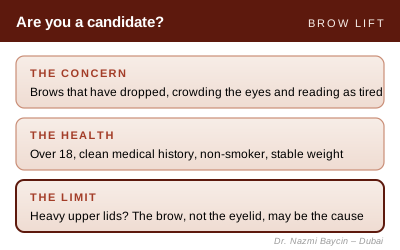
A clean medical history and good general health, free of systemic disease such as heart disease, are the foundation of safe brow lift surgery, and the starting point of every assessment I make.
Beyond that, you are likely a good candidate if your brows have dropped to the point of crowding your eyes, if your upper eyelids look heavy or hooded because of brow position rather than excess lid skin alone, if deep forehead or frown lines give you a tired or stern expression, or if you would simply like a more open, rested look around the eyes. There is no strict age limit: brow descent is most often a change of the forties and beyond, but some people are born with a naturally low brow, and for them a lift can be appropriate earlier. What matters is that the brow is genuinely the problem — which is exactly what I determine at your consultation.
What does Dr. Baycin aim for in your brow lift?
My aim is a brow that sits where it naturally belongs — not higher. The ideal brow position differs between men and women: a woman’s brow arches gently and rests just above the bony rim of the eye socket, while a man’s sits lower and flatter, along the rim itself. Lifting a man’s brow to a feminine height, or arching it too much, is one of the clearest tells of overdone surgery, and I plan every lift with these distinctions in mind.
Equally important is what the lift does to the eyes. A well-placed brow opens the upper eyelid, relieves the hooding, and softens the frown lines between the brows — while the endoscopic approach also lets me release and weaken the muscles responsible for those lines, so the improvement is not only lifted but smoothed. The result I am after is a face that looks rested and alert, with nothing about it that suggests surgery. In many patients, brow position and eyelid excess coexist, and combining a brow lift with an eyelid surgery gives a more complete, harmonious rejuvenation of the whole upper face than either alone; where the whole face has aged together, it may form part of a facelift plan.
How does Dr. Baycin perform a brow lift?
I perform brow lifts endoscopically. Rather than the long ear-to-ear incision of the traditional coronal brow lift — with its extensive scar, its numbness, and its tendency to raise the hairline — the endoscopic technique works through three to five small incisions of about a centimeter each, hidden entirely within the hair-bearing scalp. Through these I pass a slim endoscope and fine instruments, releasing the forehead tissues from the bone, freeing the brows from the attachments that hold them down, and weakening the frown muscles between the brows. The brows are then repositioned to their new height and fixed in place with absorbable Endotine® devices, which hold the tissue securely during the weeks of healing and then dissolve — leaving nothing permanent behind.
The advantages over the traditional approach are substantial: no visible scar, no change to the hairline, far less numbness of the scalp, a shorter operation of about an hour, and a considerably faster recovery. The endoscopic brow lift is performed under general anesthesia, and I also infiltrate a long-acting local anesthetic into the area, so the first day — usually when discomfort would peak — passes comfortably.

Stages of the endoscopic brow lift: 1- Small incisions hidden in the hairline, 2- Endoscopic release of the forehead tissues, 3- Repositioning of the brows, 4- Absorbable Endotine® fixation
| Factor | Endoscopic brow lift | Traditional coronal brow lift |
|---|---|---|
| Incisions | 3–5 small (~1 cm) incisions hidden in the hair | One long ear-to-ear incision across the scalp |
| Visible scar | None | Long scalp scar, may show with thinning hair |
| Hairline | Unchanged | Often raised |
| Scalp numbness | Minimal, temporary | Common, can be lasting |
| Procedure time | About 1 hour | 1.5–2 hours |
| Recovery | 5–7 days downtime | 10–14 days downtime |
| Frown-line treatment | Yes — muscles released endoscopically | Yes |
In-depth reading: the techniques and decisions behind a brow lift in Dubai
These articles go deeper into the questions that decide a good brow lift — how the brow and eyelid are told apart, why over-lifting happens and how it is avoided, and how the brow is planned differently for men and women:
- Brow lift vs. eyelid surgery: which one do you actually need? — the manual brow-elevation test and the anatomical signs that separate brow descent from true eyelid excess, and why treating the wrong one leaves the tired look in place.
- Avoiding the surprised look: why conservative elevation matters — how much lift is too much, why the medial brow should move less than the lateral brow, and how the endoscopic technique gives fine control over both.
- The male brow lift: preserving a masculine brow position — why a man’s brow sits lower and flatter, how it is lifted without feminizing the face, and the special considerations of a receding hairline.
Where does Dr. Baycin perform brow lift surgery in Dubai?
I perform every brow lift in a premium, JCI-accredited hospital in Dubai that meets the highest international standards for safety and hygiene. Your procedure takes place in a modern, fully equipped surgical environment, with your safety and comfort the first priorities at every step.
What is recovery after a brow lift like?
Recovery from an endoscopic brow lift is quicker and more comfortable than most people expect. You can usually go home the same day or after one night. The forehead feels tight and there is some swelling and bruising around the eyes, which peaks at two to three days and settles within seven to ten; a mild headache in the first day or two is normal and easily managed with medication. You can shower after two to three days. Most of the stitches are hidden and dissolvable; two small sutures at the scalp incisions are removed at about one week.
You will look presentable within about a week and can return to desk work at that point, with the result clearly visible from around two weeks as the swelling clears. Sport and strenuous activity can resume at two to three weeks. The brows sit a little high in the first days — this is deliberate and expected, and they settle into their final position over one to three months. Some numbness or tingling of the scalp behind the incisions is normal and resolves over the following weeks. To understand the full science behind how I support your healing after surgery, see my advanced recovery protocol in Dubai article.
Download Dr. Baycin’s brow lift aftercare instructions
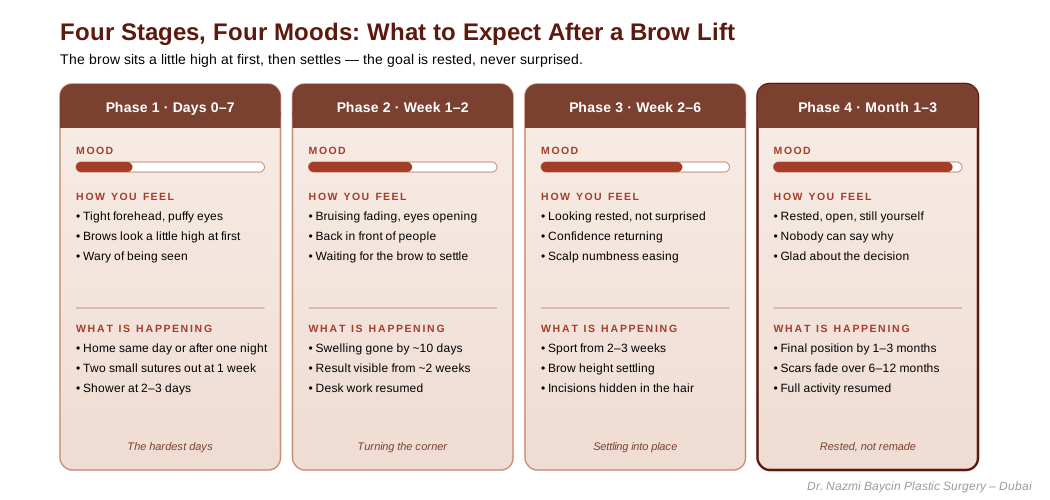
Recovery after a brow lift is short on the body’s clock and a little longer on the mirror’s. The milestones are quick: home the same day or after one night, showering at two to three days, the two small scalp sutures out at a week, swelling and bruising gone by around ten days, back at a desk within the week, sport from two to three weeks. What takes longer is the brow itself. In the first days it sits a little higher than it will stay — that is deliberate — and with the puffiness around the eyes it is the moment most patients would rather not be seen. By the second week the eyes are opening and the result is visible; by the sixth the brow is settling and the scalp numbness is easing; and over one to three months it comes to rest where it belongs, with the incisions lost in the hair and the scars fading over six to twelve months. The aim throughout is rested, never surprised. The pace varies with personality; the shape rarely does.
What are the risks and complications of a brow lift?
A brow lift is a safe procedure in experienced hands, but as with any surgery there are risks worth being candid about. Temporary numbness or tingling of the scalp is common and usually resolves within weeks to a few months. Hematoma (blood collecting beneath the skin) and infection are the general surgical risks, minimized by careful technique and the right medication. Hair loss around the scalp incisions is uncommon with the endoscopic approach and usually temporary.
The risks particular to a brow lift are the ones that come from lifting too much or unevenly: an over-elevated, surprised look, or a slight asymmetry between the two brows. Both are prevented by conservative, individually planned elevation — which is why I lift only as far as your face requires and check the symmetry carefully during surgery. Rarely, a weakness of the forehead muscle on one side can occur from irritation of the nerve that controls it; this is almost always temporary. Where any issue does arise, it can be managed and treated effectively.
Checklist before having brow lift in Dubai
IMPORTANT ! Before getting the appointment, check your medical conditions yourself.
| # | Conditions | Safety | Aesthetic Suitability |
|---|---|---|---|
| 1 | Are you over 18? | 🟢 Fit for surgery | — |
| 2 | Have your eyebrows dropped, giving a tired or sad expression? | 🟢 Fit for surgery | 🟡 Ideal candidate |
| 3 | Do your upper eyelids look heavy because of a low brow position? | 🟢 Fit for surgery | 🟡 Ideal candidate |
| 4 | Do you have deep forehead or frown lines between the brows? | 🟢 Fit for surgery | 🟡 Ideal candidate |
| 5 | Do you have a cardiovascular problem such as heart disease or deep vein thrombosis? | 🔴 Contraindicated | — |
| 6 | Do you have pulmonary system problems such as chronic lung disease? | 🔴 Contraindicated | — |
| 7 | Do you have chronic liver disease? | 🔴 Contraindicated | — |
| 8 | Do you have a urinary system disease such as kidney failure? | 🔴 Contraindicated | — |
| 9 | Do you have a hematologic problem such as anemia or coagulopathy? | 🔴 Contraindicated | — |
| 10 | Do you have any transmitting disease through blood such as HIV? | 🔴 Contraindicated | — |
| 11 | Have you been taking anticoagulant medication? | 🔴 Contraindicated | — |
| 12 | Have you been taking psychotropic drugs? | 🔴 Contraindicated | — |
| 13 | Any drug abuse or addiction | 🔴 Contraindicated | — |
How much does a brow lift cost in Dubai, UAE?
Brow lift prices in Dubai can vary considerably from clinic to clinic, typically ranging from 20,000 AED ($5,500) to 40,000 AED ($11,000), depending on the technique used and whether it is combined with other procedures.
These figures don’t represent Dr. Baycin’s personal rates; you’ll get the exact pricing during your consultation after he evaluates your condition.
For a complete overview of treatment fees, please refer to full price list of the procedures.
Schedule your private consultation with Dr. BaycinWhat makes Dr. Baycin an exceptional brow lift surgeon in Dubai?
A brow lift is judged not by how much it changes but by how natural the change looks — and with more than 300 endoscopic brow lifts, that is the standard Dr. Baycin holds.
- 25+ years of facial surgery expertise: a board-certified plastic surgeon, DHA-licensed and a member of the American Society of Plastic Surgeons (ASPS), with deep experience across the full range of facial rejuvenation.
- Endoscopic mastery: a minimally invasive technique that leaves no visible scar, preserves the hairline and scalp sensation, and delivers a faster, more comfortable recovery.
- Conservative by principle: lifting only as far as the face requires, with the brow planned separately for men and women, so the result is rested — never surprised.
- Brow or eyelid — the honest answer: a careful assessment of whether heavy upper lids are truly a brow problem, an eyelid problem, or both, so you have the right operation, not the nearest one.
- Whole-upper-face harmony: expert combination with eyelid surgery or a facelift where it gives a more complete, balanced rejuvenation.
- A safety record you can trust: thousands of aesthetic surgeries in JCI-accredited hospitals, with an uncompromising approach to every step.
- Honest, transparent consultations: realistic expectations, every option explained, and no procedure recommended that you do not genuinely need.
- Comprehensive aftercare: structured follow-up and direct surgeon access throughout recovery.
- International recognition: patients travel from across the GCC, Europe, and beyond for his natural facial results in Dubai.
- Artistry with restraint: an aesthetic sense that values a face that looks like you at your best, not a face that looks operated on.
About Dr. Nazmi Baycin
Surgery, to me, is precision applied in service of restoration — a conviction that has guided every one of the more than 7,000 procedures I have performed over 25 years in practice. I am a DHA-licensed, board-certified plastic surgeon, trained in Turkey and based in Dubai since 2016. I operate exclusively within JCI-accredited hospitals, and hold international membership in the American Society of Plastic Surgeons (ASPS). Three techniques, in particular, have become signatures of my practice. Scarless breast augmentation, performed through a transaxillary approach that leaves no incision on the breast itself. Labiaplasty designed individually around each patient’s own anatomy, never to a standard template. And 3D customized facial bone implants, engineered through CT-based bespoke printing — a technique I currently offer as the only surgeon in Dubai providing it. My practice today spans facial rejuvenation, breast surgery, body contouring, and cosmetic genital procedures, drawing patients from across the UAE, Europe, and the wider GCC. Yet the principle guiding each of these specialties has never changed: to restore form is to restore function.
FAQs about brow lift in Dubai
-
What is a brow lift?
A brow lift is how I raise sagging eyebrows and smooth the forehead to restore a more open, rested, youthful appearance to the upper face. As the forehead tissues lose elasticity, the brows descend and crowd the eyes, making them look smaller and giving a tired, sad, or stern expression. By repositioning the brows to their natural height and releasing the frown muscles, I open the eyes and soften the forehead. I perform it endoscopically, through small incisions hidden in the hair, so there is no visible scar.
-
How much does a brow lift cost in Dubai?
Brow lift costs in Dubai vary from clinic to clinic and depend on several factors, ranging from AED 20,000 to AED 40,000, depending on the technique and whether it is combined with eyelid surgery or a facelift. These are general market figures, not Dr. Baycin’s personal rates; the precise cost is confirmed at your consultation, once your brow and upper face have been assessed.
-
What is an endoscopic brow lift?
The endoscopic brow lift is the minimally invasive technique I use for nearly every brow lift. Instead of the long ear-to-ear incision of the traditional approach, I work through three to five small incisions of about a centimeter each, hidden within the hair. Through these I pass a slim endoscope and fine instruments to release the forehead tissues, reposition the brows, and weaken the frown muscles, then fix the brows in place with absorbable devices. The result is no visible scar, an unchanged hairline, minimal numbness, and a much faster recovery.
-
Do I need a brow lift or eyelid surgery?
This is the most important question, and it is the first thing I assess. Heavy, hooded upper eyelids are often caused not by excess eyelid skin but by the brow sitting too low and pushing skin down onto the lid. If that is the case, eyelid surgery alone leaves the real problem in place, and a brow lift is the right operation. In many people both contribute, and combining a brow lift with eyelid surgery gives the most complete result. At consultation I examine exactly where the heaviness comes from and advise you honestly.
-
Will a brow lift give me a surprised look?
Not when it is done with restraint, and that restraint is my guiding principle. The surprised look comes from over-lifting the brows or arching them too much, particularly the inner brow. I lift only as far as your face genuinely requires, moving the inner brow less than the outer, and I plan a woman’s brow and a man’s brow differently, since a man’s naturally sits lower and flatter. The endoscopic technique gives me fine control over exactly how much each part of the brow moves, so the result looks rested and open, not startled.
-
Where are the scars after a brow lift?
With the endoscopic technique, there are no visible scars at all. The three to five small incisions are placed entirely within the hair-bearing scalp, behind the hairline, where they are hidden by your hair even when it is wet or pulled back. Because the incisions are so small and the hairline is not moved, the endoscopic approach avoids the long scalp scar, the raised hairline, and the numbness that the older coronal brow lift could leave.
-
What is recovery after a brow lift like?
Recovery is quicker than most people expect. You go home the same day or after one night, and the forehead feels tight with some swelling and bruising around the eyes that peaks at two to three days and settles within seven to ten. You can shower after two to three days, two small sutures are removed at about a week, and you are presentable and back at desk work within about a week. The result is visible from around two weeks, sport can resume at two to three weeks, and the brows settle into their final position over one to three months.
-
Are the results of a brow lift permanent?
The results are long-lasting. A brow lift resets the position of the brows and releases the muscles that pull them down, and that correction endures for many years. Aging does continue, so over time the brows will gradually descend again as they would have anyway, but from a higher starting point. Most patients enjoy their result for ten years or more, and a good result is easily maintained with sun protection and, where wished, occasional non-surgical treatments for forehead lines.
-
Is a brow lift in Dubai safe?
In experienced hands a brow lift is a safe procedure, and the endoscopic technique adds to that safety by minimizing incisions and tissue disruption. As with any surgery there are risks, which I discuss honestly: temporary numbness or tingling of the scalp is common and resolves within weeks to months, while hematoma and infection are uncommon and minimized by careful technique. The risks specific to a brow lift, over-elevation and asymmetry, are prevented by conservative, individually planned lifting. Where any issue does arise, it can be managed and treated effectively.
-
Are you a good candidate for a brow lift?
You are likely a good candidate if your brows have dropped to the point of crowding your eyes, your upper eyelids look heavy because of brow position, deep forehead or frown lines give you a tired or stern expression, or you would like a more open, rested look around the eyes, and you are in good general health. There is no strict age limit, though brow descent is most common from the forties onward. A clean medical history is the foundation of safe surgery, and I confirm that the brow is genuinely the problem at your consultation.
-
Can a brow lift in Dubai be combined with other procedures?
Yes, and it often should be. A brow lift is most frequently combined with eyelid surgery, since brow position and eyelid excess so often coexist, giving a more complete rejuvenation of the upper face than either alone. Where the whole face has aged together, it forms part of a facelift plan. At consultation I assess your face as a whole and recommend combining procedures only where it is safe and genuinely gives a more harmonious result.


GET APPOINTMENT
Get ready to look and feel best… You deserve…
