


Table of content
- What can a facelift in Dubai do for you?
- Are you a good candidate for facelift?
- Endoscopic mid-facelift (the “ponytail facelift”)
- Deep plane facelift
- Mini facelift (MACS lift)
- Can I see facelift before and after pictures?
- What are the risks and complications of facelift?
- Checklist before having facelift in Dubai
- How much does a facelift cost in Dubai, UAE?
- Get appointment
The mark of a good facelift is that no one can tell you have had one. I am Dr. Nazmi Baycin, and after more than two hundred facelift procedures my reputation rests on exactly that — rejuvenation that looks rested, not operated; lifted, not pulled. A facelift in Dubai with me is never a single routine applied to every face. It is a judgment: which of several techniques — deep plane, endoscopic mid-facelift, or mini — will turn back the clock on your particular face while keeping it unmistakably your own.
That judgment is the whole of the art. Aging does not affect every face the same way, and the right operation for a sagging jawline in the sixties is not the right one for early cheek descent in the thirties. Performing facelift surgery in Dubai within JCI-accredited hospitals, I match the technique to your anatomy, your age, and your goals — restoring volume and lifting deep structure rather than simply tightening skin. The principle is the one that guides all my work: to restore form is to restore function.
Facelift in Dubai quick facts
| Procedure detail | Facelift in Dubai |
|---|---|
| Techniques | Deep plane, endoscopic mid-facelift, mini (MACS) |
| Anesthesia | General |
| Procedure time | 1.5–2 hrs (endoscopic); 2–4 hrs (deep plane) |
| Hospital stay | 1 day (same-day possible for mini) |
| Incision | At the ear margin / within the hairline — hidden |
| Sutures | Hidden, dissolvable (none to remove) |
| Shower | ~2 days |
| Downtime | 5–7 days |
| Swelling / bruising | Settles over 7–10 days; mild over 3–4 months |
| Deep plane longevity | Often 7–10 years or more |
What can a facelift in Dubai do for you?
Aging is something none of us escapes — but a facelift can turn back the clock convincingly, removing excess skin and lifting the deeper tissues to make you look five to ten years younger while still looking like yourself. It softens the tired, heavy look that comes with age: the sagging cheek, the deepening fold, the loosening jawline and neck.
There are three main facelift techniques, each suited to a different degree of aging and a different age group, and the most natural results often come from restoring lost volume as much as lifting. To understand the philosophy of volume restoration that underpins my approach to facial rejuvenation, see my regenerative lift article. For patients addressing several features at once, a facelift can form part of a planned full facial transformation rather than a single procedure.
Are you a good candidate for a facelift?
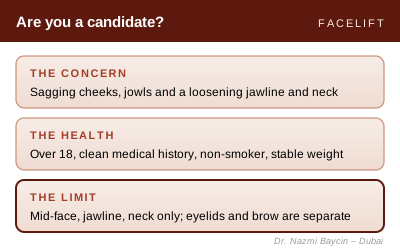
A clean medical history, good overall health, and freedom from systemic disease such as heart disease are the foundations of safe facelift surgery — and the starting point of every assessment I make. Beyond that, the deciding factor is often how your face looks rather than the number on your passport: if your face shows changes that a lift would soften, we can consider surgery whatever your age.
At our consultation I choose the technique that fits your age, your anatomy, and your expectations. And where aging is compounded by trauma or a congenital difference, facial plastic and reconstructive surgery can restore the underlying tissues, not just the surface.
A few conditions make for the safest, most satisfying result:
- a clean medical history, free of systemic disease such as heart disease
- good general health and realistic expectations
- a non-smoker, or willing to stop 10–15 days before surgery (smoking impairs healing)
- facial aging — sagging skin, jowls, deep folds, neck laxity — that a lift can meaningfully improve
It is worth being clear about what a facelift does not treat. It lifts and repositions the deeper tissues of the mid-face, jawline, and neck — it does not correct the upper face. Where the concern is a heavy, hooded upper lid or under-eye bags, that is upper and lower eyelid rejuvenation in Dubai; where the brows themselves have descended, a brow repositioning in Dubai is the operation that addresses it. These are frequently combined with a facelift, but each treats a region the others leave untouched.
Which facelift technique is right for you?
There is no single best facelift — only the best facelift for your face. I work across three principal techniques, choosing between them by the degree and pattern of aging.

A natural facelift is a question of layer, not of how tight. Beneath the skin lies the SMAS — the muscle and its sheath — tethered to bone by retaining ligaments, and aging is that layer descending. A lift that asks the skin to hold the result pulls it sideways under tension: the windswept look, flattened expression and widening scars that patients rightly fear, and a result that relaxes within a year or two. Dr. Baycin never carries a lift on the skin. In the mini (MACS) lift the SMAS is folded and suspended upward through an incision in front of the ear, for mild to moderate cheek and jawline sagging. In the deep plane facelift the retaining ligaments are released and skin and SMAS are moved together as one composite flap, anchored deep, so cheek, jawline and neck are restored with the expression intact — the technique he most often recommends for advanced aging, and the one that holds for seven to ten years or more. In the endoscopic mid-facelift the cheek tissues are lifted off the bone through two 2 cm hairline incisions and fixed to deep fascia with no skin removed, for early cheek descent in the twenties to forties. In every case the skin is the last layer moved and the one never asked to hold the result.
Endoscopic mid-facelift (the “ponytail facelift”)
I lean toward the endoscopic mid-facelift when the issue is drooping cheek tissue and excess cheek skin without significant wrinkles. It is better suited to younger patients than a full facelift — even those in their twenties and thirties who want a fresher look or a subtly different face shape — and it is a much newer approach than the classical technique. You may have heard it called the “ponytail facelift”: a catchy name that has gained attention lately, but in substance it is simply an endoscopic facelift.
Deep plane facelift

Patient satisfaction rate after facelift
The deep plane facelift is the most thorough method available, tightening the cheeks, jawline, and neck together. I most often recommend it for sagging cheeks with loose, wrinkled skin on the face and neck — because it rejuvenates the facial tissues and lifts the neck in one comprehensive procedure. Because the deep plane lift also rejuvenates the neck, it pairs naturally with dedicated neck and double-chin contouring where a sharper jawline-to-neck transition is the goal. There are several variations, including the biplanar facelift and SMAS plication, tailored to the individual.
To understand the surgical philosophy behind the high-SMAS technique I use, see my high-SMAS facelift article. The published evidence is worth reading closely: a 2025 systematic review and one-arm meta-analysis of 2,896 patients reported a pooled patient-satisfaction rate of 94.4% for deep plane facelifts against 87.8% for the SMAS technique, alongside a higher pooled complication rate of 17.2% against 10.3%.
Mini facelift (MACS lift)
A mini facelift — often called the MACS lift (Minimal Access Cranial Suspension) — is a shorter-scar lift in which the SMAS is folded and suspended with plication sutures rather than moved as a deep flap, and it is particularly effective for mild to moderate sagging of the cheek and jawline. The incision is made in front of the ear and does not extend behind it, giving a more youthful look with minimal, well-hidden scarring and a lighter, quicker recovery.
Deep plane, endoscopic or mini: which suits you?
These three techniques answer different problems — the deep plane for more advanced, whole-face aging, the endoscopic mid-facelift for earlier, subtler change in the cheek, and the mini (MACS) lift for mild to moderate sagging where a short scar and a lighter recovery matter. The table below sets them side by side.
| Factor | Deep plane facelift | Endoscopic mid-facelift | Mini facelift (MACS) |
|---|---|---|---|
| Typical pattern of aging | Jowls, loose and wrinkled face and neck skin; advanced, whole-face aging | Early cheek descent without loose or wrinkled skin; often 20s–40s | Mild to moderate sagging of the cheek and jawline |
| What is lifted | Skin and SMAS moved together as one flap after the retaining ligaments are released; anchored deep | Cheek tissues lifted off the bone and fixed to deep fascia; no skin removed | SMAS folded and suspended with plication sutures; excess skin trimmed |
| Incision | Along the front margin of the ear — no visible scar from the side | About 2 cm within the temple hairline on each side | In front of the ear only; does not extend behind it |
| Anesthesia · time | General · 2–4 hours | General · 1.5–2 hours | General · shorter than deep plane |
| Stay | 1 night; light bandage for a few days | Same evening or 1 night | Same day possible |
| Downtime | Back to desk work in 5–7 days; social in 2–3 weeks; mild swelling up to 3–4 months | Discomfort 2–3 days; eye-area bruising clears in 7–10 days | Lighter and quicker than deep plane |
| Longevity | Often 7–10 years or more | Durable for the cheek; does not treat jawline or neck | Several years; less than a deep plane lift |
| Published evidence | Pooled satisfaction 94.4% (vs 87.8% for SMAS); pooled complications 17.2% (vs 10.3% for SMAS) — 2025 meta-analysis, 2,896 patients | Subtle, natural enhancement; high reported satisfaction in single-technique series | Included within the SMAS-technique figures at left |
How does Dr. Baycin perform each facelift?

The endoscopic mid-facelift incision, hidden in the hairline.
How is the endoscopic mid-facelift performed?
I begin by trimming about 2 cm within the hair-covered temple on each side, then insert a camera through that small incision. Guided by its view, I gently lift the soft tissues of the temple and cheek away from the bone beneath, then secure those released tissues upward into their refreshed position before closing with discreet stitches. The procedure takes around 1.5 to 2 hours, usually with an overnight stay — and thanks to the short incisions and its largely bloodless nature, it tends to be markedly less painful.

The deep plane facelift incision, at the ear’s margin.
How is the deep plane facelift performed?
I start with an incision along the front edge of the ear, carefully separating the cheek skin from the tissue beneath. I then lift the muscle layer and its sheath — the SMAS — upward, anchoring it from within with internal stitches so the sagging cheek is lifted from below rather than dragged tight at the surface. I then re-drape the skin, remove the excess, and close the edges to smooth wrinkles and correct cheek descent. Because the incision sits right at the ear’s margin, there is no visible scar from the side, and I use hidden, absorbable stitches throughout. A deep plane facelift requires general anesthesia and takes about 2 to 4 hours depending on the variation, with a one-day hospital stay and a light bandage for a few days. Where it serves the result, I sometimes combine the deep plane and endoscopic techniques.

The mini (MACS) facelift incision, in front of the ear only.
How is the mini facelift (MACS) performed?
I lift the skin across the cheek and upper neck to expose the SMAS layer, then fold and secure it with plication sutures to lift the loose tissue from within for a lasting result. After the SMAS plication I trim the excess skin to smooth superficial wrinkles, then close with discreet, absorbable stitches. The work is confined to an incision in front of the ear, which is why the scar stays minimal and the recovery is lighter.
In-depth reading: the techniques, science, and considerations behind a facelift in Dubai
A facelift is not a single operation but a family of techniques, each matched to a different pattern of aging — how the deeper layers are moved, where the lift is anchored, how lost volume is restored, and how the surrounding units are kept in harmony. These detailed articles explore each dimension in depth so you can understand the reasoning behind the technique I recommend for your face.
- How modern technique makes a facelift safer, not just more natural — why the distortions patients fear are also the visible traces of avoidable complications, and how repositioning the deep layers prevents hematoma, nerve injury, and skin loss.
- Why some facelifts end up looking overdone — what produces the tight, pulled, windblown look, and how carrying the lift on the deep layer instead of the skin avoids it.
- The advantages of the deep-plane facelift technique — how lifting the skin, SMAS, and muscle as one composite flap rejuvenates the lower face and neck while preserving natural expression.
- The anatomy behind the deep plane facelift — how facial descent unfolds layer by layer, why releasing the retaining ligaments is what allows repositioning, and where the lift is anchored so it endures.
- Deep plane versus SMAS: what actually holds a facelift up — why a lift held by structure behaves differently over time from one held by tension, and which aging pattern points to which technique.
- What actually deepens the nasolabial fold — why the crease is a compartment boundary rather than a wrinkle, and why that anatomy limits what volume alone can achieve.
- Why “mini” in a deep-plane mini facelift describes the incision, not the lift — how the same structural repositioning is delivered through a shortened, hidden scar, and which patients the short-scar window genuinely suits.
- The high-SMAS technique and differential vector resuspension — how planning separate lift vectors at the SMAS restores movement rather than a flat, tightened surface.
- Key surgical considerations for the endoscopic mid-facelift — the incision vectors, subperiosteal release, and deep-fascia fixation behind the minimal-scar mid-face lift for younger patients.
- Why the neck, chin, and jawline must be treated together — how an isolated mid-face lift leaves the neck and jawline behind, and why complete rejuvenation treats them as one continuum.
- Restoring lost facial volume with structural fat grafting — how addressing deflation, not just descent, is often the missing half of a natural, youthful result.
- How a facelift refreshes your look without changing your identity — why working the deeper layers, not tightening skin, keeps you looking like yourself, only rested.
- What makes a facelift look unnatural and how to avoid it — a natural result depends less on how tight the lift is than on avoiding a handful of technical errors.
Where does Dr. Baycin perform facelift surgery in Dubai?
I perform every facelift in a premium, JCI-accredited hospital in Dubai that upholds the highest international standards of safety, hygiene, and patient care. Your procedure takes place in a fully equipped, modern surgical setting built for comfort, confidence, and natural-looking results.
What is recovery after a facelift like?
Recovery depends on the technique, and your own face will guide its pace — but in every case the swelling and bruising that look alarming at first resolve to reveal a natural, rested result.
Endoscopic mid-facelift recovery
Recovery here is generally shorter and more comfortable than after a deep plane facelift. Expect moderate discomfort for two to three days, eased by the medication I prescribe. You will be up within a few hours and can go home the same evening if you feel well, or stay overnight if you prefer. You may shower two days afterward, and because I close with hidden absorbable stitches, there is nothing to remove. Some patients notice swelling and bruising around the eyes, which usually clears within 7 to 10 days.
Deep plane facelift recovery
Afterward you may feel minor pain, bruising, swelling, tension, and numbness in the face — all a normal part of healing, and all manageable with medication. Most swelling settles within the first week or two, with any lingering mild swelling resolving over three to four months; as it subsides, the tension and numbness ease day by day. The numbness is temporary, caused by the disruption of nerve connections under the skin, and returns gradually as the tissues heal. Bruising can take up to two weeks to fade fully, though it is usually less marked after an endoscopic lift. In the first days the swelling may make your face hard to recognize — this passes, and your own features re-emerge as it resolves. To understand the full science behind how I support your healing after surgery, visit my advanced recovery protocol in Dubai article.
Mini facelift recovery
Recovery after a mini facelift resembles the classical technique but is lighter and quicker, letting you return to everyday life sooner.
Download Dr. Baycin’s facelift aftercare instructions

The incision mark, planned at the ear margin before surgery.

After closure — the sutures sit beneath the skin, none visible

The incision one week after surgery, healing discreetly.
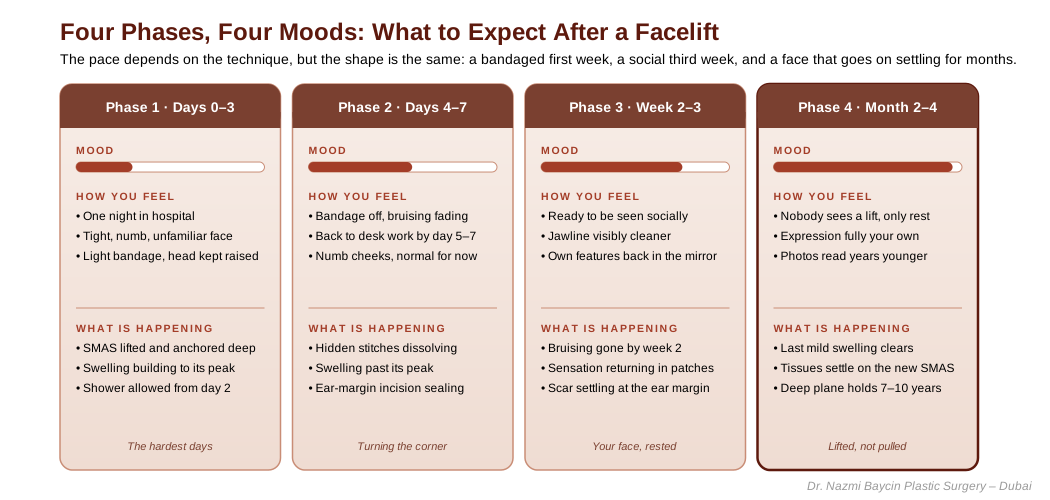
Recovery after a facelift is gentler than the first mirror suggests. After a deep plane lift you spend one night in hospital and wear a light bandage for a few days; the face feels tight, numb and not quite yours while the swelling builds to its peak, and you may shower from day two. By the end of the first week the bandage is off, the bruising is fading and most patients are back at desk work; the stitches are hidden and dissolvable, so there is nothing to remove. Weeks two and three are when you feel ready to be seen, the jawline reads cleaner, and sensation begins to return in patches. The last mild swelling clears over three to four months as the tissues settle onto the repositioned SMAS, and a deep plane lift then holds for seven to ten years or more. An endoscopic or mini lift runs the same course, only faster. The mood follows a step behind the body. The pace varies with personality; the shape rarely does.
Can I see facelift before and after pictures?


What are the risks and complications of a facelift?
A facelift is safe in experienced hands, but I believe in being candid about the risks. Smoking and diabetes raise them — particularly with a deep plane facelift — because smoking slows wound healing and can lead to skin necrosis; ideally, stop smoking 10 to 15 days before surgery. Nerve injury is an extremely rare complication of the deep plane facelift, but worth knowing about, and it is almost always temporary. The risk of hematoma (a collection of blood under the skin) or infection is markedly reduced by careful control of bleeding during surgery and by the antibiotics I prescribe — and is lower still with the endoscopic approach. With meticulous technique and the right medication, a facelift reliably leads to a positive experience and high patient satisfaction.
Checklist before having facelift in Dubai
IMPORTANT ! Before getting the appointment, check your medical conditions yourself.
| # | Conditions | Safety | Aesthetic Suitability |
|---|---|---|---|
| 1 | Are you over 18? | 🟢 Fit for surgery | — |
| 2 | Do you have droopy cheeks or midface sagging? | 🟢 Fit for surgery | 🟡 Ideal candidate |
| 3 | Do you have facial wrinkles or signs of aging caused by skin laxity? | 🟢 Fit for surgery | 🟡 Ideal candidate |
| 4 | Do you feel that your face looks older than your actual age and wish for a more youthful appearance? | 🟢 Fit for surgery | 🟡 Ideal candidate |
| 5 | Do you have a cardiovascular problem such as heart disease or deep vein thrombosis? | 🔴 Contraindicated | — |
| 6 | Do you have pulmonary system problems such as chronic lung disease? | 🔴 Contraindicated | — |
| 7 | Do you have chronic liver disease? | 🔴 Contraindicated | — |
| 8 | Do you have a urinary system disease such as kidney failure? | 🔴 Contraindicated | — |
| 9 | Do you have a hematologic problem such as anemia or coagulopathy? | 🔴 Contraindicated | — |
| 10 | Do you have any transmitting disease through blood such as HIV? | 🔴 Contraindicated | — |
| 11 | Have you been taking anticoagulant medication? | 🔴 Contraindicated | — |
| 12 | Have you been taking psychotropic drugs? | 🔴 Contraindicated | — |
| 13 | Any drug abuse or addiction | 🔴 Contraindicated | — |
How much does a facelift cost in Dubai, UAE?
Facelift prices in Dubai can differ quite a bit from clinic to clinic, depending on a number of factors. Typically, you’re looking at a range from 15,000 AED ($4,100) to 60,000 AED ($16,400).
Do keep in mind that these costs don’t reflect Dr. Baycin’s personal pricing; the exact amount will be shared with you during your consultation after assessing your specific situation.
For a complete overview of treatment fees, please refer to full price list of the procedures. If you are looking specifically for this procedure, you can also review pricing information.
Schedule your private consultation with Dr. BaycinWhat makes Dr. Baycin an exceptional facelift surgeon in Dubai?
A facelift asks for more than technique — it asks for artistry and judgment — and with more than 200 successful facelifts, that is the standard Dr. Baycin holds.
- 25+ years of proven expertise: a board-certified plastic surgeon, DHA-licensed and a member of the American Society of Plastic Surgeons (ASPS), among the most sought-after names in facial rejuvenation.
- Tailored, patient-centered solutions: every face tells a unique story, so every facelift is planned around the patient’s features and goals for results that look natural and harmonious.
- Master of advanced techniques: from SMAS and deep-plane facelifts to minimally invasive lifts, applied for youthful definition without the “pulled” look.
- Technology for better recovery: the latest surgical technologies to minimize tissue trauma and scarring, for shorter downtime and faster healing.
- An unmatched safety record: zero major complications across thousands of aesthetic surgeries.
- Open, honest consultations: every option explained, expectations set realistically, no unnecessary interventions.
- Comprehensive aftercare: structured protocols, direct surgeon access, and continuous support through recovery.
- A global reputation: patients from Europe, the GCC, and beyond seek his facelift results in Dubai.
- Results that speak for themselves: 200+ facelifts known for their natural finish, longevity, and artistic precision.
- Compassion with artistry: an empathetic approach that respects the emotional weight of facial rejuvenation.
About Dr. Nazmi Baycin
Surgery, to me, is precision applied in service of restoration — a conviction that has guided every one of the more than 7,000 procedures I have performed over 25 years in practice. I am a DHA-licensed, board-certified plastic surgeon, trained in Turkey and based in Dubai since 2016. I operate exclusively within JCI-accredited hospitals, and hold international membership in the American Society of Plastic Surgeons (ASPS). Three techniques, in particular, have become signatures of my practice. Scarless breast augmentation, performed through a transaxillary approach that leaves no incision on the breast itself. Labiaplasty designed individually around each patient’s own anatomy, never to a standard template. And 3D customized facial bone implants, engineered through CT-based bespoke printing — a technique I currently offer as the only surgeon in Dubai providing it. My practice today spans facial rejuvenation, breast surgery, body contouring, and cosmetic genital procedures, drawing patients from across the UAE, Europe, and the wider GCC. Yet the principle guiding each of these specialties has never changed: to restore form is to restore function.
FAQs about facelift in Dubai
-
What is a facelift?
A facelift is how I restore a younger, refreshed appearance to the face and neck by lifting and repositioning the deeper tissues that sag with age, not merely tightening the skin. As we grow older, the face loses volume and the supporting structures descend, creating jowls and deep folds. I address that descent at its source, resetting the foundation beneath the skin so the result looks naturally rested and rejuvenated rather than tight or pulled.
-
How much does a facelift cost in Dubai?
Facelift prices in Dubai can differ quite a bit from clinic to clinic, depending on a number of factors, typically ranging from AED 15,000 to AED 60,000. These are general market figures, not Dr. Baycin’s personal rates; the exact cost is confirmed at your consultation, once your face has been assessed and a plan agreed.
-
What is a deep plane facelift?
The deep plane facelift is the technique I most often favor, because it works beneath the muscle layer rather than on the skin. Instead of pulling the skin tight, I release the ligaments that tether the face and reposition the deeper SMAS layer and its muscle as a single unit, lifting it upward without tension on the skin. This is precisely what avoids the over-tightened, wind-swept look and gives a result that is both natural and long-lasting.
-
Why does a facelift look natural rather than pulled?
Because I lift the foundation, not the surface. The pulled, unnatural look that people rightly fear comes from tightening the skin alone, which stretches it against its own tension. By repositioning the deeper SMAS layer and releasing the ligaments beneath, I allow the skin to redrape naturally over a restored foundation, with no tension on it. The face is lifted upward rather than pulled sideways, which is the whole difference between a rejuvenated look and an operated one.
-
What are the different types of facelift in Dubai you offer?
I match the technique to the face rather than applying one method to everyone. The deep plane facelift addresses the mid and lower face and neck at a deep level for comprehensive, lasting rejuvenation. The endoscopic mid-facelift uses tiny camera-guided incisions to lift the cheek region with minimal scarring. And the mini facelift, or MACS lift, is a shorter-scar option suited to younger patients with early jowling. At consultation I recommend the one that fits your degree of aging.
-
Which facelift technique is right for me?
The right technique depends on your age, your anatomy, and how much rejuvenation you are seeking, which is exactly what we determine together. Younger patients with early jowling often do beautifully with a mini or endoscopic approach and its shorter scars, while more advanced aging of the mid-face and neck is better served by a deep plane lift. I never fit a patient to a favorite technique; I choose the method that gives you the most natural result for your particular face.
-
Will a facelift leave visible scars?
Scarring is minimal and carefully hidden. I place the incisions along the natural contours around the ear and within the hairline, where they are concealed and fade well over time. The endoscopic and mini techniques use even shorter incisions. I always close with meticulous, tension-free technique, which is not only kinder to the scar but part of what keeps the result looking natural. Once healed, the scars are generally very difficult for anyone to notice.
-
How long is recovery after a facelift?
Recovery is more comfortable than most people expect. Swelling and bruising are normal in the first one to two weeks and then settle steadily; most patients are back at desk work within five to seven days and feel ready to be seen socially at around two to three weeks. A light bandage is worn for the first few days after a deep plane lift, and I guide you carefully through each stage. The face continues to refine over the following months, with the final, settled result emerging gradually as the tissues relax into their new position.
-
How long does a facelift last?
A well-performed facelift lasts many years, and the deep plane technique in particular is known for its longevity. Because I reposition the deep structural layer rather than relying on skin tension, which inevitably relaxes, the result holds far longer than a skin-only lift. The published evidence supports this durability. Aging does continue naturally over time, of course, but a deep plane lift effectively turns the clock back and keeps it there for a long while.
-
Is a facelift in Dubai safe, and what are the risks?
In experienced hands a facelift is a safe, well-established procedure, but it is real surgery and I discuss the risks honestly. These include bleeding or fluid collection, temporary numbness as the nerves settle, and, uncommonly, temporary weakness of a facial-movement nerve that typically recovers. Careful technique in the correct anatomical plane, along with good patient selection and a clean medical history, keeps these risks low, and any issue that arises can be managed effectively.
-
Am I a good candidate for a facelift?
You are likely a good candidate if you have noticeable sagging of the cheeks, jowls, or neck, good general health, and realistic expectations of natural rejuvenation. A clean medical history, free of systemic disease such as heart disease, is the foundation of safe surgery. Because I offer a range of techniques, candidacy is rarely about age alone; whether you are in your forties with early jowling or older with more advanced changes, there is usually an approach that suits you.
-
Can a facelift in Dubai be combined with other procedures?
Yes, and it very often is, because rejuvenating the whole face in balance gives the most harmonious result. I frequently combine a facelift with eyelid surgery or a brow lift for the upper face, and with neck contouring to refine the jaw and neck, all within a single recovery. At consultation I assess your whole face and recommend a combination only where it genuinely serves your result.


GET APPOINTMENT
Get ready to look and feel best… You deserve…
