


Table of content
- Forehead lift surgery quick facts
- Why might you need a forehead lift?
- Are you a good candidate for a forehead lift?
- Forehead lift or brow lift: which do you need?
- Why does Dr. Baycin prefer the endoscopic technique?
- How does Dr. Baycin perform an endoscopic forehead lift?
- Where does Dr. Baycin perform forehead lift surgery in Dubai?
- What is recovery after a forehead lift like?
- What are the risks and complications of a forehead lift?
- Forehead lift in Dubai: suitability and safety checklist
- What are the steps of a forehead lift in Dubai from consultation to surgery?
- How much does a forehead lift cost in Dubai, UAE?
- What makes Dr. Baycin an exceptional forehead lift surgeon in Dubai?
- About Dr. Nazmi Baycin
- FAQs about forehead lift in Dubai
- What is a forehead lift?
- How much does a forehead lift cost in Dubai?
- What is the difference between a forehead lift and a brow lift?
- Is an endoscopic forehead lift better than the classical method?
- How does a forehead lift soften frown lines?
- Will a forehead lift leave a visible scar?
- How long is recovery after a forehead lift?
- Will a forehead lift change my expression?
- How long does a forehead lift last?
- Where are the forehead lift incisions placed?
- Am I a good candidate for a forehead lift?
- Can a forehead lift in Dubai be combined with other procedures?
- What patients say
- Book a forehead lift consultation in Dubai
The upper third of the face ages in its own way — the brows descend, the forehead creases, and deep frown lines settle between the eyebrows — and a forehead lift is the one procedure that addresses all of it together. I am Dr. Nazmi Baycin, and my forehead lift in Dubai, also called an upper face lift, tightens the forehead and temples, raises the brows, and softens the lines of expression, restoring a rested, open, and youthful upper face. It is the answer when the whole brow and forehead have aged, rather than just the outer edge of the brow.
What makes the modern operation so much kinder than the forehead lifts of the past is the endoscope. Performing endoscopic forehead lift surgery in Dubai within JCI-accredited hospitals, I work through a few small incisions hidden beyond the hairline, guided by a camera, with no long scalp incision and no visible scars. The principle is the one that guides all my work: to restore form is to restore function.
Forehead lift surgery quick facts
| Procedure detail | Forehead lift in Dubai |
|---|---|
| Technique | Endoscopic (camera-guided), small hidden incisions |
| Treats | Drooping brows, forehead wrinkles & frown lines |
| Also does | Weakens the muscles that crease the forehead |
| Anesthesia | Local with deep sedation, or general |
| Procedure time | About 1.5 hours (up to 2 if combined) |
| Hospital stay | Day case — usually home the same day |
| Incisions | Beyond the hairline — no visible scalp scar |
| Stitches | Hidden, absorbable (none to remove) |
| Bruising / swelling | Fades within about a week |
| Downtime | 5–7 days (back to work in 4–5 if ready) |
| Air travel | Possible during early recovery |
Why might you need a forehead lift?
A forehead lift — an upper face lift — is designed to tighten the forehead and temple area and to lift the eyebrows, and it can transform the upper face. As we age, the brows droop and the forehead gathers wrinkles, and together these lend the face a tired, heavy, sometimes stern expression even when you feel none of those things. By smoothing the forehead, easing the frown lines, and raising the brows back to a natural position, a forehead lift restores a refreshed, youthful, and vibrant look to the whole upper third of the face. It treats not just the position of the brows but the lines of the forehead themselves — which is what sets it apart from a simple brow lift.
Are you a good candidate for a forehead lift?
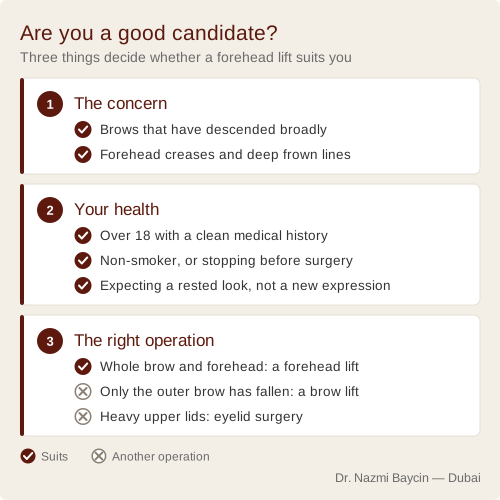 A clean medical history and good general health, free of systemic disease such as heart disease, are the foundation of safe forehead lift surgery, and the starting point of every assessment I make. Beyond that, you are likely a good candidate if your brows have descended broadly and your forehead carries horizontal wrinkles or deep frown lines that give your upper face a tired, heavy, or stern look you do not feel. What matters is the anatomy of your upper face, not your age on paper.
A few things shape the decision. If only the outer part of the brow has dropped and the forehead itself is smooth, a more limited brow lift is usually the better choice. If the heaviness sits in the upper eyelids rather than the brows, eyelid surgery is what you need — and because the two look almost identical in the mirror, I check this carefully with you. If frown lines are your only concern and your brows still sit well, injectable treatment may be enough for now. The height of your hairline and the thickness of your hair also matter, because they affect where the small incisions sit and which approach I recommend.
Good candidates also have realistic expectations: a forehead lift softens lines and restores a rested, open look, but it should never change your expression, and natural aging continues gently afterwards. Because smoking slows healing, smokers will need to stop before surgery.
Forehead lift or brow lift: which do you need?
This is the first thing I help patients sort out, because the two procedures overlap but are not the same. A brow lift is the right, more limited choice when it is only the outer part of the eyebrow that has fallen and the forehead itself is fine. A forehead lift is the better choice when the brows have drooped more broadly and the forehead carries wrinkles or deep frown lines — because it lifts the whole brow and forehead together and weakens the muscles that crease the skin, which a brow lift alone does not do. Where the upper eyelids are also heavy, a forehead lift pairs naturally with eyelid surgery, and where the mid and lower face have aged too, with a facelift. At consultation I will tell you honestly which of these genuinely fits your face, rather than reaching for the largest operation.
There is one distinction worth making before any of this, because it is the one most often got wrong: a heavy upper lid and a descended brow look almost identical in the mirror but need different operations, and removing eyelid skin will not correct a brow that has fallen. The manual test that separates them is set out in my article on telling a heavy brow from heavy eyelids.
| Factor | Forehead lift | Brow lift |
|---|---|---|
| Best for | Broad brow droop + forehead & frown lines | Outer brow descent only |
| Treats the forehead | Yes — lifts and smooths the whole forehead | No — focuses on the eyebrow |
| Softens forehead lines | Yes — weakens the line-causing muscles | Not specifically |
| Extent | Whole upper third of the face | More targeted, around the brow |
Why does Dr. Baycin prefer the endoscopic technique?
There are two ways to lift the forehead, and I almost always choose the modern one.
The classic method uses a long incision, about three to four centimeters behind the hairline, running all the way across from one temple to the other; the forehead skin is lifted, a strip of excess skin removed, and the whole closed tightly. It works, but it is invasive, so it is rarely used today — I reserve it for selected cases that need a much stronger effect.
The endoscopic technique has replaced it because it achieves the same lift through a few small incisions instead of one long one — less invasive, faster healing, and crucially no long scalp scar. The evidence behind it is reassuring: in a single-center series of 171 endoscopic forehead lifts followed for up to seven years, the 46 patients who were measured again still showed the brow sitting higher than before surgery, and the 65 who completed the validated FACE-Q scales reported high satisfaction with their forehead and eyebrows. That series handled the muscles differently and used no fixation device, so I read it as encouragement for the endoscopic approach in general rather than as a test of the technique I use.
How does Dr. Baycin perform an endoscopic forehead lift?
The endoscopic forehead lift is usually done under local anesthesia with deep sedation, or general anesthesia, and takes about an hour and a half. I make a few small incisions — each roughly one and a half to two centimeters long — just beyond the hairline, with incisions at both temples and on each side of the forehead. Through these I pass an endoscopic camera about half a centimeter in diameter, along with the fine instruments designed for endoscopic work, introduced through additional tiny cuts. Guided by the camera’s magnified view, I gently lift the skin away from the bone down to the level of the eyebrows — the camera makes this both precise and safe.
Weakening the muscles that cause forehead lines
This is the step that softens the lines, and it is what a forehead lift does that a brow lift cannot. Once the skin is lifted, I carefully weaken the muscles responsible for the forehead and frown lines by making fine scores in them — relaxing the very muscles that pull the skin into creases — which also helps release the skin so it can be re-draped smoothly. The result is not just lifted brows but a calmer, smoother forehead.
How the lifted forehead is fixed in place
With the skin freed and the muscles released, I draw the forehead upward and secure it in its new, tighter position. There are several recognized ways to fix it: some surgeons make a small tunnel in the bone and pass a stitch through it, some use small three-to-four-millimeter screws, and some use purpose-made hangers anchored to the bone with screws.
I am candid with patients that, in terms of the final result, it genuinely does not matter which of these is chosen — each holds the brow skin securely against the bone, and the outcome is the same. I close the small incisions with absorbable stitches, and because every incision sits beyond the hairline, there are no visible scars along the scalp.
Where does Dr. Baycin perform forehead lift surgery in Dubai?
I perform every forehead lift in a state-of-the-art, JCI-accredited hospital in Dubai that meets the highest international standards for safety and cleanliness. Your procedure takes place in a fully equipped, advanced surgical environment, with patient safety and natural results the first priorities at every step.
What is recovery after a forehead lift like?
Recovery is gentler than most people expect. Just a few hours after surgery, once the anesthesia wears off, you are up and moving — and you can usually go home the same day. There is no intense pain to dread; you may feel some mild discomfort, well controlled with medication, and a sensation of tension across the forehead that is completely normal and simply takes a little time to get used to. Because the skin around the eyes is delicate, it tends to swell and bruise — how much varies from person to person — and applying ice around the eyes on that first day, right up until you settle to sleep, really helps to keep both down. To understand the full science behind how I support your healing after surgery, see my advanced recovery protocol in Dubai article.
When can you return to normal life?
You will not be confined to bed for a moment. Even on the first day many patients feel well enough to look after themselves, and the more you move the better and faster you recover. Swelling and bruising generally fade within a week, and most people take about seven days of rest — though if you feel ready, you could be back at the office, a little swelling and all, after just four to five days. Traveling by plane is perfectly possible during this time too.
Download Dr. Baycin’s forehead lift aftercare instructions
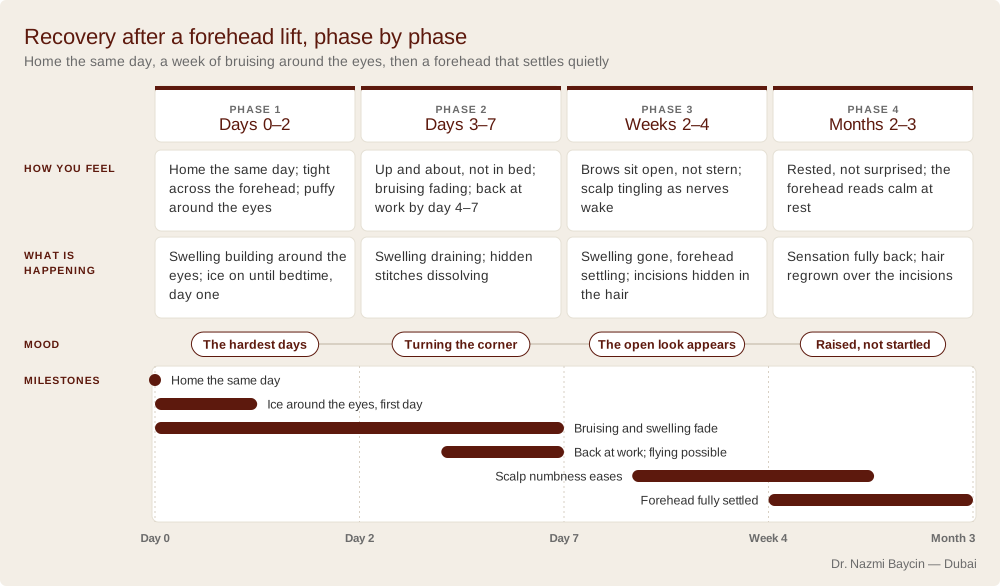
Recovery after an endoscopic forehead lift is gentler than most people expect. You are up a few hours after surgery and usually home the same day, with a sensation of tension across the forehead that is normal and passes. Because the skin around the eyes is delicate it swells and bruises, so ice through the first day makes a real difference. There is no bed rest: the more you move, the faster you recover. The bruising fades within about a week, and most people are back at work after seven days, some after four or five; flying is fine in this period. Over weeks two to four the forehead settles and the numb patches near the hidden incisions begin to tingle back to life, and by two to three months sensation has returned, the hair has closed over the scars, and the brows sit open and calm rather than lifted. The mood follows: tight and puffy, then relieved, then quietly pleased, then simply rested. The pace varies with personality; the shape rarely does.
What are the risks and complications of a forehead lift?
A forehead lift carries no serious surgical risk and its outcomes are reliably satisfying, but I believe in being complete about the minor risks even when they are uncommon. Because the incisions sit within the hair-bearing scalp, a little localized hair thinning around them can occur, though the surrounding hair almost always conceals it.
The small sensory nerves of the forehead and scalp can be temporarily affected, causing numbness or altered sensation that typically recovers on its own over some weeks to a couple of months. Swelling and bruising around the eyes are expected and settle within a week, and infection is uncommon, reduced further by good technique and care.
Rarely, a slight asymmetry between the two sides can occur, but it is usually barely perceptible. Where any complication does arise, it can be managed and treated effectively.
Forehead lift in Dubai: suitability and safety checklist
Important: This checklist helps you prepare for your consultation. It cannot decide whether surgery is safe or suitable for you. Please disclose your full medical history, medicines, and supplements when we meet — everything you share stays confidential.
- Discuss at consultation We plan around it together. Usually not a barrier on its own.
- Medical review The anesthesia team or a specialist reviews it, sometimes with tests or a clearance letter, before a date is confirmed.
- Postpone Surgery waits until this has changed or settled.
- Alternative advised This procedure is not the right fit; another option may suit you better.
| # | Question | Why it matters | If the answer is “NO” |
|---|---|---|---|
| 1 | Are you 18 or older? | Cosmetic facial surgery is offered to adults only. | Not offered |
| 2 | When you gently lift your brows with your fingertips in a mirror, do your eyes look more open and the lid heaviness ease? | If so, the brow is likely the cause. If the heaviness stays, it is more likely excess eyelid skin. | Alternative advised Eyelid surgery, or both together. |
| 3 | Has the whole brow dropped, with lines across the forehead or deep frown lines — rather than only the outer edge of the brow? | A forehead lift treats the whole upper third and the muscles that crease it; outer-brow descent alone needs a smaller operation. | Alternative advised A brow lift. |
| 4 | Is your goal a rested, natural upper face rather than a noticeably lifted one? | Lifting with restraint keeps your expression your own; over-lifting is hard to hide. | Discuss at consultation |
| 5 | Do you understand that a forehead lift softens lines but may not remove every wrinkle? | Weakening the line-forming muscles smooths the forehead; fine wrinkles may still need other care. | Discuss at consultation |
| 6 | Can you plan about a week before returning to work or social events? | Swelling and bruising around the eyes fade within about a week. | Postpone Choose a date with a week clear. |
| # | Does this apply to you? | Why it matters | Usual next step |
|---|---|---|---|
| Medical history | |||
| 7 | Heart disease, high blood pressure, or an irregular heartbeat | Sedation or general anesthesia adds strain on the heart. | Medical review |
| 8 | A previous blood clot (DVT or PE), a clotting disorder, or a close relative with clots | Surgery raises clot risk; prevention is planned around your personal risk. | Medical review |
| 9 | Diabetes | Blood-sugar control affects healing and infection risk. | Medical review |
| 10 | Asthma, other lung disease, or sleep apnea | These affect breathing under sedation or general anesthesia. | Medical review |
| 11 | Liver or kidney disease, anemia, or a bleeding disorder | These affect how medicines are cleared, bleeding, and recovery. | Medical review |
| 12 | HIV, hepatitis B or C, or another blood-borne infection | Well-controlled infection does not automatically rule surgery out; your team plans around it. | Discuss at consultation In confidence. |
| 13 | Past problems with anesthesia, or allergy to local anesthetics, antibiotics, or latex | This is done under local anesthesia with deep sedation, or general anesthesia. | Medical review |
| 14 | Previous brow, forehead, or eyelid surgery, or thread lifts in the forehead | Earlier surgery and scar tissue change how much can be lifted safely. | Medical review |
| 15 | Difficulty closing your eyes fully, dry eyes, or another eye condition | Raising the brow can affect eye closure and dry-eye symptoms, especially after eyelid surgery. | Medical review An eye assessment may be needed. |
| 16 | Facial weakness or Bell’s palsy, now or in the past, or a noticeable difference between your two brows | The nerve that raises the forehead runs nearby; existing weakness and asymmetry are recorded and planned for. | Medical review |
| 17 | Thinning hair or a high or receding hairline | This affects where the small scalp incisions are placed and how well they are hidden. | Discuss at consultation |
| 18 | Anti-wrinkle injections or fillers in the forehead or brow in the last few months | These change brow position and how the forehead muscles move, which affects planning. | Discuss at consultation |
| 19 | A rash, infection, or wound on the scalp or forehead | Operating through affected skin raises infection risk. | Postpone Until treated and healed. |
| 20 | A history of keloid or thick, raised scars | Affects how the small scalp incisions heal. | Discuss at consultation |
| 21 | Pregnant or breastfeeding | Elective surgery and anesthesia are deferred until after pregnancy and breastfeeding. | Postpone |
| Medicines and supplements | |||
| 22 | Blood thinners, aspirin, or anti-inflammatories such as ibuprofen | These increase bleeding; some are paused before surgery under medical guidance. | Medical review Never stop a prescribed medicine on your own. |
| 23 | Supplements such as fish oil, vitamin E, ginkgo, garlic, or turmeric | Several raise bleeding risk and are usually paused before surgery. | Discuss at consultation |
| 24 | Weight-loss injections such as semaglutide or tirzepatide | They slow stomach emptying, which matters for sedation or general anesthesia. | Medical review |
| 25 | The contraceptive pill, hormone therapy, or prescribed testosterone | Estrogen raises clot risk; testosterone can thicken the blood. | Medical review |
| 26 | Anabolic steroids or other performance-enhancing drugs | These affect the heart, liver, blood count, and anesthesia. | Medical review Please be open with us — it stays confidential. |
| 27 | Antidepressants or other psychiatric medication | Some interact with anesthesia or pain medicines. | Medical review Keep taking them unless your prescriber advises otherwise. |
| Lifestyle and travel | |||
| 28 | Smoking, vaping, or any nicotine — including pouches, gum, or patches | Nicotine reduces skin blood flow and slows healing. | Discuss at consultation Nicotine-free recovery period is advised. |
| 29 | Recreational drug use or regular heavy drinking | These interact with anesthesia and slow healing. | Medical review |
| 30 | Flying long-haul to Dubai for surgery, or planning to fly home soon after | Long flights add to clot risk around surgery. | Discuss at consultation We plan your travel dates with you. |
| Expectations and wellbeing | |||
| 31 | Do you spend a lot of time worrying about how your face looks, or feel no change would be enough even when others disagree? | This can be a sign of body-image distress that surgery rarely relieves. | Discuss at consultation A supportive, private conversation. |
Medical note: A medical condition, infection, or medicine does not automatically rule out a forehead lift. The decision depends on the diagnosis, how well it is controlled, the planned procedure, and assessment by the surgeon and anesthesia team. Never stop or change prescribed medication without advice from your treating clinician.
Forehead lift risks: These include swelling and bruising around the eyes, temporary numbness of the forehead and scalp, localized hair thinning near the incisions, infection, slight asymmetry, and rare, usually temporary forehead weakness. They are discussed in full at consultation.
Aesthetic note: A forehead lift raises the brows and forehead together and softens forehead and frown lines. Descent of the outer brow alone may need only a brow lift, and heaviness from excess eyelid skin needs eyelid surgery. Results vary with your anatomy, and this checklist cannot guarantee a particular result.
Checklist medically reviewed by Dr. Nazmi Baycin, DHA-licensed plastic surgeon · Checklist last updated: 21.10.2026
What are the steps of a forehead lift in Dubai from consultation to surgery?
Because a forehead lift is performed under general anesthesia or local anesthesia with deep sedation, the path from your first visit to your procedure follows five steps. Each one is there to confirm that surgery is both safe and right for you.
- Consultation: I assess whether the whole brow and forehead have aged or only the outer brow, check whether the true problem is the brow or the upper eyelids, and tell you honestly whether a forehead lift, a brow lift, or a combination genuinely fits your face. Consultations are paid, and this is where your exact pricing is confirmed.
- Booking the procedure: Once you decide to proceed, we reserve your surgery date. Procedures are scheduled within 2–10 days, depending on the hospital’s operating theater (OT) availability.
- Preoperative blood tests: Routine blood tests are carried out before surgery to confirm that you are in good general health for general anesthesia or sedation.
- Preoperative anesthesia consultation for clearance: The anesthesiologist reviews your test results and medical history and gives clearance for general anesthesia or sedation.
- Procedure: Your forehead lift is performed endoscopically in a JCI-accredited hospital and takes about 1.5 hours (up to 2 if combined). The hospital stay is a day case — usually home the same day.
How much does a forehead lift cost in Dubai, UAE?
Forehead lift prices in Dubai can differ significantly from clinic to clinic, generally ranging from 15,000 AED ($4,100) to 30,000 AED ($8,200) based on various factors.
Keep in mind that these prices aren’t what Dr. Baycin charges; you’ll find out the precise cost during your consultation once he assesses your situation.
For a complete overview of treatment fees, please refer to full price list of the procedures.
Schedule your private consultation with Dr. BaycinWhat makes Dr. Baycin an exceptional forehead lift surgeon in Dubai?
Rejuvenating the upper face well takes more than lifting skin — it takes judgment about brows, muscles, and proportion, and the restraint to keep a face looking like itself. That is the standard Dr. Baycin brings to every forehead lift.
- 25+ years of facial-surgery expertise: a board-certified plastic surgeon, DHA-licensed and a member of the American Society of Plastic Surgeons (ASPS), with deep experience across the full range of upper-face rejuvenation.
- A committed endoscopic approach: mastery of the minimally invasive, camera-guided technique that lifts the forehead and brows and softens lines through small hidden incisions, with no long scalp scar.
- Natural, expression-preserving results: every forehead lift is planned to refresh the upper face without an “overdone” look, keeping your own expression intact.
- Honest, transparent consultations: clear guidance on whether a forehead lift, a simpler brow lift, or a combination genuinely fits your face — never an unnecessary operation.
- Muscle-aware technique: careful weakening of the muscles that cause forehead and frown lines, for a smoother result that a brow lift alone cannot achieve.
- An uncompromising safety record: thousands of cosmetic surgeries performed to the highest standards in JCI-accredited hospitals.
- Comprehensive aftercare: structured follow-up and direct surgeon access throughout your recovery.
- A trusted international reputation: patients travel from Europe, the GCC, and beyond for his facial-rejuvenation results in Dubai.
- Artistry with empathy: an understanding that rejuvenating the face is about restoring confidence, with every patient treated with care and respect.

Written and medically reviewed by
About Dr. Nazmi Baycin
DHA-licensed, board-certified plastic surgeon, Dubai
- 25+ years in practice
- 7,000+ procedures
- JCI-accredited hospitals
- ASPS international member
Surgery, to me, is precision applied in service of restoration — a conviction that has guided every one of the more than 7,000 procedures I have performed over 25 years in practice. I am a DHA-licensed, board-certified plastic surgeon, trained in Turkey and based in Dubai since 2016. I operate exclusively within JCI-accredited hospitals, and hold international membership in the American Society of Plastic Surgeons (ASPS). Three techniques, in particular, have become signatures of my practice. Scarless breast augmentation, performed through a transaxillary approach that leaves no incision on the breast itself. Labiaplasty designed individually around each patient’s own anatomy, never to a standard template. And 3D customized facial bone implants, engineered through CT-based bespoke printing — a technique I currently offer as the only surgeon in Dubai providing it. My practice today spans facial rejuvenation, breast surgery, body contouring, and cosmetic genital procedures, drawing patients from across the UAE, Europe, and the wider GCC. Yet the principle guiding each of these specialties has never changed: to restore form is to restore function.
FAQs about forehead lift in Dubai
-
What is a forehead lift?
A forehead lift is how I rejuvenate the upper third of the face, raising a heavy, sagging forehead and brows while softening the deep frown lines between the eyebrows and the horizontal wrinkles across the forehead. It refreshes a tired or stern-looking upper face and restores a more open, rested expression. I most often use a minimally invasive, camera-guided endoscopic technique, lifting with restraint so the result looks naturally refreshed and unmistakably your own, never surprised or over-lifted.
-
How much does a forehead lift cost in Dubai?
Forehead lift prices in Dubai can differ significantly from clinic to clinic, generally ranging from AED 15,000 to AED 30,000 based on various factors. These are general market figures, not Dr. Baycin’s personal rates; the precise amount is confirmed at your consultation, once your situation has been assessed.
-
What is the difference between a forehead lift and a brow lift?
This distinction matters, because the two solve related but different problems. A forehead lift addresses the whole upper third, raising the forehead and brows together and smoothing forehead wrinkles and frown lines. A brow lift focuses specifically on repositioning the eyebrows. If your concern is a heavy forehead with descent of the whole area, a forehead lift is usually the better choice; at consultation I tell you honestly which genuinely fits your anatomy.
-
Is an endoscopic forehead lift better than the classical method?
Each has its place, and I am fluent in both. The endoscopic technique is the one I most often prefer: through a few small incisions beyond the hairline, a camera shows me every structure in fine detail, so I can release and lift the tissue while avoiding even the tiniest nerves and vessels, with smaller incisions and a quicker recovery. The classical method, with a longer incision across the scalp, is invasive and rarely used today; I reserve it for selected cases that need a much stronger effect.
-
How does a forehead lift soften frown lines?
This is one of the most satisfying parts of the operation, and it works at the source. The deep vertical frown lines between the brows and the horizontal lines across the forehead are created by the repeated pull of specific muscles. During the lift, I carefully weaken or adjust those muscles, the corrugators that knit the brows and the frontalis that raises them, so the lines soften from within. It is a lasting, surgical way to ease expression lines that creams and injectables only treat temporarily.
-
Will a forehead lift leave a visible scar?
Scarring is minimal, because the endoscopic incisions are small and every one of them sits beyond the hairline, where your hair conceals it, and I close with hidden, absorbable stitches. There is no long scalp incision and no visible scar, and as the hair grows back over the small incisions they become very difficult to find.
-
How long is recovery after a forehead lift?
One of the pleasures of this procedure is how manageable the recovery is. You go home the same day, and because it is performed under local anesthesia with deep sedation, or general anesthesia, discomfort is minimal. In the first few days you may notice some swelling and bruising around the forehead and eyes, but these fade within about a week, and you can shower just a couple of days after surgery. The refreshed look emerges over the following weeks.
-
Will a forehead lift change my expression?
No, and preserving your natural expression is central to how I work. The upper face carries so much of how we are read, so the difference a few millimeters makes is profound, and so is the danger of overdoing it. Performed with restraint, a forehead lift lifts away the heavy, tired, or stern look while keeping you recognizably yourself, never startled or over-lifted. Lifting with precision rather than excess is exactly what careful technique is there to protect.
-
How long does a forehead lift last?
A surgical forehead lift gives lasting results, because I reposition the tissues structurally and address the muscles at their source, unlike temporary, non-surgical options. While natural aging continues gently over the years, the elevation and the softening of frown lines hold well over the long term. In one published series, the 46 patients who were measured again between three and seven years after an endoscopic forehead lift still had their brows sitting appreciably higher than before surgery. For many patients the improvement is effectively long-lasting, and it far outlasts creams or injectable treatments aimed at the same lines.
-
Where are the forehead lift incisions placed?
Always beyond the hairline, where your hair conceals them. In the endoscopic forehead lift I work through a few small incisions, each roughly one and a half to two centimeters long, at both temples and on each side of the forehead, so there is no long scalp incision and no visible scar. Even the classic open lift, which I reserve for selected cases that need a much stronger effect, places its longer incision about three to four centimeters behind the hairline.
-
Am I a good candidate for a forehead lift?
You are likely a good candidate if your forehead and brows have begun to sag with age, or if deep frown lines and forehead wrinkles give your upper face a tired, heavy, or stern look you do not feel. Good general health, free of systemic disease such as heart disease, is the foundation of safe surgery and my starting point. You must be over 18, but there is no strict upper age limit; what matters is that your health permits the procedure, which we confirm together at consultation.
-
Can a forehead lift in Dubai be combined with other procedures?
Yes, very often, and it pairs naturally with the rest of upper-face rejuvenation. A forehead lift combines beautifully with eyelid surgery, since a heavy brow and hooded lids frequently go together, and with a facelift for full, balanced facial rejuvenation in a single recovery. At consultation I assess your whole face and plan the combination that best suits your features and your goals.
What patients say


Book a forehead lift consultation in Dubai
Get ready to look and feel best… You deserve…
