

Key takeaways: prevention, sequencing, and the right candidate
- J-Plasma (helium plasma) is a tool for preventing skin laxity after liposuction, not correcting severe laxity later.
- It works best immediately after liposuction, while the tissue planes are open.
- Sequence is critical: liposuction first, J-Plasma second — never the reverse.
- It suits mild-to-moderate laxity — the middle ground between liposuction alone and a lift.
- It does not replace a tummy tuck, arm lift, or thigh lift where skin is truly excess.
- The tightening matures over three to six months as collagen remodels.
In Dubai, J-Plasma has become a valuable tool when used at the correct time, in the correct patient, and in the correct sequence. It does not replace liposuction, and liposuction does not replace it. Its strength lies in preventing skin laxity after fat removal, not rescuing severe laxity afterward. I use it not as a universal add-on, but as a precision instrument for select patients where my assessment predicts poor skin retraction. Below I explain when it meaningfully improves outcomes, how the combination works, and why sequencing determines success.
Why skin becomes loose after liposuction
Liposuction removes volume, and the skin must then contract to fit the new contour. That contraction depends on several things: baseline skin elasticity, collagen quality, age, genetic factors, and the degree of fat removed. When elasticity is limited, the skin envelope fails to retract fully, leaving waviness, creasing, or sagging — most visible where gravity and movement place constant stress on the skin.
A common mistake I see is surgeons removing maximum fat volume with no realistic plan for the skin, hoping it will bounce back. My approach is different. At consultation I perform a detailed skin-quality and pinch-test assessment, which identifies who will benefit from a combined liposuction and J-Plasma strategy versus who needs a skin-excision procedure from the start.
What is secondary skin laxity?
Secondary skin laxity is new looseness that appears after liposuction, even when the skin looked acceptable beforehand. It is most common in patients over 35, post-pregnancy patients, those with prior weight fluctuations, and areas with thin or sun-damaged skin. Crucially, this laxity is often mild to moderate, not severe — and that is exactly the range where J-Plasma is most effective. Many patients fall into a middle ground, where a tummy tuck is too much but liposuction alone is not enough. It is for these patients in Dubai that the integrated approach offers an ideal solution.
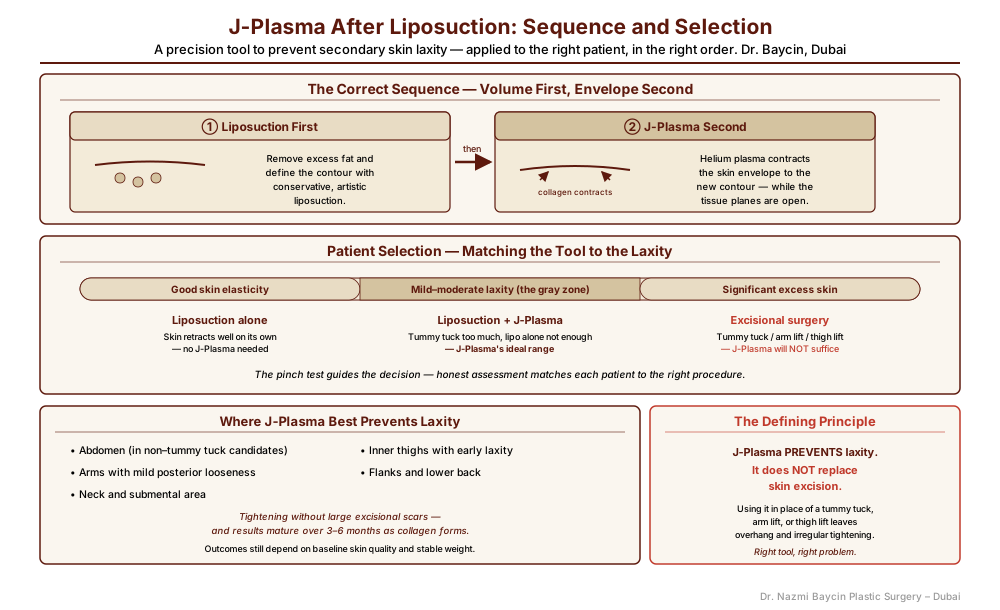
The correct sequence — liposuction first to remove fat and define the contour, then J-Plasma to contract the open skin envelope to the new shape — and the candidacy split: mild-to-moderate laxity (the gray zone) suits combined liposuction and J-Plasma, while significant excess skin needs an excisional lift — by Dr. Nazmi Baycin, Dubai.
Why J-Plasma works best immediately after liposuction
J-Plasma contracts collagen most effectively when applied immediately after fat removal, while the tissue planes are still open and accessible. At that stage the skin envelope is already separated, energy delivery is uniform, collagen fibers respond more predictably, and tissue contraction happens in real time. Waiting months or years reduces effectiveness, because scar tissue forms and collagen remodeling has already stabilized.
This is why J-Plasma is best seen as a preventive adjunct, not a delayed correction. In my protocol, the transition from liposuction to J-Plasma is a single, continuous step: I thermally contract the tissue bed precisely where I have just removed fat, tailoring the skin envelope to the new contour before closing.
That seamless integration cannot be replicated in a separate, staged procedure. Because helium-plasma energy delivers real thermal effect to soft tissue, technique and dosing matter for safety. A multicenter retrospective review of 192 patients treated with helium-based plasma, alone or with ultrasound-assisted liposuction, recorded no serious adverse events; some adverse event occurred in 24% of patients, most often seroma at 6.8%, and seroma appeared only where liposuction had also been performed — never where the plasma was used on its own. The setting that mattered most was not the plasma but the ultrasound liposuction power: above 70%, the odds of an adverse event were 7.63 times those at 40–70%, which is why the authors advise restraint when stacking energy sources in the same tissue. Two things to weigh with it: the study was funded by the device manufacturer, with two of its three authors consulting for that company, and mean follow-up was only three months. For the underlying tissue-contraction science — exactly how the plasma energy remodels collagen — see my companion article on how J-Plasma tightens the skin.
Why sequencing matters
Correct sequencing is critical: liposuction first, to remove excess fat and define the contour; J-Plasma second, to contract the skin envelope to the new shape. Reverse that order, or use J-Plasma alone, and the result suffers. J-Plasma cannot tighten skin that is still stretched over excess fat volume.
My planning always follows the same hierarchy — first address volume, then address the envelope — so each action builds on the last toward a cohesive, stable result. For patients seeking comprehensive contouring, understanding this refined approach to J-Plasma treatment in Dubai is key to setting realistic expectations.
Where J-Plasma most effectively prevents laxity
J-Plasma is particularly useful after liposuction in areas prone to mild-to-moderate laxity: the abdomen (in non–tummy-tuck candidates), arms with mild posterior looseness, the neck and submental area, inner thighs with early laxity, and the flanks and lower back.
In these zones, it often makes the difference between an acceptable result and a visibly tightened one, without large excisional scars. I find it exceptionally valuable in the neck and inner thighs, where even minor laxity can be a patient’s primary complaint. By combining meticulous liposuction with targeted J-Plasma energy, I can achieve a more defined jawline or a smoother inner-thigh contour than either technology could deliver alone. This is the same balance of technology and hand-skill that governs my liposuction surgery in Dubai.
Why J-Plasma does not replace skin excision
It must be said clearly: J-Plasma does not replace a tummy tuck, arm lift, or thigh lift in patients with excess skin. Using it in place of excisional surgery — a misapplication I sometimes see in revision cases — leads to persistent skin overhang, irregular tightening, and patient dissatisfaction.
J-Plasma prevents secondary laxity; it does not remove existing redundancy. That distinction defines ethical practice. At consultation I am direct: if your skin pinch test exceeds a certain threshold, I will recommend the appropriate excisional lift. My commitment is to your optimal outcome, not to selling a technology that cannot meet your anatomical needs.
Combined approaches vs. over-treatment
One advantage of combining liposuction with J-Plasma is that it avoids over-aggressive fat removal. The surgeon does not have to chase tightness by removing excessive fat, which can cause surface irregularities, visible muscle outlines, and an unnatural, aged appearance. Instead, contour comes from balanced fat reduction and controlled skin contraction.
My technique is conservative, artistic fat removal to create a smooth substrate, followed by J-Plasma to secure the result. That avoids the over-defined or irregular look that occurs when surgeons rely on liposuction alone to create tightness.
The combined liposuction and J-Plasma sequence
Because the benefit depends entirely on doing things in the right order at the right moment, it helps to see the combined procedure as a single sequence in which each stage sets up the next. The table below sets out what happens at each stage and how it works to prevent laxity rather than chase it later.
| Stage | What I do | Why it prevents laxity |
|---|---|---|
| Liposuction (first) | Remove the excess fat, define the new contour, and open the tissue planes. | Establishes the smaller shape the skin must redrape to, and opens the plane J-Plasma needs to reach. |
| J-Plasma (immediately after, same session) | Thermally contract the open skin envelope onto the freshly defined contour. | Collagen contracts in real time while the planes are still open and blood supply is intact — the point at which retraction is most achievable. |
| First six weeks | Compression garment and managed swelling. | Supports the contracting envelope while early healing sets; the tightening is still masked by swelling at this stage. |
| Three to six months | No further intervention — the tissue remodels on its own. | New collagen matures, and the final tightened contour becomes progressively apparent. |
Recovery and result evolution
Immediately after surgery, swelling masks the tightening effect. Over the next three to six months, collagen remodeling continues, skin firmness improves gradually, and the final contour becomes more apparent. This delayed improvement is often misunderstood by patients expecting instant tightening, so education at consultation is essential. I give every patient a clear timeline, so they understand the tightened result matures over several months as new collagen forms. Because every case is individual, the plan and its cost are discussed transparently at consultation, and this measured, technology-with-skill philosophy runs through all of my plastic surgery in Dubai.
FAQs about J-Plasma after liposuction in Dubai
-
Does J-Plasma replace a tummy tuck or skin excision surgery?
No. This is the most important distinction I make. J-Plasma prevents secondary skin laxity after liposuction; it does not remove existing excess skin. In patients with significant skin redundancy — for example after massive weight loss — a tummy tuck, arm lift, or thigh lift is required, and using J-Plasma in its place leads to persistent overhang and irregular tightening. J-Plasma is ideal for mild-to-moderate laxity, the middle ground, not for genuine excess skin. A pinch test at consultation determines which you need.
-
Is J-Plasma done at the same time as liposuction or separately?
J-Plasma is most effective when performed immediately after liposuction, in the same operation. At that moment the tissue planes are open and accessible, energy delivery is uniform, collagen responds predictably, and the skin contracts in real time as the surgeon works. Performing it months or years later is far less effective, because scar tissue has formed and collagen remodeling has stabilized. I treat the transition from liposuction to J-Plasma as a single continuous step within one well-planned procedure.
-
Why does the sequence — liposuction first, then J-Plasma — matter?
Because J-Plasma cannot tighten skin that is still stretched over excess fat. The volume must be corrected first so the skin envelope can then be contracted to the new, smaller contour. Reversing the order, or using J-Plasma alone over un-treated fat, produces inferior results. My rule is always volume first, envelope second — each step builds on the previous one for a cohesive, stable result.
-
How long does J-Plasma take to tighten the skin?
The tightening is gradual, not instant. Immediately after surgery, swelling masks the effect. Over the following three to six months, collagen remodels, skin firmness improves, and the final contour becomes progressively more apparent. Many patients are surprised that the result continues to improve over months — which is why I provide a clear timeline so expectations match the natural pace of collagen formation.
-
What areas benefit most from J-Plasma after liposuction?
J-Plasma is particularly effective after liposuction in areas prone to mild-to-moderate laxity: the abdomen (in patients who are not tummy tuck candidates), arms with mild posterior looseness, the neck and submental area, inner thighs with early laxity, and the flanks and lower back. I find it especially valuable in the neck and inner thighs, where even minor laxity can be a patient’s main concern and where the combination achieves what either technique alone could not.
-
Does combining J-Plasma with liposuction reduce the risk of an over-operated look?
Yes. Having a skin-tightening tool available means the surgeon does not have to over-remove fat to chase tightness — a practice that can cause surface irregularities, visible muscle outlines, and an unnatural, aged appearance. I perform conservative, artistic fat removal to create a smooth substrate, then use J-Plasma to secure the result. The combination permits restraint with both techniques, producing a smoother and more natural contour than aggressive liposuction alone.


GET APPOINTMENT
Get ready to look and feel best… You deserve…
