

Key takeaways: the surgeon, not the machine, defines the result
- VASER is a better tool, but its advantages are only realized in skilled hands.
- The technology has no judgment — it cannot decide where to sculpt or how much to preserve.
- Results from the same machine vary dramatically depending on who operates it.
- Fat is layered, living tissue; treating every layer identically is a core technical mistake.
- The result is sculpted by cannula artistry — fine strokes, cross-tunneling, feathered edges.
- Over-aggressive removal damages the stromal network that skin retraction depends on.
Here in Dubai, where advanced technologies are heavily marketed, this distinction matters. The gap between a smooth, natural contour and an irregular, operated look is carved by the practitioner’s expertise — not the device’s specifications.
What VASER technology does, and does not do
The VASER system uses targeted ultrasound energy to selectively emulsify fat cells. Its design spares surrounding nerves, blood vessels, and the connective-tissue stromal network. That allows gentler fat removal and can encourage better skin retraction than traditional methods; a 2022 series of 261 third-generation ultrasound-assisted liposuction cases reported it to be a safe and effective approach in experienced hands. But its capabilities are strictly circumscribed, because the technology has no inherent judgment. It cannot discern where to sculpt for an athletic, natural silhouette. It cannot determine how much fat to remove from each layer to maintain support. And it cannot create the feathered transitions between anatomical zones that prevent a stamped-on look.
Those decisions live solely in the surgeon’s domain. That is why results can vary so widely — not because of the machine, but because of the very different levels of skill operating it.
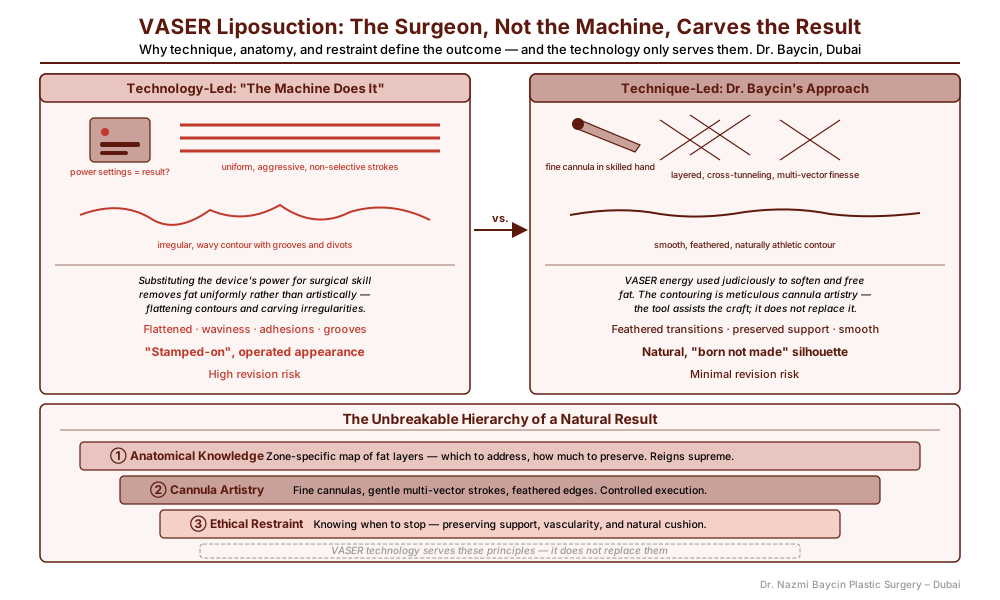
A technique-led approach — layer-specific selective removal, fine multi-vector cannula work, feathered edges, and a preserved stromal network — produces a smooth, natural contour, while a technology-led approach that leans on the machine produces wavy, irregular, grooved results — by Dr. Nazmi Baycin, Dubai.
The common pitfall: mistaking energy for expertise
A frequent and consequential error — obvious in the revision cases I treat in Dubai — is over-reliance on the device’s power settings. Surgeons who substitute technology for technique remove fat uniformly rather than artistically. The result is predictable: flattened, unnatural contours that lack the subtle topography of the human body; visible irregularities, grooves, and adhesions from aggressive, non-selective disruption; and a loss of the soft-tissue dynamics that give a healthy, athletic look.
My approach inverts this logic. I use VASER energy judiciously, as a precise way to soften and liberate fat cells. The actual contouring is an act of meticulous cannula artistry. The tool assists the craft. It does not replace it.
Anatomical intelligence: the true foundation of contouring
Fat is not an inert filler. It is a structured, living tissue organized in distinct layers and compartments, and treating it all identically is a profound technical mistake. In the superficial layer, aggressive or uneven removal risks visible waviness, adherent skin, and irreversible contour shadows. In the deep layer, failing to address the compartment adequately leaves bulk unresolved and undermines the definition the patient wants.
My technique is governed by a detailed, zone-specific anatomical map. For each area — abdomen, flanks, thighs, or chest — I follow a specific plan: which layer to address, and, crucially, how much to preserve to maintain natural cushion, skin support, and vascular health.
Cannula artistry: where the result is actually sculpted
The VASER machine prepares the canvas; the cannula in the surgeon’s hand creates the sculpture. Poor technique shows itself as large, aggressive strokes and inconsistent depth control, which carve grooves and divots into the subcutaneous landscape. My method is one of layered, cross-tunneling finesse. I use fine, specialized cannulas. I work in deliberate, gentle movements across multiple intersecting vectors. And I feather the edges of each treatment zone to forge seamless, invisible transitions.
That disciplined execution is what separates a refined, naturally athletic silhouette from an obviously surgical one. The same restraint governs my approach to high-definition work, where imposing harsh, stark shapes ages badly — a point I explore in my article on why over-etching ruins abdominal definition in Dubai.
The reality behind high-definition and skin-tightening promises
High-definition liposuction is often marketed for dramatic six-pack etching. It is precisely where restraint matters most. Performed without anatomical subtlety, it creates artificially harsh muscle outlines that look unnatural and age poorly. My philosophy is to enhance the muscular anatomy that already exists, not to impose arbitrary shapes.
Skin tightening carries a similar caveat. VASER can aid retraction by preserving the connective-tissue framework, but it is not a primary skin-tightening procedure. Paradoxically, over-aggressive fat removal damages the very stromal network that drives contraction, producing laxity. Real improvement in skin drape is earned through conservative, tissue-respecting technique that lets the envelope adapt.
Technique-led versus technology-led: a comparison
| Factor | Technique-Led (Dr. Baycin) | Technology-Led Approach |
|---|---|---|
| Core belief | Surgeon defines the result | Machine defines the result |
| Fat removal | Layer-specific, selective | Uniform, non-selective |
| Cannula strokes | Fine, gentle, multi-vector | Large, aggressive, linear |
| Fat layer approach | Zone-specific anatomical map | Same approach everywhere |
| Edges | Feathered, seamless transitions | Abrupt, stamped-on |
| Skin support | Stromal network preserved | Often damaged |
| High-definition | Enhances natural anatomy | Imposes harsh stark shapes |
| Contour result | Smooth, natural, athletic | Wavy, irregular, grooved |
| Revision risk | Minimized | Elevated |
Why revision surgery underscores the primacy of technique
Revision VASER liposuction is among the most demanding procedures I perform. It routinely addresses problems forged by poor primary technique: dense scar tissue and fibrosis, uneven fat layers, and compromised skin elasticity. These cases offer the clearest testimony of all — the most advanced technology cannot compensate for a deficiency in foundational surgical skill. The safest path is to choose a surgeon whose meticulous technique minimizes the risk of needing revision at all.
The unbreakable hierarchy: surgeon first, tool second
VASER is a powerful adjunct in modern body contouring. But natural, balanced, aesthetically coherent results follow a hierarchy: the surgeon’s anatomical knowledge reigns supreme, followed by controlled cannula artistry and ethical restraint. The technology serves those principles, never the other way around.
For patients who want contouring that looks born, not made, the choice is clear — choose the surgeon first, the tool second. Because every body is individual, the plan and its cost are discussed transparently at consultation. This technique-first philosophy is the thread running through my VASER liposuction in Dubai, and through my wider aesthetic surgery clinic based in Dubai.
FAQs about VASER technology vs. surgeon’s skill
-
Is VASER liposuction better than traditional liposuction?
VASER offers genuine advantages over traditional liposuction: its ultrasound energy selectively emulsifies fat while sparing nerves, blood vessels, and connective tissue, which allows gentler removal and can improve skin retraction. However, these advantages are only realized in skilled hands. The technology is a better tool, but the result still depends almost entirely on the surgeon’s technique, anatomical judgment, and artistry — not on the machine alone. A skilled surgeon using traditional liposuction will produce a far better result than an unskilled one using VASER.
-
Does the VASER machine guarantee a good result?
No. This is the most important misconception I address with patients. The VASER machine possesses no judgment — it cannot decide where to sculpt, how much fat to remove from each layer, or how to create natural transitions. Those decisions, which determine the entire outcome, belong to the surgeon. Results from the same machine vary dramatically depending on who is operating it. You must choose the surgeon first and the technology second.
-
Does VASER liposuction tighten skin?
VASER can aid skin retraction by preserving the connective tissue framework, which is a genuine advantage — but it is not a primary skin-tightening procedure and should not be marketed as one. There is a paradox: over-aggressive fat removal damages the stromal network that enables skin contraction, producing more laxity, not less. Genuine improvement in skin drape comes from conservative, tissue-respecting technique that lets the skin adapt naturally. For significant skin laxity, a skin-tightening or excisional procedure may be needed alongside or instead of VASER.
-
Why do VASER results vary so much between surgeons?
Because the machine is largely identical from clinic to clinic, but the skill operating it is not. The outcome depends on a hierarchy of surgeon-controlled factors: anatomical knowledge of the fat layers, the artistry of cannula technique, and the restraint to know how much to remove and preserve. A surgeon who relies on the machine’s power rather than their own technique produces flattened, irregular results; a surgeon who uses the machine judiciously and sculpts by hand produces natural ones. The variation is entirely about the surgeon.
-
What causes lumpy or uneven results after VASER liposuction?
Contour irregularities — lumps, grooves, waviness, and adhesions — are almost always caused by poor technique rather than the machine: large aggressive cannula strokes, inconsistent depth control, non-selective fat removal, and over-aggressive disruption of the superficial fat layer. I prevent these through fine cannulas, gentle multi-vector cross-tunneling, careful preservation of the superficial layer, and meticulous feathering of treatment zone edges. These irregularities are difficult to correct once formed, which is why prevention through technique matters so much.
-
How do I choose the right VASER liposuction surgeon in Dubai?
Look for a surgeon who talks about their technique and anatomical approach rather than primarily marketing the machine. Ask how they approach the different fat layers, how they avoid contour irregularities, and what their philosophy is on how much to remove versus preserve. Ask to see their results across a range of patients with your body type. A surgeon who answers these specifically and shows consistent results understands that the outcome is in their hands — which is exactly the surgeon you want.
-
Can a bad VASER liposuction result be revised?
Yes, but revision VASER liposuction is among the most demanding procedures in body contouring. It must address problems created by poor primary technique — dense scar tissue and fibrosis, uneven fat layers, and compromised skin elasticity — with no guarantee of fully restoring a smooth contour. This difficulty is precisely why I emphasize choosing a surgeon whose meticulous technique minimizes the risk of needing revision in the first place. Prevention is far preferable to correction.


GET APPOINTMENT
Get ready to look and feel best… You deserve…
