

Table of content
- What are the key takeaways about sculpting abdominal definition?
- What distinguishes a high-definition tummy tuck from a standard one?
- Why is muscle repair the foundation of abdominal definition?
- How does the muscle repair create the columns, midline and V-line?
- Why is the fat layer kept rather than thinned?
- When is liposuction added to a high-definition tummy tuck?
- Who benefits most from a high-definition tummy tuck?
- Where can you read more about each part of a tummy tuck?
- What do patients ask about high-definition abdominal sculpting?
- Get appointment
This article covers how abdominal definition is sculpted, stage by stage; the tummy tuck techniques, candidacy, recovery, scar and risks are covered on tummy tuck in Dubai, how the skin is redraped to shape the waist in strategic skin redraping, and the navel in high-definition abdominoplasty with natural umbilicoplasty.
What are the key takeaways about sculpting abdominal definition?
- The definition comes from the midline muscle repair itself, not from liposuction.
- It is not an artificial six-pack; it reveals the natural columns, midline and V-line.
- The muscle repair is the non-negotiable foundation for stable definition.
- The fat layer over the wall is kept, so the shape beneath reads as soft shadows.
- Liposuction is optional, added only where fat reduction is needed.
- Best suited to patients near their target weight with loose skin or separated muscles.
What distinguishes a high-definition tummy tuck from a standard one?
A high-definition tummy tuck is distinguished from a standard one by what is done with the effect the muscle repair has on the tissue above it: when the separated muscles are plicated along the midline, the fat lying on either side of the midline is drawn toward it as well, and as that fat settles into its new position the muscle columns show through inherently. A standard tummy tuck closes the muscles and leaves it there; the high-definition version plans the repair, the fat layer and the skin redraping so that the effect is preserved and read, and the result is a subtle two-pack or muscle-column contour, a highlighted midline and a lower abdomen that tapers into a V, with the abdomen flowing into the waist.
| Feature | Standard tummy tuck | High-definition tummy tuck | Abdominal etching |
|---|---|---|---|
| Excess skin removal | Yes | Yes | No |
| Muscle repair (diastasis recti) | Yes, closed flat | Yes, with the effect on the fat above it preserved | No |
| How the definition is created | Not created | By the midline repair drawing the paramedian fat inward beneath a preserved fat layer | By removing fat along the muscle lines |
| Liposuction | Optional, where fat reduction is needed | Optional, where fat reduction is needed | The procedure itself |
| Muscle border and V-line definition | No | Yes, subtle | Yes, carved |
| Suited to post-pregnancy laxity | Yes | Yes | No |
How to read this table: read down the middle column to see what the high-definition version adds to a standard tummy tuck, and across the last two columns to see how it differs from etching, which creates definition by removing fat without removing skin or repairing muscle; what each procedure involves in full is on my pages on tummy tuck in Dubai and abdominal etching in Dubai.
Why is muscle repair the foundation of abdominal definition?
Muscle repair is the foundation of abdominal definition because the shadows that define a sculpted abdomen are cast by the muscle wall beneath, and a separated, slack wall casts none. Many patients, especially after pregnancy, have a separation of the rectus muscles, and closing it is the cornerstone of the procedure. My repair is layered and tension-controlled, and it does more than close a gap: it reconstructs the natural corset of the abdomen from the breastbone to the pubic bone, recreating the inherent V-shape or hourglass of the torso. Why a layered repair holds for the long term is the subject of my article on structural abdominoplasty, and the repair itself is described on my page on diastasis recti repair in Dubai.
How does the muscle repair create the columns, midline and V-line?
The muscle repair creates the columns, midline and V-line because plicating the muscles along the midline does not only close the gap: it also draws the paramedian fat, the fat lying on either side of the midline, toward the midline with it. As that overlying fat adapts to its new position over the weeks that follow, the two rectus columns show through as soft vertical lines, the midline between them reads as a subtle groove, and the lower abdomen, where the repair runs down to the pubic bone, tapers into a V. Nothing is carved into the surface and no fat is removed to make it; the effect appears inherently from the repair, and the fat layer kept over the wall is what turns it into soft shadows rather than lines.
| Feature | How the repair creates it | How it reads on the surface |
|---|---|---|
| Muscle columns | The midline plication draws the paramedian fat toward the midline; the columns show as the fat settles | Two soft vertical lines, the two-pack or muscle-column effect |
| Midline (linea alba) | The closed midline sits between the two approximated columns and reads as a subtle groove | A subtle vertical line that shows in movement and blends at rest |
| Lower V-line | The repair runs down to the pubic bone, and the lower abdomen tapers with it | A V-shaped taper of the lower abdomen |
| Waist transition | The repair narrows the wall; the skin is then redraped to the new waist | An abdomen that flows into the waist rather than sitting as a defined island |
How to read this table: every row follows from the midline repair, not from removing fat; the last row is finished by the skin redraping, which is the subject of my article on strategic skin redraping.
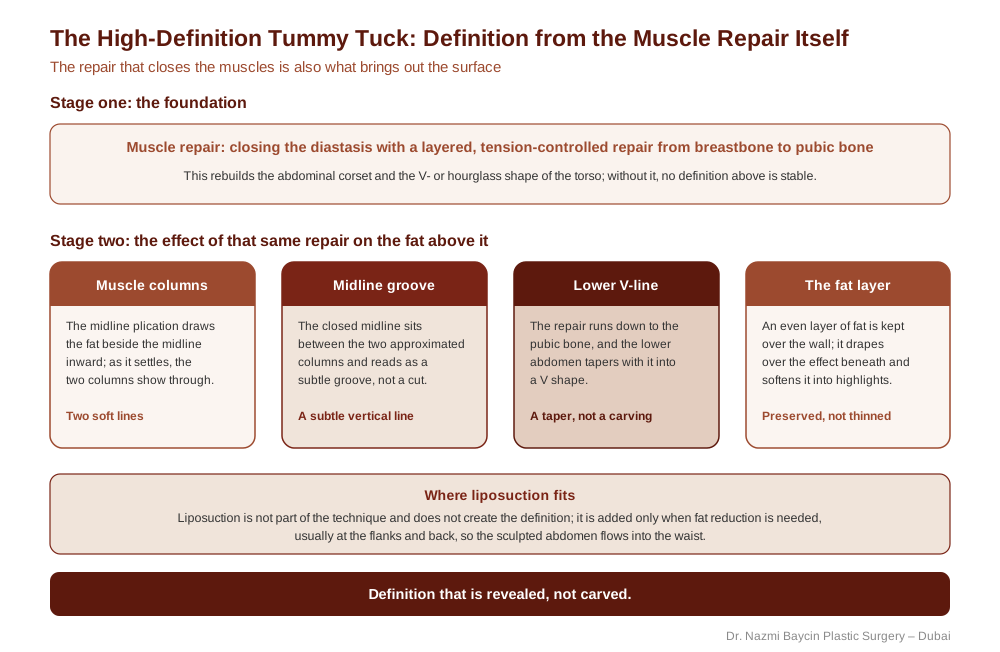
The two stages of a high-definition tummy tuck: the muscle repair that rebuilds the corset, and the effect of that same repair on the fat above it, which reveals the columns, the midline and the lower V-line beneath a preserved layer of fat, by Dr. Nazmi Baycin, Dubai.
Why is the fat layer kept rather than thinned?
The fat layer over the muscle wall is kept rather than thinned because it is what turns the effect of the repair into soft, natural highlights; fat removed uniformly, or etched directly over the lines, gives the gouged look of overdone surgery. The even layer drapes over the contour beneath it and softens it, so the definition is visible when you stand and move and blends seamlessly at rest. That is also why I never etch the linea alba or the V-line into the surface: the lines arise from the repair beneath and are revealed through the fat, not cut into it. Why over-etching ruins definition, and how preserving the natural fat planes prevents it, is set out in my article on why over-etching ruins abdominal definition.
When is liposuction added to a high-definition tummy tuck?
Liposuction is added to a high-definition tummy tuck only when fat reduction is needed, usually at the flanks and back, so that the sculpted abdomen flows into the waist rather than sitting as an isolated, defined island. It is not a standard part of the technique and it does not create the definition. Combining the two operations is well described in the literature: a 2018 series of 593 consecutive liposuction-assisted abdominoplasties reported no venous thromboembolism, no postoperative respiratory complications and no hospital transfers, with results the authors judged to compare favorably with abdominoplasty outcomes published elsewhere. It is a single-surgeon series without a control group, so it shows that the combination can be performed safely in experienced hands rather than that it is superior. Why treating the front alone leaves a boxy torso is explained in my article on combined tummy tuck and liposuction, and the sculpting of the flanks and back itself is covered on my page on liposuction in Dubai.
Who benefits most from a high-definition tummy tuck?
A high-definition tummy tuck benefits most the patient who is at or near target weight but is held back by loose skin and separated muscles, often after pregnancy, and who wants an athletic contour rather than simply a flatter abdomen. Because the definition is created by the repair rather than by the patient’s own muscle development, it does not depend on underlying muscle tone. It is not a substitute for significant weight loss. Candidacy in full, with the health requirements, is on my page on tummy tuck in Dubai. When performed with anatomical respect and restraint, the result is stable and natural: the repaired wall provides lasting support and the contours mature gracefully, a standard of measured, anatomical sculpting that runs through all of my plastic surgery work in Dubai.
Where can you read more about each part of a tummy tuck?
This article covers how the definition is sculpted; the pages below cover each other part of a tummy tuck in depth.
- The techniques, candidacy, recovery, scar and risks: the tummy tuck procedure page
- The muscle repair: structural abdominoplasty and long-term core strength
- The waistline and skin: sculpting the waistline with strategic skin redraping
- The navel: high-definition abdominoplasty with natural umbilicoplasty
- The whole torso: combined tummy tuck and liposuction
- Definition without skin removal: abdominal etching and why over-etching ruins definition
- After the surgery: pregnancy after abdominoplasty
What do patients ask about high-definition abdominal sculpting?
-
Will the abdominal definition look natural, or will it look done?
The goal of every high-definition tummy tuck I perform is definition that reads as earned, not operated. That comes from where the shape is made: in the muscle layer, beneath an even layer of fat that softens it into natural highlights, rather than carved into the surface. The test is whether the definition looks natural in motion and from every angle, not only under clinical lighting.
-
Can a high-definition tummy tuck give me a six-pack?
It gives a two-pack or muscle-column contour, a subtle midline and a lower V-line, created by the midline repair of the muscle wall, which draws the fat beside the midline inward so the columns show as it settles, rather than by anything carved into the fat. A carved six-pack is the aim of abdominal etching, a superficial procedure that removes fat along the muscle lines for lean patients without loose skin or muscle separation, and the two should not be confused.
-
Is liposuction part of a high-definition tummy tuck?
Not as standard. The definition is created by the midline muscle repair, not by liposuction, and the fat layer over the wall is deliberately kept. Liposuction is combined with the operation only when fat reduction is needed, most often at the flanks and back, so that the sculpted abdomen flows into the waist.
-
What happens to the definition if I gain weight or become pregnant later?
Definition is the shape of the muscle wall seen through the fat over it, so a meaningful weight gain thickens that layer and softens the shadows, and losing the weight again brings them back. A later pregnancy stretches the repaired muscles and skin, and some of the result can be lost; the repair itself is not dangerous to a pregnancy, which is why I advise completing your family first where possible. What a pregnancy means after a tummy tuck is covered in my article on pregnancy after abdominoplasty.


GET APPOINTMENT
Get ready to look and feel best… You deserve…
