

Key takeaways: reveal, don’t carve
- High-definition VASER sculpts anatomical lines over real muscle, not just bulk fat removal.
- Six-pack surgery (abdominal etching) reveals the muscle architecture you already have.
- The best results come from framing the abdomen within a 360° torso, not an isolated etch.
- It is a refinement tool, not a weight-loss procedure — candidacy depends on being near goal weight.
- Good skin quality is essential for even retraction after fat removal.
- Results are maintained by weight stability, since remaining fat cells can still enlarge.
The evidence base for this superficial-plane work is still maturing. A 2023 systematic review of 6,964 high-definition liposuction cases noted that the technique generates a desirable anatomical profile while promoting skin retraction, though the data specific to high-definition work remain more limited than for traditional liposuction. That is exactly why technique, planning, and patient selection carry so much weight here — the margin between a natural result and an over-done one is narrow.
What high-definition VASER liposuction really means
High-definition VASER liposuction is not simply about removing fat; it is about sculpting clear anatomical lines over well-chosen muscle groups to create an athletic, three-dimensional appearance. I use ultrasound-assisted VASER technology to selectively emulsify fat while preserving the connective tissue and vascular structures that support good skin retraction and smoother long-term contours. Many patients come to me in Dubai after standard liposuction elsewhere, complaining of flat but featureless abdomens, irregular shadows, or contour deformities. Those problems usually stem from aggressive, blind suctioning without proper preoperative markings or an understanding of how light and shadow interact with muscle anatomy. Six-pack surgery, also called abdominal etching, is a highly specialized extension of this: superficial fat is removed strategically along and between the borders of the rectus abdominis and oblique muscles so the underlying architecture becomes more visible, without an artificial, carved look. The most powerful results come when I combine the two — etching the central and lateral abdominal lines, the iliac furrows, and the adjacent flanks — so the six-pack reads as a natural product of training rather than an isolated, overdone feature.
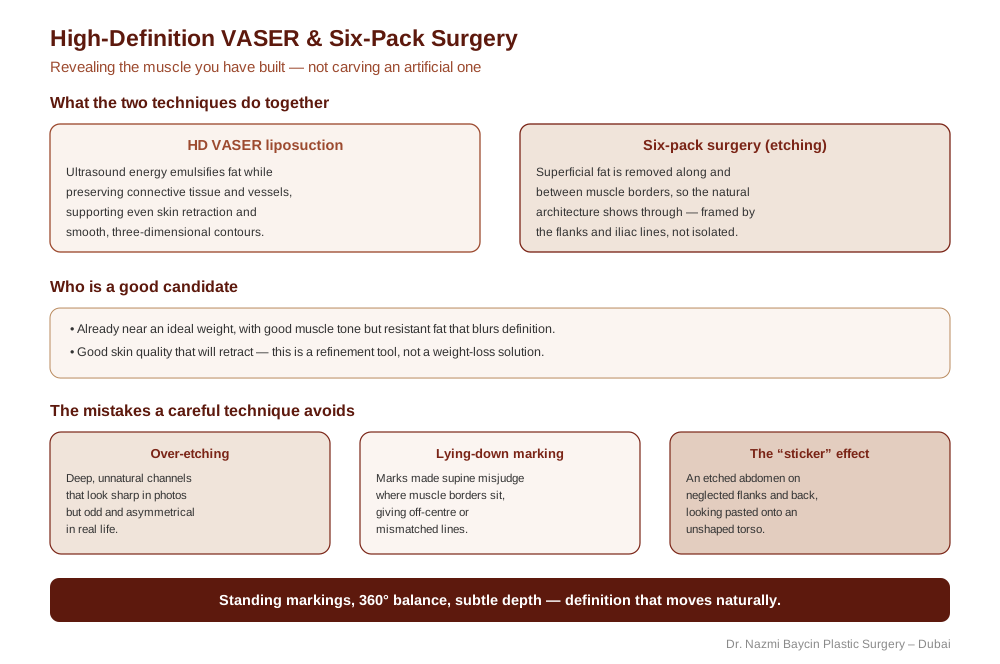
How high-definition VASER liposuction and abdominal etching work together to reveal natural muscle definition — and the common mistakes a careful technique avoids — by Dr. Nazmi Baycin, Dubai.
Common technical mistakes and how I avoid them
Most of the revision cases I see after high-definition work performed elsewhere fall into a few recurring categories, summarized in the table below.
| Common Mistake | Why It Happens | How I Avoid It |
|---|---|---|
| Over-removal of fat | Deep channels cut for photographic sharpness | Subtle depth variations and gentle transitions |
| Ignoring male/female aesthetics | One template applied to every patient | Sharper lines for men, softer contours for women |
| Lying-down marking | Muscle borders sit differently when supine | Detailed markings done with the patient standing |
| Neglecting the wider torso | Focus only on the abdomen | 360° contouring of flanks, waist, and lower back |
- The first and most damaging error is over-removal of fat in specific channels, which creates deep, unnatural lines that look sharp in photographs but odd and asymmetrical in real life. This is the same trap I describe in my article on why over-etching ruins abdominal definition — once the natural fat planes are violated, the result cannot look believable.
- A second category comes from insufficient planning: when markings are made lying down rather than standing, the surgeon misjudges where the muscle borders and fat deposits actually sit in daily life, producing off-center or mismatched lines. I always mark while you are standing, mapping muscle borders, asymmetries, and fat thickness against your true anatomy.
- The third problem is failing to integrate the abdomen into the rest of the torso, which leaves a sharply etched abdomen on neglected flanks and back — the unnatural sticker effect of a six-pack pasted onto an otherwise unshaped body.
My approach instead evaluates 360-degree torso balance, combining etching with selective contouring of the flanks, waist, and lower back for a coherent silhouette from every angle.
How my technique preserves natural results
My approach in Dubai begins with a comprehensive consultation assessing your fat distribution, skin quality, muscle tone, lifestyle, and long-term goals. I do not recommend full six-pack surgery for everyone; sometimes softer central definition, or high-definition in only a few limited zones, gives a more natural, age-appropriate, and sustainable outcome.
Intraoperatively, I use controlled VASER settings to emulsify fat while preserving the support structures that keep the surface smooth and let the skin redrape evenly. I favor subtle depth variations over extreme channels, so the definition looks like real muscle when you move rather than a set of static, carved grooves.
This emphasis on judgment over equipment is a theme I return to often, because the device does not create the result — the surgeon does. I discuss it directly in my piece on why surgeon technique matters more than technology for VASER liposuction. Where skin excess would otherwise hide any definition, particularly after major weight loss, I may stage these procedures alongside other body-contouring techniques.
This anatomy-driven, stepwise approach is central to how I perform abdominal etching and six-pack surgery in Dubai, where the aim is always a result that ages well rather than one that photographs well on day one.
A refinement tool, not a weight-loss procedure
Careful selection is what protects the natural result. The ideal candidate is already close to their goal weight, with reasonably good muscle tone but persistent fat that blurs abdominal and torso definition — these procedures are refinement tools designed to reveal the structure you have built through your own effort, not weight-loss solutions.
Good skin quality matters just as much, because heavily damaged or very lax skin may not retract evenly after fat removal; where the skin is too lax, I may pair the sculpting with a lifting or tightening procedure so folds and irregularities do not undo the detailed work. Maintenance is part of candidacy too: the removed fat cells do not return, but the remaining cells can still enlarge if your weight rises significantly, which can soften or distort the etched lines over time.
Recovery and protecting your result
Most patients return to light daily activities within one to two weeks, depending on the extent of treatment and any associated procedures. Swelling and tightness are expected early on, and I use carefully planned garments and taping to support the newly sculpted lines while protecting the microcirculation and lymphatic drainage. Light office work is often possible around the second week, while more intense activity, including gym training, is usually resumed progressively after four to six weeks, once the internal tissues are stable enough.
The final definition continues to sharpen over three to six months as swelling resolves and the skin adapts to the new contours. Because remaining fat cells can still enlarge, the durability of the result depends heavily on weight stability — a relationship I explore in my article on skin quality and six-pack longevity in Dubai.
Careful, anatomy-led sculpting of this kind is what you should expect from a considered approach to cosmetic surgery in Dubai. Because every torso is different, both the surgical plan and its cost are best worked out at a consultation, tailored to your body type, skin quality, and goals.
FAQs about natural six-pack definition with HD VASER in Dubai
-
What is the difference between VASER liposuction and six-pack surgery?
VASER liposuction is an ultrasound-assisted technique that emulsifies fat while preserving connective tissue, allowing precise fat removal and good skin retraction. Six-pack surgery, or abdominal etching, is a specialized application of that technique: instead of simply reducing fat, it strategically removes superficial fat along and between the abdominal muscle borders so the underlying muscle definition shows through. In practice they are usually combined — VASER provides the refined fat removal and skin retraction, while etching sculpts the specific lines that create an athletic, three-dimensional look framed within the whole torso.
-
Is high-definition liposuction a weight-loss procedure?
No. High-definition VASER liposuction and six-pack surgery are refinement tools, not weight-loss solutions. They are designed to reveal and enhance the muscle structure you have already built, by removing resistant fat that blurs your natural definition. For that reason, the ideal candidate is someone already close to their goal weight with reasonably good muscle tone. Using these procedures as a substitute for weight loss leads to disappointing, unnatural results, which is why patient selection and realistic expectations are such an important part of the initial consultation.
-
Do I need to be at my goal weight before high-definition sculpting?
Yes — or very close to it. The best candidates are near their ideal weight, have relatively good muscle tone, and are bothered by persistent fat that obscures their abdominal and torso definition. Good skin quality is also important, because skin that is heavily damaged or very lax may not retract smoothly after fat removal. If the skin is too lax, a lifting or tightening procedure may be recommended alongside the sculpting to avoid folds and irregularities. A full assessment of your fat distribution, skin quality, muscle tone, medical history, and healing characteristics at consultation determines whether high-definition work is right for you.
-
Will the results look natural or carved and artificial?
That depends entirely on technique. Natural results come from subtle depth variations and gentle transitions that look like real muscle definition when you move, rather than deep, static channels that look sharp in photos but odd in real life. Marking the muscle borders while you are standing, respecting the natural fat planes, and balancing the abdomen against the whole 360-degree torso all help avoid the over-etched, carved appearance. The goal is definition that reads as the natural result of training, integrated with the flanks, waist, and back rather than pasted on in isolation.
-
How long do the results last?
The fat cells removed during surgery do not grow back, so the sculpted definition is long-lasting in principle. However, the fat cells that remain can still enlarge if your weight increases significantly, which can soften or distort the etched lines over time. This means the durability of your result depends heavily on maintaining a stable weight through consistent nutrition and training. With good weight stability and healthy skin, the contours remain visible and harmonious for years; significant weight gain is the main thing that undermines them.
-
What does recovery involve?
Most patients return to light daily activities within one to two weeks, with light office work often possible around the second week. Swelling and tightness are normal early on, and planned compression garments and taping are used to support the new lines and protect circulation and lymphatic drainage. More intense activity, including gym training, is usually resumed gradually after four to six weeks once the tissues are stable. The final definition continues to sharpen over three to six months as swelling settles and the skin adapts to the new contours, so the full result takes some months to appear.
-
Can it be combined with other procedures?
Yes, and often it should be. Where skin excess would otherwise hide any definition — particularly after major weight loss — high-definition sculpting can be staged alongside skin-tightening or lifting procedures so the result is not undermined by loose skin. It can also be combined with broader body-contouring work to balance the whole torso. The right combination depends on your skin quality, the degree of fat and skin excess, and your overall goals, all of which are assessed at consultation so the plan matches your anatomy and recovery capacity rather than a fixed formula.


GET APPOINTMENT
Get ready to look and feel best… You deserve…
