

Key takeaways: one template does not fit both
- Six-pack surgery is abdominal etching — it reveals existing muscle, it does not build it.
- Male goals center on definition, angularity, and segmentation; female goals on smoothness and flow.
- The surgical map differs by gender — the same pattern on a woman looks masculinized.
- For women, waist sculpting and blended transitions matter more than sharp horizontal lines.
- A protective fat layer is preserved in women to avoid an unnatural washboard look.
- Conservative precision wins: it is always safer to slightly under-etch than to over-etch.
This is grounded in established technique. A 2020 review of abdominal etching in Clinics in Plastic Surgery sets out how the procedure sculpts the fat layers over the abdominal muscles to reveal the underlying architecture. How far that etching is taken is a graded choice, and that grading is exactly the lever I adjust by gender: a higher degree of definition for a masculine result, a softer degree for a feminine one.
The foundational difference: strength vs. harmony
The core of my planning in Dubai lies in defining the endpoint before the first incision. For men, the aesthetic goal typically centers on definition, angularity, and the visible suggestion of power; the aim is to accentuate the natural segmentation of the rectus abdominis and create sharp, athletic shadows.
For women, the goal is almost always smoothness, flow, and harmonious proportion. The focus shifts to narrowing the waist, creating a gentle athletic taper, and avoiding any contour that would masculinize the silhouette. A female abdomen should have a soft, defined curve — not a hard, segmented appearance. This one philosophical difference informs every technical decision that follows, and it is why I never approach the two the same way.
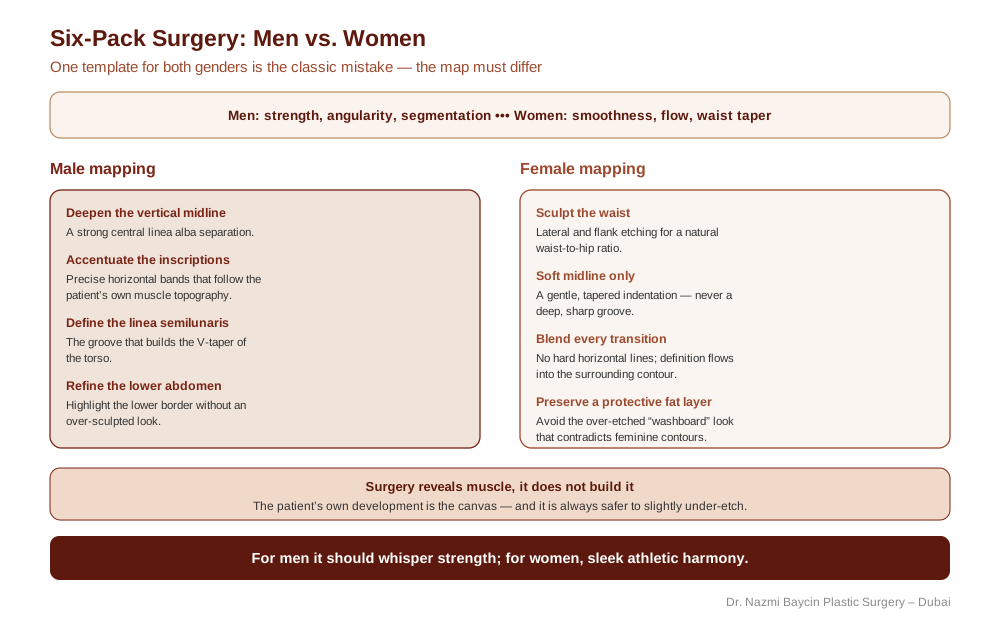
How the surgical map differs between men and women in six-pack surgery — with the shared principle that etching reveals muscle rather than building it — by Dr. Nazmi Baycin, Dubai.
Surgical mapping: a custom blueprint for each gender
I do not use a standard template in Dubai. In the operating room I follow a dynamic map drawn from the patient’s own anatomy, muscle development, and fat distribution. The table below contrasts the two blueprints.
| Focus | Male Mapping | Female Mapping |
|---|---|---|
| Midline | Deepen the linea alba for strong separation | Soft, tapered indentation only |
| Horizontal lines | Accentuate the tendinous inscriptions | Blend transitions; avoid hard lines |
| Side contour | Define the linea semilunaris for a V-taper | Lateral and flank etching for waist taper |
| Fat layer | Refine lower abdomen without over-sculpting | Preserve a protective subcutaneous layer |
For men, the etching is more pronounced but still controlled: I deepen the vertical midline to create a strong central separation, accentuate the horizontal inscriptions that produce the pack appearance while following the patient’s own muscle topography, and define the linea semilunaris — the subtle vertical groove between the rectus abdominis and the obliques — to add to the V-taper of the torso. The lower abdomen is refined to highlight the lower rectus border without an unnatural, over-sculpted look.
For women, the strategy is one of subtle enhancement: lateral and posterior flank etching to sculpt the waist, midline definition that stays soft and gradual rather than becoming a deep groove, and a deliberately preserved subcutaneous layer that keeps the smooth drape of the female abdomen. What that feminine endpoint actually looks like, and why the waistline rather than the abdominal muscles is its centerpiece, is the subject of my article on the feminine endpoint of high-definition liposuction. Over-aggressive etching in women is a common cause of visible irregularities and an unnatural washboard look — the very thing I map the surgery to prevent, a principle I explore further in my article on why over-etching ruins abdominal definition.
The role of underlying muscle anatomy
It is vital for my patients in Dubai to understand that this surgery does not build muscle; it reveals it. The patient’s own muscular development is the canvas, so I assess it carefully in consultation. A patient with a well-developed rectus abdominis will achieve a more dramatic, natural-looking result than someone with very little muscle mass.
For the latter, I counsel realistic expectations — the goal may shift more toward overall abdominal refinement and waist slimming than toward pronounced etching, and in some cases I recommend a preparatory period of targeted core conditioning to optimize the surgical potential. Because definition has to move naturally with the body rather than sit as a static pattern, this thinking connects closely to the ideas in my piece on the 4D concept in liposculpture.
The pitfall of over-etching and long-term results
The most significant risk, especially when chasing dramatic results, is over-aggressive etching. It is a technical mistake that can leave permanent contour irregularities, adhesions, and an unnatural appearance that worsens with weight fluctuation or as the skin loses elasticity with age.
My philosophy is conservative precision. It is always safer and more natural to slightly under-etch, because subtle refinement ages far more gracefully than deep, surgical-looking grooves. How well a result holds over the years also depends heavily on skin quality and weight stability, which I discuss in my article on skin quality and six-pack longevity. This same measured approach applies to related definition work, such as pectoral etching in men, where restraint again protects the natural result.
True definition respects form and function
At its best, six-pack surgery is a fusion of surgical science and artistic vision. For men it should whisper of strength; for women it should speak of sleek, athletic harmony. My role is to be both anatomist and artist, using the tool of liposuction to reveal what is uniquely powerful or elegantly proportioned in each patient.
This gender-specific artistry is central to how I approach abdominal etching and six-pack surgery in Dubai, and it is the standard you should expect from a board-certified cosmetic surgeon in Dubai. Because the plan is so individual, both the surgical map and its cost are best worked out at a consultation, where the artistic vision for your body can be discussed alongside the technique.
FAQs about six-pack surgery for men and women in Dubai
-
Is six-pack surgery different for men and women?
Yes, significantly. Although the underlying technique — high-definition abdominal etching — is the same, the aesthetic goal and the surgical map differ by gender. For men, the aim is definition, angularity, and visible segmentation of the abdominal muscles for an impression of strength. For women, the aim is smoothness, flow, and a narrowed waist, with soft rather than sharp definition. Applying a male etching pattern to a woman tends to masculinize the silhouette and can look unnatural. Planning the operation around the correct gender-specific goal is what produces a result that looks powerful or elegant rather than surgically imposed.
-
Does six-pack surgery create muscle?
No. Abdominal etching reveals the muscle you already have; it does not build new muscle. The technique uses precise liposuction to remove and sculpt the fat around and between the abdominal muscles, so the underlying structure becomes visible. This means your existing muscular development is the canvas: a well-developed rectus abdominis gives a more dramatic, natural result, while limited muscle mass gives a subtler one. For patients with little underlying muscle, the realistic goal often shifts toward overall abdominal refinement and waist slimming, sometimes after a period of targeted core conditioning to improve the surgical potential.
-
Why must the female approach be more conservative?
Because the feminine aesthetic depends on smoothness and soft contour rather than hard segmentation. Women naturally carry a slightly thicker subcutaneous fat layer that gives the abdomen its smooth drape, and preserving that layer is important. Over-aggressive etching in women is a common cause of visible irregularities and an unnatural washboard appearance that contradicts feminine contours. So the female map emphasizes waist sculpting, soft midline definition, and blended transitions rather than deep grooves and sharp horizontal lines. The art lies in creating a defined, athletic curve while keeping the overall look unmistakably natural and feminine.
-
What does the male mapping focus on?
The male map is more pronounced but still controlled. It deepens the vertical midline along the linea alba to create a strong central separation, accentuates the horizontal tendinous inscriptions that produce the classic pack appearance, and defines the linea semilunaris — the groove between the rectus abdominis and the obliques — to enhance the V-taper of the torso. The lower abdomen is refined to highlight the lower muscle border without looking over-sculpted. Throughout, the etching follows the patient’s own muscle topography rather than an imposed pattern, so the result matches his individual anatomy and reads as natural athletic definition.
-
Who is a good candidate?
The best candidates are close to their ideal weight, with reasonable underlying muscle development and localized fat that blurs their natural definition. Because the procedure reveals rather than creates muscle, existing muscular tone strongly influences the result. Good skin quality also matters, since it affects how the definition holds over time. Candidates should have realistic expectations and understand that this is a refinement tool, not a weight-loss solution or a substitute for training. A thorough assessment of muscle development, fat distribution, and skin quality at consultation determines whether pronounced etching or a subtler refinement is the right plan.
-
Will the results look natural?
They should, provided the surgery is mapped and executed with restraint. Natural results come from following the patient’s own muscle topography, matching the degree of definition to their gender and anatomy, and resisting the temptation to over-etch. It is always safer to slightly under-etch, because subtle refinement ages far more gracefully than deep, surgical-looking grooves. Over-aggressive etching can create permanent contour irregularities and an artificial appearance that worsens with weight change or as skin elasticity declines. Conservative precision — enough definition to enhance, never so much that it looks operated — is what keeps the result looking natural over the long term.
-
How long do the results last?
The fat removed during etching does not return, so the sculpted definition is long-lasting in principle. However, the result is not immune to change: significant weight gain can enlarge the remaining fat cells and blur the definition, and as skin loses elasticity with age the contours can soften. This is why weight stability and good skin quality are so important to a durable outcome. Maintaining a stable weight and healthy skin helps the definition remain crisp for years, whereas large weight fluctuations are the main thing that undermines it. Conservative, well-planned etching also ages more gracefully than aggressive work.


GET APPOINTMENT
Get ready to look and feel best… You deserve…
