

Key takeaways: shape the whole torso, not one wall
- 360° liposuction is a surgical philosophy, not a device setting.
- Waist definition comes from contrast — the flanks and back must be reduced too, not just the abdomen.
- Circumferential planning balances every zone and avoids abrupt transitions.
- Over-aggressive removal is the root of most complications: waviness, dents, and hollows.
- Skin retraction depends on gentle, layered removal that preserves superficial fat and vessels.
- Technology assists precision — it does not replace anatomical judgment.
Treating the torso circumferentially is a well-established surgical approach rather than a marketing idea. A 1999 series of 161 patients treated circumferentially over four years recorded no major complications, and its authors concluded that the approach was a sure and viable one — the foundation on which modern, precision-focused circumferential contouring is built. It is worth being clear about what that series was: large-volume surgery, averaging 8.7 litres of aspirate, from a single institution and assessed by the operating surgeons. Its more useful finding for my purposes is the risk analysis. Palpable contour irregularities affected 14.9 percent of those patients and were visible in 5 percent, and the four factors most associated with complications were the amount of fat removed, how close the patient was to an ideal height-to-weight relationship, the diameter of the cannulas used, and the experience accumulated over the course of the series. Three of those four are decisions the surgeon makes, which is precisely the argument for restraint that follows. What has advanced since then is not the concept of going around the body, but the discipline applied to how much is removed and where.
A philosophy, not a device setting
One of the most common misunderstandings I encounter is the belief that 360° liposuction is a machine-based procedure. It is not. True circumferential liposuction requires the ability to visualize the torso as a three-dimensional structure and to plan fat reduction as a continuous flow rather than a set of isolated zones.
The abdomen, flanks, waist, and lower back are anatomically connected, and treating one area without respecting the others inevitably creates imbalance. This is precisely why traditional liposuction so often fails to define the waist: when the approach focuses almost entirely on the abdomen, it may flatten the front of the body while doing very little for the overall silhouette.
The waistline is defined by contrast — if the flanks and lower back stay bulky, the abdomen looks disconnected from the rest of the torso, producing a straight, boxy shape rather than a sculpted one. Real waist definition requires circumferential reduction, so that as volume comes down evenly around the torso, the waist naturally narrows and the whole body gains proportion.
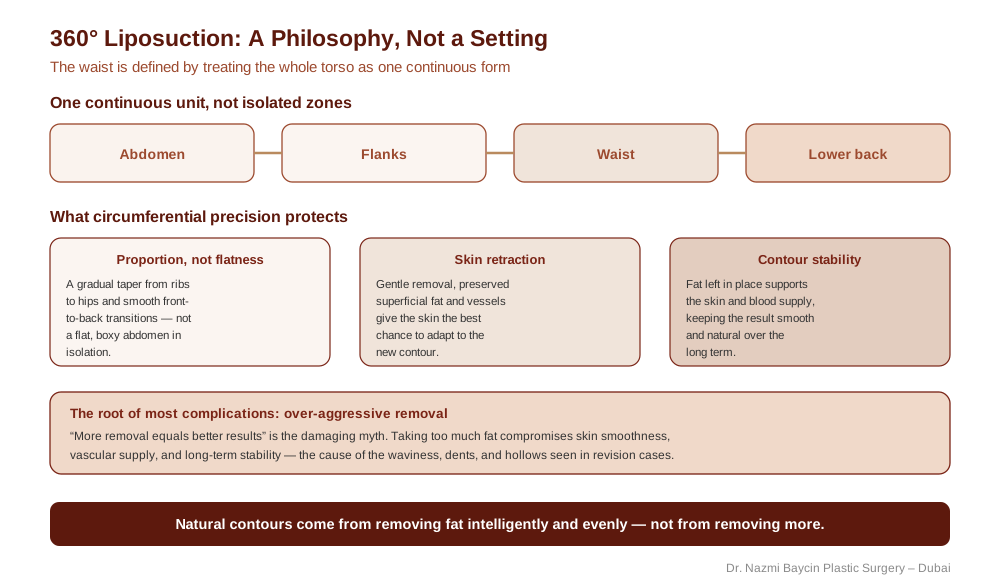
Why 360° liposuction is a matter of circumferential planning and restraint rather than a machine setting — treating the torso as one continuous form — by Dr. Nazmi Baycin, Dubai.
Circumferential planning: seeing the body as a whole
Before surgery in Dubai, I evaluate the torso from every angle — front, side, oblique, and posterior — because fat distribution is rarely uniform and asymmetries are common. Planning circumferentially lets me balance fat removal across zones, maintain natural curves, avoid abrupt transitions, and preserve the structural support the skin depends on.
When surgeons fail to plan this way, they often overcorrect one area to compensate for untreated zones, and that is what produces surface irregularities and unnatural contours. Precision, in other words, begins long before the first incision. Men and women also need genuinely different strategies here: men typically benefit from subtle waist narrowing, preservation of muscular definition, and avoidance of exaggerated curves, while women often seek a more pronounced waist, smooth hip transitions, and an enhanced feminine contour. Applying one circumferential template to every patient is a reliable route to an unnatural result.
The mistakes that ruin a circumferential result
The single most damaging error I see in Dubai is excessive fat removal, driven by the mistaken belief that more removal equals a better result. The table below sets out the recurring mistakes and how a disciplined approach avoids them.
| Common Mistake | Consequence | How I Avoid It |
|---|---|---|
| Over-aggressive fat removal | Waviness, dents, hollows, unstable contour | Controlled, layered removal with restraint |
| Treating only the abdomen | Boxy waist, disconnected silhouette | Circumferential reduction around the torso |
| Ignoring skin quality | Loose, uneven skin after surgery | Gentle removal preserving superficial fat |
| One template for everyone | Unnatural, gender-mismatched contour | Gender-specific, individualized planning |
Fat provides support to the skin, so removing too much compromises skin smoothness, vascular supply, and long-term contour stability. Patients who present with waviness, dents, or hollowed areas almost always had overly aggressive suction in an attempt to create dramatic change.
My approach prioritizes controlled, layered fat removal — reshaping the torso while preserving the integrity of the skin and underlying tissue, because that restraint is what allows results to stay natural over time. The same logic applies to waist sculpting: a flat abdomen alone does not create an attractive result, and over-flattened abdomens often look unnatural when the surrounding areas are ignored.
What matters is a gradual taper from ribs to hips, smooth transitions between abdomen and flanks, and a harmonized contour between front and back. This tissue-aware judgment is also why the fat itself matters — dense fibrous fat and soft fat behave differently under the cannula, a distinction I explore in my article on how tissue type changes liposuction technique and outcomes.
Skin quality, retraction, and healing
Skin does not simply snap back on its own, and across the large surface areas treated in a circumferential procedure that matters far more than it does in a single zone. Gentle removal, consistent depth, and smooth cannula motion give the envelope the best chance to adapt to its new contour, while aggressive suction over the same wide area leaves it loose and uneven. When that groundwork is done well, swelling resolves more evenly and the contour settles smoothly over the following months.
The anatomy underneath that behavior — the layered fat compartments, the fibrous scaffold, and what has to survive the operation for a shape to hold its position over years — is a subject in its own right, and I set it out in my article on long-term contour stability.
Managing the healing phase properly is just as important, and where early scar tissue or firmness threatens the result, timely intervention matters — something I discuss in my article on post-liposuction fibrosis prevention and early management. Compression garments are not optional either; they guide skin retraction, reduce swelling, and protect the sculpted contour, and improper use can compromise even well-executed surgery.
Technology assists precision — it does not create it
Devices such as VASER can help emulsify fat and make removal smoother, but they do not replace anatomical understanding or surgical judgment. Poor outcomes occur when surgeons lean on technology instead of technique, because a device cannot decide where fat should remain or how much support the skin requires.
Successful circumferential liposuction depends on how the surgeon uses the tools, not on which tools are used — a principle I make the case for in detail in my article on why surgeon technique matters more than technology. The best candidates for this surgery are close to a stable weight with localized fat deposits that resist diet and exercise; good skin elasticity improves outcomes, though careful technique can compensate when elasticity is only moderate.
It is not a weight-loss solution but a contouring procedure designed to refine proportions. Because circumferential liposuction leaves no angle hidden — the body must look natural from front, side, and back — experience is what determines where fat should be preserved, how much reduction is appropriate, how transitions are blended, and how the skin will behave over time.
Patients who want to understand how this level of contouring is achieved can explore my approach to liposuction in Dubai, where the surgical principles and anatomical strategy are set out in full. Because circumferential body contouring is never one-size-fits-all, both the surgical plan and its cost are best worked out at a consultation; choosing a well-planned primary surgery from an experienced plastic surgeon in Dubai is always more economical than undergoing a revision later.
FAQs about 360° liposuction in Dubai
-
What is 360° liposuction?
360° liposuction is a circumferential body-contouring procedure that reshapes the abdomen, flanks, waist, and lower back as one continuous unit. Unlike traditional liposuction, which usually targets isolated areas, it focuses on balanced fat removal from every angle to create a smoother silhouette and natural waist definition. The emphasis is not on removing as much fat as possible but on removing it evenly and proportionally, so the body looks harmonious from the front, side, and back. Done well, it treats the torso as a single three-dimensional form rather than a collection of separate zones.
-
How is it different from regular liposuction?
Regular liposuction usually concentrates on one area, most often the abdomen, which can flatten the front while leaving the flanks and back untreated. That imbalance tends to produce a boxy waistline and abrupt transitions between treated and untreated zones. 360° liposuction instead reduces volume around the entire torso, so the waist narrows naturally through contrast and the silhouette stays smooth from every angle. The difference is really one of planning philosophy: treating the body as a continuous unit rather than addressing isolated spots one at a time.
-
Why is it better for waist definition?
Waist definition depends on contrast, not just on flattening the abdomen. If the flanks and lower back remain bulky, even a very flat front will look disconnected and boxy. By reducing volume circumferentially — including the flanks and lower back — the waist is revealed through a gradual taper from ribs to hips. This is why circumferential contouring produces a more naturally narrow, well-defined waist than abdomen-only liposuction: it shapes the whole frame around the waist rather than treating the waist in isolation.
-
What are the most common mistakes?
The most common errors are incomplete circumferential treatment, over-aggressive fat removal, and poor blending of transitions between zones. Over-removal is especially damaging because fat supports the skin — taking too much compromises skin smoothness, vascular supply, and long-term stability, producing waviness, dents, or hollows. Treating only the front of the body leaves a boxy, disconnected shape, and applying a single template to every patient ignores important differences in anatomy and goals. Avoiding these requires careful circumferential planning and disciplined restraint rather than maximal suction.
-
Does it tighten the skin?
360° liposuction does not directly tighten skin, but good technique gives the skin the best chance to retract naturally. Skin does not simply snap back on its own; its ability to adapt depends on how gently the fat is removed, whether the superficial fat layers are preserved, and how well the vascular networks are respected. Aggressive suction damages these structures and leaves loose, uneven skin, which is a particular risk across the large surface areas treated in circumferential surgery. Where skin elasticity is limited, a separate tightening procedure may be discussed at consultation.
-
Is the approach the same for men and women?
No — the surgical strategy must differ. Men typically require subtle waist narrowing, preservation of muscular definition, and avoidance of exaggerated curves, so the contour stays straight and athletic. Women often benefit from a more pronounced waist, smooth hip transitions, and an enhanced waist-to-hip relationship. Applying the same circumferential plan to everyone leads to results that look unnatural for that individual. Gender-specific, individualized planning is essential to authenticity, which is why the assessment always starts from the patient’s own anatomy and goals rather than a fixed formula.
-
Is it a weight-loss procedure?
No. 360° liposuction is a body-contouring procedure, not a weight-loss solution. It is designed for people who are already close to their stable weight but have localized, stubborn fat deposits that resist diet and exercise and blur their proportions. It refines the shape of the torso rather than reducing overall body weight. The best candidates have reasonable skin elasticity, though careful technique can compensate when elasticity is moderate. Using it as a substitute for weight loss leads to disappointing results, which is why realistic expectations are part of the initial consultation.


GET APPOINTMENT
Get ready to look and feel best… You deserve…
