

Key takeaways: technique matched to anatomy
- Gigantomastia is generally defined by a resection over ~1500–2000 g per breast or a sternal notch-to-nipple distance over ~40 cm.
- There is no single best technique — the choice is driven by anatomy, risk factors, and the patient’s priorities.
- A pedicled approach (modified superomedial pedicle) keeps the nipple attached on its blood supply, usually preserving sensation and projection.
- Free nipple grafting is the safest option when the nipple must travel further than any pedicle can reliably support.
- The main tradeoff of free grafting is permanent loss of nipple sensation and erectile function.
- Reduction relieves neck, shoulder, and back pain in over 90% of patients, with a dramatic gain in quality of life.
Defining gigantomastia
The surgical literature offers varying definitions. Some authors define gigantomastia as a resection weight exceeding 1500 grams per breast; others use a threshold of 2000 to 2500 grams. The sternal notch-to-nipple distance, often exceeding 40 centimeters in these patients, provides another objective measure. Whatever definition one chooses, the clinical challenge is consistent: the distance the nipple must travel and the sheer volume of tissue involved push standard techniques to their limits, which is exactly why matching technique to anatomy matters more here than in routine reduction.
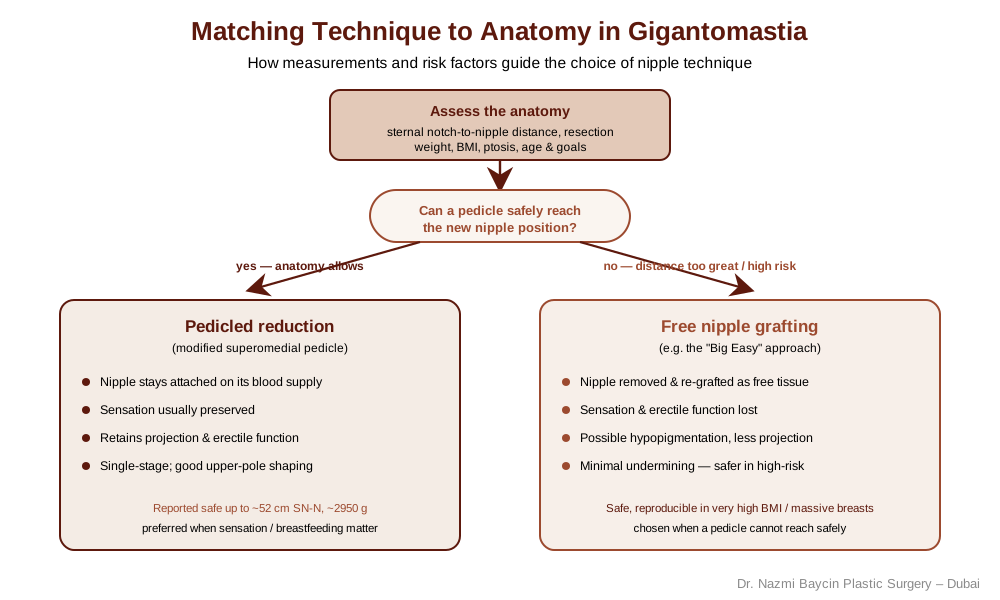
Matching technique to anatomy: measurements and risk factors guide the choice between a sensation-preserving pedicled reduction and free nipple grafting — by Dr. Nazmi Baycin, Dubai.
The spectrum of surgical options
When a woman presents with gigantomastia, I do not reach for a single preferred technique; I evaluate her specific anatomy and discuss a spectrum of options. The superomedial pedicle, once considered risky for very large breasts, has emerged as a versatile and reliable option even in gigantomastia. In a step-by-step video technique article on the superomedial approach, the authors report that their senior surgeon has carried the technique to sternal notch-to-nipple distances of up to 52 centimeters and resections of up to 2950 grams per breast without untoward complications — a description of one surgeon’s experience, referenced to his earlier work rather than measured in that article, but an indication of how far the reach of this pedicle now extends. It derives its blood supply from the internal mammary perforators, supplemented in my modified approach by preserving connections to the underlying perforators, which enhances nipple-areolar viability even when the pedicle must be lengthy.
The traditional inferior pedicle remains valid for many patients, though in extreme cases the pedicle length required may exceed safe limits. When the distance the nipple must travel exceeds what any pedicle can reliably support, free nipple grafting becomes the safest option — a five-year single-surgeon series of 337 consecutive patients, with a median specimen weight of 2055 grams per breast and an average BMI of 40.1, reported no patients requiring a return to the operating room. It is a consecutive series by one surgeon reported in abstract form, so it demonstrates that the approach is reproducible in his hands rather than that it outperforms a pedicled reduction.
Whichever route the anatomy dictates, safeguarding the nipple’s circulation is the priority — the specific strategies for protecting the blood supply against nipple necrosis are covered separately.
Comparing the techniques
Each option carries distinct advantages and tradeoffs. The table below summarizes how the two principal approaches differ across the factors that matter most to patients.
| Factor | Pedicled (superomedial) | Free nipple grafting |
|---|---|---|
| Nipple blood supply | Stays attached on its own pedicle | Removed and re-grafted as free tissue |
| Sensation | Usually preserved | Permanently lost |
| Erectile function | Retained | Lost (smooth muscle divided) |
| Projection | Maintained | Often reduced |
| Pigmentation | Native color retained | Hypopigmentation common; may need tattooing |
| Best suited to | When anatomy allows and sensation matters | Extreme pedicle length, very high BMI, or highest-risk patients |
The decision-making framework
Choosing among these options rests on several factors considered together. The sternal notch-to-nipple distance correlates with how far the nipple must travel — historically, distances beyond 35 to 40 centimeters were considered relative contraindications to pedicled techniques, though modern modifications have extended that reach.
Resection weight influences pedicle design, since massive resections require longer pedicles and more extensive skin excision. Patient age and reproductive plans matter: for younger patients who may desire future breastfeeding or who value nipple sensation highly, every effort is made to preserve a pedicled nipple, while for older patients who have completed their families, free grafting may be acceptable if anatomy dictates.
The link between pedicle choice and nipple sensation is strong enough that it deserves its own discussion, especially for patients to whom sensation matters most. Comorbidities such as diabetes, smoking, or very high BMI raise the risk of wound-healing complications, and the minimal flap undermining of free grafting may offer a safer profile in some high-risk patients. Finally, breast shape and ptosis grade influence which technique yields the best aesthetic result.
The modified superomedial pedicle: technical refinements
For patients who are candidates for pedicled reduction, I employ a modified superomedial pedicle technique, following the refinements now well described in the superomedial literature. The pedicle base is typically 8 to 9 centimeters wide, with the superior border beginning at the inferomedial vertex of the Wise pattern to facilitate rotation of the nipple into its new position.
I dissect with careful attention to blood supply — beveling the inferomedial border away from the pedicle at 45 degrees, dissecting the superolateral border perpendicularly to the chest wall, and deliberately not undermining the pedicle so that connections to the underlying perforators are preserved.
A temporary skin handle — a preserved skin bridge between the lateral flap and the pedicle — lets an assistant provide countertension during dissection, reducing traction on the lateral flap and potentially lowering the risk of T-junction wound breakdown.
Finally, the dermal layer along the pedicle base is carefully scored while leaving the subdermal plexus intact, releasing tension and allowing a greater arc of rotation without compromising blood supply. When free grafting is chosen, my technique also differs from historical descriptions: rather than simply amputating the breast, I preserve a de-epithelialized inferior parenchymal pedicle sutured to the pectoralis fascia to create upper-pole fullness and maintain projection.
Recovery and outcomes
Recovery in gigantomastia differs from a routine reduction in scale rather than in kind. Because the resections are so large, an overnight stay for monitoring is the norm rather than the exception, and drains are more likely to be needed to manage the greater raw surface left behind.
The return-to-activity milestones that follow — desk work first, then exercise — are the same as for any reduction, so rather than repeat them here I set them out in full in my guide to breast reduction in Dubai. What sets gigantomastia apart is the large skin envelope. The outcomes extend far beyond the physical: breast reduction relieves neck, shoulder, and back pain in over 90 percent of patients, and quality of life improves dramatically.
Patients often describe a freedom they had forgotten was possible — buying clothing off the rack, exercising without discomfort, and moving through the world without the constant awareness of their breasts. Because these are complex cases requiring specialized pedicle modifications or free nipple grafting, the surgical plan is always individualized.
Scars mature over the following year, fading from firm and pink to soft and pale, and I guide patients through silicone therapy and sun protection to help them settle as favorably as possible. Because the skin envelope in gigantomastia is so large, a little laxity can reappear as swelling resolves; where needed, a minor refinement under local anesthesia tidies the final contour once everything has healed and stabilized.
Why individualization matters
If you are living with the burden of giant breasts, you know the toll they take — the neck pain that never quite resolves, the shoulder grooves, the skin irritation, the clothing that never fits. Relief is possible, and the techniques for gigantomastia have evolved dramatically: what was once a choice between an inadequate reduction and a mutilating amputation is now a spectrum of options tailored to each patient’s anatomy. My approach is to treat each patient not as a single problem requiring a single solution, but as an individual whose unique anatomy demands an individualized surgical plan.
FAQs about gigantomastia reduction in Dubai
-
What exactly is gigantomastia, and how is it different from a large breast reduction?
There’s no single universal threshold, but it’s generally defined as a resection weight exceeding 1500 to 2000 grams per breast, or a sternal notch-to-nipple distance over 40 centimeters. Beyond the numbers, gigantomastia represents a different surgical challenge entirely: the distance the nipple must travel and the volume of tissue involved push standard techniques to their limits, which is why an individualized strategy matters so much more than in routine reduction.
-
Will I lose nipple sensation after surgery?
It depends on the technique used. A pedicled approach, like the superomedial pedicle, carries the nerve supply along with the tissue, so most patients retain erotic and tactile sensation. Free nipple grafting, by contrast, permanently severs this nerve connection, since the nipple is removed and re-grafted as a free tissue transfer. This is one of the most important tradeoffs we discuss before deciding on your surgical plan.
-
How do you decide between a pedicled technique and free nipple grafting?
Several factors guide this decision together: your sternal notch-to-nipple distance, the volume of tissue to be removed, your age and any future breastfeeding plans, your overall health and risk factors like BMI or smoking history, and your own priorities. When anatomy allows, I make every effort to preserve a pedicled, sensate nipple, particularly for younger patients.
-
Will I be able to breastfeed after gigantomastia reduction?
Any breast reduction can affect future breastfeeding capacity, since some ductal tissue is necessarily removed, but pedicled techniques generally preserve more of the natural ductal architecture than free nipple grafting does. If future breastfeeding is a priority, this should be a central part of our discussion when choosing your surgical approach.
-
What’s recovery like after this kind of surgery?
You’ll typically spend one night in the hospital for monitoring. If drains are placed, they’re usually removed within the first week. Most patients return to desk work within two weeks, and to full activity, including exercise, within six to eight weeks. Beyond the physical recovery, the majority of patients experience significant relief from neck, shoulder, and back pain.
-
Does a higher BMI rule out a pedicled (sensation-preserving) technique?
Not automatically, but it is one of several factors that shifts the risk-benefit calculation. Patients with a very high BMI, diabetes, or a smoking history face increased risks of wound healing complications with any technique, and free nipple grafting’s minimal flap undermining may offer a safer profile in some of these higher-risk cases. This is assessed individually, not by BMI alone.


GET APPOINTMENT
Get ready to look and feel best… You deserve…
