

Key takeaways: durability is built, not assumed
- Relapse is not a return to the original size — it is subtle descent, lower-pole stretch, and lost upper-pole fullness.
- It is driven by biology, not surgical failure — tissue memory and skin elasticity.
- Tissue memory: long-stretched skin and Cooper’s ligaments resist fully resetting.
- Skin elasticity is the external determinant — poorer recoil means higher relapse risk.
- The defense is an internal support structure, not a skin-reliant closure.
- The patient protects the result through weight stability, bra support, and skin care.
For patients seeking breast reduction surgery in Dubai, this understanding is the key to realistic expectations and long-term satisfaction. The longevity of shape correction after reduction and mastopexy has been reviewed systematically: a 2022 review of 24 studies covering 1,235 patients and 2,235 breasts reported that superior and superomedial pedicles tended to hold position better over time than inferior pedicles, and that added internal support — mesh, dermal suspension flaps, and muscular slings — showed promise over standard technique. Two things belong alongside that. The review could draw no conclusion at all about incision pattern, because vertical and wise-pattern operations are performed on different breasts, so it does not settle the question of skin tightening either way. And most of the included work is case series, with only two studies reporting five years or more, which is why its authors call for controlled trials rather than naming a winner.
Defining relapse: the nature of post-surgical change
First, the term needs defining. Relapse does not mean the breasts return to their pre-operative size. It describes subtle, progressive changes in shape and position: a descent of the nipple-areola complex, a stretching of the lower pole, a deflation of upper-pole fullness, and a renewed sensation of weight. These changes come from the skin envelope and internal support system slowly yielding under persistent gravity, despite a technically sound reduction. Recognizing this distinction is vital — it shifts the perspective from error to biology.
Tissue memory: when anatomy remembers
A concept I emphasize with my patients is tissue memory. The skin and Cooper’s ligaments — the internal fibrous supports — of a breast that has been significantly enlarged for years or decades become chronically stretched, adapted to bearing a heavy load. Surgery can remove weight and reshape the tissue, but it cannot completely reset the mechanical properties of these collagen fibers. They retain a kind of memory of their stretched state. This matters most in patients who carried very substantial volume for a long time, or who have a genetic predisposition to softer, more malleable connective tissue. My surgical plan therefore has to account for that tendency by creating a new, robust internal structure that can resist these forces.
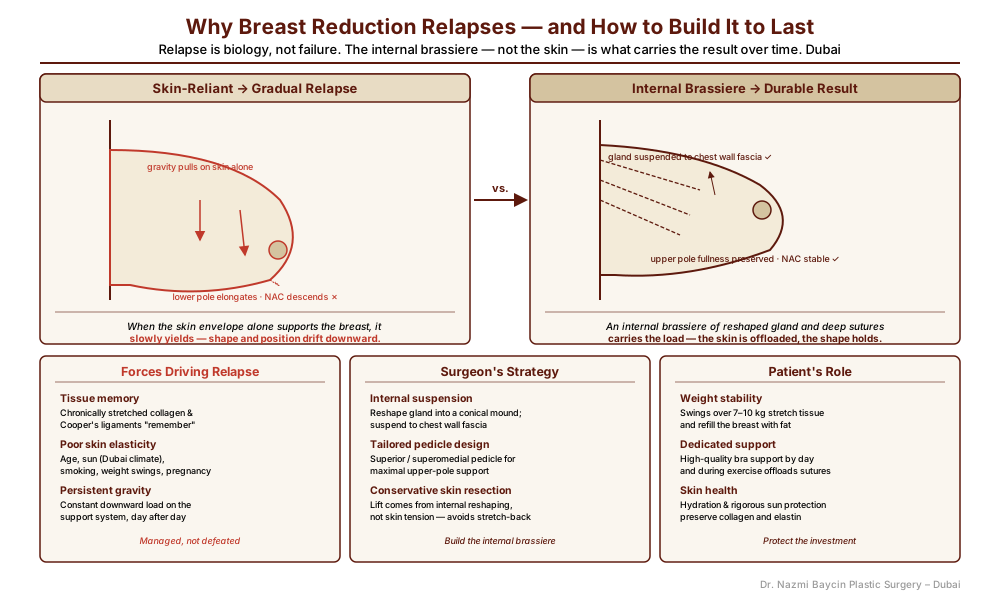
Why some breast reduction results relapse — a durable result is held by an internal suspension of the reshaped gland to the chest wall, backed by good skin elasticity and firm connective tissue, while tissue memory, poor elasticity, and a skin-reliant closure let the shape gradually descend and lose upper-pole fullness — by Dr. Nazmi Baycin, Dubai.
Skin elasticity: the biological canvas
If tissue memory is the internal factor, skin elasticity is the external determinant. Elasticity is the skin’s innate ability to snap back after being stretched. It is genetically endowed but profoundly affected by age, sun exposure (highly relevant in Dubai’s climate), smoking history, significant weight fluctuations, and pregnancies. During a reduction, I am not merely removing excess skin — I am relying on the remaining skin to act as a tight, supportive brassiere for the newly shaped mound for decades. So assessing skin quality is as important as measuring volume. When elasticity is poor, the long-term risk of stretch and relapse rises, which calls for more conservative skin resection and a greater emphasis on internal support.
What raises or lowers relapse risk
Durability is the product of several factors working together — some biological, some surgical, some in the patient’s own hands. The table below sets out what favors a lasting result against what raises the risk of relapse.
| Factor | Favors a Durable Result | Raises Relapse Risk |
|---|---|---|
| Skin elasticity | Good recoil, younger skin | Poor — age, sun, smoking damage |
| Pre-operative volume | Moderate, shorter duration | Very large, carried for decades |
| Connective tissue | Firm, resilient collagen | Soft, stretchy (genetic) |
| Internal support technique | Suspension to chest wall fascia | Skin-reliant closure only |
| Pedicle choice | Superior / superomedial | Inferior pedicle alone |
| Skin resection | Conservative, low tension | Aggressive, high tension |
| Weight stability | Stable within 7–10 kg | Significant fluctuation |
| Bra support | Consistent, high-quality | Inconsistent |
| Sun & skin care | Disciplined protection | Neglected (Dubai UV) |
The surgeon’s strategy: counteracting biological forces
My technical approach is designed to actively combat these forces, and it goes far beyond simple volume removal.
- The first element is internal suspension and reshaping. I do not just excise tissue and close; I reshape the remaining gland into a stable, conical mound and use deep, durable sutures to suspend that new parenchyma to the chest wall fascia at a higher position. This creates an internal brassiere, reducing the long-term gravitational pull on the skin alone. The principle of structural reinforcement is central to my breast lift surgery in Dubai, and it is doubly important in reduction cases.
- The second element is a tailored pedicle design. The pedicle — the attached stalk carrying the nipple and its blood supply — is chosen not only for safety but for structural contribution; in high-relapse-risk patients I favor a design that maximizes upper-pole support and minimizes tension on the lower-pole closure.
- The third is conservative skin resection. With poor elasticity, aggressive skin tightening only invites widened scars and stretch-back, so the true lift comes from internal reshaping, not from pulling the skin tight.
The patient’s role: protecting the surgical investment
Surgery sets the stage, but long-term maintenance is a shared responsibility, so I give my patients clear, non-negotiable guidelines. Weight stability comes first: fluctuations of more than seven to ten kilograms can dramatically stretch tissues and refill the breast with fat, directly causing relapse. Dedicated support matters too — consistent, high-quality bra support, especially during daytime activity and exercise, offloads stress from the healing internal sutures and the skin. And skin health helps: a disciplined regimen of hydration and rigorous sun protection preserves the collagen and elastin in the skin envelope. Patients can read more about the operation itself on my breast reduction in Dubai page.
When revision becomes necessary
For some patients, despite optimal planning and adherence, biology prevails and a revision becomes desirable to restore shape. Revision breast reduction is a more complex undertaking. It focuses on re-tightening the stretched envelope, re-suspending the gland, and often converting to a different pedicle technique for enhanced support. It is a reminder of a core principle: in plastic surgery, we manage nature’s tendencies rather than defeat them. Because every case is individual, the plan and its cost are discussed transparently at consultation.
A partnership for lasting relief
Relapse after breast reduction is not a mystery; it is a predictable biological challenge. My role is to apply a deep understanding of tissue biomechanics to a plan that anticipates and mitigates these forces. Through meticulous internal reconstruction, respect for skin biology, and a true partnership with the patient on aftercare, we achieve more than reduction — we achieve a durable restoration of form and function. The goal is a result that stands up to time and gravity, and that same durability-first philosophy runs through all of my plastic surgery practice in Dubai.
FAQs about relapse risk after breast reduction surgery in Dubai
-
Does breast reduction last, or will my breasts sag again?
For most patients, breast reduction provides a durable, long-lasting result. A subset experiences gradual, partial relapse over the years — not a return to the original size, but subtle descent, lower-pole elongation, and loss of upper-pole fullness. This is driven by biology (tissue memory and skin elasticity) rather than surgical failure. I counter it by building an internal support structure — suspending the reshaped gland to the chest wall fascia — so the result relies on internal scaffolding rather than the skin alone, which dramatically improves longevity.
-
What is tissue memory in breast reduction?
Tissue memory describes how the skin and Cooper’s ligaments of a breast that has been large for years or decades become chronically stretched, retaining a tendency to return toward that stretched state. Surgery removes weight and reshapes the breast but cannot fully reset the mechanical properties of these collagen fibers. This is why patients who carried very large volume for a long time, or who have naturally soft connective tissue, are more prone to relapse — and why I build robust internal support to resist this inherent tendency.
-
How does skin elasticity affect breast reduction results?
Skin elasticity — the skin’s ability to recoil after stretching — is a key determinant of how long a result lasts. After reduction, the remaining skin acts as a supportive brassiere for the new breast shape. When elasticity is poor (from age, sun exposure, smoking, weight changes, or pregnancies), the skin is more likely to stretch over time, allowing relapse. For these patients, I use more conservative skin resection and rely more heavily on internal support, since the skin cannot be trusted to hold the shape alone.
-
Can I prevent my breast reduction results from relapsing?
You play a major role in protecting the result. The three most important factors are: maintaining a stable weight (fluctuations over 7–10 kg can stretch tissues and refill the breast with fat), wearing consistent high-quality bra support especially during exercise to offload the healing internal sutures, and protecting skin health through hydration and rigorous sun protection — particularly important in Dubai’s climate. These, combined with a surgical plan built around internal support, give the best chance of a lasting result.
-
Is relapse after breast reduction a sign the surgery failed?
No. Relapse is rarely a surgical failure — it is a biological process. A technically excellent reduction can still gradually change shape because the patient’s own tissues (tissue memory, skin elasticity) continue to behave according to their nature under persistent gravity. The distinction matters: it shifts the focus from blame to biology, and it explains why the surgical strategy centers on building internal support to resist these forces rather than assuming the skin will hold the result indefinitely.
-
What does revision breast reduction involve?
Revision breast reduction is performed when relapse has occurred and a patient wishes to restore shape. It is more complex than the primary procedure, focusing on re-tightening the stretched skin envelope, re-suspending the descended gland, and often converting to a different pedicle technique for enhanced long-term support. It applies the lessons of how that patient’s tissues behaved over time to build a more durable second result. With well-planned primary surgery, most patients never require it.
-
Who is most likely to need a breast reduction revision?
Higher-risk patients include those who had very large breasts for many years (greater tissue memory), those with poor skin elasticity from age, sun, smoking, or major weight loss, those with naturally soft connective tissue, and those who experience significant weight fluctuation or pregnancy afterward. Being higher-risk does not make relapse inevitable — it means the surgery should be planned with greater internal support and conservative skin handling from the outset, which is exactly how I approach these cases.


GET APPOINTMENT
Get ready to look and feel best… You deserve…
