

Key takeaways: weight, not just skin
- In heavy breasts, ptosis is a weight-bearing problem, not only a skin-elasticity one.
- A lift repositions tissue but removes no mass — so a heavy breast keeps pulling down.
- Lift-only surgery on heavy breasts often recurs within one to two years.
- Adding reduction creates a lighter, more stable cone the skin can actually support.
- The combined approach also delivers functional relief — less neck, shoulder, and back strain.
- An anchor (inverted-T) scar under low tension outlasts a short scar under high stress.
This begins with an objective assessment of ptosis rather than a guess — though the profession has not settled on one way of doing it. A 2023 systematic review of breast-ptosis classification and assessment screened 2,550 publications and identified seven separate classification systems and four measurement techniques in use, concluding that a better system is still needed because the existing ones lack robust statistical validation. That is worth knowing before any surgeon quotes you a grade: the grade depends on which system they are using. What follows is the measurement-led approach I use, and why measuring the load — not just the droop — is what makes the plan reliable.
Why a lift alone often fails in heavy breasts
A breast lift reshapes and repositions existing tissue, but it does not eliminate excess mass unless a reduction is performed at the same time. In patients with heavy, pendulous breasts, a lift-only operation leaves a persistent downward gravitational pull, early stretching of the lower pole, scar widening from unrelieved tension, and a rapid recurrence of ptosis. Skin, however well it is sutured, cannot indefinitely support excessive breast weight without gradually deforming.
When volume is not addressed, the lift becomes a temporary measure rather than a stable reshaping. Many of the revision cases I see in Dubai are exactly this: patients who had a lift-only procedure elsewhere and returned within one to two years with flattened upper poles and bottomed-out lower breasts. The tissue did not fail because of poor healing — it failed because the load was never reduced. The same forces explain why some results relapse as tissue memory and skin elasticity reassert themselves over time.
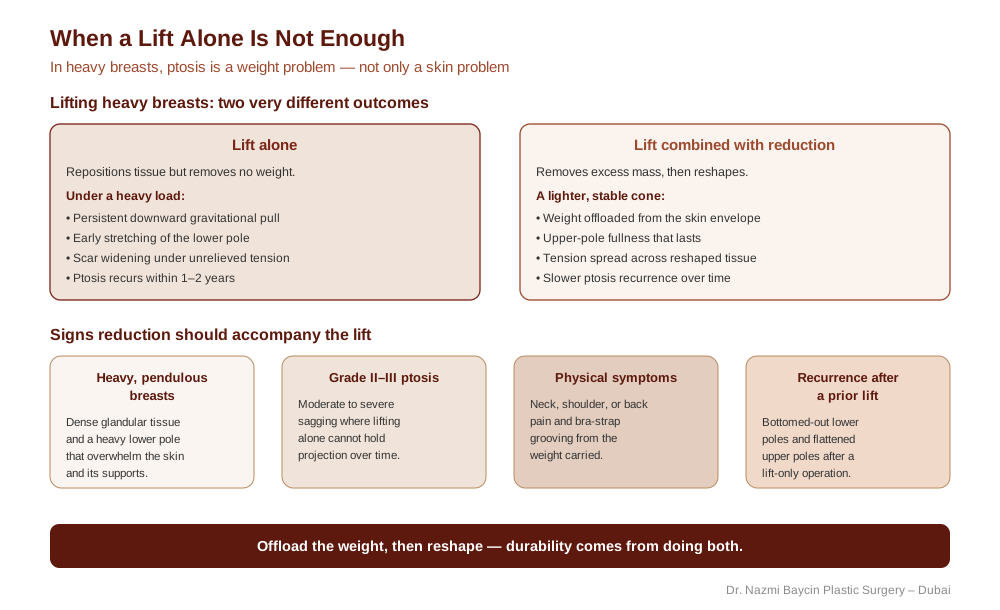
Why a lift alone is not enough for heavy breasts — offloading the weight before reshaping produces a lighter, more stable cone and slower ptosis recurrence — by Dr. Nazmi Baycin, Dubai.
The relationship between breast weight and ptosis
Breast ptosis is not solely a skin-elasticity issue; it is fundamentally a weight-bearing one, made worse by dense glandular tissue, a wide breast base, a heavy lower-pole concentration, and weak internal support structures. Genetics, pregnancy, and weight fluctuations all amplify these factors, which is why quantifying volume is non-negotiable at consultation. When excessive tissue density overwhelms the skin envelope and its ligamentous supports, even the most precise lift cannot maintain projection or upper-pole fullness over time unless the underlying mass is offloaded. My preoperative evaluation in Dubai therefore quantifies breast weight relative to the torso frame, so the decision between an isolated lift and a combined lift-reduction is based on structural reality rather than size preference alone.
How planning determines the reduction needed
My planning relies on objective anatomical analysis rather than subjective size targets. The measurements that matter include the nipple-to-inframammary-fold distance, the breast base width, the lower-pole height relative to the upper pole, skin elasticity assessed by a pinch test, and tissue density. The table below shows how each measurement informs the decision.
| Assessment | What It Measures | How It Guides Surgery |
|---|---|---|
| Nipple-to-fold distance | Degree of nipple descent | Determines how far the nipple-areola must be repositioned |
| Breast base width | Footprint of the breast on the chest | Informs cone reshaping and pedicle planning |
| Lower vs upper pole height | Distribution of volume | Reveals lower-pole heaviness that lift alone can’t hold |
| Skin pinch test | Skin elasticity and quality | Shows whether skin can support the reshaped tissue |
| Tissue density | Glandular weight | Decides whether reduction is needed for stability |
If breast weight exceeds what the reshaped skin envelope can support, I incorporate a reduction to create a lighter, more stable cone. This data-driven approach avoids over-reliance on skin tension alone, which is a common technical mistake that leads to bottoming out. The goal is to let the measurements — not an approximate visual impression — determine whether reduction is required for structural longevity.
Surgical strategy, pedicle choice, and sensation
I perform the combined lift and reduction as a single integrated operation: removing excess glandular and fatty tissue, repositioning the nipple-areola complex, reshaping the remaining parenchyma into a stable cone, and redraping the skin without excessive tension. The core principles are glandular redistribution for upper-pole fullness, precise pedicle design for nipple viability, and skin undermining limited to what is necessary to preserve blood supply.
Pedicle selection is critical here, because it maintains both circulation and nipple sensation — a relationship I examine in detail in how pedicle choice affects nipple sensation. Vertical and superomedial pedicles give excellent upper-pole shape in moderate reductions, while inferior pedicles suit very large-volume removals that demand maximal safety.
The right choice depends on breast dimensions, ptosis severity, and the vascular pattern seen during surgery — defaulting to one pedicle for every case is a common error, compromising either fullness or safety. This careful, individualized judgment is central to my approach to breast reduction in Dubai, where safety, shape, and sensation are balanced together rather than traded against one another.
Why anchor scars often excel
Minimal scarring understandably appeals to patients, but combined lift-reduction in heavy breasts often needs an anchor, or inverted-T, pattern. That pattern allows maximal skin removal, distributes tension evenly, prevents bottoming out, and improves long-term shape retention. A longer scar under low tension heals more predictably than a short scar under high stress. Vertical or lollipop patterns are perfectly adequate for smaller reductions, but under the load of heavy breasts they tend to fail, producing widened T-junctions or pseudoptosis. Choosing the scar pattern to match the load — rather than to the shortest possible line — is part of prioritizing stability over minimalism.
Functional benefits and getting the amount right
Reducing volume alongside the lift delivers measurable physical relief: less neck and shoulder pain, improved posture, easier physical activity, and better clothing fit. For many active patients these functional gains motivate surgery as much as appearance does, and they compound the aesthetic improvement into comprehensive value.
The amount of reduction, though, has to be judged carefully. Over-reduction produces flat, deflated breasts that age prematurely, while under-reduction invites ptosis to return. My approach targets genuine functional relief — typically in the range of 300–800g per breast — along with structural longevity and proportions that suit the frame, refined through intraoperative tissue weighing and shaping trials rather than an arbitrary resection target.
The aim of the combined procedure in Dubai is a lighter, balanced breast that keeps its projection without sagging. This structural, measurement-led philosophy is what you should expect from a board-certified cosmetic surgeon in Dubai, and because every breast is different, both the surgical plan and its cost are best worked out at a consultation built around your measurements and goals.
FAQs about breast lift combined with reduction in Dubai
-
When does a breast lift need to be combined with a reduction?
A lift needs a reduction when the breast is heavy enough that its weight, not just loose skin, is driving the sagging. In heavy, pendulous breasts, a lift alone repositions the tissue but leaves the excess mass pulling downward, so the result tends to stretch and drop again. Signs that reduction should be added include moderate to severe (Grade II–III) ptosis, dense heavy breasts, physical symptoms like neck or shoulder pain and bra-strap grooving, and recurrence after a previous lift. An objective assessment of volume and ptosis at consultation determines whether reduction is necessary.
-
Why does a lift alone fail in heavy breasts?
A lift reshapes and repositions tissue but removes no weight. When a breast is heavy, that unaddressed mass keeps exerting a downward pull, so the skin — however well it is sutured — gradually stretches, the lower pole descends, and scars widen under tension. The result is often a return of sagging within one to two years, with flattened upper poles and bottomed-out lower breasts. It is not usually a healing failure but a mechanical one: the load was never reduced, so the reshaping could not hold.
-
Will combining reduction with my lift help with neck and back pain?
Very often, yes. Much of the neck, shoulder, and back strain associated with heavy breasts comes from the weight itself, along with bra-strap grooving and postural load. Reducing the volume during the lift removes a meaningful portion of that weight, which many patients find relieves chronic symptoms and makes physical activity and posture easier. For a lot of patients these functional benefits are as motivating as the aesthetic ones. The degree of relief depends on how much weight is safely reduced, which is planned around your anatomy.
-
How much breast tissue is removed?
The amount is individualized, but it typically falls in the range of around 300 to 800 grams per breast for the goal of functional relief with lasting shape. The target is deliberately balanced: over-reduction can leave breasts flat, deflated, and prone to premature aging, while under-reduction invites the sagging to return. Rather than working to an arbitrary figure, the reduction is refined during surgery using tissue weighing and shaping trials, so the final result is a lighter, proportionate breast that keeps its projection. Your frame and goals guide where within that range you fall.
-
Why is an anchor (inverted-T) scar often recommended?
In heavy breasts, an anchor or inverted-T pattern allows the maximal skin removal needed, distributes tension evenly, helps prevent bottoming out, and improves long-term shape retention. A longer scar healing under low tension is generally more predictable than a short scar under high stress. Shorter vertical or lollipop patterns are excellent for smaller reductions, but under the load of a heavy breast they can widen at the T-junction or allow pseudoptosis. The scar pattern is matched to the breast’s weight and reshaping needs, prioritizing stability and a durable result.
-
Will I keep nipple sensation after the combined procedure?
Preserving nipple sensation and blood supply is a central priority, and it depends heavily on pedicle design — the tissue bridge that keeps the nipple-areola alive and connected. The pedicle is chosen for your specific breast dimensions, degree of ptosis, and vascular pattern, rather than using one method for every case. Vertical and superomedial pedicles suit moderate reductions, while inferior pedicles are used for very large-volume removals needing maximal safety. Careful, individualized pedicle planning is what protects both sensation and nipple viability during a combined lift and reduction.


GET APPOINTMENT
Get ready to look and feel best… You deserve…
