

Key takeaways: the transaxillary dual-plane approach
- The transaxillary incision is hidden in the armpit crease, leaving no scar on the breast itself.
- The dual-plane pocket places the implant partly under the muscle (upper pole) and partly behind the gland (lower pole).
- This combination aims for a natural slope, natural movement, and reduced animation deformity.
- The extent of muscle release is tailored to each patient’s anatomy.
- The technique is technically demanding — building that pocket through a small, distant incision requires specialized instruments and experience.
- Recovery is manageable: most patients return to desk work within a week, with strenuous activity restricted for four to six weeks.
A note on scope. This article is about one thing: building a dual-plane pocket through the underarm. Why the armpit rather than the breast, and what each incision route actually costs you, is the subject of my article on where the scar goes, and what it records. How the dual plane itself works — the spectrum of release, and what each level does to the shape — is set out in the dual-plane breast augmentation. And how the three standard planes compare is covered in how implant pocket selection shapes the final look. What follows is what happens when you ask for both at once.
The invisible incision: why the armpit?
The transaxillary incision is placed precisely within the natural crease of the armpit, and when healed it is virtually invisible. The arm rests naturally against the body, concealing the small scar completely, so a patient can wear a bikini, a low-cut top, or lingerie — or simply raise her arms — without any telltale sign of surgery.
Many surgeons avoid this approach because it is technically demanding. Working through a small incision, distant from the pocket where the implant will rest, requires specialized instruments and a three-dimensional mental map of the anatomy, navigating around nerves, blood vessels, and muscle attachments. For me that difficulty is a privilege, because it lets me offer patients a transformation that leaves no trace.
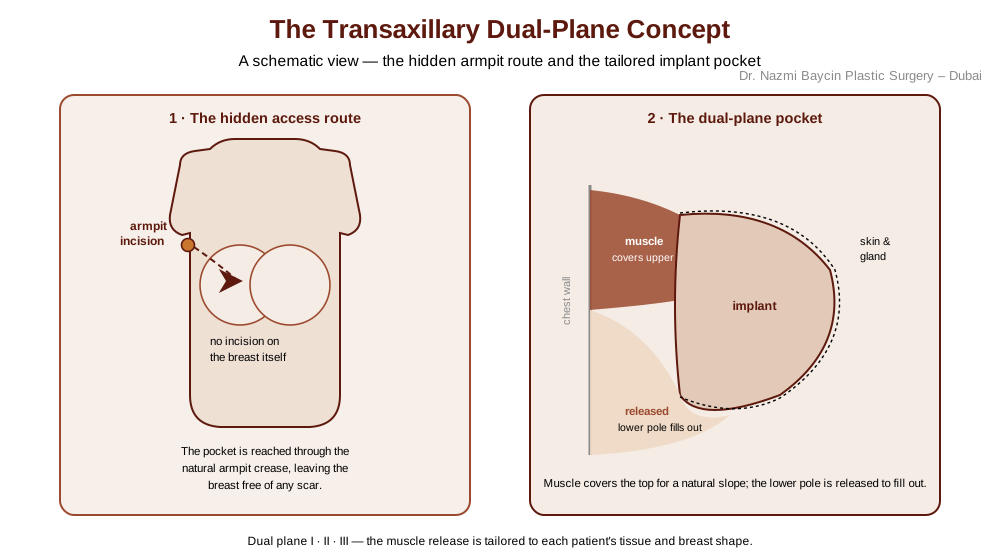
A schematic of the transaxillary dual-plane concept — the hidden armpit route and the tailored implant pocket, muscle over the upper pole with the lower pole released — by Dr. Nazmi Baycin, Dubai.
Building the pocket from the far side of the chest
The incision is only half the story; the pocket where the implant resides is where the artistry truly begins. And building a dual-plane pocket through the armpit is a materially harder problem than building the same pocket through an incision beneath the breast, because every boundary that matters lies at the far end of a long, narrow working corridor.
This is where mastery matters. Dissecting the dual plane from the axilla requires an intimate understanding of the pectoralis attachments, the nerve supply to the chest and breast, and the vascular anatomy that must be preserved. The muscle is divided along its inferior border exactly where needed, no more and no less, and the pocket is created with millimeter accuracy — all of it judged at a distance, with the two sides compared continuously against each other as the dissection proceeds, because a chest is never symmetric and the second side must be built to match the first rather than to a template. The result is a breast that looks and moves naturally: implants that do not jump or distort when the chest muscles flex, that fall naturally to the sides when lying down, and that reveal no scar, rippling, or evidence that surgery ever occurred. Patients who wish to understand the fundamentals can read more about my approach to breast augmentation in Dubai.
How far the muscle is released is the decision that most changes the result, and it is made during surgery rather than beforehand. I set out the spectrum of release, and what each level does to the shape, in my article on the dual plane; what belongs here is that the judgment has to be made from the axilla, without the direct working access an incision on the breast would give.
What the evidence says about the muscle
It is worth being honest about where the published work points, including where it does not point my way. A 2024 comparison of 82 transaxillary patients set the standard dual plane against a reverse dual plane that is roughly seventy per cent subfascial, and found less pain, better softness when lying down, and no animation deformity at all in the reverse group, against two cases in forty for the conventional dual plane. The arm that did better is the arm that involved the muscle less. That is a fair argument for asking, in any given patient, how much muscle the result actually needs — and it is one reason the release is graded rather than routine. It is also a single-centre study of eighty-two patients with patient-reported outcomes and an animation difference resting on two events, so it is a signal rather than a settled case.
Work on breast animation deformity relates the problem to how far the pectoralis is disrupted, which is the same reasoning from the other direction: the less muscle is recruited, and the more precisely what remains is released, the less there is to distort.
What my patients experience
Women who choose this technique consistently report the same outcomes: no scars on the breast, implants that move naturally without the distortion of traditional submuscular placement, and breasts that look and feel like their own, only fuller. For a mother who has lost volume after breastfeeding, the goal is restoration that feels invisible — and where significant sagging accompanies that volume loss, augmentation is sometimes combined with a breast lift in Dubai to reposition the tissue as well as restore fullness.
Recovery is manageable: most patients return to desk work within a week, initial discomfort is controlled with medication, and strenuous upper-body activity is restricted for four to six weeks to protect the muscle release and let the pocket stabilize.
The philosophy of respect
My philosophy has always been the same: respect the anatomy, and the anatomy will reward you. The transaxillary dual-plane technique embodies this completely. It respects the breast by leaving it scar-free and preserving its natural function. It respects the muscle by releasing it precisely where needed, and no further. It respects the implant by placing it in a pocket optimized for its shape, size, and material. And it respects the patient by delivering a result that looks and feels natural, allowing her to forget she ever had surgery.
This demands continuous learning and meticulous technique, but the reward — a patient who looks in the mirror and sees herself, only better — is worth every moment. This principled approach reflects the wider philosophy behind my work as a cosmetic surgeon in Dubai. Because every breast is unique, the plan is individualized and discussed candidly in consultation.
FAQs about transaxillary dual-plane breast augmentation in Dubai
-
Is the transaxillary approach really scarless?
There is still an incision, but it is placed in the natural crease of the armpit rather than on the breast. When healed, it sits hidden with the arm resting at the side, so the breast itself carries no scar. That is what the term scarless breast augmentation refers to — no visible mark on the breast, which is the area most patients most want to keep unmarked.
-
Will my implants move or distort when I use my chest muscles?
Animation deformity — visible movement when the pectoral muscle contracts — is most pronounced with total submuscular placement. It relates to how much the muscle is disrupted, so a measured, tailored dual-plane release is designed to limit it. In practice, most of my patients find their implants move naturally rather than jumping or distorting during exercise.
-
Is the transaxillary technique suitable for everyone?
It suits most patients seeking primary augmentation who want no scar on the breast, but it is not universal. Certain revisions, very significant sagging that needs a lift, or specific anatomical situations may be better served by another incision or a combined procedure. I discuss candidly at consultation whether it is the right choice for your anatomy and goals rather than applying one technique to everyone.
-
What is recovery like?
Most patients return to desk work within about a week. Early discomfort is controlled with medication, and a compression garment provides support. Because the technique involves a precise muscle release, strenuous and upper-body activity is restricted for four to six weeks so the pocket can stabilize. The final, settled result emerges over the following weeks as swelling resolves.


GET APPOINTMENT
Get ready to look and feel best… You deserve…
