

Key takeaways: the pocket is the foundation
- The pocket, not the implant, is the true architect of a long-lasting result.
- The implant is a passive device — it behaves exactly as the space around it dictates.
- Dimensional accuracy matters: the pocket width should match the implant to the millimeter.
- A reinforced inframammary fold is the cornerstone that prevents bottoming out.
- Instrument-only techniques that limit pocket shaping compromise precise pocket control.
- Most revision surgery is pocket reconstruction, not simply an implant swap.
This focus on the pocket is well established in the surgical literature. A retrospective review of 220 augmentation patients examined three variables in surgical design — incision site, implant characteristics, and pocket-plane selection — and their influence on aesthetic results in both primary and secondary cases. It is worth being precise about what that paper covers: its author states plainly that no attempt was made to address long-term issues such as capsular contracture, so it establishes the pocket plane as one of the core decisions in surgical design rather than settling how a result behaves over a decade. The pocket plane is not a detail. It is one of the decisions the whole design rests on.
Why the pocket, not the implant, is the true architect
Patients in Dubai often pour their energy into choosing an implant. That is understandable, but the implant is a passive device. Its behavior is dictated entirely by the environment we create for it. Think of the pocket as the custom-fitted foundation for a sculpture.
My goal is to engineer a space that gives stable positioning, a natural upper-pole slope, balanced fullness, and resilience against gravity and time. This internal architecture is what prevents lateral drift, double-bubble deformities, and palpable edges. Those problems are the signature of a poorly planned pocket, not a poorly chosen implant. Structural integrity of this kind sits at the center of how I approach breast augmentation in Dubai.
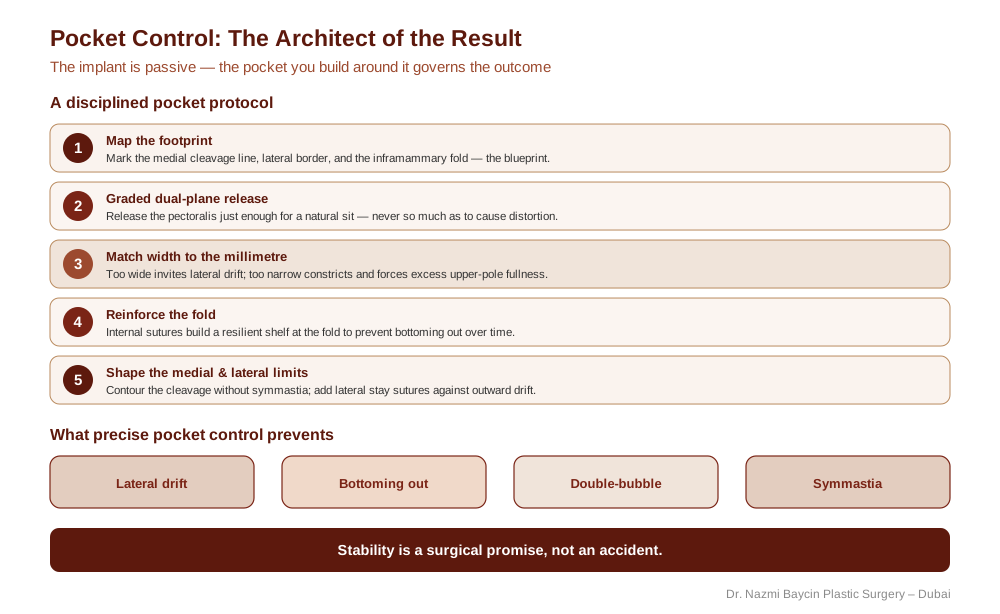
The pocket protocol that governs long-term stability — and the deformities precise pocket control prevents — by Dr. Nazmi Baycin, Dubai.
My step-by-step protocol for precision
There is no universal technique. Every patient’s anatomy is different — chest-wall width, breast footprint, tissue elasticity, muscular attachments. So my plan in Dubai follows a disciplined, anatomical sequence, summarized in the table below.
| Step | What It Involves | Why It Matters |
|---|---|---|
| Preoperative mapping | Mark medial line, lateral border, inframammary fold | Defines the breast footprint — the blueprint |
| Dual-plane dissection | Graded release of the pectoralis major | Natural sit without dynamic distortion |
| Dimensional accuracy | Pocket width matched to implant width | Prevents lateral drift and constriction |
| Fold reinforcement | Internal sutures at the inframammary fold | Resists bottoming out over time |
| Medial & lateral contouring | Shape cleavage; add lateral stay sutures | Avoids symmastia and outward drift |
A few of these steps deserve emphasis. The dual-plane release must be graded with care: enough to let the implant sit naturally, never so much that it compromises coverage or causes animation deformity when the chest muscle flexes. What that balance between implant, muscle, and gland involves, and how the degree of release is chosen, is the subject of my article on the dual-plane breast augmentation.
Dimensional accuracy is equally unforgiving. A pocket that is too wide invites lateral displacement; one that is too narrow constricts the implant and forces excessive upper-pole fullness. And the inframammary fold is the true cornerstone of long-term support, which is why I reinforce it with internal suturing to create a resilient shelf that stops the implant descending over the years.
The limits of non-standard techniques
In consultation, I am sometimes asked about methods that promise minimal scarring or rapid recovery. I owe patients honest anatomical clarity here. Techniques that constrain how far the surgeon can shape the pocket — some instrument-led approaches, for example — carry a real compromise. Without controlled dissection to the exact boundaries the implant requires, the nuanced medial contour, exact lateral border, and reinforced lower pole described above are geometrically very difficult to achieve.
The same limitation applies to marketed systems such as the Mia Femtech method. Its own three-year study of 100 patients describes the procedure as an axillary incision with prepectoral implant placement, carried out with a set of proprietary single-use instruments and one specific implant. That is a defined pathway rather than a pocket engineered around the individual, and it does not offer the planes beneath the muscle at all. My technique prioritizes lifetime stability over the appeal of a marginally smaller scar. That trade-off is one of the recurring themes in my article on technical mistakes in breast augmentation and how to avoid them.
Revision surgery is pocket reconstruction
A substantial part of my practice in Dubai is corrective work. In nearly every case of malposition, rotation, or bottoming out, the root cause is not a bad implant. It is a poorly conceived or executed pocket. Revision, therefore, is fundamentally about rebuilding that space. Sometimes it means using internal sutures — capsulorrhaphy — to reduce a pocket that has become too large. Sometimes a new, properly positioned pocket must be reconstructed with acellular dermal matrix or suture techniques when the original is irreparably misshapen. Often a lost or weakened inframammary fold has to be rebuilt entirely. These operations are complex, and they exist precisely because the original anatomy was not respected. Getting it right the first time is always the better path.
Active lifestyles demand superior engineering
My patients lead dynamic, active lives. They want a result that looks beautiful at rest and stays stable through exercise and daily movement. That demands exceptional pocket control. For athletic women, or those with lean tissue, I pay particular attention to soft-tissue coverage through a precisely graded muscle release, and I consider ergonomic implants designed for such anatomies.
How much a patient’s tissue can accommodate is itself a planning variable, one I discuss in my piece on how tissue elasticity shapes implant selection. The aim is always the same: a result that looks and feels integrated with the body, not placed on top of it. Because that plan is so individual, both the surgical approach and its cost are best worked out at a consultation.
Stability is a surgical promise, not an accident
Long-term satisfaction in breast augmentation is not luck. It is the product of surgical science and artistry focused on the implant’s foundation. My entire technique is devoted to building a perfectly tailored pocket that respects and enhances each patient’s anatomy. That is how a result stays symmetrical, naturally proportioned, and — above all — stable for the long term. This precision-first philosophy is what defines careful work by a board-certified plastic surgeon in Dubai, where the foundation matters more than any shortcut.
FAQs about implant pocket control in Dubai
-
What is the implant pocket, and why does it matter so much?
The implant pocket is the precisely dissected internal space that holds the breast implant. It matters more than almost any other variable because the implant itself is passive — it simply settles into whatever space is created for it. The pocket determines positioning, upper-pole slope, fullness, and resistance to gravity over time. A well-engineered pocket produces a stable, natural, symmetrical result that lasts for years. A poorly designed one leads to drift, bottoming out, and asymmetry, regardless of how good the implant is. This is why pocket design is the true foundation of the procedure.
-
Is the implant or the pocket more important for the result?
The pocket is more important. Patients understandably focus on selecting an implant, and implant quality does matter, but the implant is a passive device whose behavior is dictated entirely by the space around it. A beautiful implant placed in a poorly designed pocket will still drift, sit too low, or look unnatural. Conversely, a precisely engineered pocket allows the implant to sit exactly where it should and stay there. Think of the pocket as the custom-fitted foundation for a sculpture: the foundation, not the sculpture alone, determines whether the result stays stable.
-
What causes an implant to bottom out?
Bottoming out happens when the implant gradually descends below the natural breast crease, so the nipple appears to sit too high and the fullness shifts to the lower pole. The usual cause is a weak or poorly supported inframammary fold — the structural shelf at the base of the breast. If that fold is not adequately reinforced, the weight of the implant slowly stretches the lower pole over time. To prevent this, I reinforce the fold with internal suturing to create a strong, resilient shelf. Careful attention to this one structure is one of the most important safeguards of a lasting result.
-
Why do you not recommend some minimal-scar or device-only methods?
Some methods promise minimal scarring or very rapid recovery, but achieve this by limiting how far the surgeon can shape the pocket. Precise pocket engineering — the nuanced medial contour, the exact lateral border, the reinforced lower pole — depends on controlled dissection to the exact boundaries the implant requires. When a technique restricts that access, it becomes geometrically very difficult to shape the pocket accurately, which raises the long-term risk of malposition and revision. I prioritize lifetime stability over a marginally smaller scar, because the foundation of the result is what patients live with for years.
-
Can a poor previous result be corrected?
Yes. A large part of my practice is corrective surgery, and in nearly every case of malposition, rotation, or bottoming out, the underlying problem is the pocket rather than the implant. Revision is essentially pocket reconstruction. Depending on the situation, this may mean using internal sutures to reduce a pocket that has become too large, reconstructing a new and properly positioned pocket with acellular dermal matrix or sutures, or rebuilding a weakened inframammary fold. These operations are more complex than a first-time augmentation, which is exactly why getting the anatomy right from the outset is so valuable.
-
Does an active lifestyle affect how the pocket should be built?
It does. An active or athletic patient needs a result that stays stable during exercise and movement, not just at rest, and that places extra demands on pocket control. For athletic women or those with lean tissue, I pay particular attention to ensuring adequate soft-tissue coverage through a precisely graded muscle release, and I may consider ergonomic implants designed for those anatomies. The goal is a result that looks and feels integrated with the body rather than sitting on top of it. Assessing your tissue, activity level, and anatomy at consultation is what allows the pocket plan to be matched to your lifestyle.


GET APPOINTMENT
Get ready to look and feel best… You deserve…
