

Key takeaways: the dual-plane relationship
- Dual-plane is about the dynamic interplay of implant, muscle, and gland — not a single static pocket.
- The classic over-versus-under-the-muscle choice is a compromise: subglandular risks rippling; full submuscular risks animation deformity.
- Dual-plane covers the upper implant with muscle while the lower implant meets the gland, via a partial release of the muscle’s lower attachments.
- It is a spectrum (Dual-Plane I, II, III), chosen by the degree of muscle release.
- The level is decided on the operating table from your gland firmness, ptosis, and muscle tightness — not from a textbook.
- The goal is soft-tissue coverage plus natural movement, reducing rippling and animation while keeping a unified drape.
Deconstructing the planes: the anatomy of choice
To appreciate the dual-plane advantage, it helps to understand the three anatomic options for implant placement, each with distinct trade-offs. In a subglandular placement (over the muscle), the implant rests directly behind the breast tissue; in patients with thin soft tissue this can lead to visible implant edges, palpability, and offers no mitigation of animation deformity. In a submuscular placement (fully under the pectoralis major), the implant can move and distort with muscle contraction (“animation deformity”) and may create excessive upper-pole fullness or a high-riding look if the muscle is tight.
The dual-plane approach is the hybrid: the upper portion of the implant is covered by muscle while the lower portion sits in direct contact with the gland, achieved through a precise, partial release of the muscle’s lower attachments. Its genius is adaptability — by controlling the degree of muscle release, the implant’s interaction with the dynamic muscle above and the soft gland below can be tailored, like a custom-fitted garment rather than an off-the-rack solution.
| Placement | How it sits | Main trade-off |
|---|---|---|
| Subglandular (over the muscle) | Implant behind gland, atop the pectoral muscle | Edge visibility and rippling in thin tissue; no help with animation |
| Submuscular (under the muscle) | Implant fully covered by pectoralis major | Animation deformity; possible upper-pole excess or high-riding look |
| Dual-plane (hybrid) | Upper implant under muscle, lower implant against gland | Technically more complex; requires judging the exact release level |
Tailoring the plane to the patient: Dual-Plane I, II, and III
The decision for the exact dual-plane level is made on the operating table, based on your unique anatomy, and it is a judgment that takes focused experience to master.
- Dual-Plane I suits patients with a firm, tight breast gland and minimal sagging: a minor muscle release lets the implant settle properly behind existing tissue.
- Dual-Plane II — the most commonly employed level for the majority of patients — uses a more significant release so the breast gland and implant unite as a composite, reducing upper-pole fullness, encouraging a natural slope, and significantly minimizing animation deformity.
- Dual-Plane III is reserved for more pronounced sagging (grade I ptosis): the most extensive release allows the implant to fill the lower pole fully, providing a mild internal lift by redistributing glandular tissue.
This tailored approach aims for optimal soft-tissue coverage across the entire implant, reducing ripple visibility while allowing the breast to move with a natural, unified drape.
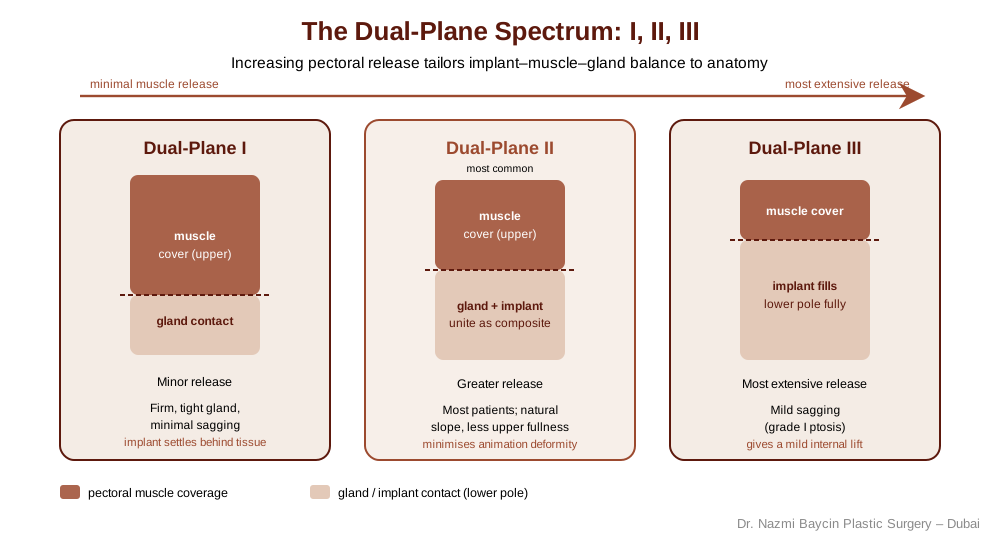
The dual-plane spectrum: as pectoral release increases from Dual-Plane I to III, muscle coverage of the upper implant decreases and lower-pole gland–implant contact increases, matching the technique to each patient’s anatomy — by Dr. Nazmi Baycin, Dubai.
How releasing the muscle changes the mechanics
The reason the dual-plane spectrum works is mechanical. An intact pectoralis major that still grips the lower implant behaves like a bowstring: every time the muscle contracts, it presses on the implant and pushes it sideways and upward, which is the root of both animation deformity and the high-riding look. Releasing the muscle’s lower border along the inframammary fold breaks that bowstring effect at the bottom while leaving the upper muscle intact for soft coverage.
The result is a division of labor across the breast. The upper pole keeps a layer of muscle that hides implant edges and softens the transition into the chest, while the lower pole is handed over to the gland and skin, which drape over the implant the way natural tissue does. Increasing the release simply moves the boundary between these two zones lower, which is precisely what Dual-Plane I, II, and III describe. The plane is only half the picture, though; the pocket around the implant must also be engineered to hold it stable, which I discuss in implant pocket control.
The pitfalls of a one-size-fits-all approach
The results of an improperly selected plane are telling, and they are common reasons for revision — one of the avoidable technical errors that compromise a breast augmentation result. A fully submuscular implant that stays high and rigid can create a “static shelf” — a stark, two-segment appearance that fails to blend with the natural breast tissue below. Traditional submuscular placement is also associated with unnatural animation: distortion and lateral displacement of the implant with arm movement or chest flexing. And in thin patients, a subglandular implant can show visible rippling in the upper and medial cleavage, where tissue coverage is thinnest. Matching the plane — and the release level — to the individual is a proactive strategy for natural integration from the start, rather than correcting these issues later.
At rest and in motion: two tests, one result
I judge a breast augmentation against two separate standards. The first is the still photograph: is the upper pole smooth, is the slope natural, are the edges invisible? Almost any competent placement can pass this test on the operating table. The harder, more revealing test comes later, in motion — when a patient lifts her arms, leans forward, lies down, or contracts her chest. A well-chosen dual plane is designed to pass both. Because the lower implant is no longer held hostage by active muscle, the breast falls naturally to the side when lying down and does not jump or flatten when the pectoral flexes. This is what people mean when they say an augmentation looks and feels like their own body rather than something placed on top of it — and it is a property of the plane, not the implant.
Where the dual-plane concept comes from
The dual-plane approach is well described in the surgical literature. Tebbetts’s series of 468 dual-plane augmentations performed between 1992 and 1998 introduced the dual-plane concept and described its indications and techniques across a wide range of breast types, explaining how retromammary, partial-retropectoral, and total-submuscular pockets each carry their own trade-offs — and how adjusting the implant–soft-tissue relationship addresses the limitations of any single fixed pocket. It is worth being precise about what that paper establishes: it is a single-surgeon consecutive series with no comparison group, and its author disclosed a consultancy with the manufacturer of one of the implants used, so it sets out the indications and the technique rather than demonstrating superiority over any other pocket. That framework, rather than any one-size formula, is what underpins tailoring the plane to each patient’s anatomy.
A surgeon as anatomist and strategist
Executing a dual-plane augmentation well requires strategic vision as much as technical skill: an understanding of how your specific tissue characteristics — skin elasticity, glandular density, muscle tightness — will interact with the chosen implant over time. Every millimeter of muscle release is deliberate, made with the final dynamic result in mind. The outcome is a breast that looks full and beautiful when you stand still, yet moves as one with your body in motion — a restoration of contour that respects your native anatomy. Because this is a more intricate dissection than a standard placement, it requires longer operating time and precise judgment; the full details are set out on my main breast augmentation in Dubai page.
FAQs about dual-plane implant placement in Dubai
-
What is a dual-plane breast augmentation?
It’s a technique where the upper portion of the implant is covered by the pectoral muscle while the lower portion sits in direct contact with the breast gland, created through a partial release of the muscle’s lower attachments. This combines the soft upper coverage of a submuscular placement with the natural lower drape of a subglandular one, aiming for fullness that also moves naturally.
-
How is it different from over or under the muscle?
Placing an implant fully over the muscle (subglandular) can show edges and rippling in thin tissue, while placing it fully under the muscle (submuscular) can cause animation deformity and upper-pole tightness. Dual-plane is a hybrid that covers the upper implant with muscle and lets the lower implant meet the gland, which is designed to reduce both problems at once.
-
What do Dual-Plane I, II, and III mean?
They describe how much the lower pectoral muscle is released, along a spectrum. Dual-Plane I is a minor release for a firm, tight gland with minimal sagging; Dual-Plane II is a greater release that unites gland and implant as a composite and is the most commonly used level; Dual-Plane III is the most extensive release, reserved for mild sagging, and provides a small internal lift by redistributing glandular tissue.
-
How do you decide which level is right for me?
The exact level is chosen based on your anatomy — the firmness and density of your gland, the degree of any sagging, and how tight your pectoral muscle is. While the plan is discussed beforehand, the final decision is confirmed on the operating table, where the tissue behavior can be assessed directly. It is an individualized judgment rather than a fixed formula.
-
Does dual-plane reduce animation deformity?
It is designed to. Animation deformity — implant movement and distortion when the chest muscle contracts — is more associated with fully submuscular placement. By releasing the lower muscle attachments so the lower implant is no longer under active muscle, the dual-plane technique (particularly Dual-Plane II) is intended to reduce this movement while keeping soft upper-pole coverage.
-
Will the result look and move naturally?
That is the central goal of the technique: optimal soft-tissue coverage to reduce visible rippling, combined with a lower pole that drapes and moves with the body rather than sitting as a rigid, separate shelf. Matching the plane and release level to your anatomy is what supports a result that looks full at rest and unified in motion.


GET APPOINTMENT
Get ready to look and feel best… You deserve…
