

Key takeaways: structure, definition, and a natural navel
- The foundation is a complete architectural repair of rectus diastasis, not a superficial tightening.
- High-definition sculpting creates a subtle two-pack shadow — an implication of fitness, not bodybuilder lines.
- The navel is made scar-free using an internal suturing technique that hides the scar inside the umbilicus.
- Scarpa’s fascia is preserved, which is well supported for reducing seroma and shortening the time to drain removal.
- The three goals are pursued as one integrated procedure, not separate steps.
- Recovery is similar to a standard tummy tuck — desk work in about two weeks, with the fine definition emerging over months.
Foundation first: the architecture of dynamic muscle repair
Lasting beauty requires an impeccable foundation, and the cornerstone of my abdominoplasty is a complete architectural repair of the rectus diastasis. This is not a superficial tightening: the rectus muscles are re-approximated in layers from the sternum to the pubic bone with high-tensile permanent sutures, reconstructing the natural midline linea alba and restoring the functional integrity of the core. What the condition itself is, how it is measured and when it warrants repair at all, I set out in my article on diastasis recti and when it actually needs repair, and the engineering that makes the repair durable in my article on structural abdominoplasty and the multi-layer core repair.
What matters here is what that foundation makes possible. A simple plication of the outer fascial layer leaves the deep separation uncorrected and risks future bulging, and it cannot carry the surface work that follows. My repair is designed for permanence, providing the stable canvas essential for the next stage of sculpting.
The sculptor’s hand: creating natural two-pack definition
With a stable muscular wall restored, we enter the realm of artistry, because a flat abdomen can still appear soft and undefined. My high-definition technique introduces light, shadow, and suggestion. The two-pack effect is not about the sharp, exaggerated lines of a bodybuilder; it is about subtlety. Using precise surgical technique, I delicately define the repaired upper rectus abdominis muscles — a controlled etching along the muscle’s natural medial and lateral borders. The result is a gentle, natural indentation, a shadow that suggests underlying tone: an implication of fitness rather than an overt declaration.
The masterpiece detail: the scarless, natural navel
The umbilicus is the focal point of the abdomen, and a poorly crafted belly button is the unmistakable hallmark of a mediocre abdominoplasty. My goal is a navel so natural it appears never touched by surgery, and my technique rests on three pillars set out in the table below.
| Pillar | What it means | Why it matters |
|---|---|---|
| Anatomic positioning | The navel is placed centered and harmonious with your proportions | Keeps the focal point balanced within the new abdominal landscape |
| Three-dimensional sculpting | A subtle vertical oval with gentle superior hooding and depth | Avoids a shallow, stitched, or knotted appearance |
| The invisible scar | The old stalk is excised; the navel is fixed to deep fascia with internal sutures | The scar forms inside the navel, invisible once healed |
The pivotal technical step is the invisible scar. I completely excise the old umbilical stalk and its scar, then attach the new navel to the deep abdominal fascia using fine, dissolvable sutures placed entirely from the inside, so the final scar forms within the depths of the navel and is rendered completely invisible once healed. The common alternative — suturing the skin edge from the outside — invariably traps a visible, circular scar.
My internal technique erases this telltale sign, delivering a truly natural belly button. You can see how these techniques come together on my main abdominoplasty in Dubai page.
The synergistic layer: preserving Scarpa’s fascia for a superior contour
Supporting these primary goals is a nuanced technical step: the preservation of Scarpa’s fascia, a distinct membranous layer within the lower abdominal fat. During surgery I carefully preserve and then re-approximate this layer, which limits dead space, may support better lymphatic drainage, and helps create a smoother transition in the lower abdomen and suprapubic area.
The recovery benefit is reasonably well supported. A randomized trial of 160 abdominoplasty patients, eighty in each arm reported seroma in 2.5 percent of the preservation group against 18.8 percent of the controls, and a systematic review and meta-analysis pooling seven prospective controlled studies and 682 patients found significant reductions in seroma, total drain output and time to drain removal — though not in haematoma, infection, skin necrosis or wound dehiscence.
One caveat belongs with those figures rather than after them. A published discussion of the trial argued that its seroma difference may owe as much to electrodissection in the control arm as to the fascia itself, and the meta-analysis found the same pattern independently: seroma of 3 percent where a scalpel was used for dissection against 11 percent with electrocautery. The layer is worth preserving, and I preserve it — but the instrument used to raise the flap is plausibly doing part of the work the technique is credited with.
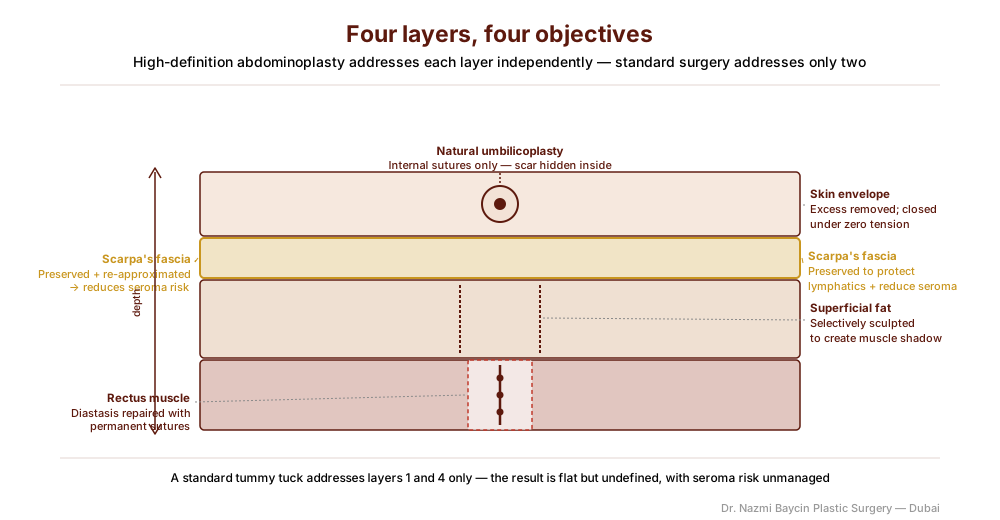
The layered structure of a high-definition abdominoplasty — deep muscle repair, preserved Scarpa’s fascia, sculpted fat, and the skin envelope with a scar-free navel — by Dr. Nazmi Baycin, Dubai.
Why definition must be built on repair, not fat alone
It is worth being clear about why the sequence matters, because the market is full of six-pack promises built on fat sculpting alone. Etching shadows into the fat layer without first repairing the underlying muscle wall is building on sand: if the rectus muscles remain separated, the abdomen still bulges from within, and no amount of surface definition will disguise a convex, unsupported midline. The shadows may even accentuate it.
That is why, in my hands, the definition is always secondary to the structural repair. I first rebuild a flat, stable, supported abdominal wall, and only then refine the surface over it. The two-pack shadow reads as natural precisely because there is a genuine, repaired muscular architecture beneath it for the light to fall across — not a cosmetic illusion etched onto a compromised foundation.
Who is a candidate — and who is better served by something simpler
Not every patient needs, or should have, the full high-definition approach, and part of an honest consultation is saying so. The ideal candidate has a genuine structural problem to correct — meaningful skin excess, rectus diastasis, or both — together with a moderate, sculptable fat layer and skin of reasonable quality. In that patient, combining the muscle repair, the definition, and the natural navel in one operation produces a result none of those steps could achieve alone.
Two groups are better served by something else. A patient whose only concern is a stubborn fat layer over a fit, undamaged abdominal wall does not need an abdominoplasty at all; liposuction or dedicated etching addresses that more directly and with a far shorter recovery. And a patient with very thin skin, minimal fat, or a strong tendency to poor scarring may not have the raw material for crisp surface definition, in which case I steer toward a clean, flat standard tummy tuck rather than promising shadows the tissue cannot reliably hold.
Matching the operation to the anatomy — rather than applying the most elaborate technique to everyone — is itself part of the craft. Which category of operation the anatomy calls for in the first place is a separate reading, which I set out in my article on how abdominal anatomy decides the tummy tuck plan. In practice, this honest sorting at the consultation stage is what protects patients from an over-engineered result they did not need and a recovery longer than their goals warranted.
The distinction of a surgical artist
The difference lies in the details. My approach is designed to avoid the pitfalls of a standard operation: the flat yet undefined abdomen, the telltale trapped-scar belly button, and unnatural tightness. Instead, I aim for a torso with a quietly athletic suggestion, a flawless focal point, and a sense of organic wholeness — a result that is as intelligently crafted as it is beautiful. Because it combines careful fat sculpting with muscle repair, this approach also draws on the contouring principles of liposuction in Dubai to refine the transitions around the definition.
This precision requires an intimate understanding of surface anatomy and fat-layer dynamics, and it draws on the same principles as dedicated abdominal etching (six-pack surgery) in Dubai, refined here for a natural rather than an overtly muscular look, and always kept in proportion to the individual patient’s frame and goals.
FAQs about high-definition abdominoplasty in Dubai
-
How is high-definition abdominoplasty different from a standard tummy tuck?
A standard tummy tuck removes excess skin and tightens the muscle to create a flat abdomen. A high-definition approach adds a layer of artistry on top of that foundation: after the muscle repair, I sculpt subtle shadows along the natural borders of the abdominal muscles and craft a scar-free navel. The goal is not just flat, but a torso with a quietly athletic, natural-looking definition.
-
What is the two-pack effect, and will it look overdone?
The two-pack effect is a subtle definition of the upper abdominal muscles — a gentle shadow that suggests tone rather than the sharp, carved lines of a bodybuilder. It is deliberately understated. The aim is an implication of fitness that looks authentically yours, so that in most clothing and lighting it simply reads as a naturally fit abdomen rather than an obviously operated one.
-
Why is the belly button the most telling part of a tummy tuck?
Because the navel is the focal point of the abdomen, a poorly made one is the clearest giveaway of surgery. A circular scar around the rim, or a shallow, stitched, knotted look, immediately signals an operation. By excising the old stalk and fixing the new navel with sutures placed entirely on the inside, the scar forms within the depths of the navel — so the belly button looks natural and untouched.
-
Does the muscle repair have to come before the definition?
Yes, and the order is not negotiable. Etching shadows into the fat layer over a wall that is still separated is building on sand: the abdomen keeps bulging from within, and the shadows can accentuate the convexity rather than disguise it. So I rebuild the midline first, from the sternum to the pubic bone, and only then refine the surface over a foundation that will hold it.
What the separation is in itself, and when it warrants an operation at all, is a separate question I answer on my diastasis recti page; how the repair is engineered so it does not re-stretch is the subject of my article on structural abdominoplasty. Here the point is narrower: the definition is only as convincing as the wall beneath it.
-
What is Scarpa’s fascia, and why do you preserve it?
Scarpa’s fascia is a membranous layer within the lower abdominal fat. Preserving and re-approximating it limits dead space and supports lymphatic drainage, which is well supported in the research for reducing seroma (fluid collection), lowering drain output, and shortening the time to drain removal. It also helps create a smoother transition in the lower abdomen, contributing to a cleaner overall contour.
I would add one honest qualification. Part of the benefit attributed to the technique may come from raising the flap with a scalpel rather than electrocautery, since the pooled data show a lower seroma rate with the scalpel regardless. I preserve the layer because I think it helps, not because the evidence is beyond argument.
-
How long is the recovery, and when will I see the definition?
Most patients are up and walking within a day or two and return to desk work in about two weeks, with strenuous activity restricted for four to six weeks to protect the muscle repair. The abdomen looks flatter immediately, but the fine definition and the settled navel emerge over several months as swelling resolves and the tissues soften. Scars mature over roughly twelve to eighteen months.


GET APPOINTMENT
Get ready to look and feel best… You deserve…
