

Key takeaways: anatomy decides, not preference
- The choice is dictated by anatomy — muscle separation, skin laxity, and contour goals.
- A mini tummy tuck suits isolated lower-abdominal laxity with intact upper skin and muscle.
- A full tummy tuck is needed when laxity or diastasis extends above the navel.
- The extent of diastasis recti is often the single most critical determinant.
- A mini procedure cannot redrape upper-abdominal skin or sculpt the waistline.
- Choosing the wrong procedure risks an incomplete result and revision surgery.
Two different solutions: mini tummy tuck and full tummy tuck
A mini tummy tuck is a targeted procedure for a specific problem. It is designed for patients who have good skin tone and muscle integrity above the navel, but isolated excess skin and fat in the lower abdomen. The incision is shorter, and the belly button is typically not repositioned. I consider this approach only when my examination in Dubai confirms that the upper abdomen requires no adjustment and the rectus muscles are intact or have only a minor, low separation.
A full tummy tuck, in contrast, is a complete abdominal reconstruction. It is necessary when skin laxity exists both above and below the navel, and when there is significant separation of the abdominal muscles (diastasis recti). This allows me to repair the entire vertical length of the muscle wall, remove skin from the upper and lower abdomen, and strategically reposition the umbilicus for a natural appearance. It is the definitive solution for restoring core strength and creating a smooth, flat contour from the ribcage to the pubic bone.
These classic distinctions are well described in the surgical literature; a 2014 review of abdominoplasty principles and technique sets out how the extent of skin laxity and muscle repair determine the appropriate approach.
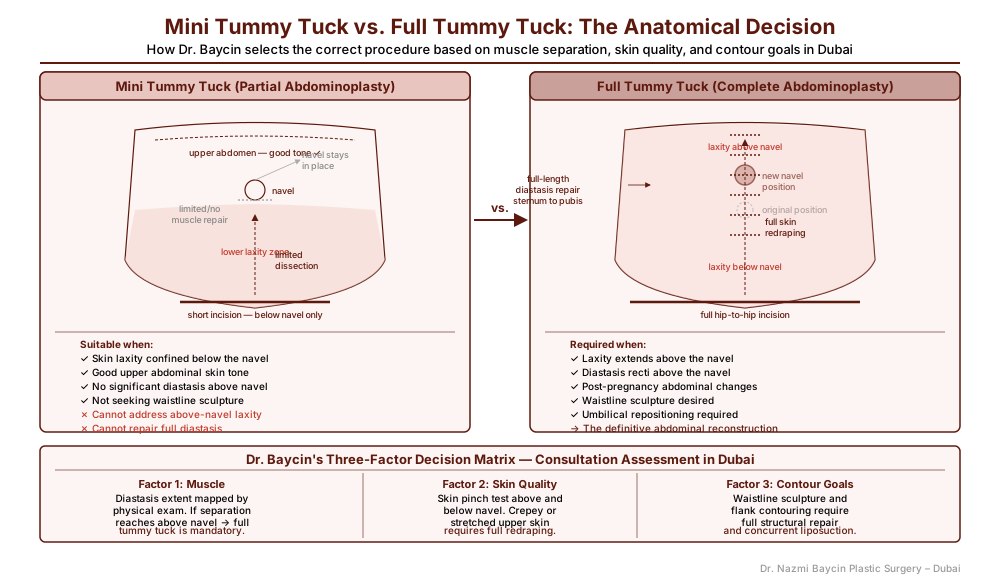
Mini versus full tummy tuck — a mini addresses the lower abdomen only with a short incision, while a full tummy tuck redrapes the entire abdomen, repairs the full length of the muscle wall, and repositions the umbilicus — by Dr. Nazmi Baycin, Dubai.
The deciding factor: muscle separation (diastasis recti)
The presence and extent of diastasis recti is often the most critical determinant. During consultation I assess this through a physical exam while you engage your core. If the separation is isolated below the navel, a mini tummy tuck may suffice. However, if the gap extends toward or above the belly button — common after pregnancy or significant weight fluctuation — a full tummy tuck is mandatory.
Choosing a mini procedure when a full repair is needed leaves the core unsupported, which can result in persistent bulging in the upper abdomen, poor posture, and even back pain. The repair of this muscular corset, central to every tummy tuck I perform in Dubai, is the foundation on which a beautiful, stable contour is built.
Skin quality and distribution: the visual blueprint
The behavior of your skin is equally important. A mini tummy tuck cannot address loose or creepy skin above the belly button. I carefully evaluate your skin’s elasticity and the pattern of laxity: if you have thinning skin, stretch marks, or sagging in the upper abdomen, only a full tummy tuck can redrape this tissue properly. Attempting a mini procedure in this scenario would create a noticeable mismatch between a tight lower abdomen and a loose upper abdomen, leading to an unnatural result.
Waistline definition and long-term harmony
Your desired outcome must also guide the choice. A mini tummy tuck improves the lower abdomen but does not actively sculpt the waistline. A full tummy tuck allows me to narrow the waist through the internal muscle repair and to contour the flank areas through concurrent liposuction, creating the harmonious silhouette that many of my patients in Dubai seek — transforming the entire torso rather than just one zone. For the full surgical detail behind both approaches, see my overview of tummy tuck surgery in Dubai.
Mini versus full tummy tuck at a glance
The table below sets the two procedures side by side across the factors that determine which is right for a given anatomy.
| Feature | Mini Tummy Tuck | Full Tummy Tuck |
|---|---|---|
| Incision length | Short (lower midline only) | Hip to hip |
| Area addressed | Below navel only | Entire anterior abdomen |
| Skin above navel | Not addressed | ✓ Fully redraped |
| Diastasis recti repair | Lower portion only | ✓ Full length — sternum to pubis |
| Umbilical repositioning | ✗ Navel stays in place | ✓ Repositioned to natural height |
| Waistline sculpting | ✗ | ✓ (with concurrent liposuction) |
| Suitable post-pregnancy | Limited cases only | ✓ Primary indication |
| Operative time | ~1–1.5 hours | ~2.5–3 hours |
| Recovery time | Desk work typically 2–3 days; longer for physical work | Desk work typically 7–10 days; longer for physical work |
| Duration of results | Good if correctly selected | Superior — structural repair |
My consultation process: mapping your anatomy
My goal during your consultation is to remove the guesswork through a systematic evaluation: I chart any diastasis, quantify skin excess above and below the navel with a pinch test, and observe how your abdomen behaves when standing, sitting, and flexing. That three-part reading — and how it maps onto the full range of abdominoplasty options, from a limited correction through to an extended one — is set out in detail in my article on how abdominal anatomy decides the tummy tuck plan. The question here is narrower: which of these two procedures your findings point toward.
My duty is not to sell you the procedure you think you want, but to recommend the surgery you truly need for an optimal, lasting outcome. The choice between a mini and full tummy tuck is a foundational surgical decision that hinges on the hidden anatomy of your abdominal wall, not merely the visible skin — and because it is individual, the plan, timing, and cost are discussed transparently at consultation. This principled approach runs through all of my plastic surgery practice in Dubai.
FAQs about abdominoplasty techniques in Dubai
-
Is a mini tummy tuck less effective than a full tummy tuck?
It is not less effective — it is effective only when anatomy is suitable. A mini tummy tuck produces excellent results for patients with isolated lower abdominal laxity, intact upper skin tone, and no significant diastasis above the navel. Applying it to anatomy that requires a full repair produces an incomplete result, regardless of how well the procedure itself is executed. Effectiveness depends entirely on correct patient selection.
-
Can a mini tummy tuck fix muscle separation (diastasis recti)?
Only very limited separation confined to the lower abdomen. If the diastasis extends to or above the navel — which is true for the majority of post-pregnancy patients — a mini tummy tuck cannot address it. The full-length muscular repair from the xiphoid to the pubic symphysis, which is essential for core stability and lasting abdominal flatness, is only achievable through a full tummy tuck.
-
Will a mini tummy tuck improve my waistline?
No. Waistline sculpture requires the structural muscle repair and flank liposuction that are components of a full tummy tuck. A mini tummy tuck addresses the lower midline only. If creating a defined waistline or hourglass silhouette is among your goals, a full tummy tuck with concurrent flank contouring is the appropriate procedure.
-
Which procedure has longer-lasting results?
A correctly performed full tummy tuck offers superior long-term stability because it addresses the structural cause of abdominal laxity — the diastasis recti — rather than only its surface manifestation. The rebuilt muscular corset provides lasting support for the abdominal wall. A mini tummy tuck’s results are durable when the procedure is correctly selected, but do not include the deep structural repair that underlies a full tummy tuck’s longevity.
-
How do I know if I need a mini or full tummy tuck?
Through a diagnostic consultation — not through self-assessment or online comparison. I assess the extent of any diastasis recti through a physical examination, evaluate skin quality and distribution above and below the navel with a pinch test, and weigh your postural and contour goals to determine the correct procedure for your specific anatomy. The decision is made by what is found at examination, not by what a patient prefers before that examination takes place.
-
Can I have a mini tummy tuck if I plan to have more children?
A mini tummy tuck, like a full tummy tuck, produces results that may be affected by a subsequent pregnancy. However, because the mini procedure involves less structural repair, its results are generally less impacted by further pregnancies than those of a full tummy tuck. Both procedures are ideally performed after a patient has completed their family. I discuss timing and family planning at every tummy tuck consultation in Dubai.


GET APPOINTMENT
Get ready to look and feel best… You deserve…
