

A classic tummy tuck addresses the front of the abdomen, with excellent results for the right patient. But in my practice, a significant number of people — particularly those who have gone through massive weight loss or multiple pregnancies — arrive with a problem that extends far beyond the midline. Their concerns wrap around the entire torso: loose skin and stubborn fat on the flanks, the lower back, and even the upper buttock region. For these patients, a standard abdominoplasty is only a partial solution, often leaving noticeable lateral folds and an unbalanced silhouette. This is where the 360° abdominoplasty in Dubai becomes not just an option, but the procedure the anatomy actually requires.
Key takeaways: treating the torso in three dimensions
- A classic tummy tuck treats only the front of the abdomen.
- After major weight loss or pregnancies, laxity is often circumferential.
- The 360° approach addresses the abdomen, flanks, back, and upper buttock as one.
- Muscle repair first builds the stable internal foundation for the lift.
- A belt-like excision lifts the lower trunk and elevates the buttocks.
- Refining liposuction smooths the transitions for a seamless result.
My goal is always a result that is as functional as it is aesthetic — restoring not just shape, but comfort and confidence. That means treating the trunk as the complete, three-dimensional structure it is, delivering a circumferential correction a traditional tummy tuck simply cannot match.
This is a major reconstructive operation that calls for extensive planning, a deep understanding of post-weight-loss anatomy, and a firm commitment to safety. The distinction it rests on is drawn plainly in the literature: a 2022 review of post-bariatric abdominoplasty and body contouring reserves traditional abdominoplasty for patients whose skin laxity is limited to the anterior trunk and abdomen, without a back or buttock component, and describes the circumferential belt lipectomy for everyone else. The same review notes that redundant skin follows bariatric surgery in up to 96 percent of patients, and — a point worth stating plainly on a page recommending the larger operation — that abdominoplasty carries a higher complication rate than other body-contouring procedures. That is precisely why candidate selection and sequencing matter as much as technique.
Identifying the right candidate: when a 360° tummy tuck is essential
The decision to recommend a 360° abdominoplasty in Dubai is always anatomical, never arbitrary. In consultation, I look for specific indicators that a patient’s needs surpass the scope of a standard procedure. The ideal candidate usually presents with a combination of the following.
| Indicator | What It Looks Like |
|---|---|
| Circumferential skin laxity | Loose skin from the pubic area, around the flanks, and across the lower back — often an apron of tissue or back rolls that wrap around the body |
| Flattened or sagging buttocks | Descending tissue pulls down on the upper gluteal area, with loss of projection and shape |
| Resistant fat deposits | Dense fat pockets persist on the flanks and lower back despite significant weight loss, worsening the look of laxity |
| Generalized muscle laxity | Weakening or separation of the abdominal muscles (diastasis recti) across the whole core wall, causing a protruding abdomen and poor posture |
These patients have usually experienced massive weight loss through bariatric surgery or major lifestyle change, or they are mothers who have had multiple pregnancies. Many have already researched tummy tuck surgery in Dubai and intuitively understand that a front-only procedure will not resolve their full contour concern.
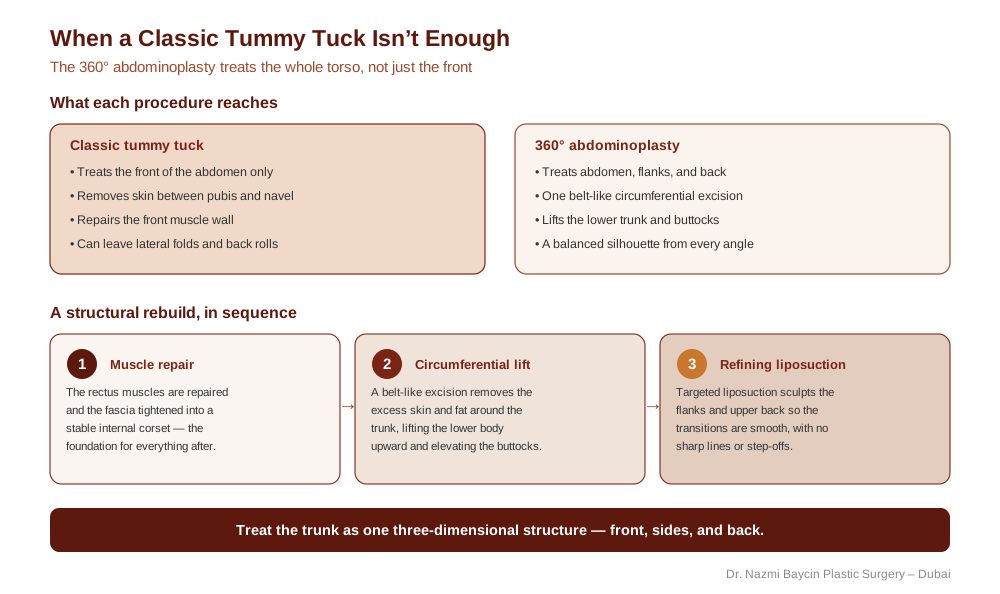
Why the 360° abdominoplasty treats the trunk as one three-dimensional structure — by Dr. Nazmi Baycin, Dubai.
My surgical philosophy: a structural rebuilding, not just skin removal
A 360° abdominoplasty is a major reconstructive operation, and my approach is founded on restoring structural integrity first. The surgery has several components performed in a precise sequence.
It begins with comprehensive muscle repair. I repair the rectus abdominis muscles from the sternum to the pubic bone to correct diastasis recti, and I often extend this fascial tightening laterally to reinforce the oblique areas, creating a strong, stable internal corset. This step is crucial for core strength, better posture, and a solid foundation for the skin redraping that follows.
Next comes the circumferential tissue excision and lift. With the muscle layer secured, I design a belt-like incision around the entire lower torso and remove the predetermined excess skin and fat from the abdomen, flanks, and back in a single continuous segment. This lets me lift the whole lower trunk upward and inward, smoothing the transition from front to back and elevating the buttocks for a more youthful profile.
Finally, strategic liposuction refines the result. I integrate high-definition contouring to sculpt harmonious transitions and address residual fat, meticulously refining the flanks, upper back, and adjacent zones so there are no sharp lines or step-offs between treated and untreated areas. This detail is a discipline in itself, one I discuss in my article on why circumferential liposuction demands surgical precision. Taken together, this method treats the body as a unified whole — the difference between patching a wall and rebuilding the room’s architecture.
Incision strategy and scar management: the art of concealment
The scar for a 360° procedure is more extensive than for a standard tummy tuck, so strategic scar placement is a central part of my preoperative planning. My goal is to position the incision so it is entirely concealed by everyday undergarments, swimsuits, and clothing.
The scar runs circumferentially around the body, but I place it low on the abdomen and along the natural crease where the buttocks meet the thigh in the back. Advanced closure techniques distribute tension across multiple deep tissue layers, which minimizes the risk of scar widening or hypertrophy.
Every patient then receives a structured scar-management protocol to optimize healing and fading. A scar is inevitable, but its visibility can be strategically managed to preserve the aesthetic outcome. Because scar quality ultimately comes down to how tissue tension is handled, the same principle shapes incision length and closure across abdominal surgery — a relationship I explore in my article on how tissue elasticity determines incision and closure strategy.
Why specialized experience is non-negotiable
This is not a procedure for every cosmetic surgeon. It demands specific expertise in post-bariatric body contouring, an intimate knowledge of the vascular supply to the truncal skin, and the ability to manage a complex, lengthy operation safely. The complications of a poorly performed circumferential lift can be serious.
My experience has taught me how to balance aggressive contouring against preservation of blood supply, how to sequence the surgery for efficiency and safety, and how to tailor every decision — from incision design to muscle repair — to the individual’s anatomy and healing capacity. That circumferential correction is usually one stage within a larger post-weight-loss plan, which I set out in my article on post-bariatric body contouring for the massive weight loss patient. Choosing a surgeon with a proven track record in these advanced techniques — the standard you should expect from a leading cosmetic surgeon in Dubai — is the single most important safeguard.
The recovery journey: what to expect
Honesty about recovery is part of my ethical practice. Healing from a 360° abdominoplasty in Dubai is more involved than from a standard tummy tuck, but it is very manageable with clear guidance and support.
In the initial phase (weeks 1–2), you will have surgical drains and wear a firm compression garment continuously. Mobility is limited and you will need help with daily activities, and my team monitors you closely throughout.
During the intermediate phase (weeks 3–6), swelling begins to subside and you can gradually increase walking and light activity, though the compression garment remains essential.
In the refinement phase (months 2–6), you return to most normal activities and light exercise, and as swelling resolves your new contours become increasingly apparent. Diligent scar care matters most during this window.
By the final phase (6–12 months), the tissues fully settle, scars mature and fade, and the stable outcome of your torso restoration is revealed. The wait is demanding, but patients consistently tell me the result is worth every week of patience.
A transformation clothing cannot hide
The ultimate reward of this surgery is a smoother, tighter torso with a dramatically improved waistline and balanced proportions from every angle. Patients can wear clothes that fit properly, move with greater comfort, and experience a real renewal of confidence.
This procedure is about reclaiming the body that significant weight loss or life change has earned. Because each patient’s anatomy and plan is unique, both the surgical strategy and its scope are best defined at a consultation — the right setting for a thorough evaluation and a tailored plan toward the complete, harmonious result you are looking for.
FAQs about 360° abdominoplasty in Dubai
-
What is the main difference between a 360° abdominoplasty and a standard tummy tuck?
A standard tummy tuck focuses solely on the front of the abdomen, removing excess skin and fat between the pubic bone and navel and repairing the underlying muscles. A 360° abdominoplasty is a circumferential procedure. It addresses the entire lower torso — the abdomen, flanks, lower back, and upper buttock area — in a single surgery. This creates a belt-like lift and tightening effect, resulting in a completely harmonized silhouette from all angles, which is often essential after massive weight loss.
-
Who is the ideal candidate for a 360° tummy tuck in Dubai?
The ideal candidate is typically someone who has achieved significant, stable weight loss — often through bariatric surgery — and is left with loose, hanging skin around the entire trunk. Other candidates include people with severe skin laxity following multiple pregnancies or major weight fluctuations. You should be in good general health, a non-smoker, and have realistic expectations about the outcome and scar placement. During a consultation, I perform a thorough assessment to determine whether this is the most appropriate and safe procedure for your anatomy.
-
Will the scar be very noticeable?
The scar from a 360° abdominoplasty is a continuous line that circles the body. My surgical planning prioritizes concealment: I place the incision low on the abdomen so it can be hidden by underwear or a bikini bottom, and it follows the natural crease where the buttocks meet the thighs in the back. While the scar is longer, meticulous closure techniques and a dedicated scar-care protocol help it fade to a thin, discreet line over time. Careful tension distribution across deep tissue layers is central to keeping that scar as fine as possible.
-
What is the recovery time, and when can I return to work?
Recovery is more structured than with a standard tummy tuck because of the extent of the surgery. Most patients need two to three weeks before returning to a sedentary job. You will have surgical drains and must wear a compression garment for several weeks. Light walking is encouraged immediately, but strenuous activity, heavy lifting, and vigorous exercise must be avoided for at least six to eight weeks. The full healing process, as swelling subsides and final contours settle, takes six to twelve months. Every patient receives a detailed, personalized recovery plan.
-
Can this procedure be combined with other surgeries?
Yes, it is common and often recommended to combine a 360° abdominoplasty with other procedures to achieve total body harmony. The most frequent combination is with an upper body lift or breast surgery, such as a breast lift or reduction, which addresses the skin laxity that often affects both the upper and lower body after major weight loss. Combining procedures can be efficient because it condenses recovery into a single period, though it requires careful planning to keep safety first. Whether it is right for you depends on your anatomy, health, and goals.
-
What are the main risks or potential complications of a 360° tummy tuck?
As with any major surgery, risks include bleeding, infection, and reactions to anesthesia. Specific to this procedure are risks related to wound healing, such as delayed healing or separation at the incision line, fluid accumulation (seroma), and changes in skin sensation. There is also a risk of blood clots (deep vein thrombosis). Abdominoplasty is also reported to carry a higher complication rate than other body-contouring procedures, which is why choosing a board-certified plastic surgeon who operates in an accredited hospital setting and has extensive experience in circumferential lifts is your best defense.
-
How long do the results last?
The results of a 360° abdominoplasty are very long-lasting, provided you maintain a stable weight and a healthy lifestyle. The excess skin is permanently removed, and the muscle repair is designed to be durable. While the natural aging process and gravity continue to have a mild effect, the dramatic improvement in torso contour is permanent. Significant weight gain or a pregnancy after surgery can compromise the result, so it is important to undergo this procedure only when you are confident your weight is stable.
-
Why is choosing a surgeon with specific experience so important?
A 360° abdominoplasty is one of the most complex procedures in body contouring. It requires an intricate understanding of three-dimensional anatomy, the blood supply to the skin, and advanced tension-management techniques to prevent healing problems. A surgeon experienced in post-bariatric body lifting knows how to safely remove the maximum amount of excess tissue while preserving circulation, where to place sutures for optimal support, and how to manage the unique challenges of the procedure. This expertise is critical both for your safety and for achieving a smooth, natural result.
-
What does the procedure involve, and how is it planned?
The operation is planned around your specific pattern of laxity and fat, and it is built in a deliberate sequence: repairing and tightening the muscle wall to create a stable internal foundation, then removing excess skin and fat through a belt-like circumferential excision that lifts the lower trunk and elevates the buttocks, and finally refining the flanks and upper back with targeted liposuction for smooth transitions. Because it is a lengthy, complex operation, careful sequencing for efficiency and safety is essential. Every plan is tailored to your anatomy, healing capacity, and goals.
-
How do I start the process to see if I’m a candidate?
The process begins with a comprehensive, in-person consultation. During this meeting I review your medical and weight-loss history, examine your skin quality and the distribution of laxity, discuss your aesthetic goals, and explain the procedure, scars, and recovery in detail. This is the most important step to determine whether a 360° abdominoplasty is right for you and to build a tailored surgical plan that aligns with your vision for a transformed body. It is also the right time to ask any questions and to understand every stage of the journey ahead.


GET APPOINTMENT
Get ready to look and feel best… You deserve…
