

High-definition VASER liposuction in Dubai has become one of the most requested body contouring procedures among patients who want more than simple fat removal. The expectation now is a sculpted, athletic look with smooth transitions and natural proportions. Yet for all its popularity, it is also one of the most technically demanding procedures in plastic surgery. Performed poorly, it can leave contour deformities, asymmetry, and an artificial appearance that is genuinely difficult to correct. This article explains how the procedure should be performed, the mistakes that create those deformities, and how I avoid them.
Key takeaways: definition through restraint
- Success depends on precision and restraint, not aggressive fat removal.
- VASER uses tissue-selective ultrasound to emulsify fat while sparing vessels and nerves.
- Most deformities come from over-resection, uneven depth, or a template approach.
- Preserving the superficial fat layer is what keeps contours smooth.
- The technique must be tailored to male or female anatomy, never copied across.
- A natural result should look athletic without ever looking surgical.
My philosophy is straightforward: a successful result is not about removing as much fat as possible, but about precision, anatomical respect, and surgical restraint. That principle is well documented; the foundational 2007 description of VASER-assisted high-definition liposculpture characterizes it as a difficult, time-consuming procedure with a steep learning curve, suitable only for highly experienced surgeons — precisely because it works in the delicate superficial fat layers to reveal the underlying muscular anatomy.
What high-definition VASER liposuction actually is
VASER liposuction uses ultrasound energy to selectively emulsify fat cells while preserving the surrounding tissues — blood vessels, nerves, and connective structures. This tissue-selective action allows for more precise fat removal and smoother healing than traditional methods.
In the high-definition work I perform in Dubai, that energy is used strategically to highlight the natural muscle anatomy. The abdomen, flanks, chest, arms, and thighs are sculpted to create the definition, shadows, and transitions that read as an athletic physique. Where traditional liposuction focuses on volume reduction alone, this is a form of surgical body sculpting.
Achieving that refinement requires a deep knowledge of three-dimensional anatomy and an understanding of how the body looks both at rest and in motion. Without that expertise, the risk of contour irregularities rises sharply — which is the whole subject of the sections that follow.
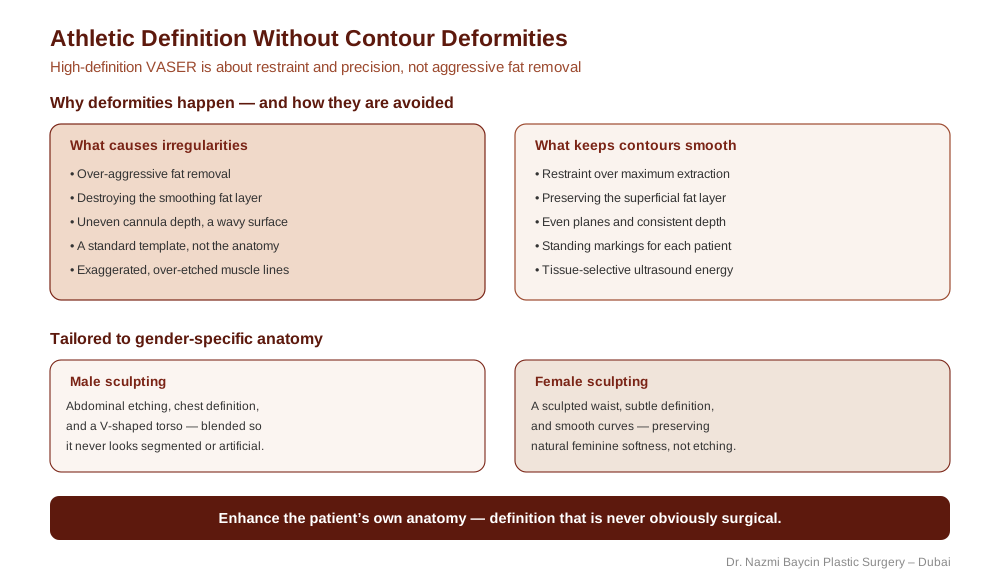
Why high-definition VASER results depend on restraint and preserving the superficial fat layer — by Dr. Nazmi Baycin, Dubai.
Why contour deformities occur
Contour deformities are among the most common complications seen after poorly performed high-definition work. They show up as dents, waviness, sharp edges, asymmetry, or exaggerated muscle outlines — and almost all of them trace back to a handful of avoidable errors.
The most frequent is over-aggressive fat removal. Some surgeons assume that taking out as much fat as possible produces better definition. In reality, excessive extraction destroys the natural smoothing layer between skin and muscle, leaving a harsh, unnatural surface.
A second is inconsistent cannula depth. Working at uneven levels beneath the skin creates an irregular surface that only becomes more visible as swelling subsides — a problem that is especially unforgiving in lean patients seeking high definition.
A third is the absence of individualized planning. Body sculpting should never follow a standard template, because every patient has unique muscle insertions, fat compartments, and natural asymmetries that have to be respected. The table below sets out how each of these errors is avoided.
| Common Error | Consequence | How I Avoid It |
|---|---|---|
| Over-aggressive fat removal | Loss of the smoothing layer; a harsh, unnatural surface | Conservative extraction that leaves a healthy fat cushion |
| Inconsistent cannula depth | A wavy, irregular surface that worsens as swelling settles | Even, controlled planes at a consistent depth |
| Template-based planning | Definition that ignores the patient’s real anatomy | Standing markings mapped to each patient’s muscles |
| Ignoring the superficial layer | A result that looks surgical and ages poorly | Deliberate preservation of the superficial fat layer |
My surgical approach
When patients consult me for high-definition VASER liposuction in Dubai, I make one point clear from the start: it is not about creating an artificial six-pack. It is about enhancing your own anatomy while keeping transitions smooth and proportions natural.
The process begins with a detailed preoperative evaluation. Markings are done while you are standing, so I can accurately identify muscle borders, asymmetries, and fat distribution. This planning stage is what prevents overcorrection and contour deformities before the first incision.
During surgery, I use controlled ultrasound energy to gently emulsify fat while preserving connective tissue and vascular structures. This minimizes trauma, supports skin retraction, and reduces the risk of postoperative irregularities.
The principle I hold to most firmly is preservation of the superficial fat layer, which is essential for smooth, natural-looking contours. Surgeons who ignore it tend to produce results that look surgical and age poorly. The related mistake of removing too much in pursuit of sharper lines is one I discuss in my article on why over-etching ruins abdominal definition. Because outcomes also depend on the character of the fat itself, I plan around tissue type as well, which I cover in my article on how fibrous versus soft fat changes technique.
Definition that moves naturally with you
True high-definition sculpting has to account for how the body looks not just standing still in a mirror, but in motion. Definition that looks convincing at rest but distorts when you move has been placed without regard for the dynamic anatomy underneath.
This is why I plan the sculpted shadows and transitions around the way the muscles actually behave during movement, an approach I explore in my article on the 4D concept in liposculpture. The aim is a result that stays natural whether you are relaxed or active, rather than one that only works from a single angle.
Male and female sculpting are not the same
High-definition liposuction in Dubai must always be tailored to gender-specific anatomy and aesthetic goals. Male patients typically want abdominal etching, chest definition, and a V-shaped torso, while female patients more often want a sculpted waist, subtle abdominal definition, and smooth curves.
A common error is applying male-style abdominal etching to a female patient, which produces an overly masculine look. I avoid this by customizing the technique to preserve feminine anatomy and natural softness.
In male patients, the opposite error appears: excessive etching without proper blending creates a segmented, artificial appearance. In both cases, balance and proportion take priority over aggressive definition.
Choosing the right surgeon
Dubai has become an international destination for aesthetic surgery, but high demand does not mean every clinic offers the same level of expertise in advanced body contouring. Certification alone is not enough; this procedure demands advanced training, artistic judgment, and extensive experience in both primary and revision cases.
In my practice I frequently treat patients seeking correction of liposuction performed elsewhere, and these revision cases underline how much the choice of surgeon matters. Ultimately, technique matters more than the brand of technology in the room — a point I make in my article on why surgeon technique matters more than technology. You can also review my approach to VASER liposuction in Dubai for more detail on how the procedure is tailored to your anatomy. The standard to look for is the one you should expect from any serious provider of plastic surgery in Dubai: experience and judgment over promotional titles.
Recovery and long-term results
Good surgical technique has a direct effect on recovery. When tissues are respected and trauma is minimized, swelling resolves more evenly and the result becomes visible sooner.
After surgery I provide detailed guidelines covering compression garment use, lymphatic drainage, and safe activity timelines. These measures support smooth healing and further reduce the risk of contour irregularities.
Long-term, the result depends on a stable weight and healthy lifestyle. The treated fat cells are permanently removed, but the fat cells that remain can still enlarge with significant weight gain. True high-definition results should be visible without appearing surgical — and because each body is unique, both the plan and its scope are best defined at a consultation, where your anatomy and goals can be assessed directly.
FAQs about high-definition VASER liposuction in Dubai
-
What makes high-definition VASER liposuction different from standard liposuction?
Standard liposuction focuses on reducing volume — removing fat to make an area smaller. High-definition VASER liposuction is a form of surgical body sculpting: ultrasound energy is used strategically to emulsify fat in specific layers and reveal the natural muscle anatomy underneath, creating definition, shadows, and athletic transitions. The VASER technology is tissue-selective, so it targets fat while sparing blood vessels, nerves, and connective tissue. The goal is not just a slimmer area but a sculpted, proportionate contour that looks natural at rest and in movement.
-
Why do contour deformities happen after high-definition liposuction?
Most deformities come from a small set of avoidable errors. The most common is over-aggressive fat removal, which destroys the natural smoothing layer between skin and muscle and leaves a harsh, uneven surface. Another is inconsistent cannula depth, which creates a wavy surface that becomes more visible as swelling subsides — especially in lean patients. A third is using a standard template instead of planning around each patient’s unique muscle insertions and fat compartments. Avoiding these means restraint, consistent depth, individualized markings, and preserving the superficial fat layer.
-
Will the result look natural or obviously done?
The aim is athletic definition that is visible without looking surgical. That comes from enhancing your own anatomy rather than imposing an artificial six-pack, and from preserving the superficial fat layer that keeps contours smooth. Over-etched, exaggerated muscle lines are exactly what make a result look operated, so I prioritize balance and natural transitions over aggressive definition. A well-planned result should read as a fit, toned physique — something that looks like the product of training rather than surgery, and that continues to look natural as you age.
-
Is the technique different for men and women?
Yes, and this distinction is important. Male patients typically want abdominal etching, chest definition, and a V-shaped torso, while female patients more often want a sculpted waist, subtle abdominal definition, and smooth curves. Applying male-style etching to a woman produces an overly masculine, unnatural look, so the technique is customized to preserve feminine softness. In men, over-etching without proper blending creates a segmented, artificial appearance. In both cases the technique is tailored to gender-specific anatomy, with balance and proportion prioritized over sharp lines.
-
Am I a good candidate for high-definition VASER liposuction?
Good candidates are generally close to a stable, healthy weight and want definition and sculpting rather than large-volume fat reduction. Reasonable skin quality helps, since the skin needs to retract over the new contours. Realistic expectations matter just as much: the procedure refines and defines your own anatomy, it does not create a physique you do not have the underlying structure for. Because results depend on your specific fat distribution, muscle anatomy, and skin, the most reliable way to know if it suits you is an in-person assessment.
-
What is recovery like?
Because VASER is tissue-selective and careful technique minimizes trauma, recovery is generally smoother than with aggressive traditional liposuction, but it still requires commitment. You will wear a compression garment, and I usually recommend lymphatic drainage to help swelling resolve evenly. Light activity resumes early, with a graduated return to more strenuous exercise. Swelling settles over weeks to months, and the sculpted definition becomes progressively clearer as it does. Following the aftercare plan closely is part of what protects the smoothness of the final contour.
-
How long do the results last?
The treated fat cells are permanently removed, so the sculpted contour is durable. However, the fat cells that remain can still enlarge with significant weight gain, which can blur the definition. For that reason, the best and most lasting results come to patients who maintain a stable weight and a healthy lifestyle after surgery. Think of the procedure as revealing and refining your anatomy: keeping that result crisp over the long term depends on staying close to the weight you were at when it was performed.


GET APPOINTMENT
Get ready to look and feel best… You deserve…
